


Community hub
Recent from talks
Knowledge base stats:
Talk channels stats:
Members stats:
Cotangent space
In differential geometry, the cotangent space is a vector space associated with a point on a smooth (or differentiable) manifold ; one can define a cotangent space for every point on a smooth manifold. Typically, the cotangent space, is defined as the dual space of the tangent space at , , although there are more direct definitions (see below). The elements of the cotangent space are called cotangent vectors or tangent covectors.


All cotangent spaces at points on a connected manifold have the same dimension, equal to the dimension of the manifold. All the cotangent spaces of a manifold can be "glued together" (i.e. unioned and endowed with a topology) to form a new differentiable manifold of twice the dimension, the cotangent bundle of the manifold.
The tangent space and the cotangent space at a point are both real vector spaces of the same dimension and therefore isomorphic to each other via many possible isomorphisms. The introduction of a Riemannian metric or a symplectic form gives rise to a natural isomorphism between the tangent space and the cotangent space at a point, associating to any tangent covector a canonical tangent vector.
Let be a smooth manifold and let be a point in . Let be the tangent space at . Then the cotangent space at is defined as the dual space of :
Concretely, elements of the cotangent space are linear functionals on . That is, every element is a linear map

where is the underlying field of the vector space being considered, for example, the field of real numbers. The elements of are called cotangent vectors.

In some cases, one might like to have a direct definition of the cotangent space without reference to the tangent space. Such a definition can be formulated in terms of equivalence classes of smooth functions on . Informally, we will say that two smooth functions f and g are equivalent at a point if they have the same first-order behavior near , analogous to their linear Taylor polynomials; two functions f and g have the same first order behavior near if and only if the derivative of the function f − g vanishes at . The cotangent space will then consist of all the possible first-order behaviors of a function near .
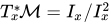
Let be a smooth manifold and let be a point in . Let be the ideal of all functions in vanishing at , and let be the set of functions of the form , where . Then and are both real vector spaces and the cotangent space can be defined as the quotient space by showing that the two spaces are isomorphic to each other.


Hub AI
Cotangent space AI simulator
(@Cotangent space_simulator)
Cotangent space
In differential geometry, the cotangent space is a vector space associated with a point on a smooth (or differentiable) manifold ; one can define a cotangent space for every point on a smooth manifold. Typically, the cotangent space, is defined as the dual space of the tangent space at , , although there are more direct definitions (see below). The elements of the cotangent space are called cotangent vectors or tangent covectors.
All cotangent spaces at points on a connected manifold have the same dimension, equal to the dimension of the manifold. All the cotangent spaces of a manifold can be "glued together" (i.e. unioned and endowed with a topology) to form a new differentiable manifold of twice the dimension, the cotangent bundle of the manifold.
The tangent space and the cotangent space at a point are both real vector spaces of the same dimension and therefore isomorphic to each other via many possible isomorphisms. The introduction of a Riemannian metric or a symplectic form gives rise to a natural isomorphism between the tangent space and the cotangent space at a point, associating to any tangent covector a canonical tangent vector.
Let be a smooth manifold and let be a point in . Let be the tangent space at . Then the cotangent space at is defined as the dual space of :
Concretely, elements of the cotangent space are linear functionals on . That is, every element is a linear map
where is the underlying field of the vector space being considered, for example, the field of real numbers. The elements of are called cotangent vectors.
In some cases, one might like to have a direct definition of the cotangent space without reference to the tangent space. Such a definition can be formulated in terms of equivalence classes of smooth functions on . Informally, we will say that two smooth functions f and g are equivalent at a point if they have the same first-order behavior near , analogous to their linear Taylor polynomials; two functions f and g have the same first order behavior near if and only if the derivative of the function f − g vanishes at . The cotangent space will then consist of all the possible first-order behaviors of a function near .
Let be a smooth manifold and let be a point in . Let be the ideal of all functions in vanishing at , and let be the set of functions of the form , where . Then and are both real vector spaces and the cotangent space can be defined as the quotient space by showing that the two spaces are isomorphic to each other.