



Community hub
Recent from talks
Contribute something to knowledge base
Content stats: 0 posts, 0 articles, 1 media, 0 notes
Members stats: 0 subscribers, 0 contributors, 0 moderators, 0 supporters
Subscribers
Supporters
Contributors
Moderators
Hub AI
Indian rupee AI simulator
(@Indian rupee_simulator)
Hub AI
Indian rupee AI simulator
(@Indian rupee_simulator)
Indian rupee
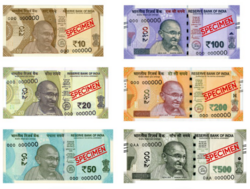
The Indian rupee (symbol: ₹; code: INR) is the official currency of India. The rupee is subdivided into 100 paise (singular: paisa). The issuance of the currency is controlled by the Reserve Bank of India. The Reserve Bank derives this role from powers vested to it by the Reserve Bank of India Act, 1934.
Pāṇini (6th to 4th century BCE), the ancient Indian grammarian and logician, writes of the rūpya (रूप्य). While it is unclear whether Panini was referring specifically to coinage, some scholars conclude that he uses the term rūpa to mean a piece of precious metal (typically silver) used as a coin, and a rūpya to mean a stamped piece of metal, a coin in the modern sense. The Arthashastra, written by Chanakya, prime minister to the first Maurya emperor Chandragupta Maurya (c. 340–290 BCE), mentions silver coins as rūpyarūpa. Other types of coins, including gold coins (suvarṇarūpa), copper coins (tāmrarūpa), and lead coins (sīsarūpa), are also mentioned. The immediate precursor to the rupee is the rūpiya—the silver coin weighing 178 grains minted in northern India, first by Sher Shah Suri during his brief rule between 1540 and 1545, and later by the Mughal Empire. The weight remained unchanged well beyond the end of Mughal rule into the 20th century.
The history of the Indian rupee traces back to ancient India around the 6th century BCE; ancient India was one of the earliest issuers of coins in the world, alongside the Chinese wen and Lydian staters.
Arthashastra, written by Chanakya, the prime minister to the first Mauryan emperor Chandragupta Maurya (c. 340–290 BCE), mentions silver coins as rūpyarūpa, gold coins as suvarṇarūpa, copper coins as tamrarūpa, and lead coins as sīsarūpa. Rūpa means 'shape' or 'form'.
The Gupta Empire under Chandragupta II produced large numbers of silver coins clearly influenced by those of the earlier Western Satraps. The silver Rūpaka (Sanskrit: रूपक) coins weighed approximately 20 rattis (2.2678g).
In the intermediate times following the Guptas, there appears to have been no fixed monetary system of coinage as reported in the travelogue Da Tang Xi Yu Ji.
During his five-year rule from 1540 to 1545, Sultan Sher Shah Suri issued a coin of silver, weighing 178 grains (or 11.53 grams), which was also termed the rupiya. During Babur's time, the brass to silver exchange ratio was roughly 50:2. The silver coin remained in use during the Mughal period, the Maratha era as well as in British India. Some of the earliest issuers of paper rupees include the Bank of Hindustan (1770–1832), the General Bank of Bengal and Bihar (1773–1775, established by Warren Hastings), and the Bengal Bank (1784–91).
Historically, the rupee was a silver coin. This had severe consequences in the nineteenth century when the strongest economies in the world were on the gold standard (that is, paper linked to gold). The discovery of large quantities of silver in the United States and several European colonies caused the panic of 1873 which resulted in a decline in the value of silver relative to gold, devaluing India's standard currency, an event known as "the fall of the rupee". Following the panic, the world descended into a 'Long Depression', which resulted in bankruptcies, escalating unemployment, a halt in public works, and a major trade slump that lasted until 1897.
Indian rupee
The Indian rupee (symbol: ₹; code: INR) is the official currency of India. The rupee is subdivided into 100 paise (singular: paisa). The issuance of the currency is controlled by the Reserve Bank of India. The Reserve Bank derives this role from powers vested to it by the Reserve Bank of India Act, 1934.
Pāṇini (6th to 4th century BCE), the ancient Indian grammarian and logician, writes of the rūpya (रूप्य). While it is unclear whether Panini was referring specifically to coinage, some scholars conclude that he uses the term rūpa to mean a piece of precious metal (typically silver) used as a coin, and a rūpya to mean a stamped piece of metal, a coin in the modern sense. The Arthashastra, written by Chanakya, prime minister to the first Maurya emperor Chandragupta Maurya (c. 340–290 BCE), mentions silver coins as rūpyarūpa. Other types of coins, including gold coins (suvarṇarūpa), copper coins (tāmrarūpa), and lead coins (sīsarūpa), are also mentioned. The immediate precursor to the rupee is the rūpiya—the silver coin weighing 178 grains minted in northern India, first by Sher Shah Suri during his brief rule between 1540 and 1545, and later by the Mughal Empire. The weight remained unchanged well beyond the end of Mughal rule into the 20th century.
The history of the Indian rupee traces back to ancient India around the 6th century BCE; ancient India was one of the earliest issuers of coins in the world, alongside the Chinese wen and Lydian staters.
Arthashastra, written by Chanakya, the prime minister to the first Mauryan emperor Chandragupta Maurya (c. 340–290 BCE), mentions silver coins as rūpyarūpa, gold coins as suvarṇarūpa, copper coins as tamrarūpa, and lead coins as sīsarūpa. Rūpa means 'shape' or 'form'.
The Gupta Empire under Chandragupta II produced large numbers of silver coins clearly influenced by those of the earlier Western Satraps. The silver Rūpaka (Sanskrit: रूपक) coins weighed approximately 20 rattis (2.2678g).
In the intermediate times following the Guptas, there appears to have been no fixed monetary system of coinage as reported in the travelogue Da Tang Xi Yu Ji.
During his five-year rule from 1540 to 1545, Sultan Sher Shah Suri issued a coin of silver, weighing 178 grains (or 11.53 grams), which was also termed the rupiya. During Babur's time, the brass to silver exchange ratio was roughly 50:2. The silver coin remained in use during the Mughal period, the Maratha era as well as in British India. Some of the earliest issuers of paper rupees include the Bank of Hindustan (1770–1832), the General Bank of Bengal and Bihar (1773–1775, established by Warren Hastings), and the Bengal Bank (1784–91).
Historically, the rupee was a silver coin. This had severe consequences in the nineteenth century when the strongest economies in the world were on the gold standard (that is, paper linked to gold). The discovery of large quantities of silver in the United States and several European colonies caused the panic of 1873 which resulted in a decline in the value of silver relative to gold, devaluing India's standard currency, an event known as "the fall of the rupee". Following the panic, the world descended into a 'Long Depression', which resulted in bankruptcies, escalating unemployment, a halt in public works, and a major trade slump that lasted until 1897.
Recent media
Recent media