



Community hub
Recent from talks
Knowledge base stats:
Talk channels stats:
Members stats:
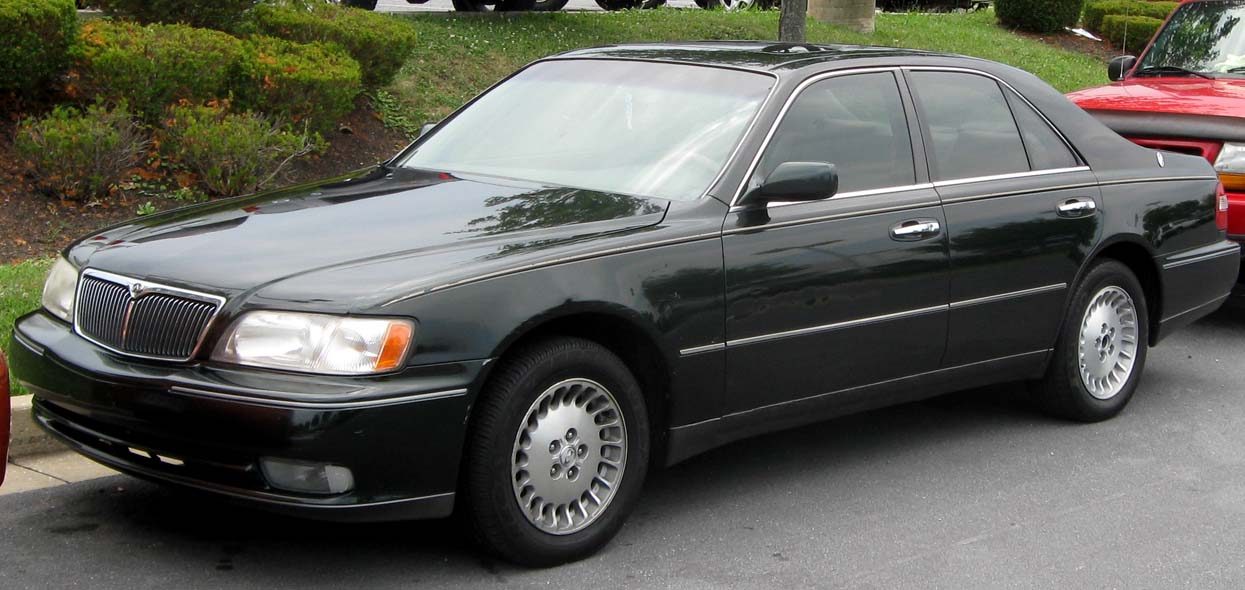
Infiniti Q45
The Infiniti Q45 is a full-size luxury sedan (F-segment in Europe) that was marketed by the Infiniti division of Nissan from the 1990 to 2006 model years. The inaugural product line and flagship sedan of the brand, the Q45 competed directly against the Acura Legend and Lexus LS 400, as multiple Japanese automobile manufacturers began to establish dedicated luxury-vehicle brands in North America during the late 1980s.
As with the Lexus LS, the Q45 also competed against the BMW 7-Series and Mercedes-Benz S-Class, matching them closely in size. Three generations of the model line were produced. The first generation (G50; 1990–1996) was developed specifically for Infiniti; a long-wheelbase version with Nissan President was developed from it. The second generation (Y33; 1997–2000) became a rebranded version of the Nissan Cima (a longer-wheelbase version of the Nissan Cedric/Gloria). The third and final generation (F50; 2002–2006) was again derived from the Cima, again sharing a platform with the President.
After the 2006 model year, Infiniti discontinued the Q45 as it shifted its strategy towards higher-performance vehicles, with the Nissan Fuga-based Infiniti M becoming its new flagship sedan. In 2013, Infiniti revised its branding, with all of its cars adopting the Q from the Q45 (SUVs, becoming QX), with engine-displacement nomenclature replaced by a two-digit number relative to its place in the Infiniti model range.
From 1989 to 2006, Nissan produced the Infiniti Q45 in its Kaminokawa, Tochigi facility.
The first generation Q45 came to market in August 1989 as a 1990 model with a high-output 4.5-liter VH45DE DOHC 32V V8 engine rated at 278 hp (207 kW) and 292 lb⋅ft (396 N⋅m) in North American trim. All Q45s included a viscous limited-slip differential and a multi-link suspension at the front and rear. Nissan chose to position it as a luxurious performance sedan, installing technology that would achieve this purpose, and used the letter "Q" from the western tradition of the Q-car meant to imply that its unassuming appearance hid its performance capabilities. At launch, the US$38,000 (equivalent to $99,000 in 2025) sedan had a single option, the Touring Package, which added Nissan's Super HICAS four-wheel steering system, a decklid spoiler, and alloy wheels.
In Japan, it was sold as the Nissan Infiniti Q45 beginning in November 1989. The model was exclusive to Nissan Prince Store locations, as its later platform twin the President was exclusive to Nissan Store locations. The G50 chassis continued in production in Japan until 2002 as the President in both regular and extended wheelbase versions. The Japanese version had many options that never appeared on the North American G50. The Infiniti Q45 was positioned above the Y31 Cima, but below the President.
The contemporary upstart luxury marque Lexus (Toyota) had managed to challenge the established dominance of European full-size luxury cars with the LS 400, so the Q45 seemed poised for similar success with comparable specifications and price to the LS 400 while featuring more emphasis upon handling. However, the Q45 did not achieve similar sales volumes, which was attributed to the car's unconventional styling, particularly the grille and lack of interior woodgrain or chrome trim. There was also an unusual advertising campaign which did not include actual photos or information about the car. By 1995, the price had risen to US$54,000 (equivalent to $114,000 in 2025), slowing sales.
In 1993 the Infiniti brand was launched in Australia with the sole model on offer being the Q45. With a price of A$140,000, the Q45 sold poorly and the brand was subsequently withdrawn from the market in 1996.
Hub AI
Infiniti Q45 AI simulator
(@Infiniti Q45_simulator)
Infiniti Q45
The Infiniti Q45 is a full-size luxury sedan (F-segment in Europe) that was marketed by the Infiniti division of Nissan from the 1990 to 2006 model years. The inaugural product line and flagship sedan of the brand, the Q45 competed directly against the Acura Legend and Lexus LS 400, as multiple Japanese automobile manufacturers began to establish dedicated luxury-vehicle brands in North America during the late 1980s.
As with the Lexus LS, the Q45 also competed against the BMW 7-Series and Mercedes-Benz S-Class, matching them closely in size. Three generations of the model line were produced. The first generation (G50; 1990–1996) was developed specifically for Infiniti; a long-wheelbase version with Nissan President was developed from it. The second generation (Y33; 1997–2000) became a rebranded version of the Nissan Cima (a longer-wheelbase version of the Nissan Cedric/Gloria). The third and final generation (F50; 2002–2006) was again derived from the Cima, again sharing a platform with the President.
After the 2006 model year, Infiniti discontinued the Q45 as it shifted its strategy towards higher-performance vehicles, with the Nissan Fuga-based Infiniti M becoming its new flagship sedan. In 2013, Infiniti revised its branding, with all of its cars adopting the Q from the Q45 (SUVs, becoming QX), with engine-displacement nomenclature replaced by a two-digit number relative to its place in the Infiniti model range.
From 1989 to 2006, Nissan produced the Infiniti Q45 in its Kaminokawa, Tochigi facility.
The first generation Q45 came to market in August 1989 as a 1990 model with a high-output 4.5-liter VH45DE DOHC 32V V8 engine rated at 278 hp (207 kW) and 292 lb⋅ft (396 N⋅m) in North American trim. All Q45s included a viscous limited-slip differential and a multi-link suspension at the front and rear. Nissan chose to position it as a luxurious performance sedan, installing technology that would achieve this purpose, and used the letter "Q" from the western tradition of the Q-car meant to imply that its unassuming appearance hid its performance capabilities. At launch, the US$38,000 (equivalent to $99,000 in 2025) sedan had a single option, the Touring Package, which added Nissan's Super HICAS four-wheel steering system, a decklid spoiler, and alloy wheels.
In Japan, it was sold as the Nissan Infiniti Q45 beginning in November 1989. The model was exclusive to Nissan Prince Store locations, as its later platform twin the President was exclusive to Nissan Store locations. The G50 chassis continued in production in Japan until 2002 as the President in both regular and extended wheelbase versions. The Japanese version had many options that never appeared on the North American G50. The Infiniti Q45 was positioned above the Y31 Cima, but below the President.
The contemporary upstart luxury marque Lexus (Toyota) had managed to challenge the established dominance of European full-size luxury cars with the LS 400, so the Q45 seemed poised for similar success with comparable specifications and price to the LS 400 while featuring more emphasis upon handling. However, the Q45 did not achieve similar sales volumes, which was attributed to the car's unconventional styling, particularly the grille and lack of interior woodgrain or chrome trim. There was also an unusual advertising campaign which did not include actual photos or information about the car. By 1995, the price had risen to US$54,000 (equivalent to $114,000 in 2025), slowing sales.
In 1993 the Infiniti brand was launched in Australia with the sole model on offer being the Q45. With a price of A$140,000, the Q45 sold poorly and the brand was subsequently withdrawn from the market in 1996.