
Recent from talks
Influenza B virus
Knowledge base stats:
Talk channels stats:
Members stats:
Influenza B virus
Influenza B virus is the only species in the genus Betainfluenzavirus in the virus family Orthomyxoviridae.
Influenza B virus is a negative-sense single-strand RNA virus known only to infect certain mammal species, including humans, ferrets, pigs, and seals. This limited host range is apparently responsible for the lack of influenza pandemics associated with influenza B virus, in contrast with those caused by the morphologically similar influenza A virus, as both mutate by both antigenic drift and reassortment. Nevertheless, it is accepted that influenza B virus could cause significant morbidity and mortality worldwide, and significantly impacts adolescents and schoolchildren.
Until 2020, two distinct lineages of influenza B virus co-circulated in humans. Known as B/Yamagata and B/Victoria, these lineages are distinguished by differences in the antigenic structure of the surface glycoprotein hemagglutinin (HA) and their varying abilities to elicit innate immune responses in the host.
However, the B/Yamagata lineage may have become extinct in 2020/2021 due to COVID-19 pandemic measures. In October 2023, the World Health Organization concluded that protection against the Yamagata lineage was no longer necessary in the seasonal flu vaccine, reducing the number of lineages targeted by the vaccine from four to three. For the 2024–2025 Northern Hemisphere influenza season, the US Food and Drug Administration (FDA) recommends removing B/Yamagata from all influenza vaccines. The European Medicines Agency (EMA) recommends removing B/Yamagata from influenza vaccines for the 2024–2025 seasonal flu vaccine composition.
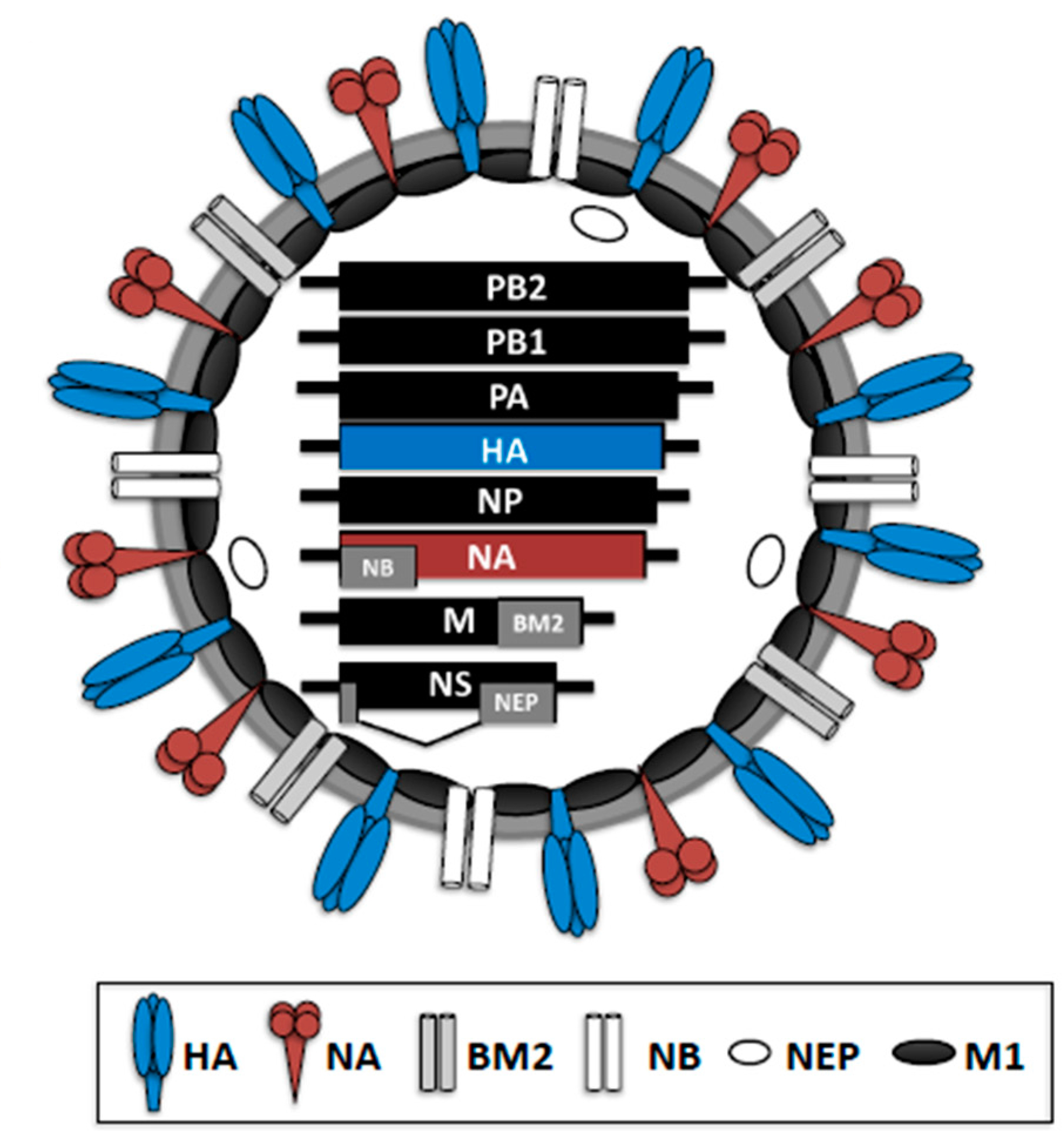
The influenza B virus capsid is enveloped while its virion consists of an envelope, a matrix protein, a nucleoprotein complex, a nucleocapsid, and a polymerase complex. It is sometimes spherical and sometimes filamentous. Its 500 or so surface projections are made of hemagglutinin and neuraminidase.
The influenza B virus genome is 14,548 nucleotides long and consists of eight segments of linear negative-sense, single-stranded RNA. The multipartite genome is encapsidated, each segment in a separate nucleocapsid, and the nucleocapsids are surrounded by one envelope.
The ancestor of influenza viruses A and B and the ancestor of influenza virus C are estimated to have diverged from a common ancestor around 8,000 years ago. Influenza viruses A and B are estimated to have diverged from a single ancestor around 4,000 years ago, while the subtypes of influenza A virus are estimated to have diverged 2,000 years ago. Metatranscriptomics studies have also identified closely related "influenza B-like" viruses such as the Wuhan spiny eel influenza virus and also "influenza B-like" viruses in a number of vertebrate species such as salamanders and fish.
Diminishing the impact of this virus is the fact that, "in humans, influenza B viruses evolve slower than A viruses and faster than C viruses". Influenza B virus mutates at a rate 2 to 3 times slower than type A.
Hub AI
Influenza B virus AI simulator
(@Influenza B virus_simulator)
Influenza B virus
Influenza B virus is the only species in the genus Betainfluenzavirus in the virus family Orthomyxoviridae.
Influenza B virus is a negative-sense single-strand RNA virus known only to infect certain mammal species, including humans, ferrets, pigs, and seals. This limited host range is apparently responsible for the lack of influenza pandemics associated with influenza B virus, in contrast with those caused by the morphologically similar influenza A virus, as both mutate by both antigenic drift and reassortment. Nevertheless, it is accepted that influenza B virus could cause significant morbidity and mortality worldwide, and significantly impacts adolescents and schoolchildren.
Until 2020, two distinct lineages of influenza B virus co-circulated in humans. Known as B/Yamagata and B/Victoria, these lineages are distinguished by differences in the antigenic structure of the surface glycoprotein hemagglutinin (HA) and their varying abilities to elicit innate immune responses in the host.
However, the B/Yamagata lineage may have become extinct in 2020/2021 due to COVID-19 pandemic measures. In October 2023, the World Health Organization concluded that protection against the Yamagata lineage was no longer necessary in the seasonal flu vaccine, reducing the number of lineages targeted by the vaccine from four to three. For the 2024–2025 Northern Hemisphere influenza season, the US Food and Drug Administration (FDA) recommends removing B/Yamagata from all influenza vaccines. The European Medicines Agency (EMA) recommends removing B/Yamagata from influenza vaccines for the 2024–2025 seasonal flu vaccine composition.
The influenza B virus capsid is enveloped while its virion consists of an envelope, a matrix protein, a nucleoprotein complex, a nucleocapsid, and a polymerase complex. It is sometimes spherical and sometimes filamentous. Its 500 or so surface projections are made of hemagglutinin and neuraminidase.
The influenza B virus genome is 14,548 nucleotides long and consists of eight segments of linear negative-sense, single-stranded RNA. The multipartite genome is encapsidated, each segment in a separate nucleocapsid, and the nucleocapsids are surrounded by one envelope.
The ancestor of influenza viruses A and B and the ancestor of influenza virus C are estimated to have diverged from a common ancestor around 8,000 years ago. Influenza viruses A and B are estimated to have diverged from a single ancestor around 4,000 years ago, while the subtypes of influenza A virus are estimated to have diverged 2,000 years ago. Metatranscriptomics studies have also identified closely related "influenza B-like" viruses such as the Wuhan spiny eel influenza virus and also "influenza B-like" viruses in a number of vertebrate species such as salamanders and fish.
Diminishing the impact of this virus is the fact that, "in humans, influenza B viruses evolve slower than A viruses and faster than C viruses". Influenza B virus mutates at a rate 2 to 3 times slower than type A.
Recent media