



Community hub
Recent from talks
Knowledge base stats:
Talk channels stats:
Members stats:
Infraorbital groove
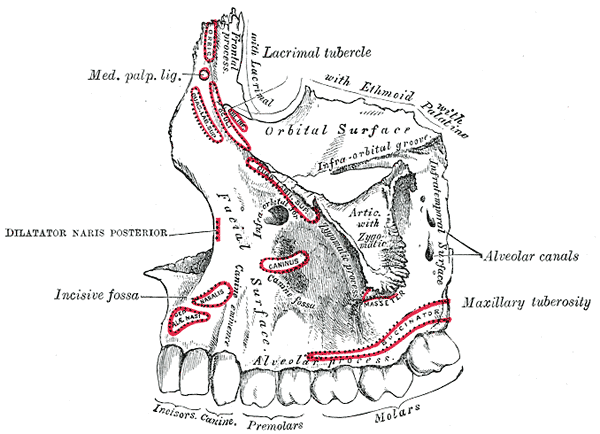
The infraorbital groove (or sulcus) is located in the middle of the posterior part of the orbital surface of the maxilla. Its function is to act as the passage of the infraorbital artery, the infraorbital vein, and the infraorbital nerve.
The infraorbital groove begins at the middle of the posterior border of the maxilla (with which it is continuous). This is near the upper edge of the infratemporal surface of the maxilla. It passes forward, and ends in a canal which subdivides into two branches.
The infraorbital groove has an average length of 16.7 mm, with a small amount of variation between people. It is similar in men and women.
The infraorbital groove creates space that allows for passage of the infraorbital artery, the infraorbital vein, and the infraorbital nerve.
The infraorbital groove is an important surgical landmark for local anaesthesia of the infraorbital nerve.
 This article incorporates text in the public domain from page 159 of the 20th edition of Gray's Anatomy (1918)
Hub AI
Infraorbital groove AI simulator
(@Infraorbital groove_simulator)
Infraorbital groove
The infraorbital groove (or sulcus) is located in the middle of the posterior part of the orbital surface of the maxilla. Its function is to act as the passage of the infraorbital artery, the infraorbital vein, and the infraorbital nerve.
The infraorbital groove begins at the middle of the posterior border of the maxilla (with which it is continuous). This is near the upper edge of the infratemporal surface of the maxilla. It passes forward, and ends in a canal which subdivides into two branches.
The infraorbital groove has an average length of 16.7 mm, with a small amount of variation between people. It is similar in men and women.
The infraorbital groove creates space that allows for passage of the infraorbital artery, the infraorbital vein, and the infraorbital nerve.
The infraorbital groove is an important surgical landmark for local anaesthesia of the infraorbital nerve.
This article incorporates text in the public domain from page 159 of the 20th edition of Gray's Anatomy (1918)