



Community hub
Recent from talks
Knowledge base stats:
Talk channels stats:
Members stats:
Ink cartridge
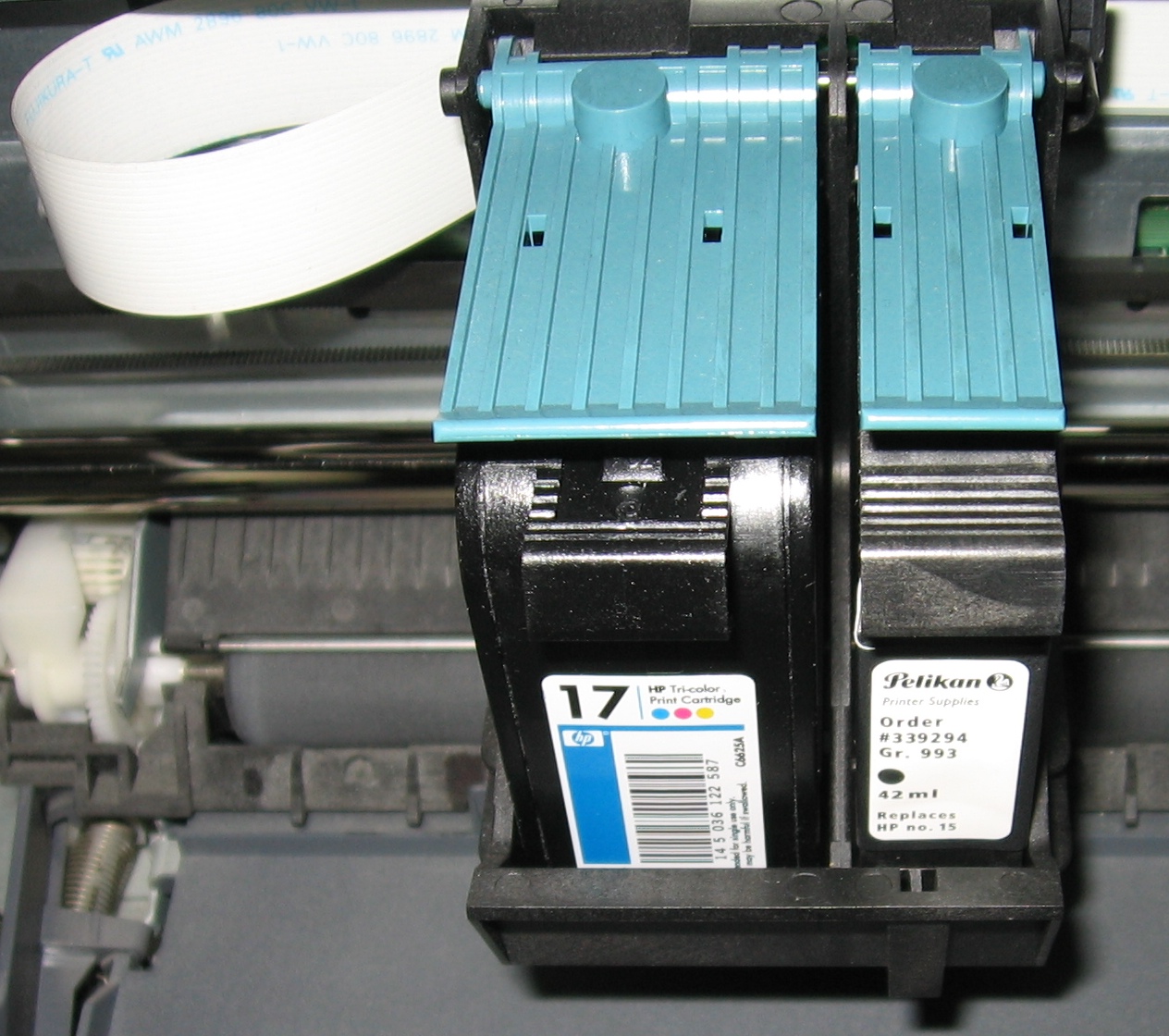
An ink cartridge or inkjet cartridge is a component of an inkjet printer that contains ink to be deposited onto paper during printing. It consists of one or more ink reservoirs and can include electronic contacts and a chip to exchange information with the printer.
Most consumer inkjet printers use a thermal inkjet. Inside each partition of the ink reservoir is a heating element with a tiny metal plate or resistor. In response to a signal given by the printer, a tiny current flows through the metal or resistor, making it warm, and the ink in contact with the heated resistor is vaporized into a tiny steam bubble inside the nozzle. As a result, an ink droplet is forced out of the cartridge nozzle onto the paper. This process takes a fraction of a millisecond.
The printing depends on the smooth flow of ink, which can be hindered if the ink begins to dry at the print head, as can happen when an ink level becomes low. Dried ink can be cleaned from a cartridge print head using 91% denatured isopropyl alcohol (not rubbing alcohol). Tap water contains contaminants that may clog the print head, so distilled water and a lint-free cloth is recommended.
The ink also acts as a coolant to protect the metal-plate heating elements − when the ink supply is depleted, and printing is attempted, the heating elements in thermal cartridges often burn out, permanently damaging the print head. When the ink first begins to run low, the cartridge should be refilled or replaced, to avoid overheating damage to the print head.
Piezoelectric printers use a piezoelectric crystal in each nozzle instead of a heating element. When current is applied, the crystal changes shape or size, increasing the pressure in the ink channel and thus forcing a droplet of ink from the nozzle. There are two types of crystals used: those that elongate when subjected to electricity or bi-morphs which bend. The ink channels in a piezoelectric ink jet print head can be formed using a variety of techniques, but one common method is lamination of a stack of metal plates, each of which includes precision micro-fabricated features of various shapes (i.e. containing an ink channel, orifice, reservoir and crystal). This cool environment allows the use of inks which react badly when heated. For example, roughly 1/1000 of every ink jet is vaporized due to the intense heat, and ink must be designed to not clog the printer with the products of thermal decomposition. Piezoelectric printers can in some circumstances make a smaller ink drop than thermal inkjets.
Stores the ink of the ink cartridge. May contain hydrophobic foam that prevents refilling.
Some ink cartridges combine ink storage and printheads into one assembly with four main additional parts:
Ink cartridges are typically priced at $13 to $75/US fl oz ($1,664 to $9,600/US gal; $440 to $2,536/L) of ink, meaning that refill cartridges sometimes cost a substantial fraction of the cost of the printer. To save money, many people use compatible ink cartridges from a vendor other than the printer manufacturer[citation needed]. A study by British consumer watchdog Which? found that in some cases, printer ink from the manufacturer is more expensive than champagne. However, the comparison depends on the brand and type of ink purchased. Others use aftermarket inks, refilling their own ink cartridges using a kit that includes bulk ink. The high cost of cartridges has also provided an incentive for counterfeiters to supply cartridges falsely claiming to be made by the original manufacturer. The print cartridge industry failed to earn $3 billion in 2009 due to this, according to an International Data Corporation estimate.
Hub AI
Ink cartridge AI simulator
(@Ink cartridge_simulator)
Ink cartridge
An ink cartridge or inkjet cartridge is a component of an inkjet printer that contains ink to be deposited onto paper during printing. It consists of one or more ink reservoirs and can include electronic contacts and a chip to exchange information with the printer.
Most consumer inkjet printers use a thermal inkjet. Inside each partition of the ink reservoir is a heating element with a tiny metal plate or resistor. In response to a signal given by the printer, a tiny current flows through the metal or resistor, making it warm, and the ink in contact with the heated resistor is vaporized into a tiny steam bubble inside the nozzle. As a result, an ink droplet is forced out of the cartridge nozzle onto the paper. This process takes a fraction of a millisecond.
The printing depends on the smooth flow of ink, which can be hindered if the ink begins to dry at the print head, as can happen when an ink level becomes low. Dried ink can be cleaned from a cartridge print head using 91% denatured isopropyl alcohol (not rubbing alcohol). Tap water contains contaminants that may clog the print head, so distilled water and a lint-free cloth is recommended.
The ink also acts as a coolant to protect the metal-plate heating elements − when the ink supply is depleted, and printing is attempted, the heating elements in thermal cartridges often burn out, permanently damaging the print head. When the ink first begins to run low, the cartridge should be refilled or replaced, to avoid overheating damage to the print head.
Piezoelectric printers use a piezoelectric crystal in each nozzle instead of a heating element. When current is applied, the crystal changes shape or size, increasing the pressure in the ink channel and thus forcing a droplet of ink from the nozzle. There are two types of crystals used: those that elongate when subjected to electricity or bi-morphs which bend. The ink channels in a piezoelectric ink jet print head can be formed using a variety of techniques, but one common method is lamination of a stack of metal plates, each of which includes precision micro-fabricated features of various shapes (i.e. containing an ink channel, orifice, reservoir and crystal). This cool environment allows the use of inks which react badly when heated. For example, roughly 1/1000 of every ink jet is vaporized due to the intense heat, and ink must be designed to not clog the printer with the products of thermal decomposition. Piezoelectric printers can in some circumstances make a smaller ink drop than thermal inkjets.
Stores the ink of the ink cartridge. May contain hydrophobic foam that prevents refilling.
Some ink cartridges combine ink storage and printheads into one assembly with four main additional parts:
Ink cartridges are typically priced at $13 to $75/US fl oz ($1,664 to $9,600/US gal; $440 to $2,536/L) of ink, meaning that refill cartridges sometimes cost a substantial fraction of the cost of the printer. To save money, many people use compatible ink cartridges from a vendor other than the printer manufacturer[citation needed]. A study by British consumer watchdog Which? found that in some cases, printer ink from the manufacturer is more expensive than champagne. However, the comparison depends on the brand and type of ink purchased. Others use aftermarket inks, refilling their own ink cartridges using a kit that includes bulk ink. The high cost of cartridges has also provided an incentive for counterfeiters to supply cartridges falsely claiming to be made by the original manufacturer. The print cartridge industry failed to earn $3 billion in 2009 due to this, according to an International Data Corporation estimate.