


Community hub
Recent from talks
Contribute something
Nothing was collected or created yet.
Heating element
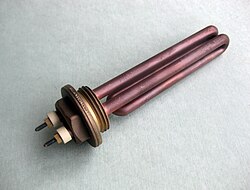
View on Wikipedia A folded tubular heating element from an espresso machine | |
| Component type | Passive |
|---|---|
| Working principle | Joule heating |
| Electronic symbol | |
  | |
A heating element is a device used for conversion of electric energy into heat, consisting of a heating resistor and accessories.[1] Heat is generated by the passage of electric current through a resistor through a process known as Joule heating. Heating elements are used in household appliances, industrial equipment, and scientific instruments enabling them to perform tasks such as cooking, warming, or maintaining specific temperatures higher than the ambient.
Heating elements may be used to transfer heat via conduction, convection, or radiation. They are different from devices that generate heat from electrical energy via the Peltier effect, and have no dependence on the direction of electrical current.
Principles of operation
[edit]Resistance & resistivity
[edit]
Materials used in heating elements have a relatively high electrical resistivity, which is a measure of the material's ability to resist electric current. The electrical resistance that some amount of element material will have is defined by Pouillet's law as where

- is the electrical resistance of a uniform specimen of the material
- is the resistivity of the material
- is the length of the specimen
- is the cross-sectional area of the specimen


The resistance per wire length (Ω/m) of a heating element material is defined in ASTM and DIN standards.[2]: 2 [3][4] In ASTM, wires greater than 0.127 mm in diameter are specified to be held within a tolerance of ±5% Ω/m and for thinner wires ±8% Ω/m.
Power density
[edit]Heating element performance is often quantified by characterizing the power density of the element. Power density is defined as the output power, P, from a heating element divided by the heated surface area, A, of the element.[5] In mathematical terms it is given as:

Power density is a measure of heat flux (denoted Φ) and is most often expressed in watts per square millimeter or watts per square inch.
Heating elements with low power density tend to be more expensive but have longer life than heating elements with high power density.[6]
In the United States, power density is often referred to as 'watt density.' It is also sometimes referred to as 'wire surface load.'
Components
[edit]Resistance heater
[edit]Wire
[edit]
Resistance wires are very long and slender resistors that have a circular cross-section. Like conductive wire, the diameter of resistance wire is often measured with a gauge system, such as American Wire Gauge (AWG).[7]
Ribbon
[edit]Resistance ribbon heating elements are made by flattening round resistance wire, giving them a rectangular cross-section with rounded corners.[8]: 54 Generally ribbon widths are between 0.3 and 4 mm. If a ribbon is wider than that, it is cut out from a broader strip and may instead be called resistance strip. Compared to wire, ribbon can be bent with a tighter radius and can produce heat faster and at a lower cost due to its higher surface area to volume ratio. On the other hand, ribbon life is often shorter than wire life and the price per unit mass of ribbon is generally higher.[8]: 55 In many applications, resistance ribbon is wound around a mica card or on one of its sides.[8]: 57
Coil
[edit]Resistance coil is a resistance wire that has a coiled shape.[8]: 100 Coils are wound very tightly and then relax to up to 10 times their original length in use. Coils are classified by their diameter and the pitch, or number of coils per unit length.
Insulator
[edit]Heating element insulators serve to electrically and thermally insulate the resistance heater from the environment and foreign objects.[9] Generally for elements that operate higher than 600 °C, ceramic insulators are used.[8]: 137 Aluminum oxide, silicon dioxide, and magnesium oxide are compounds commonly used in ceramic heating element insulators. For lower temperatures a wider range of materials are used.
Leads
[edit]Electrical leads serve to connect a heating element to a power source. They generally are made of conductive materials such as copper that do not have as high of a resistance to oxidation as the active resistance material.[8]: 131–132
Terminals
[edit]Heating element terminals serve to isolate the active resistance material from the leads. Terminals are designed to have a lower resistance than the active material by having with a lower resistivity and/or a larger diameter. They may also have a lower oxidation resistance than the active material.[8]: 131–132
Types
[edit]Heating elements are generally classified in one of three frameworks: suspended, embedded, or supported.[8]: 164–166
- In a suspended design, a resistance heater is attached at two or more points to normally either a ceramic or mica insulator. Suspended resistance heaters can transfer heat via convection and radiation, but not conduction as they are surrounded by air.
- In an embedded heating element, the resistance heater is encased in the insulator. In this framework the heater can only transfer heat via conduction to the insulator.
- Supported heating elements are a combination of the suspended and embedded frameworks. In these assemblies, the resistance heater can transfer heat via conduction, convection, or radiation.
Tubes (Calrods)
[edit]
- Resistance heating element
- Electrical insulator
- Metal casing

Tubular or sheathed elements (also referred to by their brand name, Calrods[10]) normally comprise a fine coil of resistance wire surrounded by an electrical insulator and a metallic tube-shaped sheath or casing. Insulation is typically a magnesium oxide powder and the sheath is normally constructed of a copper or steel alloy. To keep moisture out of the hygroscopic insulator, the ends are equipped with beads of insulating material such as ceramic or silicone rubber, or a combination of both. The tube is drawn through a die to compress the powder and maximize heat transmission. These can be a straight rod (as in toaster ovens) or bent to a shape to span an area to be heated (such as in electric stoves, ovens, and coffee makers).
Screen-printed elements
[edit]Screen-printed metal–ceramic tracks deposited on ceramic-insulated metal (generally steel) plates have found widespread application as elements in kettles and other domestic appliances since the mid-1990s.
Radiative elements
[edit]Radiative heating elements (heat lamps) are high-powered incandescent lamps that run at less than maximum power to radiate mostly infrared instead of visible light. These are usually found in radiant space heaters and food warmers, taking either a long, tubular form or an R40 reflector-lamp form. The reflector lamp style is often tinted red to minimize the visible light produced; the tubular form comes in different formats:
- Gold-coated – HeLeN quartz infrared heat lamps as originally patented and manufactured by Philips. A gold dichroic film is deposited on the inside that reduces the visible light and allows most of the short and medium wave infrared through. These tubular quartz lamps are designed for services other than illumination.[11]
- Ruby-coated – Same function as the gold-coated lamps, but at a fraction of the cost. The visible glare is much higher than the gold variant.
- Clear – No coating and mainly used in production processes.
Removable ceramic core elements
[edit]Removable ceramic core elements use a coiled resistance heating alloy wire threaded through one or more cylindrical ceramic segments to make a required length (related to output), with or without a center rod. Inserted into a metal sheath or tube sealed at one end, this type of element allows replacement or repair without breaking into the process involved, usually fluid heating under pressure.
Etched foil elements
[edit]Etched foil elements are generally made from the same alloys as resistance wire elements, but are produced with a subtractive photo-etching process that starts with a continuous sheet of metal foil and ends with a complex resistance pattern. These elements are commonly found in precision heating applications like medical diagnostics and aerospace.
Polymer PTC heating elements
[edit]
Resistive heaters can be made of conducting PTC rubber materials where the resistivity increases exponentially with increasing temperature.[12] Such a heater will produce high power when it is cold, and rapidly heat itself to a constant temperature. Due to the exponentially increasing resistivity, the heater can never heat itself to warmer than this temperature. Above this temperature, the rubber acts as an electrical insulator. The temperature can be chosen during the production of the rubber. Typical temperatures are between 0 and 80 °C (32 and 176 °F).
It is a point-wise self-regulating and self-limiting heater. Self-regulating means that every point of the heater independently keeps a constant temperature without the need of regulating electronics. Self-limiting means that the heater can never exceed a certain temperature in any point and requires no overheat protection.
Thick-film heaters
[edit]
 | This section needs additional citations for verification. (June 2023) |

Thick-film heaters are a type of resistive heater that can be printed on a thin substrate. Thick-film heaters exhibit various advantages over the conventional metal-sheathed resistance elements. In general, thick-film elements are characterized by their low-profile form factor, improved temperature uniformity, quick thermal response due to low thermal mass, high energy density, and wide range of voltage compatibility. Typically, thick-film heaters are printed on flat substrates, as well as on tubes in different heater patterns. These heaters can attain power densities of as high as 100 W/cm2 depending on the heat transfer conditions.[13] The thick-film heater patterns are highly customizable based on the sheet resistance of the printed resistor paste.
These heaters can be printed on a variety of substrates including metal, ceramic, glass, and polymer using metal- or alloy-loaded thick-film pastes.[13] The most common substrates used to print thick-film heaters are aluminum 6061-T6, stainless steel, and muscovite or phlogopite mica sheets. The applications and operational characteristics of these heaters vary widely based on the chosen substrate materials. This is primarily attributed to the thermal characteristics of the substrates.
There are several conventional applications of thick-film heaters. They can be used in griddles, waffle irons, stove-top electric heating, humidifiers, tea kettles, heat sealing devices, water heaters, clothes irons and steamers, hair straighteners, boilers, heated beds of 3D printers, thermal print heads, glue guns, laboratory heating equipment, clothes dryers, baseboard heaters, warming trays, heat exchangers, deicing and defogging devices for car windshields, side mirrors, refrigerator defrosting, etc.[14]
For most applications, the thermal performance and temperature distribution are the two key design parameters. In order to maintain a uniform temperature distribution across a substrate, the circuit design can be optimized by changing the localized power density of the resistor circuit. An optimized heater design helps to control the heating power and modulate the local temperatures across the heater substrate. In cases where there is a requirement of two or more heating zones with different power densities over a relatively small area, a thick-film heater can be designed to achieve a zonal heating pattern on a single substrate.
Thick-film heaters can largely be characterized under two subcategories – negative-temperature-coefficient (NTC) and positive-temperature-coefficient (PTC) materials – based on the effect of temperature changes on the element's resistance. NTC-type heaters are characterized by a decrease in resistance as the heater temperature increases and thus have a higher power at higher temperatures for a given input voltage. PTC heaters behave in an opposite manner with an increase of resistance and decreasing heater power at elevated temperatures. This characteristic of PTC heaters makes them self-regulating, as their power stabilizes at fixed temperatures. On the other hand, NTC-type heaters generally require a thermostat or a thermocouple in order to control the heater runaway. These heaters are used in applications which require a quick ramp-up of heater temperature to a predetermined set-point as they are usually faster-acting than PTC-type heaters.
Liquid
[edit]An electrode boiler uses electricity flowing through streams of water to create steam. Operating voltages are typically between 240 and 600 volts, single or three-phase AC.[15]
Laser heaters
[edit]Laser heaters are heating elements used for achieving very high temperatures.[16]
Materials
[edit]Materials used in heating elements are selected for a variety of mechanical, thermal, and electrical properties.[9] Due to the wide range of operating temperatures that these elements withstand, temperature dependencies of material properties are a common consideration.
Metal alloys
[edit]Resistance heating alloys are metals that can be used for electrical heating purposes above 600 °C in air. They can be distinguished from resistance alloys which are used primarily for resistors operating below 600 °C.[8]
While the majority of atoms in these alloys correspond to the ones listed in their name, they also consist of trace elements. Trace elements play an important role in resistance alloys, as they have a substantial influence on mechanical properties such as work-ability, form stability, and oxidation life.[8] Some of these trace elements may be present in the basic raw materials, while others may be added deliberately to improve the performance of the material. The terms contaminates and enhancements are used to classify trace elements.[9] Contaminates typically have undesirable effects such as decreased life and limited temperature range. Enhancements are intentionally added by the manufacturer and may provide improvements such as increased oxide layer adhesion, greater ability to hold shape, or longer life at higher temperatures.
The most common alloys used in heating elements include:
Ni-Cr(Fe) alloys (AKA nichrome, Chromel)
[edit]Ni-Cr(Fe) resistance heating alloys, also known as nichrome or Chromel, are described by both ASTM and DIN standards.[2][4] These standards specify the relative percentages of nickel and chromium that should be present in an alloy. In ASTM three alloys that are specified contain, amongst other trace elements:
- 80% Ni, 20% Cr
- 60% Ni, 16% Cr
- 35% Ni, 20% Cr
Nichrome 80/20 is one of the most commonly used resistance heating alloys because it has relatively high resistance and forms an adherent layer of chromium oxide when it is heated for the first time. Material beneath this layer will not oxidize, preventing the wire from breaking or burning out.
Fe-Cr-Al alloys (AKA Kanthal®)
[edit]Fe-Cr-Al resistance heating alloys, also known as Kanthal®, are described by an ASTM standard.[3] Manufacturers may opt to use this class of alloys as opposed to Ni-Cr(Fe) alloys to avoid the typically relatively higher cost of nickel as a raw material compared to aluminum. The tradeoff is that Fe-Cr-Al alloys are more brittle and less ductile than Ni-Cr(Fe) ones, making them more delicate and prone to failure.[17]
On the other hand, the aluminum oxide layer that forms on the surface of Fe-Cr-Al alloys is more thermodynamically stable than the chromium oxide layer that tends to form on Ni-Cr(Fe), making Fe-Cr-Al better at resisting corrosion.[17] However, humidity may be more detrimental to the wire life of Fe-Cr-Al than Ni-Cr(Fe).[8]
Fe-Cr-Al alloys, like stainless steels, tend to undergo embrittlement at room temperature after being heated in the temperature range of 400 to 575 °C for an extended duration.[18]
Other alloys
[edit]- Cu-Ni alloys (cupronickel): Used for low temperature heating
- Heating elements for high-temperature furnaces are often made of exotic materials, including platinum, tungsten disilicide/molybdenum disilicide, and molybdenum (vacuum furnaces).
Ceramics & semiconductors
[edit]- Molybdenum disilicide (MoSi2) an inter-metallic compound, a silicide of molybdenum, is a refractory ceramic primarily used in heating elements. It has moderate density, melting point 2030 °C (3686 °F) and is electrically conductive. At high temperatures it forms a passivation layer of silicon dioxide, protecting it from further oxidation. The application area includes glass industry, ceramic sintering, heat treatment furnaces and semiconductor diffusion furnaces.
- Silicon carbide, is used in hot surface igniters, which are heating elements designed for igniting flammable gas, are common in gas ovens and clothes dryers.
- Silicon nitride has been recently used as a surface igniter for gas furnace and diesel engine glow plugs. Such heating elements or glow plugs reach a maximum temperature of 1400 °C and quickly ignite gasoline or kerosene. The material is also used in diesel and spark ignited engines for other combustion components and wear parts.[19]
- PTC ceramic elements: PTC ceramic materials are named for their positive thermal coefficient of resistance (i.e., resistance increases upon heating). While most ceramics have a negative coefficient, these materials (often barium titanate and lead titanate composites) have a highly nonlinear thermal response, so that above a composition-dependent threshold temperature their resistance increases rapidly. This behavior causes the material to act as a self-regulating heater, since current passes when it is cool, and does not when it is hot.[20] Thin films of this material are used in heating garments,[21] in automotive rear-window defrost heaters,[22] and honeycomb-shaped elements are used in more expensive hair dryers, space heaters and most modern pellet stoves [citation needed]. Such heating elements can reach temperatures of 950–1000 °C and can reach equilibrium quickly.
- Quartz halogen infrared heaters are also used to provide radiant heating.
Applications
[edit]
Heating elements find application in a wide range of domestic, commercial, and industrial settings:
- Home Appliances: Common household appliances such as ovens, toasters, electric stoves, water heaters, and space heaters rely on heating elements to generate the necessary heat for their functions.
- Industrial Processes: In industries, heating elements are integral to processes such as metal smelting, plastic molding, and chemical reactions that require controlled temperatures.
- Scientific Instruments: Laboratories use heating elements in various equipment, including incubators, furnaces, and analytical instruments.
- Automotive Industry: Heating elements are utilized in vehicles for applications like heated seats, rear window defrosters, and engine block heaters.
Life cycle
[edit]The life of a heating element specifies how long it is expected to last in an application. Generally heating elements in a domestic appliance will be rated for between 500 and 5000 hours of use, depending on the type of product and how it is used.[8]: 164
A thinner wire or ribbon will always have a shorter life than a thicker one at the same temperature.[8]: 58
Standardized life tests for resistance heating materials are described by ASTM International. Accelerated life tests for Ni-Cr(Fe) alloys[23] and Fe-Cr-Al alloys[24] intended for electrical heating are used to measure the cyclic oxidation resistance of materials.
Packaging
[edit]Resistance wire and ribbon are most often shipped wound around spools.[8]: 58–59 Generally the thinner the wire, the smaller the spool. In some cases pail packs or rings may be used instead of spools.
Safety
[edit]General safety requirements for heating elements used in household appliances are defined by the International Electrotechnical Commission (IEC).[25] The standard specifies limits for parameters such as insulation strength, creepage distance, and leakage current. It also provides tolerances on the rating of a heating element.
See also
[edit]References
[edit]- ^ "IEC 60050 - International Electrotechnical Vocabulary - Details for IEV number 841-23-14: "heating element"". www.electropedia.org. Retrieved 2023-12-27.
- ^ a b B02 Committee. Specification for Drawn or Rolled Nickel-Chromium and Nickel-Chromium-Iron Alloys for Electrical Heating Elements (Report). ASTM International. doi:10.1520/b0344-20.
{{cite report}}: CS1 maint: numeric names: authors list (link) - ^ a b B02 Committee. Specification for Drawn or Rolled Iron-Chromium-Aluminum Alloys for Electrical Heating Elements (Report). ASTM International. doi:10.1520/b0603-07r18.
{{cite report}}: CS1 maint: numeric names: authors list (link) - ^ a b DIN 17470:1984-10, Heizleiterlegierungen; Technische Lieferbedingungen für Rund- und Flachdrähte (Report). Beuth Verlag GmbH. doi:10.31030/1164343.
- ^ Toledano, Ilan (2022-10-04). "Understanding Watt Density When Choosing Flanged Elements". Wattco. Retrieved 2023-12-27.
- ^ iqsupport91hn7l (2014-11-03). "Watt Density | What is it?". Indeeco. Retrieved 2023-12-27.
{{cite web}}: CS1 maint: numeric names: authors list (link) - ^ "Resistance Wire Overview". temcoindustrial.com. Retrieved 2024-01-08.
- ^ a b c d e f g h i j k l m n Hegbom, Thor (2017-12-19). Integrating Electrical Heating Elements in Product Design. CRC Press. ISBN 978-1-4822-9220-6.
- ^ a b c "Heating Elements". TUTCO HEATING SOLUTIONS GROUP. Retrieved 2024-01-11.
- ^ "Electric Stoves, Calrods and Cooking with Electricity". Edison Tech Center. Retrieved 2024-11-15.
- ^ Philips Lamp Specification & Application Guide 2004, pp. 116
- ^ US patent 6,734,250
- ^ a b Prudenziati, Maria; Hormadaly, Jacob (2012). Printed films: materials science and applications in sensors, electronics and photonics. Cambridge, UK: Woodhead Publishing. ISBN 978-0857096210. OCLC 823040859. Preview at Google Books
- ^ Radosavljević, Goran; Smetana, Walter (2012). "Printed heater elements". In Prudenziati, Maria; Hormadaly, Jacob (eds.). Printed Films: Materials Science and Applications in Sensors, Electronics and Photonics. Oxford: Woodhead Publishing. pp. 429–468. doi:10.1533/9780857096210.2.429. ISBN 978-1-84569-988-8.
- ^ "Electrode and Electric Resistance Steam Generators and Hot Water Heaters for low carbon process heating" (PDF). New Zealand: EECA Energy Efficiency and Conservation Authority. July 2019. Retrieved 2 October 2023.
- ^ Rashidian Vaziri, M R; et al. (2012). "New raster-scanned CO2 laser heater for pulsed laser deposition applications: design and modeling for homogenous substrate heating". Optical Engineering. 51 (4): 044301–044301–9. Bibcode:2012OptEn..51d4301R. doi:10.1117/1.OE.51.4.044301. Archived from the original on 2016-10-10.
- ^ a b "Why Your Toaster Will Eventually Fail You". Wirecutter: Reviews for the Real World. 2021-09-27. Retrieved 2023-12-29.
- ^ Nichol, T. J.; Datta, A.; Aggen, G. (April 1980). "Embrittlement of ferritic stainless steels". Metallurgical Transactions A. 11 (4): 573–585. Bibcode:1980MTA....11..573N. doi:10.1007/BF02670694. ISSN 0360-2133.
- ^ Sorrell, Chris (2001-02-06). "Silicon Nitride (Si₃N₄) Properties and Applications". AZo Journal of Materials. ISSN 1833-122X. OCLC 939116350.
- ^ How to Specify a PTC Heater for an Oven or Similar Appliance2. Process Heating. 26 May 2005. ISSN 1077-5870.
- ^ Fang, Shu; Wang, Rui; Ni, Haisu; Liu, Hao; Liu, Li (2022). "A review of flexible electric heating element and electric heating garments" (PDF). Journal of Industrial Textiles. 51 (15): 1015–136S. doi:10.1177/1528083720968278. S2CID 228936246.
- ^ Jang, Joohee; Parmar, Narendra S.; Choi, Won-Kook; Choi, Ji-Won (2020). "Rapid Defrost Transparent Thin-Film Heater with Flexibility and Chemical Stability". ACS Applied Materials & Interfaces. 12 (34): 38406–38414. Bibcode:2020AAMI...1238406J. doi:10.1021/acsami.0c10852. PMID 32698575. S2CID 220717357.
- ^ B02 Committee. Test Method for Accelerated Life of Nickel-Chromium and Nickel-Chromium-Iron Alloys for Electrical Heating (Report). ASTM International. doi:10.1520/b0076-90r18.
{{cite report}}: CS1 maint: numeric names: authors list (link) - ^ B02 Committee. Test Method of Accelerated Life of Iron-Chromium-Aluminum Alloys for Electrical Heating (Report). ASTM International. doi:10.1520/b0078-90r19.
{{cite report}}: CS1 maint: numeric names: authors list (link) - ^ IEC 60335-1:2020, Household and similar electrical appliances - Safety
| International | |
|---|---|
| National | |

Heating element
View on GrokipediaPrinciples of Operation
Electrical Resistance and Resistivity
Joule heating, also known as resistive or ohmic heating, refers to the process by which electrical energy is converted into thermal energy when an electric current passes through a material with electrical resistance, manifesting as heat dissipation proportional to the square of the current and the resistance, expressed as , where is the heat energy in joules, is the current in amperes, is the resistance in ohms, and is time in seconds.[4] This phenomenon arises from the collisions between charge carriers and the atomic lattice in the conductor, leading to vibrational energy that increases the material's temperature. The discovery of this effect is credited to James Prescott Joule, who in 1841 experimentally demonstrated the quantitative relationship between electrical current and heat production in conductors, publishing his findings in a paper submitted to the Royal Society.[5] The first practical application of Joule heating in a heating element occurred in 1879, when Thomas Edison developed an incandescent lamp using a carbon filament that glowed due to resistive heating, marking a pivotal advancement in electric lighting.[6] The foundational principle governing this energy conversion is Ohm's law, which states that the voltage across a conductor is equal to the product of the current and its resistance , or , with resistance measured in ohms () and voltage in volts (V). From this, the electrical power dissipated as heat can be derived by multiplying both sides by the current: . Substituting Ohm's law yields two equivalent forms: or , where power is quantified in watts (W), representing the rate of energy transfer. These equations illustrate that for a fixed voltage, higher resistance results in lower current and thus lower power dissipation, while for a fixed current, higher resistance increases the heat output, guiding the design of heating elements to achieve desired thermal performance.[7] Electrical resistance of a heating element is not an intrinsic property but depends on the material's resistivity , defined as the inherent opposition to current flow per unit length and area, with units of ohm-meters (). The resistance is calculated as , where is the length of the conductor in meters and is its cross-sectional area in square meters; increasing length raises resistance and promotes more uniform heat distribution along the element, while larger area reduces resistance to prevent excessive localized heating.[8] Resistivity itself varies with temperature according to , where is the resistivity at reference temperature (typically 20°C), is the operating temperature in Celsius, and is the temperature coefficient of resistivity in per degree Celsius. Most metals exhibit positive values (e.g., approximately 0.0039/°C for copper), causing resistivity and thus resistance to increase with temperature, which can lead to nonlinear heating behavior; in contrast, some semiconductors have negative coefficients (e.g., around -0.005/°C for certain carbon-based materials), resulting in decreasing resistance as temperature rises, useful for self-regulating elements.[9][10] Designers optimize and to balance these factors, ensuring stable operation and even heat generation without hotspots.[11]Power Density and Heat Generation
Power density in heating elements refers to the amount of electrical power dissipated as heat per unit area or volume of the element, serving as a key metric for design and performance. Surface power density, often termed watt density, is calculated as the total power divided by the heated surface area , yielding units of watts per square meter (W/m²) or watts per square centimeter (W/cm²). Volumetric power density, less commonly emphasized but relevant for compact designs, is divided by the element's volume, expressed in watts per cubic meter (W/m³). These measures quantify how intensely heat is generated, influencing temperature rise and material integrity.[12][13] Practical limits on power density arise from the need to balance heat generation with dissipation to prevent overheating, oxidation, or structural failure. For air heating applications, maximum safe surface power densities typically range from 1 to 6 W/cm² to minimize oxidation and extend element life, though values can vary with material and environment—lower for basic steels (around 4 W/cm²) and higher for alloys like Incoloy (up to 6.4 W/cm²). Key factors include the surrounding medium's heat transfer capabilities: convection enhances cooling in flowing air, radiation dominates at high temperatures, and conduction occurs through supports or contacts, all affecting how effectively generated heat is removed from the element surface. Exceeding these limits leads to rapid temperature spikes, accelerating degradation.[14][15] Heat dissipation in heating elements occurs via three primary modes, each governed by fundamental laws that must match input power to maintain equilibrium. Conduction transfers heat through solid materials according to Fourier's law: where is the heat flux (W/m²), is the thermal conductivity (W/m·K), and is the temperature gradient (K/m); this mode is crucial for heat flow within the element or to attached components. Convection, involving fluid motion around the element, follows Newton's law of cooling: with as the convective heat transfer coefficient (W/m²·K), the surface temperature (K), and the ambient fluid temperature (K); it is the dominant mechanism for air or liquid immersion. Radiation, significant above 500°C, obeys the Stefan-Boltzmann law: where is the emissivity (0 to 1), is the Stefan-Boltzmann constant (5.67 × 10^{-8} W/m²·K⁴), and is the surroundings temperature (K); this non-contact mode allows efficient long-range transfer in vacuum or high-temperature furnaces. Designers select densities where total dissipated heat equals generated power across these modes.[16] Efficiency in resistive heating elements is defined as the ratio of useful heat output to total electrical input power, often approaching 100% since nearly all input converts to thermal energy via Joule heating. However, practical losses reduce this: resistive heating in electrical leads can cause small losses as unwanted heat, while uneven current or temperature distribution creates hotspots, lowering overall utilization by promoting localized failures or requiring derating. Proper design, such as uniform resistivity and lead minimization, mitigates these to sustain high efficiency.[17][18] In the 2020s, finite element analysis (FEA) has advanced power density optimization by simulating coupled electrical-thermal fields, enabling precise prediction of heat distribution and hotspots. These tools model complex geometries to achieve significant improvements in temperature uniformity, reducing energy waste and extending lifespan without physical prototyping. For instance, FEA optimizes element spacing and supports for balanced convection and radiation, critical in modern compact applications.[19][20]Materials
Metallic Alloys
Metallic alloys serve as primary materials for heating elements due to their ability to generate heat via Joule heating, leveraging controlled electrical resistivity to convert current into thermal energy.[1] These alloys are prized for key properties including high melting points exceeding 1400°C, robust oxidation resistance through protective oxide layers, and thermal stability that maintains structural integrity under prolonged high-temperature exposure.[21] Selection criteria emphasize a balance between performance—such as maximum operating temperature, durability against environmental degradation, and mechanical strength—and cost, ensuring economical viability for industrial and consumer applications.[22] Nickel-chromium-iron (Ni-Cr-Fe) alloys, commonly known as nichrome or Chromel, represent a cornerstone of metallic heating materials. Invented in 1905 by metallurgist Albert Marsh, nichrome typically comprises 80% nickel and 20% chromium, with iron variants for enhanced affordability.[23] These alloys exhibit a resistivity of approximately 1.1 μΩ·m and can withstand continuous operation up to 1200°C, owing to a stable chromium oxide surface layer that prevents further oxidation.[1] Nichrome's versatility makes it ideal for everyday devices like electric toasters and industrial furnaces, where reliable heat output at moderate temperatures is essential.[23] Iron-chromium-aluminum (Fe-Cr-Al) alloys, such as those branded Kanthal, offer superior high-temperature performance. Patented in the 1930s by the Swedish company Kanthal and developed by engineer Hans von Kantzow, a representative composition includes 72% iron, 22% chromium, and 5% aluminum.[24] The aluminum content enables the formation of a dense, protective alumina (Al₂O₃) layer during oxidation, enhancing longevity at elevated temperatures.[25] With a resistivity of about 1.5 μΩ·m, these alloys support maximum operating temperatures up to 1400°C, making them suitable for demanding applications like laboratory ovens and metallurgical processes.[26] Other metallic alloys address specialized temperature regimes. Copper-nickel (Cu-Ni) alloys, such as those with 90% copper and 10% nickel, are favored for low-temperature heating elements below 500°C, providing low electrical resistivity (around 0.2 μΩ·m), excellent corrosion resistance in humid environments, and a stable temperature coefficient of resistance.[27] The following table summarizes key properties of representative metallic alloys for heating elements:| Alloy Type | Typical Composition | Resistivity (μΩ·m) | Maximum Temperature (°C) | Key Advantage |
|---|---|---|---|---|
| Ni-Cr (Nichrome) | 80% Ni, 20% Cr (Fe variants) | ~1.1 | 1200 | Balanced cost and oxidation resistance |
| Fe-Cr-Al (Kanthal) | 72% Fe, 22% Cr, 5% Al | ~1.5 | 1400 | Superior alumina protection |
| Cu-Ni | 90% Cu, 10% Ni | ~0.2 | <500 | Stability at low temperatures |