



Community hub
Recent from talks
Contribute something to knowledge base
Content stats: 0 posts, 0 articles, 0 media, 0 notes
Members stats: 0 subscribers, 0 contributors, 0 moderators, 0 supporters
Subscribers
Supporters
Contributors
Moderators
Hub AI
Polynomial AI simulator
(@Polynomial_simulator)
Hub AI
Polynomial AI simulator
(@Polynomial_simulator)
Polynomial
In mathematics, a polynomial is a mathematical expression consisting of indeterminates (also called variables) and coefficients, that involves only the operations of addition, subtraction, multiplication and exponentiation to nonnegative integer powers, and has a finite number of terms. An example of a polynomial of a single indeterminate is . An example with three indeterminates is .



Polynomials appear in many areas of mathematics and science. For example, they are used to form polynomial equations, which encode a wide range of problems, from elementary word problems to complicated scientific problems; they are used to define polynomial functions, which appear in settings ranging from basic chemistry and physics to economics and social science; and they are used in calculus and numerical analysis to approximate other functions. In advanced mathematics, polynomials are used to construct polynomial rings and algebraic varieties, which are central concepts in algebra and algebraic geometry.
The word polynomial joins two diverse roots: the Greek poly, meaning "many", and the Latin nomen, or "name". It was derived from the term binomial by replacing the Latin root bi- with the Greek poly-. That is, it means a sum of many terms (many monomials). The word polynomial was first used in the 17th century.
The occurring in a polynomial is commonly called a variable or an indeterminate. When the polynomial is considered as an expression, is a fixed symbol which does not have any value (its value is "indeterminate"). However, when one considers the function defined by the polynomial, then represents the argument of the function, and is therefore called a "variable". Many authors use these two words interchangeably.
A polynomial in the indeterminate is commonly denoted either as or as . Formally, the name of the polynomial is , not , but the use of the functional notation dates from a time when the distinction between a polynomial and the associated function was unclear. Moreover, the functional notation is often useful for specifying, in a single phrase, a polynomial and its indeterminate. For example, "let be a polynomial" is a shorthand for "let be a polynomial in the indeterminate ". On the other hand, when it is not necessary to emphasize the name of the indeterminate, many formulas are much simpler and easier to read if the name(s) of the indeterminate(s) do not appear at each occurrence of the polynomial.


The ambiguity of having two notations for a single mathematical object may be formally resolved by considering the general meaning of the functional notation for polynomials. If denotes a number, a variable, another polynomial, or, more generally, any expression, then denotes, by convention, the result of substituting for in . Thus, the polynomial defines the function which is the polynomial function associated to . Frequently, when using this notation, one supposes that is a number. However, one may use it over any domain where addition and multiplication are defined (that is, any ring). In particular, if is a polynomial then is also a polynomial.


More specifically, when is the indeterminate , then the image of by this function is the polynomial itself (substituting for does not change anything). In other words, which justifies formally the existence of two notations for the same polynomial.

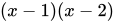
A polynomial expression is an expression that can be built from constants and symbols called variables or indeterminates by means of addition, multiplication and exponentiation to a non-negative integer power. The constants are generally numbers, but may be any expression that do not involve the indeterminates, and represent mathematical objects that can be added and multiplied. Two polynomial expressions are considered as defining the same polynomial if they may be transformed, one to the other, by applying the usual properties of commutativity, associativity and distributivity of addition and multiplication. For example and are two polynomial expressions that represent the same polynomial; so, one has the equality .


Polynomial
In mathematics, a polynomial is a mathematical expression consisting of indeterminates (also called variables) and coefficients, that involves only the operations of addition, subtraction, multiplication and exponentiation to nonnegative integer powers, and has a finite number of terms. An example of a polynomial of a single indeterminate is . An example with three indeterminates is .
Polynomials appear in many areas of mathematics and science. For example, they are used to form polynomial equations, which encode a wide range of problems, from elementary word problems to complicated scientific problems; they are used to define polynomial functions, which appear in settings ranging from basic chemistry and physics to economics and social science; and they are used in calculus and numerical analysis to approximate other functions. In advanced mathematics, polynomials are used to construct polynomial rings and algebraic varieties, which are central concepts in algebra and algebraic geometry.
The word polynomial joins two diverse roots: the Greek poly, meaning "many", and the Latin nomen, or "name". It was derived from the term binomial by replacing the Latin root bi- with the Greek poly-. That is, it means a sum of many terms (many monomials). The word polynomial was first used in the 17th century.
The occurring in a polynomial is commonly called a variable or an indeterminate. When the polynomial is considered as an expression, is a fixed symbol which does not have any value (its value is "indeterminate"). However, when one considers the function defined by the polynomial, then represents the argument of the function, and is therefore called a "variable". Many authors use these two words interchangeably.
A polynomial in the indeterminate is commonly denoted either as or as . Formally, the name of the polynomial is , not , but the use of the functional notation dates from a time when the distinction between a polynomial and the associated function was unclear. Moreover, the functional notation is often useful for specifying, in a single phrase, a polynomial and its indeterminate. For example, "let be a polynomial" is a shorthand for "let be a polynomial in the indeterminate ". On the other hand, when it is not necessary to emphasize the name of the indeterminate, many formulas are much simpler and easier to read if the name(s) of the indeterminate(s) do not appear at each occurrence of the polynomial.
The ambiguity of having two notations for a single mathematical object may be formally resolved by considering the general meaning of the functional notation for polynomials. If denotes a number, a variable, another polynomial, or, more generally, any expression, then denotes, by convention, the result of substituting for in . Thus, the polynomial defines the function which is the polynomial function associated to . Frequently, when using this notation, one supposes that is a number. However, one may use it over any domain where addition and multiplication are defined (that is, any ring). In particular, if is a polynomial then is also a polynomial.
More specifically, when is the indeterminate , then the image of by this function is the polynomial itself (substituting for does not change anything). In other words, which justifies formally the existence of two notations for the same polynomial.
A polynomial expression is an expression that can be built from constants and symbols called variables or indeterminates by means of addition, multiplication and exponentiation to a non-negative integer power. The constants are generally numbers, but may be any expression that do not involve the indeterminates, and represent mathematical objects that can be added and multiplied. Two polynomial expressions are considered as defining the same polynomial if they may be transformed, one to the other, by applying the usual properties of commutativity, associativity and distributivity of addition and multiplication. For example and are two polynomial expressions that represent the same polynomial; so, one has the equality .