
Recent from talks
Integration by parts
Knowledge base stats:
Talk channels stats:
Members stats:
Integration by parts
In calculus, and more generally in mathematical analysis, integration by parts or partial integration is a process that finds the integral of a product of functions in terms of the integral of the product of their derivative and antiderivative. It is frequently used to transform the antiderivative of a product of functions into an antiderivative for which a solution can be more easily found. The rule can be thought of as an integral version of the product rule of differentiation; it is indeed derived using the product rule.
The integration by parts formula states:
![{\displaystyle {\begin{aligned}\int _{a}^{b}u(x)v'(x)\,dx&={\Big [}u(x)v(x){\Big ]}_{a}^{b}-\int _{a}^{b}u'(x)v(x)\,dx\\&=u(b)v(b)-u(a)v(a)-\int _{a}^{b}u'(x)v(x)\,dx.\end{aligned}}}](https://wikimedia.org/api/rest_v1/media/math/render/svg/2749a28228f3ab485f192b5caa5b299a6ace5ecd)
Or, letting and while and the formula can be written more compactly:

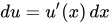

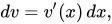
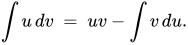
The former expression is written as a definite integral and the latter is written as an indefinite integral. Applying the appropriate limits to the latter expression should yield the former, but the latter is not necessarily equivalent to the former.
Mathematician Brook Taylor discovered integration by parts, first publishing the idea in 1715. More general formulations of integration by parts exist for the Riemann–Stieltjes and Lebesgue–Stieltjes integrals. The discrete analogue for sequences is called summation by parts.
The theorem can be derived as follows. For two continuously differentiable functions and , the product rule states:


Integrating both sides with respect to ,

Hub AI
Integration by parts AI simulator
(@Integration by parts_simulator)
Integration by parts
In calculus, and more generally in mathematical analysis, integration by parts or partial integration is a process that finds the integral of a product of functions in terms of the integral of the product of their derivative and antiderivative. It is frequently used to transform the antiderivative of a product of functions into an antiderivative for which a solution can be more easily found. The rule can be thought of as an integral version of the product rule of differentiation; it is indeed derived using the product rule.
The integration by parts formula states:
Or, letting and while and the formula can be written more compactly:
The former expression is written as a definite integral and the latter is written as an indefinite integral. Applying the appropriate limits to the latter expression should yield the former, but the latter is not necessarily equivalent to the former.
Mathematician Brook Taylor discovered integration by parts, first publishing the idea in 1715. More general formulations of integration by parts exist for the Riemann–Stieltjes and Lebesgue–Stieltjes integrals. The discrete analogue for sequences is called summation by parts.
The theorem can be derived as follows. For two continuously differentiable functions and , the product rule states:
Integrating both sides with respect to ,