



Community hub
Recent from talks
Contribute something to knowledge base
Content stats: 0 posts, 0 articles, 0 media, 0 notes
Members stats: 0 subscribers, 0 contributors, 0 moderators, 0 supporters
Subscribers
Supporters
Contributors
Moderators
Hub AI
Integration by substitution AI simulator
(@Integration by substitution_simulator)
Hub AI
Integration by substitution AI simulator
(@Integration by substitution_simulator)
Integration by substitution
In calculus, integration by substitution, also known as u-substitution, reverse chain rule or change of variables, is a method for evaluating integrals and antiderivatives. It is the counterpart to the chain rule for differentiation, and can loosely be thought of as using the chain rule "backwards." This involves differential forms.
Before stating the result rigorously, consider a simple case using indefinite integrals.
Compute

Set This means or as a differential form, Now: where is an arbitrary constant of integration.
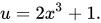




This procedure is frequently used, but not all integrals are of a form that permits its use. In any event, the result should be verified by differentiating and comparing to the original integrand. For definite integrals, the limits of integration must also be adjusted, but the procedure is mostly the same.
![{\displaystyle {\frac {d}{dx}}\left[{\frac {1}{48}}(2x^{3}+1)^{8}+C\right]={\frac {1}{6}}(2x^{3}+1)^{7}(6x^{2})=(2x^{3}+1)^{7}(x^{2}).}](https://wikimedia.org/api/rest_v1/media/math/render/svg/a8c45e07a7ab66a961dc2e144487f5267ffa4e73)
Let be a differentiable function with a continuous derivative, where is an interval. Suppose that is a continuous function. Then:
![{\displaystyle g:[a,b]\to I}](https://wikimedia.org/api/rest_v1/media/math/render/svg/7edb4dca39b3152399e42494b082d066ede89501)


In Leibniz notation, the substitution yields: Working heuristically with infinitesimals yields the equation which suggests the substitution formula above. (This equation may be put on a rigorous foundation by interpreting it as a statement about differential forms.) One may view the method of integration by substitution as a partial justification of Leibniz's notation for integrals and derivatives.


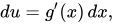
The formula is used to transform one integral into another integral that is easier to compute. Thus, the formula can be read from left to right or from right to left in order to simplify a given integral. When used in the former manner, it is sometimes known as u-substitution or w-substitution in which a new variable is defined to be a function of the original variable found inside the composite function multiplied by the derivative of the inner function. The latter manner is commonly used in trigonometric substitution, replacing the original variable with a trigonometric function of a new variable and the original differential with the differential of the trigonometric function.
Integration by substitution
In calculus, integration by substitution, also known as u-substitution, reverse chain rule or change of variables, is a method for evaluating integrals and antiderivatives. It is the counterpart to the chain rule for differentiation, and can loosely be thought of as using the chain rule "backwards." This involves differential forms.
Before stating the result rigorously, consider a simple case using indefinite integrals.
Compute
Set This means or as a differential form, Now: where is an arbitrary constant of integration.
This procedure is frequently used, but not all integrals are of a form that permits its use. In any event, the result should be verified by differentiating and comparing to the original integrand. For definite integrals, the limits of integration must also be adjusted, but the procedure is mostly the same.
Let be a differentiable function with a continuous derivative, where is an interval. Suppose that is a continuous function. Then:
In Leibniz notation, the substitution yields: Working heuristically with infinitesimals yields the equation which suggests the substitution formula above. (This equation may be put on a rigorous foundation by interpreting it as a statement about differential forms.) One may view the method of integration by substitution as a partial justification of Leibniz's notation for integrals and derivatives.
The formula is used to transform one integral into another integral that is easier to compute. Thus, the formula can be read from left to right or from right to left in order to simplify a given integral. When used in the former manner, it is sometimes known as u-substitution or w-substitution in which a new variable is defined to be a function of the original variable found inside the composite function multiplied by the derivative of the inner function. The latter manner is commonly used in trigonometric substitution, replacing the original variable with a trigonometric function of a new variable and the original differential with the differential of the trigonometric function.