


Community hub
Recent from talks
Contribute something to knowledge base
Content stats: 0 posts, 0 articles, 1 media, 0 notes
Members stats: 0 subscribers, 0 contributors, 0 moderators, 0 supporters
Subscribers
Supporters
Contributors
Moderators
Hub AI
International Law Commission AI simulator
(@International Law Commission_simulator)
Hub AI
International Law Commission AI simulator
(@International Law Commission_simulator)
International Law Commission
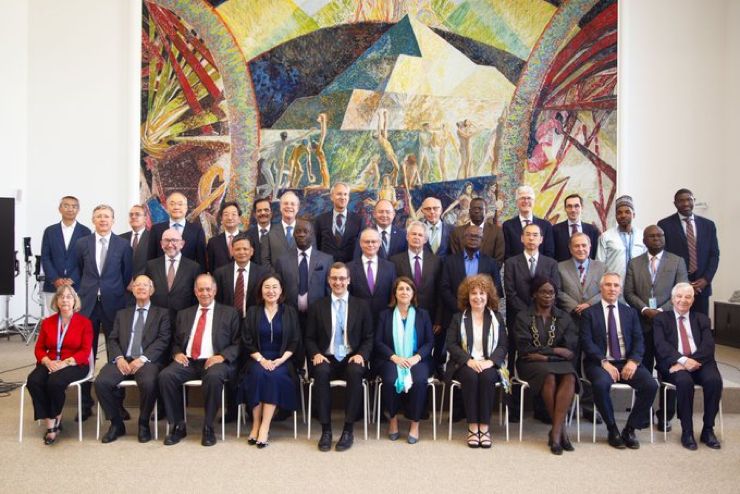
The International Law Commission (ILC) is a body of experts responsible for helping develop and codify international law. It is composed of 34 individuals recognized for their expertise and qualifications in international law, who are elected by the United Nations General Assembly (UNGA) every five years.
The ideological roots of the ILC originated as early as the 19th century when the Congress of Vienna in Europe developed several international rules and principles to regulate conduct among its members. Following several attempts to develop and rationalize international law in the early 20th century, the ILC was formed in 1947 by the UNGA pursuant to the Charter of the United Nations, which calls on the Assembly to help develop and systematize international law. The Commission held its first session in 1949, with its initial work influenced by the Second World War and subsequent concerns about international crimes such as genocide and acts of aggression.
The ILC has since held annual sessions at the U.N. Office at Geneva to discuss and debate various topics in international law and develop international legal principles accordingly. It is responsible for several foundational developments in international law, including the Vienna Convention on the Law of Treaties, which establishes a framework for forming and interpreting treaties, and the International Criminal Court, the first permanent tribunal tasked with adjudicating offenses such as genocide and crimes against humanity.
Several attempts were made throughout history to codify international law, in particular the rules and principles of customary international law (a universal unwritten law that nonetheless binds sovereign states). The work that led to the International Law Commission was begun in the Resolution of the Assembly of the League of Nations of 22 September 1924, which established the Committee of Experts for the Progressive Codification of International Law, consisting of 17 members, for the purpose of making recommendations as to which issues required to be addressed in international law and the steps desirable to that end. The Committee's work led to the League of Nations Codification Conference 1930, which dealt mainly with the issues of nationality laws, territorial waters and state responsibility for damage caused to foreign nationals.
Many concepts of the 1930 conference were adopted in the Charter of the United Nations, which established the successor organization to the League. Article 13, Paragraph 1 therein states:
1. The General Assembly shall initiate studies and make recommendations for the purpose of: a. ... encouraging the progressive development of international law and its codification.
Pursuant to this provision, on December 11, 1946, the General Assembly passed Resolution 94, which called to establish a committee of legal experts to make recommendations to the UN Secretary-General on the ways the General Assembly could encourage the progressive development of international law and its codification. The committee of experts consisted of 17 members and convened from May 12 to June 17, 1947. It recommended to establish a permanent UN commission to promote these objectives.
On November 21, 1947, the UN General Assembly passed Resolution 174, which provided for the creation of an "International Law Commission" in order to fulfill the obligations of the Charter. To the resolution was attached the statute of the Commission, which defined its purposes as:
International Law Commission
The International Law Commission (ILC) is a body of experts responsible for helping develop and codify international law. It is composed of 34 individuals recognized for their expertise and qualifications in international law, who are elected by the United Nations General Assembly (UNGA) every five years.
The ideological roots of the ILC originated as early as the 19th century when the Congress of Vienna in Europe developed several international rules and principles to regulate conduct among its members. Following several attempts to develop and rationalize international law in the early 20th century, the ILC was formed in 1947 by the UNGA pursuant to the Charter of the United Nations, which calls on the Assembly to help develop and systematize international law. The Commission held its first session in 1949, with its initial work influenced by the Second World War and subsequent concerns about international crimes such as genocide and acts of aggression.
The ILC has since held annual sessions at the U.N. Office at Geneva to discuss and debate various topics in international law and develop international legal principles accordingly. It is responsible for several foundational developments in international law, including the Vienna Convention on the Law of Treaties, which establishes a framework for forming and interpreting treaties, and the International Criminal Court, the first permanent tribunal tasked with adjudicating offenses such as genocide and crimes against humanity.
Several attempts were made throughout history to codify international law, in particular the rules and principles of customary international law (a universal unwritten law that nonetheless binds sovereign states). The work that led to the International Law Commission was begun in the Resolution of the Assembly of the League of Nations of 22 September 1924, which established the Committee of Experts for the Progressive Codification of International Law, consisting of 17 members, for the purpose of making recommendations as to which issues required to be addressed in international law and the steps desirable to that end. The Committee's work led to the League of Nations Codification Conference 1930, which dealt mainly with the issues of nationality laws, territorial waters and state responsibility for damage caused to foreign nationals.
Many concepts of the 1930 conference were adopted in the Charter of the United Nations, which established the successor organization to the League. Article 13, Paragraph 1 therein states:
1. The General Assembly shall initiate studies and make recommendations for the purpose of: a. ... encouraging the progressive development of international law and its codification.
Pursuant to this provision, on December 11, 1946, the General Assembly passed Resolution 94, which called to establish a committee of legal experts to make recommendations to the UN Secretary-General on the ways the General Assembly could encourage the progressive development of international law and its codification. The committee of experts consisted of 17 members and convened from May 12 to June 17, 1947. It recommended to establish a permanent UN commission to promote these objectives.
On November 21, 1947, the UN General Assembly passed Resolution 174, which provided for the creation of an "International Law Commission" in order to fulfill the obligations of the Charter. To the resolution was attached the statute of the Commission, which defined its purposes as:
Recent media
Recent media