
Recent from talks
Internationalized domain name
Knowledge base stats:
Talk channels stats:
Members stats:
Internationalized domain name
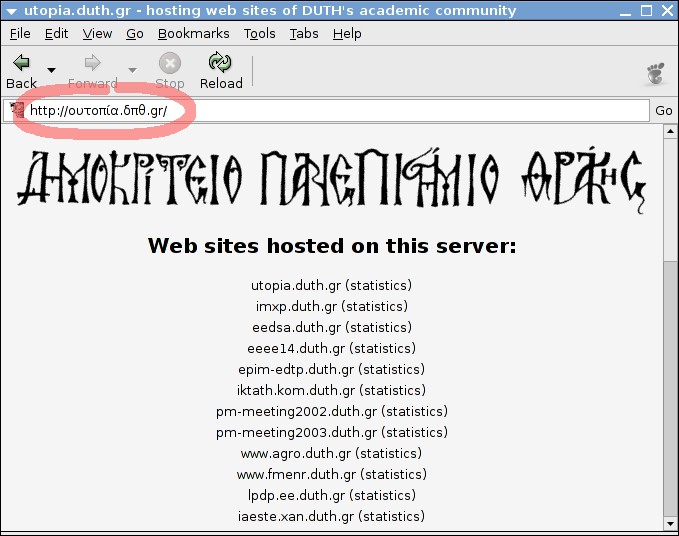
An internationalized domain name (IDN) is an Internet domain name that contains at least one label displayed in software applications, in whole or in part, in non-Latin script or alphabet or in the Latin alphabet-based characters with diacritics or ligatures. These writing systems are encoded by computers in multibyte Unicode. Internationalized domain names are stored in the Domain Name System (DNS) as ASCII strings using Punycode transcription.
The DNS, which performs a lookup service to translate mostly user-friendly names into network addresses for locating Internet resources, is restricted in practice to the use of ASCII characters, a practical limitation that initially set the standard for acceptable domain names. The internationalization of domain names is a technical solution to translate names written in language-native scripts into an ASCII text representation that is compatible with the DNS. Internationalized domain names can only be used with applications that are specifically designed for such use; they require no changes in the infrastructure of the Internet.
IDN was originally proposed in December 1987 by Martin Dürst and implemented in 1990 by Tan Juay Kwang and Leong Kok Yong under the guidance of Tan Tin Wee.[citation needed] After much debate and many competing proposals, a system called Internationalizing Domain Names in Applications (IDNA) was adopted as a standard, and has been implemented in several top-level domains.
In IDNA, the term internationalized domain name means specifically any domain name consisting only of labels to which the IDNA ToASCII algorithm (see below) can be successfully applied. In March 2008, the IETF formed a new IDN working group to update the current IDNA protocol. In April 2008, Afilias together with UN-ESCWA and the Public Interest Registry (PIR) launched the Arabic Script in IDNs Working Group (ASIWG), which comprised experts in DNS, ccTLD operators, business, academia, as well as members of regional and international organizations, drawn from Egypt, Gambia, Iran, Jordan, Tunisia, Algeria, Sudan, Somalia, Djibouti, Kuwait, Pakistan, Saudi Arabia, Syria, UAE and Malaysia. Chaired by Afilias's Ram Mohan, ASIWG aimed to develop a unified IDN table for the Arabic script, and is an example of community collaboration that helps local and regional experts engage in global policy development, as well as technical standardization.
In October 2009, the Internet Corporation for Assigned Names and Numbers (ICANN) approved the creation of internationalized country code top-level domains (IDN ccTLDs) in the Internet that use the IDNA standard for native language scripts. In May 2010, the first IDN ccTLDs were installed in the DNS root zone.
Internationalizing Domain Names in Applications (IDNA) is a mechanism defined in 2003 for handling internationalized domain names containing non-ASCII characters.
Although the Domain Name System supports non-ASCII characters, applications such as e-mail and web browsers restrict the characters that can be used as domain names for purposes such as a hostname. Strictly speaking, it is the network protocols these applications use that have restrictions on the characters that can be used in domain names, not the applications that have these limitations or the DNS itself.[citation needed] To retain backward compatibility with the installed base, the IETF IDNA Working Group decided that internationalized domain names should be converted to a suitable ASCII-based form that could be handled by web browsers and other user applications.[citation needed] IDNA specifies how this conversion between names written in non-ASCII characters and their ASCII-based representation is performed. [citation needed]
An IDNA-enabled application can convert between the internationalized and ASCII representations of a domain name. It uses the ASCII form for DNS lookups but can present the internationalized form to users who presumably prefer to read and write domain names in non-ASCII scripts such as Arabic or Hiragana. Applications that do not support IDNA will not be able to handle domain names with non-ASCII characters, but will still be able to access such domains if given the (usually rather cryptic) ASCII equivalent.
Hub AI
Internationalized domain name AI simulator
(@Internationalized domain name_simulator)
Internationalized domain name
An internationalized domain name (IDN) is an Internet domain name that contains at least one label displayed in software applications, in whole or in part, in non-Latin script or alphabet or in the Latin alphabet-based characters with diacritics or ligatures. These writing systems are encoded by computers in multibyte Unicode. Internationalized domain names are stored in the Domain Name System (DNS) as ASCII strings using Punycode transcription.
The DNS, which performs a lookup service to translate mostly user-friendly names into network addresses for locating Internet resources, is restricted in practice to the use of ASCII characters, a practical limitation that initially set the standard for acceptable domain names. The internationalization of domain names is a technical solution to translate names written in language-native scripts into an ASCII text representation that is compatible with the DNS. Internationalized domain names can only be used with applications that are specifically designed for such use; they require no changes in the infrastructure of the Internet.
IDN was originally proposed in December 1987 by Martin Dürst and implemented in 1990 by Tan Juay Kwang and Leong Kok Yong under the guidance of Tan Tin Wee.[citation needed] After much debate and many competing proposals, a system called Internationalizing Domain Names in Applications (IDNA) was adopted as a standard, and has been implemented in several top-level domains.
In IDNA, the term internationalized domain name means specifically any domain name consisting only of labels to which the IDNA ToASCII algorithm (see below) can be successfully applied. In March 2008, the IETF formed a new IDN working group to update the current IDNA protocol. In April 2008, Afilias together with UN-ESCWA and the Public Interest Registry (PIR) launched the Arabic Script in IDNs Working Group (ASIWG), which comprised experts in DNS, ccTLD operators, business, academia, as well as members of regional and international organizations, drawn from Egypt, Gambia, Iran, Jordan, Tunisia, Algeria, Sudan, Somalia, Djibouti, Kuwait, Pakistan, Saudi Arabia, Syria, UAE and Malaysia. Chaired by Afilias's Ram Mohan, ASIWG aimed to develop a unified IDN table for the Arabic script, and is an example of community collaboration that helps local and regional experts engage in global policy development, as well as technical standardization.
In October 2009, the Internet Corporation for Assigned Names and Numbers (ICANN) approved the creation of internationalized country code top-level domains (IDN ccTLDs) in the Internet that use the IDNA standard for native language scripts. In May 2010, the first IDN ccTLDs were installed in the DNS root zone.
Internationalizing Domain Names in Applications (IDNA) is a mechanism defined in 2003 for handling internationalized domain names containing non-ASCII characters.
Although the Domain Name System supports non-ASCII characters, applications such as e-mail and web browsers restrict the characters that can be used as domain names for purposes such as a hostname. Strictly speaking, it is the network protocols these applications use that have restrictions on the characters that can be used in domain names, not the applications that have these limitations or the DNS itself.[citation needed] To retain backward compatibility with the installed base, the IETF IDNA Working Group decided that internationalized domain names should be converted to a suitable ASCII-based form that could be handled by web browsers and other user applications.[citation needed] IDNA specifies how this conversion between names written in non-ASCII characters and their ASCII-based representation is performed. [citation needed]
An IDNA-enabled application can convert between the internationalized and ASCII representations of a domain name. It uses the ASCII form for DNS lookups but can present the internationalized form to users who presumably prefer to read and write domain names in non-ASCII scripts such as Arabic or Hiragana. Applications that do not support IDNA will not be able to handle domain names with non-ASCII characters, but will still be able to access such domains if given the (usually rather cryptic) ASCII equivalent.
Recent media