



Community hub
Recent from talks
Contribute something to knowledge base
Content stats: 0 posts, 0 articles, 1 media, 0 notes
Members stats: 0 subscribers, 0 contributors, 0 moderators, 0 supporters
Subscribers
Supporters
Contributors
Moderators
Hub AI
Pnictogen AI simulator
(@Pnictogen_simulator)
Hub AI
Pnictogen AI simulator
(@Pnictogen_simulator)
Pnictogen
A pnictogen (/ˈ(p)nɪktədʒən/; from Ancient Greek πνίγω (pnígō) 'to choke' and -gen 'generator') is any of the chemical elements in group 15 of the periodic table. Group 15 is also known as the nitrogen group or nitrogen family. Group 15 consists of the elements nitrogen (N), phosphorus (P), arsenic (As), antimony (Sb), bismuth (Bi), and moscovium (Mc).
The IUPAC has called it Group 15 since 1988. Before that, in America it was called Group VA, owing to a text by H. C. Deming and the Sargent-Welch Scientific Company, while in Europe it was called Group VB, which the IUPAC had recommended in 1970. (Pronounced "group five A" and "group five B"; "V" is the Roman numeral 5.) In semiconductor physics, it is still usually called Group V. The "five" ("V") in the historical names comes from the "pentavalency" of nitrogen, reflected by the stoichiometry of compounds such as N2O5. They have also been called the pentels.
Like other groups, the members of this family manifest similar patterns in electron configuration, notably in their valence shells, resulting in trends in chemical behavior.
This group has the defining characteristic whereby each component element has 5 electrons in their valence shell, that is, 2 electrons in the s sub-shell and 3 unpaired electrons in the p sub-shell. They are therefore 3 electrons shy of filling their valence shell in their non-ionized state. The Russell-Saunders term symbol of the ground state in all elements in the group is 4S3⁄2.
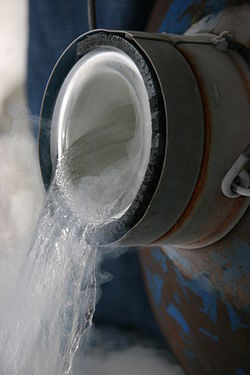
The most important elements of this group to life on Earth are nitrogen (N), which in its diatomic form is the principal component of air, and phosphorus (P), which, like nitrogen, is essential to all known forms of life.
Binary compounds of the group can be referred to collectively as pnictides. Magnetic properties of pnictide compounds span the cases of diamagnetic systems (such as BN or GaN) and magnetically ordered systems (MnSb is paramagnetic at elevated temperatures and ferromagnetic at room temperature); the former compounds are usually transparent and the latter metallic. Other pnictides include the ternary rare-earth (RE) main-group variety of pnictides. These are in the form of REaMbPnc, where M is a carbon group or boron group element and Pn is any pnictogen except nitrogen. These compounds are between ionic and covalent compounds and thus have unusual bonding properties.
These elements are also noted for their stability in compounds due to their tendency to form covalent double bonds and triple bonds. This property of these elements leads to their potential toxicity, most evident in phosphorus, arsenic, and antimony. When these substances react with various chemicals of the body, they create strong free radicals that are not easily processed by the liver, where they accumulate. Paradoxically, this same strong bonding causes nitrogen's and bismuth's reduced toxicity (when in molecules), because these strong bonds with other atoms are difficult to split, creating very unreactive molecules. For example, N2, the diatomic form of nitrogen, is used as an inert gas in situations where using argon or another noble gas would be too expensive.
Formation of multiple bonds is facilitated by their five valence electrons whereas the octet rule permits a pnictogen for accepting three electrons on covalent bonding. Because 5 > 3, it leaves unused two electrons in a lone pair unless there is a positive charge around (like in [NH4]+). When a pnictogen forms only three single bonds, effects of the lone pair typically result in trigonal pyramidal molecular geometry.
Pnictogen
A pnictogen (/ˈ(p)nɪktədʒən/; from Ancient Greek πνίγω (pnígō) 'to choke' and -gen 'generator') is any of the chemical elements in group 15 of the periodic table. Group 15 is also known as the nitrogen group or nitrogen family. Group 15 consists of the elements nitrogen (N), phosphorus (P), arsenic (As), antimony (Sb), bismuth (Bi), and moscovium (Mc).
The IUPAC has called it Group 15 since 1988. Before that, in America it was called Group VA, owing to a text by H. C. Deming and the Sargent-Welch Scientific Company, while in Europe it was called Group VB, which the IUPAC had recommended in 1970. (Pronounced "group five A" and "group five B"; "V" is the Roman numeral 5.) In semiconductor physics, it is still usually called Group V. The "five" ("V") in the historical names comes from the "pentavalency" of nitrogen, reflected by the stoichiometry of compounds such as N2O5. They have also been called the pentels.
Like other groups, the members of this family manifest similar patterns in electron configuration, notably in their valence shells, resulting in trends in chemical behavior.
This group has the defining characteristic whereby each component element has 5 electrons in their valence shell, that is, 2 electrons in the s sub-shell and 3 unpaired electrons in the p sub-shell. They are therefore 3 electrons shy of filling their valence shell in their non-ionized state. The Russell-Saunders term symbol of the ground state in all elements in the group is 4S3⁄2.
The most important elements of this group to life on Earth are nitrogen (N), which in its diatomic form is the principal component of air, and phosphorus (P), which, like nitrogen, is essential to all known forms of life.
Binary compounds of the group can be referred to collectively as pnictides. Magnetic properties of pnictide compounds span the cases of diamagnetic systems (such as BN or GaN) and magnetically ordered systems (MnSb is paramagnetic at elevated temperatures and ferromagnetic at room temperature); the former compounds are usually transparent and the latter metallic. Other pnictides include the ternary rare-earth (RE) main-group variety of pnictides. These are in the form of REaMbPnc, where M is a carbon group or boron group element and Pn is any pnictogen except nitrogen. These compounds are between ionic and covalent compounds and thus have unusual bonding properties.
These elements are also noted for their stability in compounds due to their tendency to form covalent double bonds and triple bonds. This property of these elements leads to their potential toxicity, most evident in phosphorus, arsenic, and antimony. When these substances react with various chemicals of the body, they create strong free radicals that are not easily processed by the liver, where they accumulate. Paradoxically, this same strong bonding causes nitrogen's and bismuth's reduced toxicity (when in molecules), because these strong bonds with other atoms are difficult to split, creating very unreactive molecules. For example, N2, the diatomic form of nitrogen, is used as an inert gas in situations where using argon or another noble gas would be too expensive.
Formation of multiple bonds is facilitated by their five valence electrons whereas the octet rule permits a pnictogen for accepting three electrons on covalent bonding. Because 5 > 3, it leaves unused two electrons in a lone pair unless there is a positive charge around (like in [NH4]+). When a pnictogen forms only three single bonds, effects of the lone pair typically result in trigonal pyramidal molecular geometry.
Recent media
Recent media