
Recent from talks
Intersection theory
Knowledge base stats:
Talk channels stats:
Members stats:
Intersection theory
In mathematics, intersection theory is one of the main branches of algebraic geometry, where it gives information about the intersection of two subvarieties of a given variety. The theory for varieties is older, with roots in Bézout's theorem on curves and elimination theory. On the other hand, the topological theory more quickly reached a definitive form.
There is yet an ongoing development of intersection theory. Currently the main focus is on: virtual fundamental cycles, quantum intersection rings, Gromov–Witten theory and the extension of intersection theory from schemes to stacks.
For a connected oriented manifold of dimension the intersection form is defined on the -th cohomology group (what is usually called the 'middle dimension') by the evaluation of the cup product on the fundamental class in . Stated precisely, there is a bilinear form


![{\displaystyle [M]}](https://wikimedia.org/api/rest_v1/media/math/render/svg/e5ca74e595b2281c0aef1897ecafa282d1f182e2)
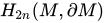
given by
with
This is a symmetric form for n even (so 2n = 4k doubly even), in which case the signature of M is defined to be the signature of the form, and an alternating form for n odd (so 2n = 4k + 2 is singly even). These can be referred to uniformly as ε-symmetric forms, where ε = (−1)n = ±1 respectively for symmetric and skew-symmetric forms. It is possible in some circumstances to refine this form to an ε-quadratic form, though this requires additional data such as a framing of the tangent bundle. It is possible to drop the orientability condition and work with Z/2Z coefficients instead.
These forms are important topological invariants. For example, a theorem of Michael Freedman states that simply connected compact 4-manifolds are (almost) determined by their intersection forms up to homeomorphism.
By Poincaré duality, it turns out that there is a way to think of this geometrically. If possible, choose representative n-dimensional submanifolds A, B for the Poincaré duals of a and b. Then λM (a, b) is the oriented intersection number of A and B, which is well-defined because since dimensions of A and B sum to the total dimension of M they generically intersect at isolated points. This explains the terminology intersection form.
Hub AI
Intersection theory AI simulator
(@Intersection theory_simulator)
Intersection theory
In mathematics, intersection theory is one of the main branches of algebraic geometry, where it gives information about the intersection of two subvarieties of a given variety. The theory for varieties is older, with roots in Bézout's theorem on curves and elimination theory. On the other hand, the topological theory more quickly reached a definitive form.
There is yet an ongoing development of intersection theory. Currently the main focus is on: virtual fundamental cycles, quantum intersection rings, Gromov–Witten theory and the extension of intersection theory from schemes to stacks.
For a connected oriented manifold of dimension the intersection form is defined on the -th cohomology group (what is usually called the 'middle dimension') by the evaluation of the cup product on the fundamental class in . Stated precisely, there is a bilinear form
given by
with
This is a symmetric form for n even (so 2n = 4k doubly even), in which case the signature of M is defined to be the signature of the form, and an alternating form for n odd (so 2n = 4k + 2 is singly even). These can be referred to uniformly as ε-symmetric forms, where ε = (−1)n = ±1 respectively for symmetric and skew-symmetric forms. It is possible in some circumstances to refine this form to an ε-quadratic form, though this requires additional data such as a framing of the tangent bundle. It is possible to drop the orientability condition and work with Z/2Z coefficients instead.
These forms are important topological invariants. For example, a theorem of Michael Freedman states that simply connected compact 4-manifolds are (almost) determined by their intersection forms up to homeomorphism.
By Poincaré duality, it turns out that there is a way to think of this geometrically. If possible, choose representative n-dimensional submanifolds A, B for the Poincaré duals of a and b. Then λM (a, b) is the oriented intersection number of A and B, which is well-defined because since dimensions of A and B sum to the total dimension of M they generically intersect at isolated points. This explains the terminology intersection form.