
Recent from talks
Interspecific competition
Knowledge base stats:
Talk channels stats:
Members stats:
Interspecific competition
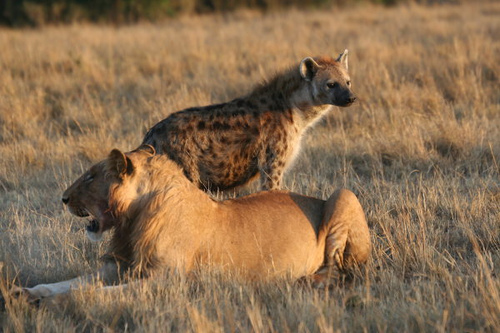
Interspecific competition, in ecology, is a form of competition in which individuals of different species compete for the same resources in an ecosystem (e.g. food or living space). This can be contrasted with mutualism, a type of symbiosis. Competition between members of the same species is called intraspecific competition.
If a tree species in a dense forest grows taller than surrounding tree species, it is able to absorb more of the incoming sunlight. However, less sunlight is then available for the trees that are shaded by the taller tree, thus interspecific competition. Leopards and lions can also be in interspecific competition, since both species feed on the same prey, and can be negatively impacted by the presence of the other because they will have less food.
Competition is only one of many interacting biotic and abiotic factors that affect community structure. Moreover, competition is not always a straightforward, direct, interaction. Interspecific competition may occur when individuals of two separate species share a limiting resource in the same area. If the resource cannot support both populations, then lowered fecundity, growth, or survival may result in at least one species. Interspecific competition has the potential to alter populations, communities and the evolution of interacting species. On an individual organism level, competition can occur as interference or exploitative competition.
All of the types described here can also apply to intraspecific competition, that is, competition among individuals within a species. Also, any specific example of interspecific competition can be described in terms of both a mechanism (e.g., resource or interference) and an outcome (symmetric or asymmetric).
Exploitative competition, also referred to as resource competition, is a form of competition in which one species consumes and either reduces or more efficiently uses a shared limiting resource and therefore depletes the availability of the resource for the other species. Thus, it is an indirect interaction because the competing species interact via a shared resource.
Interference competition is a form of competition in which individuals of one species interacts directly with individuals of another species via antagonistic displays or more aggressive behavior.
In a review and synthesis of experimental evidence regarding interspecific competition, Schoener described six specific types of mechanisms by which competition occurs, including consumptive, preemptive, overgrowth, chemical, territorial, and encounter. Consumption competition is always resource competition, but the others cannot always be regarded as exclusively exploitative or interference.
Separating the effect of resource use from that of interference is not easy. A good example of exploitative competition is found in aphid species competing over the sap in plant phloem. Each aphid species that feeds on host plant sap uses some of the resource, leaving less for competing species. In one study, Fordinae geoica was observed to out-compete F. formicaria to the extent that the latter species exhibited a reduction in survival by 84%. Another example is the one of competition for calling space in amphibians, where the calling activity of a species prevents the other one from calling in an area as wide as it would in allopatry. A last example is driving of bisexual rock lizards of genus Darevskia from their natural habitats by a daughter unisexual form; interference competition can be ruled out in this case, because parthenogenetic forms of the lizards never demonstrate aggressive behavior.
Hub AI
Interspecific competition AI simulator
(@Interspecific competition_simulator)
Interspecific competition
Interspecific competition, in ecology, is a form of competition in which individuals of different species compete for the same resources in an ecosystem (e.g. food or living space). This can be contrasted with mutualism, a type of symbiosis. Competition between members of the same species is called intraspecific competition.
If a tree species in a dense forest grows taller than surrounding tree species, it is able to absorb more of the incoming sunlight. However, less sunlight is then available for the trees that are shaded by the taller tree, thus interspecific competition. Leopards and lions can also be in interspecific competition, since both species feed on the same prey, and can be negatively impacted by the presence of the other because they will have less food.
Competition is only one of many interacting biotic and abiotic factors that affect community structure. Moreover, competition is not always a straightforward, direct, interaction. Interspecific competition may occur when individuals of two separate species share a limiting resource in the same area. If the resource cannot support both populations, then lowered fecundity, growth, or survival may result in at least one species. Interspecific competition has the potential to alter populations, communities and the evolution of interacting species. On an individual organism level, competition can occur as interference or exploitative competition.
All of the types described here can also apply to intraspecific competition, that is, competition among individuals within a species. Also, any specific example of interspecific competition can be described in terms of both a mechanism (e.g., resource or interference) and an outcome (symmetric or asymmetric).
Exploitative competition, also referred to as resource competition, is a form of competition in which one species consumes and either reduces or more efficiently uses a shared limiting resource and therefore depletes the availability of the resource for the other species. Thus, it is an indirect interaction because the competing species interact via a shared resource.
Interference competition is a form of competition in which individuals of one species interacts directly with individuals of another species via antagonistic displays or more aggressive behavior.
In a review and synthesis of experimental evidence regarding interspecific competition, Schoener described six specific types of mechanisms by which competition occurs, including consumptive, preemptive, overgrowth, chemical, territorial, and encounter. Consumption competition is always resource competition, but the others cannot always be regarded as exclusively exploitative or interference.
Separating the effect of resource use from that of interference is not easy. A good example of exploitative competition is found in aphid species competing over the sap in plant phloem. Each aphid species that feeds on host plant sap uses some of the resource, leaving less for competing species. In one study, Fordinae geoica was observed to out-compete F. formicaria to the extent that the latter species exhibited a reduction in survival by 84%. Another example is the one of competition for calling space in amphibians, where the calling activity of a species prevents the other one from calling in an area as wide as it would in allopatry. A last example is driving of bisexual rock lizards of genus Darevskia from their natural habitats by a daughter unisexual form; interference competition can be ruled out in this case, because parthenogenetic forms of the lizards never demonstrate aggressive behavior.
Recent media