
.jpg/250px-African_leopard_male_(cropped).jpg)


.jpg/2000px-African_leopard_male_(cropped).jpg)
Community hub
Recent from talks
Contribute something
Nothing was collected or created yet.
Leopard
View on Wikipedia
| Leopard Temporal range:
| |
|---|---|
.jpg)
| |
| Male African leopard in Maasai Mara National Reserve, Kenya | |
Scientific classification 
| |
| Kingdom: | Animalia |
| Phylum: | Chordata |
| Class: | Mammalia |
| Order: | Carnivora |
| Family: | Felidae |
| Genus: | Panthera |
| Species: | P. pardus[1]
|
| Binomial name | |
| Panthera pardus[1] | |
| Subspecies | |
|
See text | |

| |
| Present and historical distribution of the leopard[2] | |

The leopard (Panthera pardus) is one of the five extant cat species in the genus Panthera. It has a pale yellowish to dark golden fur with dark spots grouped in rosettes. Its body is slender and muscular, reaching a length of 92–183 cm (36–72 in) with a 66–102 cm (26–40 in) long tail and a shoulder height of 60–70 cm (24–28 in). Males typically weigh 30.9–72 kg (68–159 lb), and females 20.5–43 kg (45–95 lb).
The leopard was first described in 1758, and several subspecies were proposed in the 19th and 20th centuries. Today, eight subspecies are recognised in its wide range in Africa and Asia. It initially evolved in Africa during the Early Pleistocene, before migrating into Eurasia around the Early–Middle Pleistocene transition. Leopards were formerly present across Europe, but became extinct in the region at around the end of the Late Pleistocene-early Holocene.
The leopard is adapted to a variety of habitats ranging from rainforest to steppe, including arid and montane areas. It is an opportunistic predator, hunting mostly ungulates and primates. It relies on its spotted pattern for camouflage as it stalks and ambushes its prey, which it sometimes drags up a tree. It is a solitary animal outside the mating season and when raising cubs. Females usually give birth to a litter of 2–4 cubs once in 15–24 months. Both male and female leopards typically reach sexual maturity at the age 2–2.5 years.
Listed as Vulnerable on the IUCN Red List, leopard populations are currently threatened by habitat loss and fragmentation, and are declining in large parts of the global range. Leopards have had cultural roles in Ancient Greece, West Africa and modern Western culture. Leopard skins are popular in fashion.
Etymology
[edit]The English name "leopard" comes from Old French leupart or Middle French liepart, that derives from Latin leopardus and ancient Greek λεόπαρδος (leopardos). Leopardos could be a compound of λέων (leōn), meaning 'lion', and πάρδος (pardos), meaning 'spotted'.[3][4][5] The word λεόπαρδος originally referred to a cheetah (Acinonyx jubatus).[6]
"Panther" is another common name, derived from Latin panther and ancient Greek πάνθηρ (pánthēr);[3] The generic name Panthera originates in Latin panthera, a hunting net for catching wild beasts to be used by the Romans in combats.[7] Pardus is the masculine singular form.[8]
Taxonomy
[edit]
Felis pardus was the scientific name proposed by Carl Linnaeus in 1758.[9] The generic name Panthera was first used by Lorenz Oken in 1816, who included all the known spotted cats into this group.[10] Oken's classification was not widely accepted, and Felis or Leopardus was used as the generic name until the early 20th century.[11]
The leopard was designated as the type species of Panthera by Joel Asaph Allen in 1902.[12] In 1917, Reginald Innes Pocock also subordinated the tiger (P. tigris), lion (P. leo), and jaguar (P. onca) to Panthera.[13][14]
Living subspecies
[edit]Following Linnaeus' first description, 27 leopard subspecies were proposed by naturalists between 1794 and 1956. Since 1996, only eight subspecies have been considered valid on the basis of mitochondrial analysis.[15] Later analysis revealed a ninth valid subspecies, the Arabian leopard.[16]
In 2017, the Cat Classification Task Force of the Cat Specialist Group recognized the following eight subspecies as valid taxa:[17]
| Subspecies | Distribution | Image |
|---|---|---|
| African leopard (P. p. pardus) (Linnaeus, 1758)[1] | It is the most widespread leopard subspecies and is native to most of Sub-Saharan Africa, but likely locally extinct in Mauritania, Togo, Morocco, Algeria, Tunisia and Libya and most likely also in Gambia and Lesotho.[2] | _male_..._(51890626416).jpg)
|
| Indian leopard (P. p. fusca) (Meyer, 1794)[18] | It occurs in the Indian subcontinent, Myanmar and southern Tibet.[17][19] It is listed as Near Threatened.[20] | .jpg)
|
| Javan leopard (P. p. melas) (Cuvier, 1809)[21] | It is native to Java in Indonesia and has been assessed as Endangered in 2021.[22] | 
|
| Arabian leopard (P. p. nimr) (Hemprich and Ehrenberg, 1830)[23] | It is the smallest leopard subspecies and considered endemic to the Arabian Peninsula.[24] As of 2023, the population was estimated to comprise 100–120 individuals in Oman and Yemen; it was therefore assessed as Critically Endangered in 2023.[25] It is locally extinct in Syria, Lebanon, Israel, Palestine, Jordan, Kuwait and the United Arab Emirates.[2] | 
|
| P. p. tulliana (Valenciennes, 1856)[26] | It occurs from eastern Turkey and the Caucasus to the Iranian Plateau and the Hindu Kush into the western Himalayas. It is listed as Endangered.[27] It is locally extinct in Uzbekistan and Tajikistan.[2]
The Balochistan leopard population in the south of Iran, Afghanistan and Pakistan is separated from the northern population by the Dasht-e Kavir and Dasht-e Lut deserts.[28] |

|
| Amur leopard (P. p. orientalis) (Schlegel, 1857)[29][30] | It is native to the Russian Far East and northern China, but is locally extinct in the Korean peninsula.[2] | .jpg)
|
| Indochinese leopard (P. p. delacouri) Pocock, 1930[31] | It occurs in mainland Southeast Asia and southern China, and is listed as Critically Endangered.[32] It is locally extinct in Hong Kong, Singapore, Laos and Vietnam.[2] | 
|
| Sri Lankan leopard (P. p. kotiya) Deraniyagala, 1956[33] | It is native to Sri Lanka and listed as Vulnerable.[34] | _02_(cropped).jpg)
|
Results of an analysis of molecular variance and pairwise fixation index of 182 African leopard museum specimens showed that some African leopards exhibit higher genetic differences than Asian leopard subspecies.[35]
Evolution
[edit]
Results of phylogenetic studies based on nuclear DNA and mitochondrial DNA analysis showed that the last common ancestor of the Panthera and Neofelis genera is thought to have lived about 6.37 million years ago. Neofelis diverged about 8.66 million years ago from the Panthera lineage. The tiger diverged about 6.55 million years ago, followed by the snow leopard about 4.63 million years ago and the leopard about 4.35 million years ago. The leopard is a sister taxon to a clade within Panthera, consisting of the lion and the jaguar.[36][37]
Results of a phylogenetic analysis of chemical secretions amongst cats indicated that the leopard is closely related to the lion.[40] The geographic origin of the Panthera is most likely northern Central Asia. The leopard-lion clade was distributed in the Asian and African Palearctic since at least the early Pliocene.[41] The leopard-lion clade diverged 3.1–1.95 million years ago.[38][39] Additionally, a 2016 study revealed that the mitochondrial genomes of the leopard, lion and snow leopard are more similar to each other than their nuclear genomes, indicating that their ancestors hybridized with the snow leopard at some point in their evolution.[42]
The oldest unambiguous fossils of the leopard are from Eastern Africa, dating to around 2 million years ago.[43]
Leopard-like fossil bones and teeth possibly dating to the Pliocene were excavated in Perrier in France, northeast of London, and in Valdarno, Italy. Until 1940, similar fossils dating back to the Pleistocene were excavated mostly in loess and caves at 40 sites in Europe, including Furninha Cave near Lisbon, Genista Caves in Gibraltar, and Santander Province in northern Spain to several sites across France, Switzerland, Italy, Austria, Germany, in the north up to Derby in England, in the east to Přerov in the Czech Republic and the Baranya in southern Hungary.[44] Leopards arrived in Eurasia during the late Early to Middle Pleistocene around 1.2[45] to 0.6 million years ago.[43] Four European Pleistocene leopard subspecies were proposed. P. p. begoueni from the beginning of the Early Pleistocene was replaced about 0.6 million years ago by P. p. sickenbergi, which in turn was replaced by P. p. antiqua around 0.3 million years ago.[46] P. p. spelaea is the most recent subspecies that appeared at the beginning of the Late Pleistocene and survived until about 11,000 years ago and possibly into the early Holocene in the Iberian Peninsula.[46][47]
Leopards depicted in cave paintings in Chauvet Cave provide indirect evidence of leopard presence in Europe.[46] Leopard fossils dating to the Late Pleistocene were found in Biśnik Cave in south-central Poland.[48][45] Fossil remains were also excavated in the Iberian[49][50] and Italian Peninsula,[51][52] and in the Balkans.[53][54] Leopard fossils dating to the Pleistocene were also excavated in the Japanese archipelago.[55] Leopard fossils were also found in Taiwan.[56]
Hybrids
[edit]In 1953, a male leopard and a female lion were crossbred in Hanshin Park in Nishinomiya, Japan. Their offspring known as a leopon was born in 1959 and 1961, all cubs were spotted and bigger than a juvenile leopard. Attempts to mate a leopon with a tigress proved unsuccessful.[57]
Characteristics
[edit].jpg)


The leopard's fur is generally soft and thick, notably softer on the belly than on the back.[58] Its skin colour varies between individuals from pale yellowish to dark golden with dark spots grouped in rosettes. Its underbelly is white and its ringed tail is shorter than its body. Its pupils are round.[59] Leopards living in arid regions are pale cream, yellowish to ochraceous and rufous in colour; those living in forests and mountains are much darker and deep golden. Spots fade toward the white underbelly and the insides and lower parts of the legs.[60] Rosettes are circular in East African leopard populations, and tend to be squarish in Southern African and larger in Asian leopard populations. The fur tends to be grayish in colder climates, and dark golden in rainforest habitats.[61] Rosette patterns are unique in each individual.[62][63] This pattern is thought to be an adaptation to dense vegetation with patchy shadows, where it serves as camouflage.[64]
Its white-tipped tail is about 60–100 cm (23.6–39.4 in) long, white underneath and with spots that form incomplete bands toward the end of the tail.[65] The guard hairs protecting the basal hairs are short, 3–4 mm (0.1–0.2 in) in face and head, and increase in length toward the flanks and the belly to about 25–30 mm (1.0–1.2 in). Juveniles have woolly fur that appear to be dark-coloured due to the densely arranged spots.[62][66] Its fur tends to grow longer in colder climates.[67] The leopard's rosettes differ from those of the jaguar, which are darker and with smaller spots inside.[59] The leopard has a diploid chromosome number of 38.[68]
Melanistic leopards are also known as black panthers. Melanism in leopards is caused by a recessive allele and is inherited as a recessive trait.[69][70][71][72] In India, nine pale and white leopards were reported between 1905 and 1967.[73] Leopards exhibiting erythrism were recorded between 1990 and 2015 in South Africa's Madikwe Game Reserve and in Mpumalanga. The cause of this morph known as a "strawberry leopard" or "pink panther" is not well understood.[74]
Size
[edit]The leopard is a slender and muscular cat, with relatively short limbs and a broad head. It is sexually dimorphic with males larger and heavier than females.[65] Males stand 60–70 cm (24–28 in) at the shoulder, while females are 57–64 cm (22–25 in) tall. The head-and-body length ranges between 92 and 183 cm (36 and 72 in) with a 66 to 102 cm (26 to 40 in) long tail. Sizes vary geographically. Males typically weigh 30.9–72 kg (68–159 lb), and females 20.5–43 kg (45–95 lb).[75] Occasionally, large males can grow up to 91 kg (201 lb). Leopards from the Cape Province in South Africa are generally smaller, reaching only 20–45 kg (44–99 lb) in males.[66][67][76] The heaviest wild leopard in Southern Africa weighed around 96 kg (212 lb), and it measured 262 cm (103 in).[77] In 2016, an Indian leopard killed in Himachal Pradesh measured 261 cm (103 in) with an estimated weight of 78.5 kg (173 lb); it was perhaps the largest known wild leopard in India.[78]
The largest recorded skull of a leopard was found in India in 1920 and measured 28 cm (11 in) in basal length, 20 cm (7.9 in) in breadth, and weighed 1 kg (2.2 lb). The skull of an African leopard measured 286 mm (11.3 in) in basal length, and 181 mm (7.1 in) in breadth, and weighed 790 g (28 oz).[79]
Distribution and habitat
[edit]
.jpg)
The leopard has the largest distribution of all wild cats, occurring widely in Africa and Asia, although populations are fragmented and declining.[2] It inhabits foremost savanna and rainforest, and areas where grasslands, woodlands and riparian forests remain largely undisturbed.[61] It also persists in urban environments, if it is not persecuted, has sufficient prey and patches of vegetation for shelter during the day.[80]
The leopard's range in West Africa is estimated to have drastically declined by 95%, and in the Sahara desert by 97%.[81] In sub-Saharan Africa, it is still numerous and surviving in marginal habitats where other large cats have disappeared.[82] In southeastern Egypt, an individual found killed in 2017 was the first sighting of the leopard in this area in 65 years.[83]
In West Asia, the leopard inhabits the areas of southern and southeastern Anatolia.[84][85][86]
Leopard populations in the Arabian Peninsula are small and fragmented.[87][88][89]
In the Indian subcontinent, the leopard is still relatively abundant, with greater numbers than those of other Panthera species.[2] Some leopard populations in India live quite close to human settlements and even in semi-developed areas. Although adaptable to human disturbances, leopards require healthy prey populations and appropriate vegetative cover for hunting for prolonged survival and thus rarely linger in heavily developed areas. Due to the leopard's stealth, people often remain unaware that it lives in nearby areas.[90] As of 2020, the leopard population within forested habitats in India's tiger range landscapes was estimated at 12,172 to 13,535 individuals. Surveyed landscapes included elevations below 2,600 m (8,500 ft) in the Shivalik Hills and Gangetic plains, Central India and Eastern Ghats, Western Ghats, the Brahmaputra River basin and hills in Northeast India.[91] In Nepal's Kanchenjunga Conservation Area, a melanistic leopard was photographed at an elevation of 4,300 m (14,100 ft) by a camera trap in May 2012.[92]
In Sri Lanka, leopards were recorded in Yala National Park and in unprotected forest patches, tea estates, grasslands, home gardens, pine and eucalyptus plantations.[93][94]
In Myanmar, leopards were recorded for the first time by camera traps in the hill forests of Myanmar's Karen State.[95] The Northern Tenasserim Forest Complex in southern Myanmar is considered a leopard stronghold. In Thailand, leopards are present in the Western Forest Complex, Kaeng Krachan-Kui Buri, Khlong Saeng-Khao Sok protected area complexes and in Hala Bala Wildlife Sanctuary bordering Malaysia. In Peninsular Malaysia, leopards are present in Belum-Temengor, Taman Negara and Endau-Rompin National Parks.[96] In Laos, leopards were recorded in Nam Et-Phou Louey National Biodiversity Conservation Area and Nam Kan National Protected Area.[97][98] In Cambodia, leopards inhabit deciduous dipterocarp forest in Phnom Prich Wildlife Sanctuary and Mondulkiri Protected Forest.[99][100] In southern China, leopards were recorded only in the Qinling Mountains during surveys in 11 nature reserves between 2002 and 2009.[101]
In Java, leopards inhabit dense tropical rainforests and dry deciduous forests at elevations from sea level to 2,540 m (8,330 ft). Outside protected areas, leopards were recorded in mixed agricultural land, secondary forest and production forest between 2008 and 2014.[102]
In the Russian Far East, it inhabits temperate coniferous forests where winter temperatures reach a low of −25 °C (−13 °F).[16]
Behaviour and ecology
[edit]The leopard is a solitary and territorial animal. It is typically shy and alert when crossing roadways and encountering oncoming vehicles, but may be emboldened to attack people or other animals when threatened. Adults associate only in the mating season. Females continue to interact with their offspring even after weaning and have been observed sharing kills with their offspring when they cannot obtain any prey. They produce a number of vocalizations, including growls and snarls. Cubs call their mother with meows and an urr-urr sound.[66] The most notable vocalization is the 'sawing' roar, which consists of deep, repeated strokes. This likely functions in establishing territories and attracting mates.[103]
The whitish spots on the back of its ears are thought to play a role in communication.[104] It has been hypothesized that the white tips of their tails may function as a 'follow-me' signal in intraspecific communication. However, no significant association were found between a conspicuous colour of tail patches and behavioural variables in carnivores.[105][106]
Leopards are mainly active from dusk till dawn and will rest for most of the day and some hours at night in thickets, among rocks or over tree branches. Leopards have been observed walking up to 25 km (16 mi) across their range at night; wandering up to 75 km (47 mi) if disturbed.[66][76][107][108] In western African forests, they have been observed to be largely diurnal and hunting during twilight, when their prey animals are active; activity patterns vary between seasons.[109]
Leopards can climb trees quite skillfully, often resting on tree branches and descending headfirst.[61] They can run at over 58 km/h (36 mph; 16 m/s), leap over 6 m (20 ft) horizontally, and jump up to 3 m (9.8 ft) vertically.[110]
-
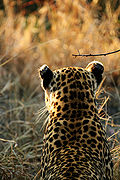 A female leopard with white markings on the backs of her ears
 -
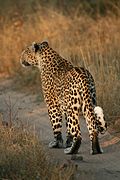 A female leopard showing white spots on the tail
 -
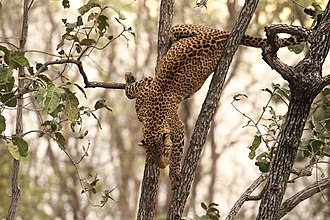 A leopard climbing down a tree
 -
 A leopard hunting a bushpig
 -
Video of a leopard in the wild


Social spacing
[edit]_male_marking_a_bush_with_urine_..._(53310719953).jpg)
In Kruger National Park, most leopards tend to keep 1 km (0.62 mi) apart.[112] Males occasionally interact with their partners and cubs, and exceptionally this can extend beyond to two generations.[75][113] Aggressive encounters are rare, typically limited to defending territories from intruders.[67] In a South African reserve, a male was wounded in a male–male territorial battle over a carcass.[107]
Males occupy home ranges that often overlap with a few smaller female home ranges, probably as a strategy to enhance access to females. In the Ivory Coast, the home range of a female was completely enclosed within a male's.[114] Females live with their cubs in home ranges that overlap extensively, probably due to the association between mothers and their offspring. There may be a few other fluctuating home ranges belonging to young individuals. It is not clear if male home ranges overlap as much as those of females do. Individuals try to drive away intruders of the same sex.[66][76]
A study of leopards in the Namibian farmlands showed that the size of home ranges was not significantly affected by sex, rainfall patterns or season; the higher the prey availability in an area, the greater the leopard population density and the smaller the size of home ranges, but they tend to expand if there is human interference.[115] Sizes of home ranges vary geographically and depending on habitat and availability of prey. In the Serengeti, males have home ranges of 33–38 km2 (13–15 sq mi) and females of 14–16 km2 (5.4–6.2 sq mi);[116][117] but males in northeastern Namibia of 451 km2 (174 sq mi) and females of 188 km2 (73 sq mi).[118] They are even larger in arid and montane areas.[67] In Nepal's Bardia National Park, male home ranges of 48 km2 (19 sq mi) and female ones of 5–7 km2 (1.9–2.7 sq mi) are smaller than those generally observed in Africa.[119]
Hunting and diet
[edit]_stalking.jpg)

_devorando_un_ant%C3%ADlope,_parque_nacional_Kruger,_Sud%C3%A1frica,_2018-07-26,_DD_06.jpg)
The leopard is a carnivore that prefers medium-sized prey with a body mass ranging from 10–40 kg (22–88 lb). Prey species in this weight range tend to occur in dense habitat and to form small herds. Species that prefer open areas and have well-developed anti-predator strategies are less preferred. More than 100 prey species have been recorded. The most preferred species are ungulates, such as impala, bushbuck, common duiker and chital. Primates preyed upon include white-eyelid mangabeys, guenons and gray langurs. Leopards also kill smaller carnivores like black-backed jackal, bat-eared fox, genet and cheetah.[120] In urban environments, domestic dogs provide an important food source.[80] The largest prey killed by a leopard was reportedly a male eland weighing 900 kg (2,000 lb).[110] A study in Wolong National Nature Reserve in southern China demonstrated variation in the leopard's diet over time; over the course of seven years, the vegetative cover receded, and leopards opportunistically shifted from primarily consuming tufted deer to pursuing bamboo rats and other smaller prey.[121]
The leopard depends mainly on its acute senses of hearing and vision for hunting.[122] It primarily hunts at night in most areas.[66] In western African forests and Tsavo National Park, they have also been observed hunting by day.[123] They usually hunt on the ground. In the Serengeti, they have been seen to ambush prey by descending on it from trees.[124] It stalks its prey and tries to approach as closely as possible, typically within 5 m (16 ft) of the target, and, finally, pounces on it and kills it by suffocation. It kills small prey with a bite to the back of the neck, but holds larger animals by the throat and strangles them.[66] It caches kills up to 2 km (1.2 mi) apart.[75] It is able to take large prey due to its powerful jaw muscles, and is therefore strong enough to drag carcasses heavier than itself up into trees; an individual was seen to haul a young giraffe weighing nearly 125 kg (276 lb) up 5.7 m (18 ft 8 in) into a tree.[123] It eats small prey immediately, but drags larger carcasses over several hundred metres and caches it safely in trees, bushes or even caves; this behaviour allows the leopard to store its prey away from rivals, and offers it an advantage over them. The way it stores the kill depends on local topography and individual preferences, varying from trees in Kruger National Park to bushes in the plain terrain of the Kalahari.[67][125] Before their extirpation from Europe, leopards there cached their meat in caves, as evidenced by fossilised bone accumulations in caves such as Los Rincones in the Province of Zaragoza, Spain.[126]
Average daily consumption rates of 3.5 kg (7 lb 11 oz) were estimated for males and of 2.8 kg (6 lb 3 oz) for females.[112] In the southern Kalahari Desert, leopards meet their water requirements by the bodily fluids of prey and succulent plants; they drink water every two to three days and feed infrequently on moisture-rich plants such as gemsbok cucumbers, watermelon and Kalahari sour grass.[127]
Enemies and competitors
[edit]
Across its range, the leopard coexists with a number of other large predators. In Africa, it is part of a large predator guild with lions, cheetahs, spotted and brown hyenas, and African wild dogs.[128] The leopard is dominant only over the cheetah while the others have the advantage of size, pack numbers or both.[66] Lions pose a great mortal threat and can be responsible for 22% of leopard deaths in Sabi Sand Game Reserve. Spotted hyenas are less threatening but are more likely to steal kills, being the culprits of up to 50% of stolen leopard kills in the same area.[129][130] To counter this, leopards store their kills in the trees and out of reach.[130][131] Lions have a high success rate in fetching leopard kills from trees.[130] Leopards do not seem to actively avoid their competitors but rather difference in prey and habitat preferences appear to limit their spatial overlap.[128] In particular, leopards use heavy vegetation regardless of whether lions are present in an area and both cats are active at the same time of day.[132]
In Asia, the leopard's main competitors are tigers and dholes. Both the larger tiger and pack-living dhole dominate leopards during encounters. Interactions between the three predators involve chasing, stealing kills and direct killing.[133] Tigers appear to inhabit the deep parts of the forest while leopards and dholes are pushed closer to the fringes.[134] The three predators coexist by hunting different sized prey.[135] In Nagarhole National Park, the average size for a leopard kill was 37.6 kg (83 lb) compared to 91.5 kg (202 lb) for tigers and 43.4 kg (96 lb) for dholes.[136] At Kui Buri National Park, following a reduction in prey numbers, tigers continued to feed on favoured prey while leopards and dholes had to increase their consumption of small prey.[137] Leopards can live successfully in tiger habitat when there is abundant food and vegetation cover.[135][138] Otherwise, they appear to be less common where tigers are numerous. The recovery of the tiger population in Rajaji National Park during the 2000s led to a reduction in leopard population densities.[139]
Reproduction and life cycle
[edit]
.jpg)
In some areas, leopards mate all year round. In Manchuria and Siberia, they mate during January and February. On average, females begin to breed between the ages of 2½ and three, and males between the ages of two and three.[61] The female's estrous cycle lasts about 46 days, and she is usually in heat for 6–7 days.[140] Gestation lasts for 90 to 105 days.[141] Cubs are usually born in a litter of 2–4 cubs.[142] The mortality rate of cubs is estimated at 41–50% during the first year.[112] Predators are the biggest cause for leopard cub mortality during their first year. Male leopards are known to cause infanticide, in order to bring the female back into heat.[75] Intervals between births average 15 to 24 months, but can be shorter, depending on the survival of the cubs.[61]
Females give birth in a cave, crevice among boulders, hollow tree or thicket. Newborn cubs weigh 280–1,000 g (9.9–35.3 oz), and are born with closed eyes, which open four to nine days after birth.[110][67] The fur of the young tends to be longer and thicker than that of adults. Their pelage is also more gray in colour with less defined spots. They begin to eat meat at around nine weeks.[75] Around three months of age, the young begin to follow the mother on hunts. At one year of age, cubs can probably fend for themselves, but will remain with the mother for 18–24 months.[143] After separating from their mother, sibling cubs may travel together for months.[61] Both male and female leopards typically reach sexual maturity at 2–2⅓ years.[75]
The generation length of the leopard is 9.3 years.[144] The average life span of a leopard is 12–17 years.[110] The oldest leopard was a captive female that died at the age of 24 years, 2 months and 13 days.[145]
Conservation
[edit]The leopard is listed on CITES Appendix I, and hunting is banned in Botswana and Afghanistan; in 11 sub-Saharan countries, trade is restricted to skins and body parts of 2,560 individuals.[2] In 2007, a leopard reintroduction programme was initiated in the Russian Caucasus, where captive bred individuals are reared and trained in 0.5–0.9 ha (1.2–2.2 acres) large enclosures in Sochi National Park; six individuals released into Caucasus Nature Reserve and Alaniya National Park in 2018 survived as of February 2022.[146]
Threats
[edit]The leopard is primarily threatened by habitat fragmentation and conversion of forest to agriculturally used land, which lead to a declining natural prey base, human–wildlife conflict with livestock herders and high leopard mortality rates. It is also threatened by trophy hunting and poaching.[2] Contemporary records suggest that the leopard occurs in only 25% of its historical range.[81][147]
Between 2002 and 2012, at least four leopards were estimated to have been poached per week in India for the illegal wildlife trade of its skins and bones.[148] In spring 2013, 37 leopard skins were found during a 7-week long market survey in major Moroccan cities.[149] In 2014, 43 leopard skins were detected during two surveys in Morocco. Vendors admitted to have imported skins from sub-Saharan Africa.[150]
Surveys in the Central African Republic's Chinko area revealed that the leopard population decreased from 97 individuals in 2012 to 50 individuals in 2017. In this period, transhumant pastoralists from the border area with Sudan moved in the area with their livestock. Rangers confiscated large amounts of poison in the camps of livestock herders who were accompanied by armed merchants. They engaged in poaching large herbivores, sale of bushmeat and trading leopard skins in Am Dafok.[151]
In Java, the leopard is threatened by illegal hunting and trade. Between 2011 and 2019, body parts of 51 Javan leopards were seized including six live individuals, 12 skins, 13 skulls, 20 canines and 22 claws.[152]
Human relations
[edit]Cultural significance
[edit]

Leopards have been featured in art, mythology and folklore of many countries. In Greek mythology, it was a symbol of the god Dionysus, who was depicted wearing leopard skin and using leopards as means of transportation. In one myth, the god was captured by pirates but two leopards rescued him.[153] Numerous Roman mosaics from North African sites depict fauna now found only in tropical Africa.[154] During the Benin Empire, the leopard was commonly represented on engravings and sculptures and was used to symbolise the power of the king or oba, since the leopard was considered the king of the forest.[155] The Ashanti people also used the leopard as a symbol of leadership, and only the king was permitted to have a ceremonial leopard stool. Some African cultures considered the leopard to be a smarter, better hunter than the lion and harder to kill.[153]
In Rudyard Kipling's "How the Leopard Got His Spots", one of his Just So Stories, a leopard with no spots in the Highveld lives with his hunting partner, the Ethiopian. When they set off to the forest, the Ethiopian changed his brown skin, and the leopard painted spots on his skin.[156] A leopard played an important role in the 1938 Hollywood film Bringing Up Baby. African chiefs, European queens, Hollywood actors and burlesque dancers wore coats made of leopard skins.[153]
The leopard is a frequently used motif in heraldry, most commonly as passant.[157] The heraldic leopard lacks spots and sports a mane, making it visually almost identical to the heraldic lion, and the two are often used interchangeably. Naturalistic leopard-like depictions appear on the coat of arms of Benin, Malawi, Somalia, the Democratic Republic of the Congo and Gabon, the last of which uses a black panther.[158]
Attacks on people
[edit]The Leopard of Rudraprayag killed more than 125 people; the Panar Leopard was thought to have killed over 400 people. Both were shot by British hunter Jim Corbett.[159] The spotted devil of Gummalapur killed about 42 people in Karnataka, India.[160]
In captivity
[edit]
The ancient Romans kept leopards in captivity to be slaughtered in hunts as well as execute criminals.[153] In Benin, leopards were kept and paraded as mascots, totems and sacrifices to deities.[155] Several leopards were kept in a menagerie originally established by King John of England at the Tower of London in the 13th century; around 1235, three of these animals were given to Henry III by Holy Roman Emperor Frederick II.[161] In modern times, leopards have been trained and tamed in circuses.[153]
See also
[edit]References
[edit]- ^ a b Wozencraft, W. C. (2005). "Species Panthera pardus". In Wilson, D. E.; Reeder, D. M. (eds.). Mammal Species of the World: A Taxonomic and Geographic Reference (3rd ed.). Johns Hopkins University Press. p. 547. ISBN 978-0-8018-8221-0. OCLC 62265494.
- ^ a b c d e f g h i j k l Stein, A.B.; Gerngross, P.; Al Hikmani, H.; Balme, G.; Bertola, L.; Drouilly, M.; Farhadinia, M.S.; Feng, L.; Ghoddousi, A.; Henschel, P.; Jhala, Y.; Khorozyan, I.; Kittle, A.; Laguardia, A.; Luo, S.-J.; Mann, G.; Miquelle, D.; Moheb, Z.; Raza, H.; Rostro-García, S.; Shivakumar, S.; Song, D. & Wibisono, H. (2024). "Panthera pardus". IUCN Red List of Threatened Species. 2024 e.T15954A254576956. Retrieved 30 June 2024.
- ^ a b Lewis, C. T. & Short, C. (1879). "lěǒpardus". A Latin Dictionary. Oxford: Clarendon Press. p. 1069.
- ^ Liddell, H. G. & Scott, R. (1889). "λέο-πάρδος". A Greek–English Lexicon. Oxford: Clarendon Press. p. 884.
- ^ Partridge, E. (1983). Origins: A Short Etymological Dictionary of Modern English. New York: Greenwich House. p. 349. ISBN 978-0-517-41425-5.
- ^ Nicholas, N. (1999). "A conundrum of cats: pards and their relatives in Byzantium". Greek, Roman, and Byzantine Studies. 40: 253–298. S2CID 56160515.
- ^ Lewis, C. T. & Short, C. (1879). "panthera". A Latin Dictionary. Oxford: Clarendon Press. p. 1298.
- ^ Lewis, C. T. & Short, C. (1879). "pardus". A Latin Dictionary. Oxford: Clarendon Press. p. 1302.
- ^ Linnaeus, C. (1758). "Felis pardus". Caroli Linnæi Systema naturæ per regna tria naturæ, secundum classes, ordines, genera, species, cum characteribus, differentiis, synonymis, locis. Vol. Tomus I (decima, reformata ed.). Holmiae: Laurentius Salvius. pp. 41−42. (in Latin)
- ^ Oken, L. (1816). "1. Art, Panthera". Lehrbuch der Zoologie. 2. Abtheilung. Jena: August Schmid & Comp. p. 1052. Archived from the original on 2024-05-05. Retrieved 2019-04-06.
- ^ Ellerman, J. R.; Morrison-Scott, T. C. S. (1966). Checklist of Palaearctic and Indian mammals 1758 to 1946 (Second ed.). London: British Museum of Natural History. pp. 315–317.
- ^ Allen, J. A. (1902). "Mammal names proposed by Oken in his 'Lehrbuch der Zoologie'". Bulletin of the American Museum of Natural History. 16 (27): 373−379. Archived from the original on 2023-12-09. Retrieved 2024-03-14.
- ^ Pocock, R. I. (1917). "The Classification of existing Felidae". The Annals and Magazine of Natural History. Series 8. XX: 329–350. doi:10.1080/00222931709487018.
- ^ Pocock, R. I. (1939). "Panthera pardus". The Fauna of British India, including Ceylon and Burma. Mammalia: Volume 1. London: Taylor and Francis. pp. 222–239.
- ^ Miththapala, S.; Seidensticker, J. & O'Brien, S. J. (1996). "Phylogeographic subspecies recognition in leopards (Panthera pardus): molecular genetic variation" (PDF). Conservation Biology. 10 (4): 1115–1132. Bibcode:1996ConBi..10.1115M. doi:10.1046/j.1523-1739.1996.10041115.x. Archived (PDF) from the original on 2016-02-17. Retrieved 2017-03-09.
- ^ a b Uphyrkina, O.; Johnson, E. W.; Quigley, H.; Miquelle, D.; Marker, L.; Bush, M. & O'Brien, S. J. (2001). "Phylogenetics, genome diversity and origin of modern leopard, Panthera pardus" (PDF). Molecular Ecology. 10 (11): 2617–2633. Bibcode:2001MolEc..10.2617U. doi:10.1046/j.0962-1083.2001.01350.x. PMID 11883877. S2CID 304770. Archived (PDF) from the original on 2011-09-10.
- ^ a b Kitchener, A. C.; Breitenmoser-Würsten, C.; Eizirik, E.; Gentry, A.; Werdelin, L.; Wilting, A.; Yamaguchi, N.; Abramov, A. V.; Christiansen, P.; Driscoll, C.; Duckworth, J. W.; Johnson, W.; Luo, S.-J.; Meijaard, E.; O'Donoghue, P.; Sanderson, J.; Seymour, K.; Bruford, M.; Groves, C.; Hoffmann, M.; Nowell, K.; Timmons, Z. & Tobe, S. (2017). "A revised taxonomy of the Felidae: The final report of the Cat Classification Task Force of the IUCN Cat Specialist Group" (PDF). Cat News (Special Issue 11): 73–75. Archived (PDF) from the original on 2020-01-17. Retrieved 2019-07-25.
- ^ Meyer, F. A. A. (1794). "Über de la Metheries schwarzen Panther". Zoologische Annalen. Erster Band. Weimar: Im Verlage des Industrie-Comptoirs. pp. 394–396. Archived from the original on 2024-05-05. Retrieved 2019-04-05.
- ^ Laguardia, A.; Kamler, J. F.; Li, S.; Zhang, C.; Zhou, Z. & Shi, K. (2017). "The current distribution and status of leopards Panthera pardus in China". Oryx. 51 (1): 153−159. doi:10.1017/S0030605315000988.
- ^ Shivakumar, S.; Khettry, A.; Surve, N.; Rahman, H.; Ghimirey, Y.; Tharchen, L.; Zaw, T.; Waseem, M. & Jhala, Y. (2023). "Panthera pardus ssp. fusca". IUCN Red List of Threatened Species. 2023 e.T215195524A215195533. Retrieved 17 March 2024.
- ^ Cuvier, G. (1809). "Recherches sur les espėces vivantes de grands chats, pour servir de preuves et d'éclaircissement au chapitre sur les carnassiers fossils". Annales du Muséum National d'Histoire Naturelle. Tome XIV: 136–164.
- ^ Wibisono, H.; Wilianto, E.; Pinondang, I.; Rahman, D.A. & Chandradewi, D. (2021). "Panthera pardus ssp. melas". IUCN Red List of Threatened Species. 2021 e.T15962A50660931. doi:10.2305/IUCN.UK.2021-2.RLTS.T15962A50660931.en. Retrieved 11 November 2023.
- ^ Hemprich, W.; Ehrenberg, C. G. (1830). "Felis, pardus?, nimr". In Dr. C. G. Ehrenberg (ed.). Symbolae Physicae, seu Icones et Descriptiones Mammalium quae ex Itinere per Africam Borealem et Asiam Occidentalem Friderici Guilelmi Hemprich et Christiani Godofredi Ehrenberg. Decas Secunda. Zoologica I. Mammalia II. Berolini: Officina Academica. pp. Plate 17.
- ^ Spalton, J. A. & Al Hikmani, H. M. (2006). "The Leopard in the Arabian Peninsula – Distribution and subspecies status" (PDF). Cat News (Special Issue 1): 4–8. Archived (PDF) from the original on 2015-06-19.
- ^ Al Hikmani, H.; Spalton, A.; Zafar-ul Islam, M.; al-Johany, A.; Sulayem, M.; Al-Duais, M. & Almalki, A. (2023). "Panthera pardus ssp. nimr". IUCN Red List of Threatened Species. 2023 e.T15958A46767457. Retrieved 17 March 2024.
- ^ Valenciennes, A. (1856). "Sur une nouvelles espèce de Panthère tué par M. Tchihatcheff à Ninfi, village situé à huit lieues est de Smyrne". Comptes Rendus Hebdomadaires des Séances de l'Académie des Sciences. 42: 1035–1039.
- ^ Ghoddousi, A. & Khorozyan, I. (2023). "Panthera pardus ssp. tulliana". IUCN Red List of Threatened Species. 2023 e.T15961A50660903. doi:10.2305/IUCN.UK.2023-1.RLTS.T15961A50660903.en. Retrieved 17 March 2024.
- ^ Khorozyan, I. G.; Gennady, F.; Baryshnikov, G. F. & Abramov, A. V. (2006). "Taxonomic status of the leopard, Panthera pardus (Carnivora, Felidae) in the Caucasus and adjacent areas". Russian Journal of Theriology. 5 (1): 41–52. doi:10.15298/rusjtheriol.05.1.06.
- ^ Schlegel, H. (1857). "Felis orientalis". Handleiding Tot de Beoefening der Dierkunde, Ie Deel. Breda: Boekdrukkerij van Nys. p. 23.
- ^ Gray, J. E. (1862). "Description of some new species of Mammalia". Proceedings of the Royal Zoological Society of London. 30: 261−263, plate XXXIII. doi:10.1111/j.1469-7998.1862.tb06524.x.
- ^ Pocock, R. I. (1930). "The Panthers and Ounces of Asia". Journal of the Bombay Natural History Society. 34 (2): 307–336.
- ^ Rostro-García, S.; Kamler, J.F.; Clements, G.R.; Lynam, A.J. & Naing, H. (2019). "Panthera pardus ssp. delacouri". IUCN Red List of Threatened Species. 2019 e.T124159083A163986056. Retrieved 17 March 2024.
- ^ Deraniyagala, P. E. P. (1956). "The Ceylon leopard, a distinct subspecies". Spolia Zeylanica. 28: 115–116.
- ^ Kittle, A.M. & Watson, A. (2020). "Panthera pardus ssp.kotiya". IUCN Red List of Threatened Species. 2020 e.T15959A50660847. Retrieved 17 March 2024.
- ^ Anco, C.; Kolokotronis, S. O.; Henschel, P.; Cunningham, S. W.; Amato, G. & Hekkala, E. (2017). "Historical mitochondrial diversity in African leopards (Panthera pardus) revealed by archival museum specimens". Mitochondrial DNA Part A. 29 (3): 455–473. doi:10.1080/24701394.2017.1307973. PMID 28423965. S2CID 4348541.
- ^ a b Johnson, W. E.; Eizirik, E.; Pecon-Slattery, J.; Murphy, W. J.; Antunes, A.; Teeling, E. & O'Brien, S. J. (2006). "The late Miocene radiation of modern Felidae: a genetic assessment". Science. 311 (5757): 73–77. Bibcode:2006Sci...311...73J. doi:10.1126/science.1122277. PMID 16400146. S2CID 41672825. Archived from the original on 2020-10-04. Retrieved 2019-07-05.
- ^ a b Werdelin, L.; Yamaguchi, N.; Johnson, W. E. & O'Brien, S. J. (2010). "Phylogeny and evolution of cats (Felidae)". In Macdonald, D. W. & Loveridge, A. J. (eds.). Biology and Conservation of Wild Felids. Oxford, UK: Oxford University Press. pp. 59–82. ISBN 978-0-19-923445-5. Archived from the original on 2018-09-25. Retrieved 2018-09-25.
- ^ a b Davis, B. W.; Li, G. & Murphy, W. J. (2010). "Supermatrix and species tree methods resolve phylogenetic relationships within the big cats, Panthera (Carnivora: Felidae)" (PDF). Molecular Phylogenetics and Evolution. 56 (1): 64–76. Bibcode:2010MolPE..56...64D. doi:10.1016/j.ympev.2010.01.036. PMID 20138224. Archived from the original (PDF) on 2016-03-05.
- ^ a b Mazák, J. H.; Christiansen, P.; Kitchener, A. C. & Goswami, A. (2011). "Oldest known pantherine skull and evolution of the tiger". PLOS ONE. 6 (10) e25483. Bibcode:2011PLoSO...625483M. doi:10.1371/journal.pone.0025483. PMC 3189913. PMID 22016768.
- ^ Bininda-Emonds, O. R. P.; Decker-Flum, D. M. & Gittleman, J. L. (2001). "The utility of chemical signals as phylogenetic characters: an example from the Felidae". Biological Journal of the Linnean Society. 72 (1): 1–15. doi:10.1111/j.1095-8312.2001.tb01297.x.
- ^ Tseng, Z. J.; Wang, X.; Slater, G. J.; Takeuchi, G. T.; Li, Q.; Liu, J. & Xie, G. (2014). "Himalayan fossils of the oldest known pantherine establish ancient origin of big cats". Proceedings of the Royal Society B: Biological Sciences. 281 (1774) 20132686. doi:10.1098/rspb.2013.2686. PMC 3843846. PMID 24225466.
- ^ Li, G.; Davis, B. W.; Eizirik, E. & Murphy, W. J. (2016). "Phylogenomic evidence for ancient hybridization in the genomes of living cats (Felidae)". Genome Research. 26 (1): 1–11. doi:10.1101/gr.186668.114. PMC 4691742. PMID 26518481.
- ^ a b Paijmans, J. L. A.; Barlow, A.; Förster, D. W.; Henneberger, K.; Meyer, M.; Nickel, B.; Nagel, D.; Havmøller, R. W.; Baryshnikov, G. F.; Joger, U.; Rosendahl, W. & Hofreiter, M. (2018). "Historical biogeography of the leopard (Panthera pardus) and its extinct Eurasian populations". BMC Evolutionary Biology. 18 (1): 156. Bibcode:2018BMCEE..18..156P. doi:10.1186/s12862-018-1268-0. PMC 6198532. PMID 30348080.
- ^ Schmid, E. (1940). "Variationstatistische Untersuchungen am Gebiss pleistozäner und rezenter Leoparden und anderer Feliden". Zeitschrift für Säugetierkunde. 15: 1–179.
- ^ a b Marciszak, A.; Lipecki, G.; Gornig, W.; Matyaszczyk, L.; Oszczepalińska, O.; Nowakowski, D.; Talamo, S. (2022). "The first radiocarbon-dated remains of the Leopard Panthera pardus (Linnaeus, 1758) from the Pleistocene of Poland". Radiocarbon. 64 (6): 1359–1372. Bibcode:2022Radcb..64.1359M. doi:10.1017/RDC.2022.33. hdl:11585/887180. S2CID 255850069. Archived from the original on 2024-05-05. Retrieved 2023-07-18.
- ^ a b c Diedrich, C. G. (2013). "Late Pleistocene leopards across Europe – northernmost European German population, highest elevated records in the Swiss Alps, complete skeletons in the Bosnia Herzegowina Dinarids and comparison to the Ice Age cave art". Quaternary Science Reviews. 76: 167–193. Bibcode:2013QSRv...76..167D. doi:10.1016/j.quascirev.2013.05.009.
- ^ Sauqué, V. & Cuenca‑Bescós, G. (2013). "The Iberian Peninsula, the last European refugium of Panthera pardus Linnaeus 1758 during the Upper Pleistocene". Quaternaire. 24 (1): 13–24. doi:10.4000/quaternaire.6468. Archived from the original on 2023-07-18. Retrieved 2023-07-18.
- ^ Marciszak, A. & Stefaniak, K. (2010). "Two forms of cave lion: Middle Pleistocene Panthera spelaea fossilis Reichenau, 1906 and Upper Pleistocene Panthera spelaea spelaea Goldfuss, 1810 from the Bísnik Cave, Poland". Neues Jahrbuch für Geologie und Paläontologie - Abhandlungen. 258 (3): 339–351. Bibcode:2010NJGPA.258..339M. doi:10.1127/0077-7749/2010/0117. Archived from the original on 2018-09-25. Retrieved 2017-08-24.
- ^ Sauqué, V.; Rabal-Garcés, R. & Cuenca-Bescós, G. (2016). "Carnivores from Los Rincones, a leopard den in the highest mountain of the Iberian range (Moncayo, Zaragoza, Spain)". Historical Biology. 28 (4): 479–506. Bibcode:2016HBio...28..479S. doi:10.1080/08912963.2014.977882.
- ^ Sanchis, A.; Real, C.; Sauqué, V.; Núñez-Lahuerta, C.; Égüez, N.; Tormo, C.; Ripoll, M. P.; Carrión, Y. M.; Duarte, E. & de la Rasilla, M. (2019). "Neanderthal and carnivore activities at Llonin Cave, Asturias, northern Iberian Peninsula: Faunal study of Mousterian levels (MIS 3)". Comptes Rendus Palevol. 18 (1): 113–141. Bibcode:2019CRPal..18..113S. doi:10.1016/j.crpv.2018.06.001. hdl:10651/49880. S2CID 134157124.
- ^ Ghezzo, E. & Rook, L. (2015). "The remarkable Panthera pardus (Felidae, Mammalia) record from Equi (Massa, Italy): taphonomy, morphology, and paleoecology". Quaternary Science Reviews. 110: 131–151. doi:10.1016/j.quascirev.2014.12.020.
- ^ Mecozzi, Beniamino; Sardella, Raffaele; Boscaini, Alberto; Cherin, Marco; Costeur, Loïc; Madurell-Malapeira, Joan; Pavia, Marco; Profico, Antonio; Iurino, Dawid A. (15 June 2021). "The tale of a short-tailed cat: New outstanding Late Pleistocene fossils of Lynx pardinus from southern Italy". Quaternary Science Reviews. 262 106840. Bibcode:2021QSRv..26206840M. doi:10.1016/j.quascirev.2021.106840. hdl:2434/959858. Retrieved 7 November 2024 – via Elsevier Science Direct.
- ^ Sommer, R. S. & Benecke, N. (2006). "Late Pleistocene and Holocene development of the felid fauna (Felidae) of Europe: a review". Journal of Zoology. 269 (1): 7–19. doi:10.1111/j.1469-7998.2005.00040.x.
- ^ Miracle, P. T.; Lenardić, J. M.; Brajković, D. (2010). "Last glacial climates, "Refugia", and faunal change in Southeastern Europe: Mammalian assemblages from Veternica, Velika pećina, and Vindija caves (Croatia)". Quaternary International. 212 (2): 137–148. Bibcode:2010QuInt.212..137M. doi:10.1016/j.quaint.2009.06.003.
- ^ Izawa, M. & Nakanishi, N. (2015). "Felidae". In Ohdachi, S. D.; Ishibashi, Y.; Iwasa, M. A. & Saitoh, T. (eds.). The Wild Mammals of Japan (Second ed.). Kyoto: Shoukadoh Book Sellers and the Mammalogical Society of Japan. pp. 226−231. ISBN 978-4-87974-691-7.
- ^ Chi T.-C.; Gan Y.; Yang T.-R. & Chang, C.-H. (2021). "First report of leopard fossils from a limestone cave in Kenting area, southern Taiwan". PeerJ. 9 e12020. doi:10.7717/peerj.12020. PMC 8388558. PMID 34513335.
- ^ Kawata, K. (2001). "Zoological gardens of Japan". In Kisling, V.N. (ed.). Zoo and Aquarium History: Ancient Animal Collections to Zoological Gardens. Boca Raton, Florida: CRC Press. pp. 295–329. ISBN 978-0-8493-2100-9. Archived from the original on 2024-05-05. Retrieved 2021-09-07.
- ^ Mills, M. G. L. (2005). "Subfamily Pantherinae". In Skinner, J. D.; Chimimba, C. T. (eds.). The mammals of the southern African sub region (Third ed.). Cambridge: Cambridge University Press. pp. 385–396. ISBN 978-0-521-84418-5. Archived from the original on 2024-05-05. Retrieved 2021-05-19.
- ^ a b Mivart, St. G. J. (1900). "Different kind of Cats". The Cat: An Introduction to the Study of Backboned Animals, Especially Mammals. London: John Murray. pp. 391–439.
- ^ Pocook, R. I. (1932). "The Leopards of Africa". Proceedings of the Zoological Society of London. 102 (2): 543–591. doi:10.1111/j.1096-3642.1932.tb01085.x.
- ^ a b c d e f Nowell, K. & Jackson, P. (1996). "Leopard Panthera pardus (Linnaeus, 1758)". Wild Cats: status survey and conservation action plan. Gland, Switzerland: IUCN/SSC Cat Specialist Group. Archived from the original on 2014-02-22.
- ^ a b Schütze, H. (2002). Field Guide to the Mammals of the Kruger National Park. Cape Town, South Africa: Struik Publishers. pp. 92–93. ISBN 978-1-86872-594-6.
- ^ Menon, V. (2014). Indian Mammals: A Field Guide. Gurgaon, India: Hachette. ISBN 978-93-5009-761-8.
- ^ Allen, W. L.; Cuthill, I. C.; Scott-Samuel, N. E. & Baddeley, R. (2010). "Why the leopard got its spots: relating pattern development to ecology in felids". Proceedings of the Royal Society B. 278 (1710): 1373–1380. doi:10.1098/rspb.2010.1734. PMC 3061134. PMID 20961899.
- ^ a b Hoath, R. (2009). "Leopard Panthera pardus (Linnaeus, 1758)". Field Guide to the Mammals of Egypt. Cairo, Egypt: American University in Cairo Press. pp. 106–107. ISBN 978-977-416-254-1. Archived from the original on 2024-05-05. Retrieved 2021-05-19.
- ^ a b c d e f g h Estes, R. (1991). "Leopard Panthera pardus". The Behavior Guide to African Mammals, Including Hoofed Mammals, Carnivores, Primates. Los Angeles: The University of California Press. pp. 366–369. ISBN 978-0-520-08085-0. Archived from the original on 2024-05-05. Retrieved 2021-05-19.
- ^ a b c d e f Stein, A. B. & Hayssen, V. (2010). "Panthera pardus (Carnivora: Felidae)". Mammalian Species. 45 (900): 30–48. doi:10.1644/900.1. PMC 7149468. S2CID 44839740.
- ^ Heptner, V. G. & Sludskii, A. A. (1992) [1972]. "Bars (leopard)". Mlekopitajuščie Sovetskogo Soiuza. Moskva: Vysšaia Škola [Mammals of the Soviet Union, Volume II, Part 2]. Washington DC: Smithsonian Institution and the National Science Foundation. pp. 203–273. ISBN 978-90-04-08876-4.
- ^ Robinson, R. (1970). "Inheritance of the black form of the leopard Panthera pardus". Genetica. 41 (1): 190–197. doi:10.1007/BF00958904. PMID 5480762. S2CID 5446868.
- ^ Eizirik, E.; Yuhki, N.; Johnson, W. E.; Menotti-Raymond, M.; Hannah, S. S.; O'Brien, S. J. (2003). "Molecular genetics and evolution of melanism in the cat family". Current Biology. 13 (5): 448–453. Bibcode:2003CBio...13..448E. doi:10.1016/S0960-9822(03)00128-3. PMID 12620197. S2CID 19021807.
- ^ Kawanishi, K.; Sunquist, M. E.; Eizirik, E.; Lynam, A. J.; Ngoprasert, D.; Wan Shahruddin, W. N.; Rayan, D. M.; Sharma, D. S. K. & Steinmetz, R. (2010). "Near fixation of melanism in leopards of the Malay Peninsula". Journal of Zoology. 282 (3): 201–206. doi:10.1111/j.1469-7998.2010.00731.x.
- ^ Da Silva L. G., K.; Kawanishi, K.; Henschel P.; Kittle, A.; Sanei, A.; Reebin, A.; Miquelle, D.; Stein, A. B.; Watson, A.; Kekule, L. B.; Machado, R. B. & Eizirik, E. (2017). "Mapping black panthers: Macroecological modeling of melanism in leopards (Panthera pardus)". PLOS ONE. 12 (4) e0170378. Bibcode:2017PLoSO..1270378D. doi:10.1371/journal.pone.0170378. PMC 5381760. PMID 28379961.
- ^ Divyabhanusinh (1993). "On mutant leopards Panthera pardus from India". Journal of the Bombay Natural History Society. 90 (1): 88−89.
- ^ Pirie, T. J.; Thomas, R. L. & Fellowes, M. D. E. (2016). "Erythristic leopards Panthera pardus in South Africa". Bothalia. 46 (1): 1–5. doi:10.4102/abc.v46i1.2034.
- ^ a b c d e f Hunter, L.; Henschel, P. & Ray, J. C. (2013). "Panthera pardus Leopard". In Kingdon, J.; Happold, D.; Butynski, T.; Hoffmann, M.; Happold, M. & Kalina, J. (eds.). Mammals of Africa. London: Bloomsbury Publishing. pp. 159–168. ISBN 978-1-4081-8996-2. Archived from the original on 2024-05-05. Retrieved 2021-05-19.
- ^ a b c Nowak, R. M. (1999). "Panthera pardus (Leopard)". Walker's Mammals of the World (Sixth ed.). Baltimore, US: Johns Hopkins University Press. pp. 828–831. ISBN 978-0-8018-5789-8. Archived from the original on 2024-05-05. Retrieved 2021-05-19.
- ^ Burnie, D. & Wilson, D. E., eds. (2001). Animal: The Definitive Visual Guide to the World's Wildlife. DK Adult. ISBN 978-0-7894-7764-4.
- ^ "Is this the longest leopard in India?". The Times of India. 2016. Archived from the original on 2019-04-06. Retrieved 2018-03-14.
- ^ Prater, S. H. (1921). "Record panther skull (P. p. pardus)". The Journal of the Bombay Natural History Society. XXVII (Part IV): 933–935. Archived from the original on 2019-05-02. Retrieved 2019-08-24.
- ^ a b Powell, J.; Axmacher, J. C.; Linnell, J. D.C. & Durant, S. M. (2021). "Diverse locations and a long history: Historical context for urban Leopards (Panthera pardus) in the early anthropocene From Seoul, Korea". Frontiers in Conservation Science. 2 765911. Bibcode:2021FrCS....2.5911P. doi:10.3389/fcosc.2021.765911. hdl:11250/2999764.
- ^ a b Jacobson, A. P.; Gerngross, P.; Lemeris, J. R. Jr.; Schoonover, R. F.; Anco, C.; Breitenmoser-Würsten, C.; Durant, S. M.; Farhadinia, M. S.; Henschel, P.; Kamler, J. F.; Laguardia, A.; Rostro-García, S.; Stein, A. B. & Dollar, L. (2016). "Leopard (Panthera pardus) status, distribution, and the research efforts across its range". PeerJ. 4 e1974. doi:10.7717/peerj.1974. PMC 4861552. PMID 27168983.
- ^ Pirie, T. J.; Thomas, R. L. & Fellowes, M. D. E. (2017). "Increasing game prices may alter farmers' behaviours towards leopards (Panthera pardus) and other carnivores in South Africa". PeerJ. 5 e3369. doi:10.7717/peerj.3369. PMC 5452990. PMID 28584709.
- ^ Soultan, A.; Attum, O.; Hamada, A.; Hatab, E. B.; Ahmed, S. E.; Eisa, A.; Al Sharif, I.; Nagy, A. & Shohdi, W. (2017). "Recent observation for leopard Panthera pardus in Egypt". Mammalia. 81 (1): 115–117. doi:10.1515/mammalia-2015-0089. S2CID 90676105.
- ^ Toyran, K. (2018). "Noteworthy record of Panthera pardus in Turkey (Carnivora: Felidae)". Fresenius Environmental Bulletin. 27 (11): 7348–7353.
- ^ Karataş, A.; Bulut, Ş. & Akbaba, B. (2021). "Camera trap records confirm the survival of the Leopard (Panthera pardus L., 1758) in eastern Turkey (Mammalia: Felidae)". Zoology in the Middle East. 67 (3): 198–205. doi:10.1080/09397140.2021.1924419. S2CID 235564429.
- ^ Ünal, Y.; Uysal, H.; Koca, A. & Zenbilci, M. (2023). "New records of the living Anatolian Leopard (Panthera pardus tulliana L., 1758) in the Mediterranean region of Turkey". Applied Ecology and Environmental Research. 21 (2): 1043–1059. Bibcode:2023ApEER..21.1043U. doi:10.15666/aeer/2102_10431059.
- ^ Spalton, J. A. & Al Hikmani, H. M. (2006). "The Leopard in the Arabian Peninsula – Distribution and subspecies status" (PDF). Cat News (Special Issue 1): 4–8.
- ^ Judas, J.; Paillat, P.; Khoja, A. & Boug, A. (2006). "Status of the Arabian leopard in Saudi Arabia" (PDF). Cat News (Special Issue 1): 11–19. Archived from the original (PDF) on 2015-09-19. Retrieved 2019-03-17.
- ^ Al Jumaily, M.; Mallon, D. P.; Nasher, A. K. & Thowabeh, N. (2006). "Status Report on Arabian Leopard in Yemen" (PDF). Cat News (Special Issue 1): 20–25.
- ^ Arthreya, V. (2012). "Living with Leopards Outside Protected Areas in India". Conservation India. Archived from the original on 2012-12-21. Retrieved 2012-12-10.
- ^ Jhala, Y.V.; Qureshi, Q. & Yadav, S.P. (2020). Status of leopards in India, 2018. Technical Report TR/2020/16 (Report). New Delhi and Dehradun: National Tiger Conservation Authority, Government of India and Wildlife Institute of India.
- ^ Thapa, K.; Pradhan, N. M. B.; Berker, J.; Dhakal, M.; Bhandari, A. R.; Gurung, G. S.; Rai, D. P.; Thapa, G. J.; Shrestha, S. & Singh, G. R. (2013). "High elevation record of a leopard cat in the Kangchenjunga Conservation Area, Nepal". Cat News (58): 26–27.
- ^ Kittle, A. M.; Watson, A. C.; Chanaka Kumara, P. H. & Nimalka Sanjeewani, H. K. (2014). "Status and distribution of the leopard in the central hills of Sri Lanka". Cat News (56): 28−31.
- ^ Kittle, A. M.; Watson, A. C.; Kumara, P. H. S. C.; Sandanayake, S. D. K. C.; Sanjeewani, H. K. N. & Fernando, T. S. P. (2014). "Notes on the diet and habitat selection of the Sri Lankan Leopard Panthera pardus kotiya (Mammalia: Felidae) in the central highlands of Sri Lanka". Journal of Threatened Taxa. 6 (9): 6214–6221. doi:10.11609/JoTT.o3731.6214-21.
- ^ Saw Sha Bwe Moo; Froese, G.Z.L. & Gray, T.N.E. (2017). "First structured camera-trap surveys in Karen State, Myanmar, reveal high diversity of globally threatened mammals". Oryx. 52 (3): 537−543. doi:10.1017/S0030605316001113.
- ^ Rostro-García, S.; Kamler, J. F.; Ash, E.; Clements, G. R.; Gibson, L.; Lynam, A. J.; McEwin, R.; Naing, H. & Paglia, S. (2016). "Endangered leopards: Range collapse of the Indochinese leopard (Panthera pardus delacouri) in Southeast Asia". Biological Conservation. 201: 293–300. Bibcode:2016BCons.201..293R. doi:10.1016/j.biocon.2016.07.001. hdl:10722/232870.
- ^ Johnson, A.; Vongkhamheng, C.; Hedemark, M. & Saithongdam, T. (2006). "Effects of human–carnivore conflict on tiger (Panthera tigris) and prey populations in Lao PDR" (PDF). Animal Conservation. 9 (4): 421–430. Bibcode:2006AnCon...9..421J. doi:10.1111/j.1469-1795.2006.00049.x. S2CID 73637721. Archived (PDF) from the original on 2017-08-10.
- ^ Robichaud, W.; Insua-Cao; Sisomphane, P. C. & Chounnavanh, S. (2010). "Appendix 4". A scoping mission to Nam Kan National Protected Area, Lao PDR. Fauna & Flora International. pp. 33−42. Archived from the original on 2019-04-07. Retrieved 2019-04-07.
- ^ Gray, T. N. & Phan, C. (2011). "Habitat preferences and activity patterns of the larger mammal community in Phnom Prich Wildlife Sanctuary, Cambodia". The Raffles Bulletin of Zoology. 59 (2): 311−318. Archived from the original on 2024-05-05. Retrieved 2019-04-16.
- ^ Gray, T. N. E. (2013). "Activity patterns and home ranges of Indochinese leopard Panthera pardus delacouri in the Eastern Plains Landscape, Cambodia" (PDF). Natural History Bulletin of the Siam Society. 59: 39−47. Archived (PDF) from the original on 2016-02-22.
- ^ Li, S.; Wang, D.; Lu, Z. & Mc Shea, W. J. (2010). "Cats living with pandas: The status of wild felids within giant panda range, China". Cat News. 52: 20–23.
- ^ Wibisono, H. T.; Wahyudi, H. A.; Wilianto, E.; Pinondang, I. M. R.; Primajati, M.; Liswanto, D. & Linkie, M. (2018). "Identifying priority conservation landscapes and actions for the Critically Endangered Javan leopard in Indonesia: Conserving the last large carnivore in Java Island". PLOS ONE. 13 (6) e0198369. Bibcode:2018PLoSO..1398369W. doi:10.1371/journal.pone.0198369. PMC 6021038. PMID 29949588.
- ^ Growcott, J; Lobora, A; Markham, A; Searle, C. E.; Wahlström, J; Wijers, M; Simmons, B. I. (2024). "The secret acoustic world of leopards: A paired camera trap and bioacoustics survey facilitates the individual identification of leopards via their roars". Remote Sensing in Ecology and Conservation. 11 (4): 361–374. doi:10.1002/rse2.429.
- ^ Leyhausen, P. (1979). Cat behavior: the predatory and social behavior of domestic and wild cats. Berlin: Garland Publishing, Incorporated. p. 281. ISBN 978-0-8240-7017-5.
- ^ Ortolani, A. (1999). "Spots, stripes, tail tips and dark eyes: predicting the function of carnivore colour patterns using the comparative method". Biological Journal of the Linnean Society. 67 (4): 433–476. doi:10.1111/j.1095-8312.1999.tb01942.x.
- ^ Caro, T. (2005). "The adaptive significance of coloration in mammals". BioScience. 55 (2): 125–136. doi:10.1641/0006-3568(2005)055[0125:TASOCI]2.0.CO;2.
- ^ a b Hunter, L.; Balme, G.; Walker, C.; Pretorius, K. & Rosenberg, K. (2003). "The landscape ecology of leopards (Panthera pardus) in northern KwaZulu-Natal, South Africa: a preliminary project report" (PDF). Ecological Journal. 5: 24–30. Archived from the original (PDF) on March 4, 2009.

- ^ Spalton, J.A.; Al Hikmani, H. M.; Willis, D. & Said, A. S. B. (2006). "Critically endangered Arabian leopards Panthera pardus nimr persist in the Jabal Samhan Nature Reserve, Oman". Oryx. 40 (3): 287–294. doi:10.1017/S0030605306000743.
- ^ Jenny, D. & Zuberbuhler, K. (2005). "Hunting behaviour in west African forest leopards". African Journal of Ecology. 43 (3): 197–200. Bibcode:2005AfJEc..43..197J. doi:10.1111/j.1365-2028.2005.00565.x. Archived from the original on 2018-09-25. Retrieved 2018-09-25.
- ^ a b c d Sunquist, M. E. & Sunquist, F. (2002). "Leopard Panthera pardus". Wild Cats of the World. Chicago: University of Chicago Press. pp. 318–342. ISBN 978-0-226-77999-7. Archived from the original on 2024-04-30. Retrieved 2021-05-19.
- ^ Bothma, Jacobus du P.; Walker, Clive (2013-11-11). Larger Carnivores of the African Savannas. Springer Science & Business Media. ISBN 978-3-662-03766-9. Archived from the original on 2024-01-06. Retrieved 2024-01-06.
- ^ a b c Bailey, T. N. (1993). The African leopard: a study of the ecology and behaviour of a solitary felid. New York: Columbia University Press. ISBN 978-1-932846-11-9.
- ^ Pirie, T. J.; Thomas, R. L.; Reilly, B. K. & Fellowes, M. D. E. (2014). "Social interactions between a male leopard (Panthera pardus) and two generations of his offspring". African Journal of Ecology. 52 (4): 574–576. Bibcode:2014AfJEc..52..574P. doi:10.1111/aje.12154.
- ^ Jenny, D. (1996). "Spatial organization of leopards Panthera pardus in Tai National Park, Ivory Coast: Is rainforest habitat a "tropical haven"?". Journal of Zoology. 240 (3): 427–440. doi:10.1111/j.1469-7998.1996.tb05296.x. Archived from the original on 2024-05-05. Retrieved 2021-09-06.
- ^ Marker, L. L. & Dickman, A. J. (2005). "Factors affecting leopard (Panthera pardus) spatial ecology, with particular reference to Namibian farmlands" (PDF). South African Journal of Wildlife Research. 35 (2): 105–115.
- ^ Bertram, B. C. R. (1982). "Leopard ecology as studied by radio tracking". Symposia of the Zoological Society of London. 49: 341–352.
- ^ Mizutani, F. & Jewell, P. A. (1998). "Home-range and movements of leopards (Panthera pardus) on a livestock ranch in Kenya". Journal of Zoology. 244 (2): 269–286. doi:10.1017/S0952836998002118.
- ^ Stander, P. E.; Haden, P. J.; Kaqece, II. & Ghau, II. (1997). "The ecology of asociality in Namibian leopards". Journal of Zoology. 242 (2): 343–364. doi:10.1111/j.1469-7998.1997.tb05806.x.
- ^ Odden, M. & Wegge, P. (2005). "Spacing and activity patterns of leopards Panthera pardus in the Royal Bardia National Park, Nepal". Wildlife Biology. 11 (2): 145–152. doi:10.2981/0909-6396(2005)11[145:SAAPOL]2.0.CO;2. S2CID 86140708.
- ^ Hayward, M.W.; Henschel, P.; O'Brien, J.; Hofmeyr, M.; Balme, G. & Kerley, G. I. H. (2006). "Prey preferences of the leopard (Panthera pardus)" (PDF). Journal of Zoology. 270 (4): 298–313. doi:10.1111/j.1469-7998.2006.00139.x. Archived (PDF) from the original on 2012-11-05.
- ^ Johnson, K. G.; Wei, W.; Reid, D. G.; Jinchu, H. (1993). "Food habits of Asiatic leopards (Panthera pardus fusca) in Wolong Reserve, Sichuan, China". Journal of Mammalogy. 74 (3): 646–650. doi:10.2307/1382285. JSTOR 1382285.
- ^ Mills, M. G. L. & Hes, L. (1997). The Complete Book of Southern African Mammals. Cape Town, South Africa: Struik Publishers. pp. 178–180. ISBN 978-0-947430-55-9.
- ^ a b Hamilton, P. H. (1976). The movements of leopards in Tsavo National Park, Kenya, as determined by radio-tracking (M.Sc. thesis). Nairobi: University of Nairobi.
- ^ Kruuk, H. & Turner, M. (1967). "Comparative notes on predation by lion, leopard, cheetah and wild dog in the Serengeti area, East Africa". Mammalia. 31 (1): 1–27. doi:10.1515/mamm.1967.31.1.1. S2CID 84619500.
- ^ Schaller, G. (1972). Serengeti: a kingdom of predators. New York: Knopf. ISBN 978-0-394-47242-3. Archived from the original on 2024-05-05. Retrieved 2020-09-18.
- ^ Sauqué, Víctor; Rabal-Garcés, Raquel; Sola-Almagro, Cristina; Cuenca-Bescós, Gloria (18 March 2014). Rook, Lorenzo (ed.). "Bone Accumulation by Leopards in the Late Pleistocene in the Moncayo Massif (Zaragoza, NE Spain)". PLoS ONE. 9 (3) e92144. Bibcode:2014PLoSO...992144S. doi:10.1371/journal.pone.0092144. ISSN 1932-6203. PMC 3958443. PMID 24642667.
- ^ Bothma, J. du P. (2005). "Water-use by southern Kalahari leopards" (PDF). South African Journal of Wildlife Research. 35: 131–137.
- ^ a b Rafiq, K.; Wayward, M. W.; Wilson, A. M.; Meloro, C.; Jordan, N. R.; Wich, S. A.; McNutt, J. W.; Golabek, K. A. (2020). "Spatial and temporal overlaps between leopards (Panthera pardus) and their competitors in the African large predator guild". Journal of Zoology. 311 (4): 246–259. doi:10.1111/jzo.12781.
- ^ Balme, G. A.; Pitman, R. T.; Robinson, H. S.; Miller, J. R. B.; Funston, P. J.; Hunter, L. T. B. (2017). "Leopard distribution and abundance is unaffected by interference competition with lions". Behavioral Ecology. 28 (5): 1348–1358. doi:10.1093/beheco/arx098.
- ^ a b c Balme, G. A.; Miller, J. R. B.; Pitman, R. T.; Hunter, L. T. B. (2017). "Caching reduces kleptoparasitism in a solitary, large felid". Journal of Animal Ecology. 86 (3): 634–644. Bibcode:2017JAnEc..86..634B. doi:10.1111/1365-2656.12654. PMID 28217865.
- ^ Vissia, S.; Fattebert, J.; van Langevelde, F. (2022). "Leopard density and interspecific spatiotemporal interactions in a hyena-dominated landscape". Ecology and Evolution. 12 (10) e9365. Bibcode:2022EcoEv..12E9365V. doi:10.1002/ece3.9365. PMC 9534747. PMID 36225822.
- ^ Miller, J. R. B.; Pitman, R. T.; Mann, G. K. H.; Fuller, A. K.; Balme, G. A. (2018). "Lions and leopards coexist without spatial, temporal or demographic effects of interspecific competition". Journal of Animal Ecology. 87 (6): 1709–1726. Bibcode:2018JAnEc..87.1709M. doi:10.1111/1365-2656.12883. PMID 30010193.
- ^ Srivathsa, A.; Ramachandran, V.; Saravanan, P.; Sureshbabu, A.; Ganguly, D. & Ramakrishnan, U. (2023). "Topcats and underdogs: intraguild interactions among three apex carnivores across Asia's forestscapes". Biological Reviews. 98 (6): 2114–2135. doi:10.1111/brv.12998. PMID 37449566. S2CID 259903849.
- ^ Thinley, P.; Rajaratnam, R.; Lassoie, J. P.; Morreale, S. J.; Curtis, P. D.; Vernes, K.; Leki Leki; Phuntsho, S.; Dorji, T. & Dorji, P. (2018). "The ecological benefit of tigers (Panthera tigris) to farmers in reducing crop and livestock losses in the eastern Himalayas: Implications for conservation of large apex predators". Biological Conservation. 219: 119–125. doi:10.1016/j.biocon.2018.08.007.
- ^ a b Karanth, K. U. & Sunquist, M. E. (2000). "Behavioural correlates of predation by tiger (Panthera tigris), leopard (Panthera pardus) and dhole (Cuon alpinus) in Nagarahole, India". Journal of Zoology. 250 (2): 255–265. doi:10.1111/j.1469-7998.2000.tb01076.x.
- ^ Karanth, K. U. & Sunquist, M. E. (1995). "Prey selection by tiger, leopard and dhole in tropical forests". Journal of Animal Ecology. 64 (4): 439–450. Bibcode:1995JAnEc..64..439K. doi:10.2307/5647. JSTOR 5647.
- ^ Steinmetz, R.; Seuaturien, N.; Intanajitjuy, P.; Inrueang, P. & Prempree, K. (2021). "The effects of prey depletion on dietary niches of sympatric apex predators in Southeast Asia". Integrative Zoology. 16 (1): 19–32. doi:10.1111/1749-4877.12461. PMID 32627329.
- ^ Odden, M.; Wegge, P. & Fredriksen, T. (2010). "Do tigers displace leopards? If so, why?". Ecological Research. 25 (4): 875–881. Bibcode:2010EcoR...25..875O. doi:10.1007/s11284-010-0723-1.
- ^ Harihar, A.; Pandav, B. & Goyal, S. P. (2011). "Responses of leopard Panthera pardus to the recovery of a tiger Panthera tigris population". Journal of Applied Ecology. 48 (3): 806–814. Bibcode:2011JApEc..48..806H. doi:10.1111/j.1365-2664.2011.01981.x.
- ^ Sadleir, R. (1966). "Notes on the Reproduction of the larger Felidae". International Zoo Yearbook. 6: 184–187. doi:10.1111/j.1748-1090.1966.tb01746.x.
- ^ Hemmer, H. (1976). "Gestation period and postnatal development in felids". In Eaton, R.L. (ed.). The World's Cats. Vol. 3. Carnivore Research Institute, Univ. Washington, Seattle. pp. 143–165.
- ^ Eaton, R.L. (1977). "Reproductive biology of the leopard". Zoologischer Garten. 47 (5): 329–351.
- ^ "Leopard (Panthera pardus); Physical characteristics and distribution". Comparative Mammalian Brain Collections. Archived from the original on 2011-01-03. Retrieved 2008-06-07.
- ^ Pacifici, M.; Santini, L.; Di Marco, M.; Baisero, D.; Francucci, L.; Grottolo Marasini, G.; Visconti, P. & Rondinini, C. (2013). "Generation length for mammals". Nature Conservation (5): 87–94.
- ^ Salisbury, S. (2014). "Roxanne, oldest spotted leopard in captivity, dies at Acreage preserve". The Palm Beach Post. Archived from the original on 2014-08-11.
- ^ Rozhnov, V.V.; Yachmennikova, A.A.; Dronova, N.A.; Naidenko, S.V.; Hernandez-Blanco, J.A.; Chistopolova, M.D.; Pkhitikov, A.B.; Tembotova, F.A.; Trepet, S.A. & Chestin, I.E. (2022). "Experience of the leopard re-covering through reintroduction in the Russian Caucasus" (PDF). Cat News (Special issue): 67–71. Archived (PDF) from the original on 2023-11-11. Retrieved 2023-11-11.
- ^ Williams, S. T.; Williams, K. S.; Lewis, B. P. & Hill, R. A. (2017). "Population dynamics and threats to an apex predator outside protected areas: implications for carnivore management". Royal Society Open Science. 4 (4) 161090. Bibcode:2017RSOS....461090W. doi:10.1098/rsos.161090. PMC 5414262. PMID 28484625.
- ^ Raza, R.H.; Chauhan, D.S.; Pasha, M.K.S. & Sinha, S. (2012). Illuminating the blind spot: A study on illegal trade in Leopard parts in India (2001–2010) (PDF) (Report). New Delhi: TRAFFIC India, WWF India. Archived (PDF) from the original on 2020-09-24.
- ^ Bergin, D. & Nijman, V. (2014). "Open, Unregulated Trade in Wildlife in Morocco's Markets". TRAFFIC Bulletin. 26 (1): 65–70. Archived from the original on 2018-10-31. Retrieved 2015-03-23.
- ^ Bergin, D. & Nijman, V. (2015). "Potential benefits of impending Moroccan wildlife trade laws, a case study in carnivore skins". Biodiversity and Conservation. 25 (1): 199–201. doi:10.1007/s10531-015-1042-1. S2CID 34533018. Archived from the original on 2020-01-07. Retrieved 2017-01-11.
- ^ Äbischer, T.; Ibrahim, T.; Hickisch, R.; Furrer, R. D.; Leuenberger, C. & Wegmann, D. (2020). "Apex predators decline after an influx of pastoralists in former Central African Republic hunting zones" (PDF). Biological Conservation. 241 108326. Bibcode:2020BCons.24108326A. doi:10.1016/j.biocon.2019.108326. S2CID 213766740. Archived (PDF) from the original on 2020-10-03.
- ^ Gomez, L. & Shepherd, C.R. (2021). "The illegal exploitation of the Javan Leopard (Panthera pardus melas) and Sunda Clouded Leopard (Neofelis diardi) in Indonesia". Nature Conservation. 43 (43): 25–39. doi:10.3897/natureconservation.43.59399. S2CID 233286106.
- ^ a b c d e Morris, D. (2014). Leopard. Reaktion Books. pp. 23–24, 31–33, 62, 99, 102, 111. ISBN 978-1-78023-318-5.
- ^ Murphey, R. (1951). "The Decline of North Africa Since the Roman Occupation: Climatic or Human?" (PDF). Annals of the Association of American Geographers. XLI (2): 116–132. doi:10.1080/00045605109352048. Archived (PDF) from the original on 2006-09-14.
- ^ a b "Benin: an African kingdom" (PDF). London: British Museum. Archived (PDF) from the original on 2008-08-05. Retrieved 2016-03-29.
- ^ Kipling, R. (1902). "How the Leopard Got His Spots" (PDF). Just So Stories. Macmillan. Archived (PDF) from the original on 2023-11-29. Retrieved 2023-05-14.
- ^ Haist, M. (1999). "The Lion, bloodline, and kingship". In Hassig, D. (ed.). The Mark of the Beast: The Medieval Bestiary in Art, Life, and Literature. London: Taylor & Francis. pp. 3–16. ISBN 978-0-8153-2952-7. Archived from the original on 2024-05-05. Retrieved 2021-09-07.
- ^ Pedersen, C. F. (1971). The International Flag Book in Color. Morrow.
- ^ Corbett, J. (1955). The Temple Tiger, and More Man-eaters of Kumaon. Oxford: Oxford University Press.
- ^ Anderson, K. (1954). "The Spotted Devil of Gummalapur". Nine Man-Eaters and one Rogue. London: George Allen & Unwin. pp. 36–51.
- ^ Owen, J. (2005). "Medieval Lion Skulls Reveal Secrets of Tower of London 'Zoo'". National Geographic Magazine. Archived from the original on November 5, 2005. Retrieved 2007-09-05.

Further reading
[edit]- Allsen, Thomas T. (2007). "Natural History and Cultural History: The Circulation of Hunting Leopards in Eurasia, Seventh-Seventeenth Centuries". In Mair, V. H. (ed.). Contact and Exchange in the Ancient World. Honolulu: University of Hawaiʻi Press. ISBN 978-0-8248-2884-4.
- DeRuiter, D. J.; Berger, L. R. (2000). "Leopards as taphonomic agents in dolomitic Caves – Implications for bone accumulations in the hominid-bearing deposits of South Africa". Journal of Archaeological Science. 27 (8): 665–684. Bibcode:2000JArSc..27..665D. doi:10.1006/jasc.1999.0470.
- Sanei, A. (2007). Analysis of leopard (Panthera pardus) status in Iran (in Persian). Tehran: Sepehr Publication Center. ISBN 978-964-6123-74-8.
- Sanei, A.; Zakaria, M.; Yusof, E.; Roslan, M. (2011). "Estimation of leopard population size in a secondary forest within Malaysia's capital agglomeration using unsupervised classification of pugmarks" (PDF). Tropical Ecology. 52 (1): 209–217. Archived from the original on 2011-10-02.
- Zakaria, M.; Sanei, A. (2011). "Conservation and management prospects of the Persian and Malayan leopards". Asia Life Sciences. Supplement 7: 1–5.
External links
[edit]
- IUCN/SSC Cat Specialist Group: Panthera pardus in Africa[permanent dead link] and Panthera pardus in Asia Archived 2018-06-23 at the Wayback Machine
- . Encyclopædia Britannica (11th ed.). 1911.
| Topics |  | |
|---|---|---|
| Types | ||
| International | |
|---|---|
| National | |
| Other | |

Leopard
View on GrokipediaEtymology and taxonomy
Etymology
The word "leopard" derives from the Late Latin leopardus, which in turn comes from the Ancient Greek leopardos (λεοπάρδος), a compound of leōn (λέων), meaning "lion," and pardos (πάρδος), referring to a "panther" or "male panther."[8][9] This etymology reflects the ancient belief, documented in classical texts such as Pliny the Elder's Natural History, that the leopard was a hybrid offspring of a lion and a panther, explaining its spotted coat as a blend of the parents' traits.[10][11] In English, the term entered the language in the Middle English period, with the earliest recorded use appearing before 1290, borrowed from Old French lebard or Anglo-French lepart.[12][9] Over time, the name has been applied specifically to the big cat Panthera pardus, distinguishing it from other spotted felids, though the original hybrid misconception persisted in European bestiaries and heraldry into the medieval era.[10]Taxonomy
The leopard (Panthera pardus) belongs to the family Felidae within the order Carnivora, classified under the subfamily Pantherinae alongside other big cats such as the lion (Panthera leo), tiger (Panthera tigris), jaguar (Panthera onca), and snow leopard (Panthera uncia). Its full taxonomic hierarchy is Kingdom: Animalia; Phylum: Chordata; Class: Mammalia; Order: Carnivora; Family: Felidae; Subfamily: Pantherinae; Genus: Panthera; Species: P. pardus. This placement reflects shared derived traits such as a specialized hyoid apparatus with ossified thyrohyal bones that enables roaring in most species (though the snow leopard has a modified structure and cannot roar effectively), distinguishing Pantherinae from the non-roaring Felinae subfamily.[13][14] The species was originally described by Carl Linnaeus in 1758 as Felis pardus in the tenth edition of Systema Naturae, based on specimens from Africa and Asia, with the specific epithet "pardus" derived from the Greek pardos for a spotted panther-like animal. Subsequent taxonomic revisions in the 19th and 20th centuries reclassified it into the genus Panthera Oken, 1816, following recognition of phylogenetic affinities through comparative anatomy, such as similar dental and cranial features. Genetic studies in the late 20th century, including mitochondrial DNA analyses, confirmed P. pardus as a distinct species within Panthera, diverging from its closest relative, the lion, approximately 2–3 million years ago during the Pliocene-Pleistocene transition.[15][11][16] Modern taxonomy emphasizes integrative approaches combining morphology, genetics, and ecology. Historically, over 27 subspecies were described based primarily on pelage variation and geographic isolation, but many were synonymized due to insufficient differentiation. In 2017, the IUCN/SSC Cat Specialist Group's Cat Classification Task Force revised the Felidae taxonomy, recognizing eight valid subspecies of P. pardus using criteria such as fixed morphological differences (e.g., rosette size and coat color), genetic divergence (e.g., >5% in cytochrome b sequences), and distinct evolutionary significant units across Africa and Eurasia. This framework prioritizes conservation relevance, treating subspecies as management units where genetic isolation supports it, though ongoing genomic studies continue to refine boundaries amid debates over hybridization in contact zones. This classification of eight subspecies remains current as of the 2024 IUCN assessments.[17][11][18][7]Subspecies
The leopard (Panthera pardus) is classified into eight subspecies, distinguished primarily by morphological traits such as coat color, rosette patterns, body size, and skull proportions, as well as genetic and ecological adaptations to their respective environments, including mergers such as former North China populations into P. p. orientalis and Sumatran into P. p. delacouri based on genetic evidence. These subspecies reflect the species' wide historical range across Africa and Eurasia, with variations often linked to habitat diversity from savannas to temperate forests. Recent taxonomic revisions, incorporating molecular data, have reduced the number from over 27 historically proposed forms to these eight, emphasizing diagnosable differences while noting the need for further genomic studies to refine boundaries.[17] The subspecies are as follows, with key distributions and characteristics:- African leopard (P. p. pardus): Native to sub-Saharan Africa, this nominate subspecies shows high variability in size (males up to 90 kg) and coat coloration, from pale in arid areas to darker in forests; two mitochondrial DNA clades occur sympatrically in southern Africa, but no further subdivision is recognized.[17]
- Persian leopard (P. p. tulliana): Found in Anatolia, the Caucasus, and extending to Iran, Afghanistan, Pakistan, Turkmenistan, Uzbekistan, Iraq, and Turkey; larger and more robust than average, with a paler coat suited to mountainous and semi-arid terrains; includes synonyms like saxicolor and ciscaucasica.[17]
- Amur leopard (P. p. orientalis): Inhabits the Russian Far East, northeast China, and the Korean Peninsula; features thick, pale fur and large paws for cold climates; critically endangered with fewer than 100 individuals, incorporating the synonym japonensis (historically reported but absent from Japan).[17]
- Indian leopard (P. p. fusca): Distributed across the Indian subcontinent, Burma, and parts of China; robust build with dense, dark rosettes; adaptable to diverse habitats from tropical forests to scrublands; includes the synonym millardi.[17]
- Indochinese leopard (P. p. delacouri): Occurs in mainland Southeast Asia, Indochina, the Malay Peninsula, and Sumatra, Indonesia; medium-sized with spotted coats adapted to forested environments; type locality in Vietnam; includes former P. p. sumatrae.[17]
- Sri Lankan leopard (P. p. kotiya): Endemic to Sri Lanka; smaller stature and darker coat for humid forest habitats; recognized for its isolation on the island.[17]
- Arabian leopard (P. p. nimr): Restricted to the Arabian Peninsula, particularly mountainous regions in Saudi Arabia, Yemen, Oman, and the UAE; smallest subspecies (males around 30 kg) with pale, sparse coat for desert adaptation; critically endangered, sometimes considered a conservation unit under pardus.[17]
- Javan leopard (P. p. melas): Confined to Java, Indonesia; nearly melanistic with very dark coats and reduced rosettes; ancient island form, highly threatened by habitat loss.[17]