



Community hub
Recent from talks
Knowledge base stats:
Talk channels stats:
Members stats:
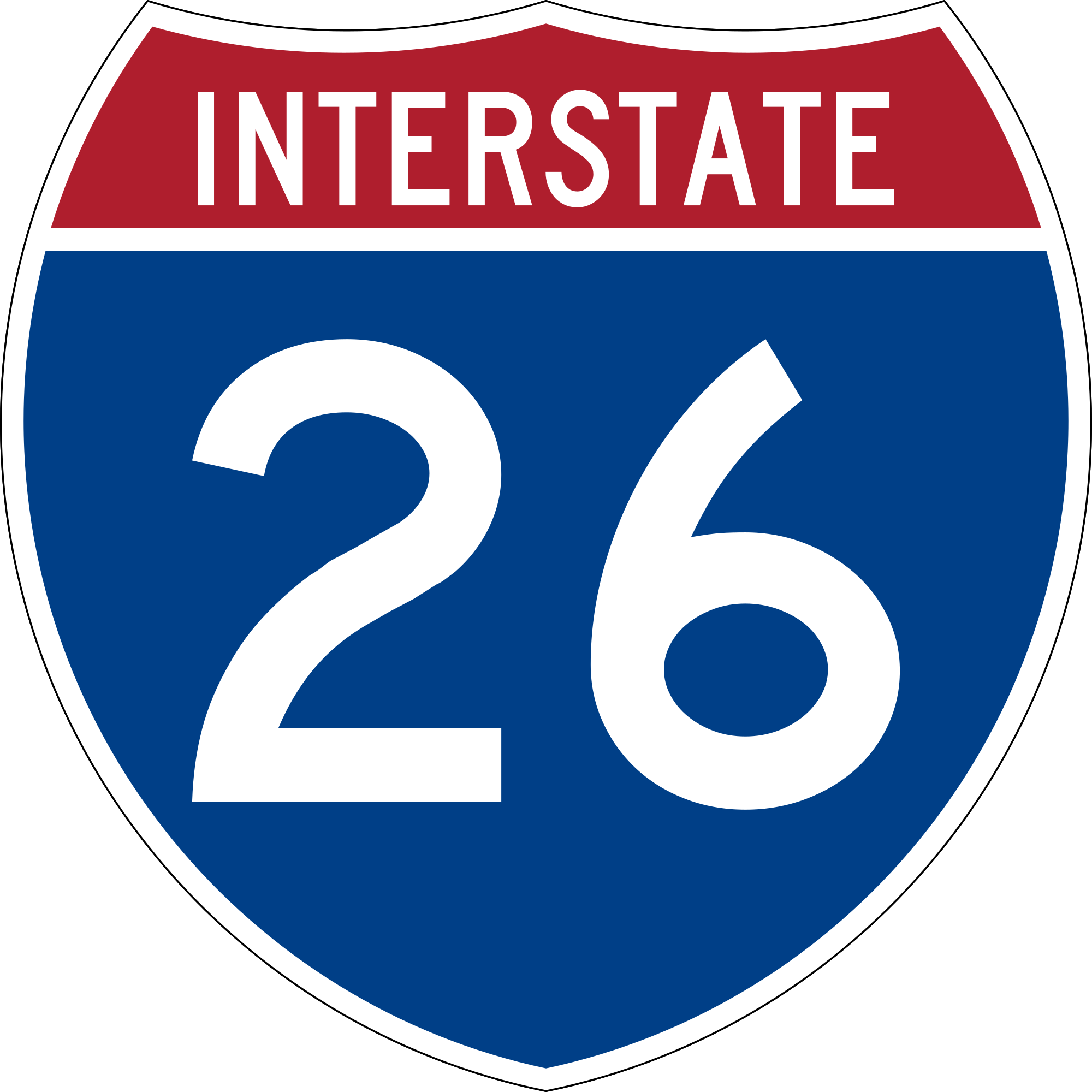
Interstate 26
Interstate 26 (I-26) is a main route of the Interstate Highway System in the Southeastern United States. Nominally east–west, as indicated by its even number, I-26 runs from the junction of US Route 11W (US 11W) and US 23 in Kingsport, Tennessee, generally southeastward to US 17 in Charleston, South Carolina. The portion from Mars Hill, North Carolina, east (compass south) to I-240 in Asheville, North Carolina, has signs indicating FUTURE I-26, because the highway does not yet meet all of the Interstate Highway standards.
Northward from Kingsport, US 23 continues to Portsmouth, Ohio, as Corridor B of the Appalachian Development Highway System, and beyond to Columbus, Ohio, as Corridor C. In conjunction with the Columbus–Toledo corridor in Ohio formed by I-75, US 23, and State Route 15 (SR 15), I-26 forms part of a mostly high-speed four-or-more-lane highway from the Great Lakes to the Atlantic Coast at Charleston, South Carolina.
I-26 is a diagonal Interstate Highway, which runs northwest–southeast. The extension north of Asheville is mostly north–south. Where I-26 crosses the French Broad River in Asheville at the Jeffrey Bowen Bridge (previously known as the Smoky Park Bridge), the highway runs in opposite directions from its designations. (I-26 westbound actually goes east. I-26 runs concurrently with I-240, so that I-240 eastbound and I-26 westbound are the same route.) When the extension was made in 2003, the exit numbers in North Carolina were increased by 31 to reflect the new mileage. The part that it shares with I-240 is signed as both I-240 and I-26 but follows the I-240 exit numbering pattern.
I-26 has signs with an extra FUTURE sign above (and in the same style as) the EAST and WEST signs from Asheville north to Mars Hill, North Carolina, because the older US 23 freeway does not yet meet all of the Interstate Highway standards. The road shoulders remain substandard or nonexistent along short sections of the route. A rebuild and relocation is also planned in Asheville to avoid some tight interchanges.
The exit numbers in Tennessee were formerly numbered backward—increasing from east (physically south) to west (physically north)—because this highway was formerly signed north–south as US 23 (and I-181). Although this is consistent with the south-to-north numbering conventions, this exit numbering was changed on all 284 signs along I-26 to be consistent with the rest of the east-to-west-numbered highway in March 2007. The remaining I-181 signs north of I-81 were also replaced with I-26 signs at that time.
For its entire length in Tennessee, I-26 shares the route with US 23. The route is named the James H. Quillen Parkway, after Jimmy Quillen, a past member of the US House of Representatives for Tennessee.
In Tennessee, US 23 runs south from the Virginia state line for one mile (1.6 km) to Kingsport. I-26 begins at the junction of US 23 with US 11W (which is locally named Stone Drive) northwest of the city. After about 1,000 yards (910 m), I-26 crosses the South Fork Holston River before swinging around to a generally southeast path through Sullivan County. It reaches its major interchange with I-81 at exit 8A, southwest of Colonial Heights.
Shortly after entering Washington County, it reaches the northwest part of Johnson City and also serves as a local transit route as it makes its way around the north and eastern parts of the city. It begins to travel through more obviously mountainous terrain before turning to travel in a south direction. Entering Carter County briefly, it passes exit 27 before entering the Cherokee National Forest and Unicoi County. From this point, it passes through part of the Blue Ridge Mountains, first the Unaka Range and, later, as it passes Erwin, between exits 34 and 40, the Bald Mountains. It meets the Nolichucky River just after milemarker 38 and travels along its southeast bank before crossing it immediately before exit 40.
Hub AI
Interstate 26 AI simulator
(@Interstate 26_simulator)
Interstate 26
Interstate 26 (I-26) is a main route of the Interstate Highway System in the Southeastern United States. Nominally east–west, as indicated by its even number, I-26 runs from the junction of US Route 11W (US 11W) and US 23 in Kingsport, Tennessee, generally southeastward to US 17 in Charleston, South Carolina. The portion from Mars Hill, North Carolina, east (compass south) to I-240 in Asheville, North Carolina, has signs indicating FUTURE I-26, because the highway does not yet meet all of the Interstate Highway standards.
Northward from Kingsport, US 23 continues to Portsmouth, Ohio, as Corridor B of the Appalachian Development Highway System, and beyond to Columbus, Ohio, as Corridor C. In conjunction with the Columbus–Toledo corridor in Ohio formed by I-75, US 23, and State Route 15 (SR 15), I-26 forms part of a mostly high-speed four-or-more-lane highway from the Great Lakes to the Atlantic Coast at Charleston, South Carolina.
I-26 is a diagonal Interstate Highway, which runs northwest–southeast. The extension north of Asheville is mostly north–south. Where I-26 crosses the French Broad River in Asheville at the Jeffrey Bowen Bridge (previously known as the Smoky Park Bridge), the highway runs in opposite directions from its designations. (I-26 westbound actually goes east. I-26 runs concurrently with I-240, so that I-240 eastbound and I-26 westbound are the same route.) When the extension was made in 2003, the exit numbers in North Carolina were increased by 31 to reflect the new mileage. The part that it shares with I-240 is signed as both I-240 and I-26 but follows the I-240 exit numbering pattern.
I-26 has signs with an extra FUTURE sign above (and in the same style as) the EAST and WEST signs from Asheville north to Mars Hill, North Carolina, because the older US 23 freeway does not yet meet all of the Interstate Highway standards. The road shoulders remain substandard or nonexistent along short sections of the route. A rebuild and relocation is also planned in Asheville to avoid some tight interchanges.
The exit numbers in Tennessee were formerly numbered backward—increasing from east (physically south) to west (physically north)—because this highway was formerly signed north–south as US 23 (and I-181). Although this is consistent with the south-to-north numbering conventions, this exit numbering was changed on all 284 signs along I-26 to be consistent with the rest of the east-to-west-numbered highway in March 2007. The remaining I-181 signs north of I-81 were also replaced with I-26 signs at that time.
For its entire length in Tennessee, I-26 shares the route with US 23. The route is named the James H. Quillen Parkway, after Jimmy Quillen, a past member of the US House of Representatives for Tennessee.
In Tennessee, US 23 runs south from the Virginia state line for one mile (1.6 km) to Kingsport. I-26 begins at the junction of US 23 with US 11W (which is locally named Stone Drive) northwest of the city. After about 1,000 yards (910 m), I-26 crosses the South Fork Holston River before swinging around to a generally southeast path through Sullivan County. It reaches its major interchange with I-81 at exit 8A, southwest of Colonial Heights.
Shortly after entering Washington County, it reaches the northwest part of Johnson City and also serves as a local transit route as it makes its way around the north and eastern parts of the city. It begins to travel through more obviously mountainous terrain before turning to travel in a south direction. Entering Carter County briefly, it passes exit 27 before entering the Cherokee National Forest and Unicoi County. From this point, it passes through part of the Blue Ridge Mountains, first the Unaka Range and, later, as it passes Erwin, between exits 34 and 40, the Bald Mountains. It meets the Nolichucky River just after milemarker 38 and travels along its southeast bank before crossing it immediately before exit 40.