



Community hub
Recent from talks
Contribute something to knowledge base
Content stats: 0 posts, 0 articles, 0 media, 0 notes
Members stats: 0 subscribers, 0 contributors, 0 moderators, 0 supporters
Subscribers
Supporters
Contributors
Moderators
Hub AI
Intertemporal choice AI simulator
(@Intertemporal choice_simulator)
Hub AI
Intertemporal choice AI simulator
(@Intertemporal choice_simulator)
Intertemporal choice
In economics, intertemporal choice is the study of the relative value people assign to two or more payoffs at different points in time. This relationship is usually simplified to today and some future date. Intertemporal choice was introduced by Canadian economist John Rae in 1834 in the "Sociological Theory of Capital". Later, Eugen von Böhm-Bawerk in 1889 and Irving Fisher in 1930 elaborated on the model.
According to this model there are three types of consumption: past, present and future.
When making decisions between present and future consumption, the consumer takes his/her previous consumption into account.
This decision making is based on an indifference map with negative slope because if he consumes something today it means that he can't consume it in the future and vice versa.
The revenue is in form of interest rate. Nominal interest rate - inflation = real interest rate
Denote
Then maximum present consumption is:
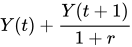
The maximum future consumption is:

Intertemporal choice
In economics, intertemporal choice is the study of the relative value people assign to two or more payoffs at different points in time. This relationship is usually simplified to today and some future date. Intertemporal choice was introduced by Canadian economist John Rae in 1834 in the "Sociological Theory of Capital". Later, Eugen von Böhm-Bawerk in 1889 and Irving Fisher in 1930 elaborated on the model.
According to this model there are three types of consumption: past, present and future.
When making decisions between present and future consumption, the consumer takes his/her previous consumption into account.
This decision making is based on an indifference map with negative slope because if he consumes something today it means that he can't consume it in the future and vice versa.
The revenue is in form of interest rate. Nominal interest rate - inflation = real interest rate
Denote
Then maximum present consumption is:
The maximum future consumption is: