
Recent from talks
Intestinal atresia
Knowledge base stats:
Talk channels stats:
Members stats:
Intestinal atresia
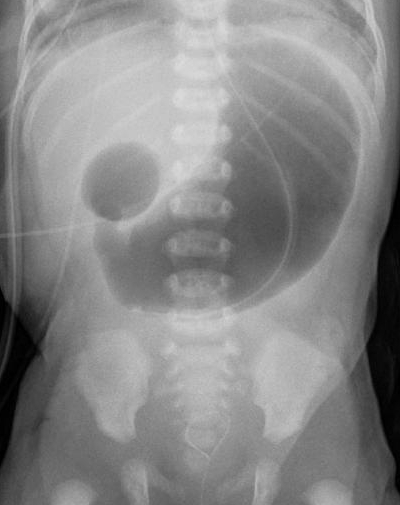
Intestinal atresia is any congenital malformation of the structure of the intestine that causes bowel obstruction. The malformation can be a narrowing (stenosis), absence or malrotation of a portion of the intestine. These defects can either occur in the small or large intestine.
The most prominent symptom of intestinal atresia is bilious vomiting soon after birth. This is most common in jejunal atresia. Other features include abdominal distension and failure to pass meconium. The distension is more generalised the further down the bowel the atresia is located and is thus most prominent with ileal atresia. Inability to pass stool is most common with duodenal or jejunal atresia; if stool is passed, it may be small, mucus-like and grey. Occasionally, there may be jaundice, which is most common in jejunal atresia. Abdominal tenderness or an abdominal mass are not generally seen as symptoms of intestinal atresia. Rather, abdominal tenderness is a symptom of the late complication meconium peritonitis.
Before birth, excess amniotic fluid (polyhydramnios) is a possible symptom. This is more common in duodenal and oesophageal atresia.
The most common cause of non-duodenal intestinal atresia is a vascular accident in utero that leads to decreased intestinal perfusion and ischemia of the respective segment of bowel. This leads to narrowing, or in the most severe cases, complete obliteration of the intestinal lumen.[citation needed]
In the case that the superior mesenteric artery, or another major intestinal artery, is occluded, large segments of bowel can be entirely underdeveloped (Type III). Classically, the affected area of bowel assumes a spiral configuration and is described to have an "apple peel" like appearance; this is accompanied by lack of a dorsal mesentery (Type IIIb). [citation needed]
An inherited form – familial multiple intestinal atresia – has also been described. This disorder was first reported in 1971. It is due to a mutation in the gene TTC7A on short arm of chromosome 2 (2p16). It is inherited as an autosomal recessive gene and is usually fatal in infancy. Ileal atresia can also result as a complication of meconium ileus.[citation needed]
A third of infants with intestinal atresia are born prematurely or with low birth weight.
Intestinal atresias are often discovered before birth; either during a routine sonogram which shows a dilated intestinal segment due to the blockage, or by the development of polyhydramnios (the buildup of too much amniotic fluid in the uterus). These abnormalities are indications that the fetus may have a bowel obstruction which a more detailed ultrasound study can confirm. Infants with stenosis instead of atresia are often not discovered until several days after birth.
Hub AI
Intestinal atresia AI simulator
(@Intestinal atresia_simulator)
Intestinal atresia
Intestinal atresia is any congenital malformation of the structure of the intestine that causes bowel obstruction. The malformation can be a narrowing (stenosis), absence or malrotation of a portion of the intestine. These defects can either occur in the small or large intestine.
The most prominent symptom of intestinal atresia is bilious vomiting soon after birth. This is most common in jejunal atresia. Other features include abdominal distension and failure to pass meconium. The distension is more generalised the further down the bowel the atresia is located and is thus most prominent with ileal atresia. Inability to pass stool is most common with duodenal or jejunal atresia; if stool is passed, it may be small, mucus-like and grey. Occasionally, there may be jaundice, which is most common in jejunal atresia. Abdominal tenderness or an abdominal mass are not generally seen as symptoms of intestinal atresia. Rather, abdominal tenderness is a symptom of the late complication meconium peritonitis.
Before birth, excess amniotic fluid (polyhydramnios) is a possible symptom. This is more common in duodenal and oesophageal atresia.
The most common cause of non-duodenal intestinal atresia is a vascular accident in utero that leads to decreased intestinal perfusion and ischemia of the respective segment of bowel. This leads to narrowing, or in the most severe cases, complete obliteration of the intestinal lumen.[citation needed]
In the case that the superior mesenteric artery, or another major intestinal artery, is occluded, large segments of bowel can be entirely underdeveloped (Type III). Classically, the affected area of bowel assumes a spiral configuration and is described to have an "apple peel" like appearance; this is accompanied by lack of a dorsal mesentery (Type IIIb). [citation needed]
An inherited form – familial multiple intestinal atresia – has also been described. This disorder was first reported in 1971. It is due to a mutation in the gene TTC7A on short arm of chromosome 2 (2p16). It is inherited as an autosomal recessive gene and is usually fatal in infancy. Ileal atresia can also result as a complication of meconium ileus.[citation needed]
A third of infants with intestinal atresia are born prematurely or with low birth weight.
Intestinal atresias are often discovered before birth; either during a routine sonogram which shows a dilated intestinal segment due to the blockage, or by the development of polyhydramnios (the buildup of too much amniotic fluid in the uterus). These abnormalities are indications that the fetus may have a bowel obstruction which a more detailed ultrasound study can confirm. Infants with stenosis instead of atresia are often not discovered until several days after birth.
Recent media