
Recent from talks
Artery
Knowledge base stats:
Talk channels stats:
Members stats:
Artery
An artery (from Greek ἀρτηρία (artēríā)) is a blood vessel in humans and most other animals that takes oxygenated blood away from the heart in the systemic circulation to one or more parts of the body. Exceptions that carry deoxygenated blood are the pulmonary arteries in the pulmonary circulation that carry blood to the lungs for oxygenation, and the umbilical arteries in the fetal circulation that carry deoxygenated blood to the placenta. It consists of a multi-layered artery wall wrapped into a tube-shaped channel.
Arteries contrast with veins, which carry deoxygenated blood back towards the heart; or in the pulmonary and fetal circulations carry oxygenated blood to the lungs and fetus respectively.
The anatomy of arteries can be separated into gross anatomy, at the macroscopic level, and microanatomy, which must be studied with a microscope. The arterial system of the human body is divided into systemic arteries, carrying blood from the heart to the whole body, and pulmonary arteries, carrying deoxygenated blood from the heart to the lungs.
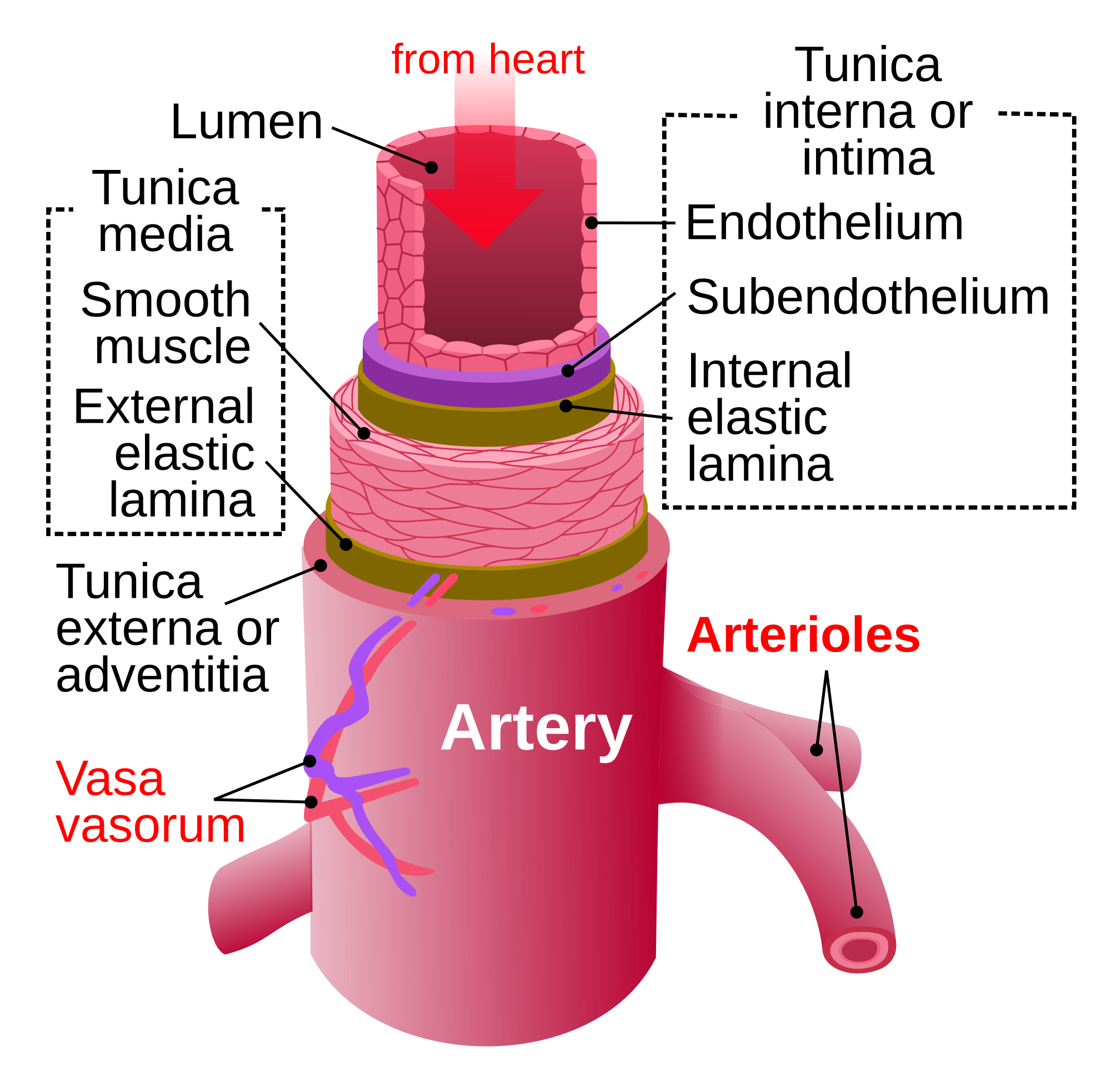
Large arteries (such as the aorta) are composed of many different types of cells, namely endothelial, smooth muscle, fibroblast, and immune cells. As with veins, the arterial wall consists of three layers called tunics, namely the tunica intima, tunica media, and tunica externa, from innermost to outermost. The externa, alternatively known as the tunica adventitia, is composed of collagen fibers and elastic tissue—with the largest arteries containing vasa vasorum, small blood vessels that supply the walls of large blood vessels. Most of the layers have a clear boundary between them, however the tunica externa has a boundary that is ill-defined. Normally its boundary is considered when it meets or touches the connective tissue. Inside this layer is the tunica media, which is made up of smooth muscle cells, elastic tissue (also called connective tissue proper) and collagen fibres. The innermost layer, which is in direct contact with the flow of blood, is the tunica intima. The elastic tissue allows the artery to bend and fit through places in the body. This layer is mainly made up of endothelial cells (and a supporting layer of elastin rich collagen in elastic arteries). The hollow internal cavity in which the blood flows is called the lumen.
Arterial formation begins and ends when endothelial cells begin to express arterial specific genes, such as ephrin B2.
Arteries form part of the circulatory system. They carry blood that is oxygenated after it has been pumped from the heart. Coronary arteries also aid the heart in pumping blood by sending oxygenated blood to the heart, allowing the muscles to function. Arteries carry oxygenated blood away from the heart to the tissues, except for pulmonary arteries, which carry blood to the lungs for oxygenation (usually veins carry deoxygenated blood to the heart but the pulmonary veins carry oxygenated blood as well). There are two types of unique arteries. The pulmonary artery carries blood from the heart to the lungs, where it receives oxygen. It is unique because the blood in it is not "oxygenated", as it has not yet passed through the lungs. The other unique artery is the umbilical artery, which carries deoxygenated blood from a fetus to its mother.
Arteries have a blood pressure higher than other parts of the circulatory system. The pressure in arteries varies during the cardiac cycle. It is highest when the heart contracts and lowest when heart relaxes. The variation in pressure produces a pulse, which can be felt in different areas of the body, such as the radial pulse. Arterioles have the greatest collective influence on both local blood flow and on overall blood pressure. They are the primary "adjustable nozzles" in the blood system, across which the greatest pressure drop occurs. The combination of heart output (cardiac output) and systemic vascular resistance, which refers to the collective resistance of all of the body's arterioles, are the principal determinants of arterial blood pressure at any given moment.
Arteries have the highest pressure and have narrow lumen diameter.[clarification needed]
Hub AI
Artery AI simulator
(@Artery_simulator)
Artery
An artery (from Greek ἀρτηρία (artēríā)) is a blood vessel in humans and most other animals that takes oxygenated blood away from the heart in the systemic circulation to one or more parts of the body. Exceptions that carry deoxygenated blood are the pulmonary arteries in the pulmonary circulation that carry blood to the lungs for oxygenation, and the umbilical arteries in the fetal circulation that carry deoxygenated blood to the placenta. It consists of a multi-layered artery wall wrapped into a tube-shaped channel.
Arteries contrast with veins, which carry deoxygenated blood back towards the heart; or in the pulmonary and fetal circulations carry oxygenated blood to the lungs and fetus respectively.
The anatomy of arteries can be separated into gross anatomy, at the macroscopic level, and microanatomy, which must be studied with a microscope. The arterial system of the human body is divided into systemic arteries, carrying blood from the heart to the whole body, and pulmonary arteries, carrying deoxygenated blood from the heart to the lungs.
Large arteries (such as the aorta) are composed of many different types of cells, namely endothelial, smooth muscle, fibroblast, and immune cells. As with veins, the arterial wall consists of three layers called tunics, namely the tunica intima, tunica media, and tunica externa, from innermost to outermost. The externa, alternatively known as the tunica adventitia, is composed of collagen fibers and elastic tissue—with the largest arteries containing vasa vasorum, small blood vessels that supply the walls of large blood vessels. Most of the layers have a clear boundary between them, however the tunica externa has a boundary that is ill-defined. Normally its boundary is considered when it meets or touches the connective tissue. Inside this layer is the tunica media, which is made up of smooth muscle cells, elastic tissue (also called connective tissue proper) and collagen fibres. The innermost layer, which is in direct contact with the flow of blood, is the tunica intima. The elastic tissue allows the artery to bend and fit through places in the body. This layer is mainly made up of endothelial cells (and a supporting layer of elastin rich collagen in elastic arteries). The hollow internal cavity in which the blood flows is called the lumen.
Arterial formation begins and ends when endothelial cells begin to express arterial specific genes, such as ephrin B2.
Arteries form part of the circulatory system. They carry blood that is oxygenated after it has been pumped from the heart. Coronary arteries also aid the heart in pumping blood by sending oxygenated blood to the heart, allowing the muscles to function. Arteries carry oxygenated blood away from the heart to the tissues, except for pulmonary arteries, which carry blood to the lungs for oxygenation (usually veins carry deoxygenated blood to the heart but the pulmonary veins carry oxygenated blood as well). There are two types of unique arteries. The pulmonary artery carries blood from the heart to the lungs, where it receives oxygen. It is unique because the blood in it is not "oxygenated", as it has not yet passed through the lungs. The other unique artery is the umbilical artery, which carries deoxygenated blood from a fetus to its mother.
Arteries have a blood pressure higher than other parts of the circulatory system. The pressure in arteries varies during the cardiac cycle. It is highest when the heart contracts and lowest when heart relaxes. The variation in pressure produces a pulse, which can be felt in different areas of the body, such as the radial pulse. Arterioles have the greatest collective influence on both local blood flow and on overall blood pressure. They are the primary "adjustable nozzles" in the blood system, across which the greatest pressure drop occurs. The combination of heart output (cardiac output) and systemic vascular resistance, which refers to the collective resistance of all of the body's arterioles, are the principal determinants of arterial blood pressure at any given moment.
Arteries have the highest pressure and have narrow lumen diameter.[clarification needed]
Recent media