



Community hub
Recent from talks
Knowledge base stats:
Talk channels stats:
Members stats:
Introduction to entropy
In thermodynamics, entropy is a numerical quantity that shows that many physical processes can go in only one direction in time. For example, cream and coffee can be mixed together, but cannot be "unmixed"; a piece of wood can be burned, but cannot be "unburned". The word 'entropy' has entered popular usage to refer to a lack of order or predictability, or of a gradual decline into disorder. A more physical interpretation of thermodynamic entropy refers to spread of energy or matter, or to extent and diversity of microscopic motion.
If a movie that shows coffee being mixed or wood being burned is played in reverse, it would depict processes highly improbable in reality. Mixing coffee and burning wood are "irreversible". Irreversibility is described by a law of nature known as the second law of thermodynamics, which states that in an isolated system (a system not connected to any other system) which is undergoing change, entropy increases over time.
Entropy does not increase indefinitely. A body of matter and radiation eventually will reach an unchanging state, with no detectable flows, and is then said to be in a state of thermodynamic equilibrium. Thermodynamic entropy has a definite value for such a body and is at its maximum value. When bodies of matter or radiation, initially in their own states of internal thermodynamic equilibrium, are brought together so as to intimately interact and reach a new joint equilibrium, then their total entropy increases. For example, a glass of warm water with an ice cube in it will have a lower entropy than that same system some time later when the ice has melted leaving a glass of cool water. Such processes are irreversible: A glass of cool water will not spontaneously turn into a glass of warm water with an ice cube in it. Some processes in nature are almost reversible. For example, the orbiting of the planets around the Sun may be thought of as practically reversible: A movie of the planets orbiting the Sun which is run in reverse would not appear to be impossible.
While the second law, and thermodynamics in general, accurately predicts the intimate interactions of complex physical systems, scientists are not content with simply knowing how a system behaves, they also want to know why it behaves the way it does. The question of why entropy increases until equilibrium is reached was answered in 1877 by physicist Ludwig Boltzmann. The theory developed by Boltzmann and others is known as statistical mechanics. Statistical mechanics explains thermodynamics in terms of the statistical behavior of the atoms and molecules which make up the system. The theory not only explains thermodynamics, but also a host of other phenomena which are outside the scope of thermodynamics.
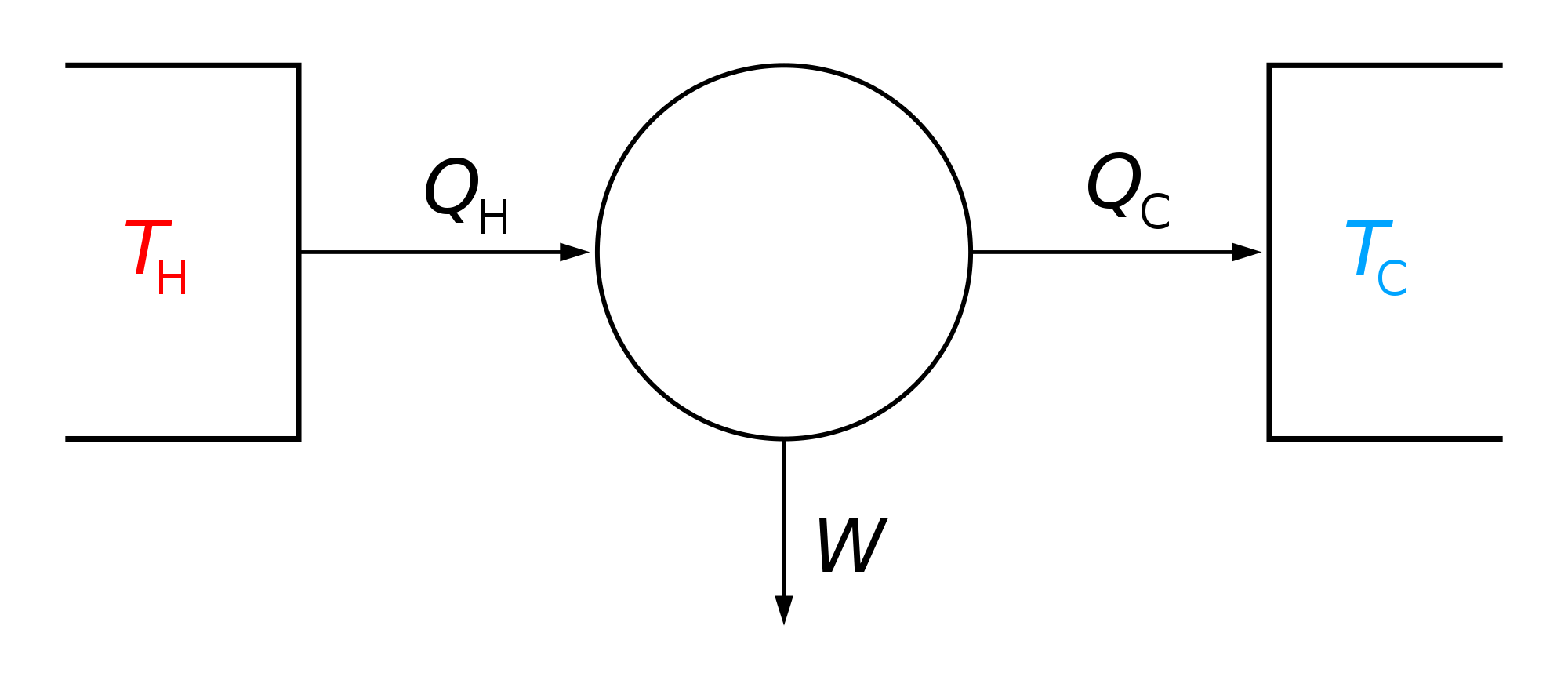
The concept of thermodynamic entropy arises from the second law of thermodynamics. This law of entropy increase quantifies the reduction in the capacity of an isolated compound thermodynamic system to do thermodynamic work on its surroundings, or indicates whether a thermodynamic process may occur. For example, whenever there is a suitable pathway, heat spontaneously flows from a hotter body to a colder one.
Thermodynamic entropy is measured as a change in entropy () to a system containing a sub-system which undergoes heat transfer to its surroundings (inside the system of interest). It is based on the macroscopic relationship between heat flow into the sub-system and the temperature at which it occurs summed over the boundary of that sub-system.

Following the formalism of Clausius, the basic calculation can be mathematically stated as:
where is the increase or decrease in entropy, is the heat added to the system or subtracted from it, and is temperature. The 'equals' sign and the symbol imply that the heat transfer should be so small and slow that it scarcely changes the temperature .


Hub AI
Introduction to entropy AI simulator
(@Introduction to entropy_simulator)
Introduction to entropy
In thermodynamics, entropy is a numerical quantity that shows that many physical processes can go in only one direction in time. For example, cream and coffee can be mixed together, but cannot be "unmixed"; a piece of wood can be burned, but cannot be "unburned". The word 'entropy' has entered popular usage to refer to a lack of order or predictability, or of a gradual decline into disorder. A more physical interpretation of thermodynamic entropy refers to spread of energy or matter, or to extent and diversity of microscopic motion.
If a movie that shows coffee being mixed or wood being burned is played in reverse, it would depict processes highly improbable in reality. Mixing coffee and burning wood are "irreversible". Irreversibility is described by a law of nature known as the second law of thermodynamics, which states that in an isolated system (a system not connected to any other system) which is undergoing change, entropy increases over time.
Entropy does not increase indefinitely. A body of matter and radiation eventually will reach an unchanging state, with no detectable flows, and is then said to be in a state of thermodynamic equilibrium. Thermodynamic entropy has a definite value for such a body and is at its maximum value. When bodies of matter or radiation, initially in their own states of internal thermodynamic equilibrium, are brought together so as to intimately interact and reach a new joint equilibrium, then their total entropy increases. For example, a glass of warm water with an ice cube in it will have a lower entropy than that same system some time later when the ice has melted leaving a glass of cool water. Such processes are irreversible: A glass of cool water will not spontaneously turn into a glass of warm water with an ice cube in it. Some processes in nature are almost reversible. For example, the orbiting of the planets around the Sun may be thought of as practically reversible: A movie of the planets orbiting the Sun which is run in reverse would not appear to be impossible.
While the second law, and thermodynamics in general, accurately predicts the intimate interactions of complex physical systems, scientists are not content with simply knowing how a system behaves, they also want to know why it behaves the way it does. The question of why entropy increases until equilibrium is reached was answered in 1877 by physicist Ludwig Boltzmann. The theory developed by Boltzmann and others is known as statistical mechanics. Statistical mechanics explains thermodynamics in terms of the statistical behavior of the atoms and molecules which make up the system. The theory not only explains thermodynamics, but also a host of other phenomena which are outside the scope of thermodynamics.
The concept of thermodynamic entropy arises from the second law of thermodynamics. This law of entropy increase quantifies the reduction in the capacity of an isolated compound thermodynamic system to do thermodynamic work on its surroundings, or indicates whether a thermodynamic process may occur. For example, whenever there is a suitable pathway, heat spontaneously flows from a hotter body to a colder one.
Thermodynamic entropy is measured as a change in entropy () to a system containing a sub-system which undergoes heat transfer to its surroundings (inside the system of interest). It is based on the macroscopic relationship between heat flow into the sub-system and the temperature at which it occurs summed over the boundary of that sub-system.
Following the formalism of Clausius, the basic calculation can be mathematically stated as:
where is the increase or decrease in entropy, is the heat added to the system or subtracted from it, and is temperature. The 'equals' sign and the symbol imply that the heat transfer should be so small and slow that it scarcely changes the temperature .