


Community hub
Recent from talks
Contribute something to knowledge base
Content stats: 0 posts, 0 articles, 1 media, 0 notes
Members stats: 0 subscribers, 0 contributors, 0 moderators, 0 supporters
Subscribers
Supporters
Contributors
Moderators
Hub AI
Heat transfer AI simulator
(@Heat transfer_simulator)
Hub AI
Heat transfer AI simulator
(@Heat transfer_simulator)
Heat transfer
Heat transfer is a discipline of thermal engineering that concerns the generation, use, conversion, and exchange of thermal energy (heat) between physical systems. Heat transfer is classified into various mechanisms, such as thermal conduction, thermal convection, thermal radiation, and transfer of energy by phase changes. Engineers also consider the transfer of mass of differing chemical species (mass transfer in the form of advection), either cold or hot, to achieve heat transfer. While these mechanisms have distinct characteristics, they often occur simultaneously in the same system.
Heat conduction, also called diffusion, is the direct microscopic exchanges of kinetic energy of particles (such as molecules) or quasiparticles (such as lattice waves) through the boundary between two systems. When an object is at a different temperature from another body or its surroundings, heat flows so that the body and the surroundings reach the same temperature, at which point they are in thermal equilibrium. Such spontaneous heat transfer always occurs from a region of high temperature to another region of lower temperature, as described in the second law of thermodynamics.
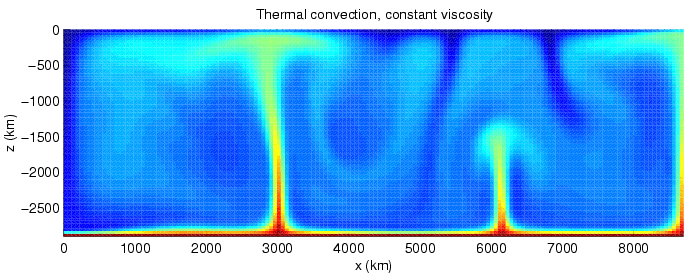
Heat convection occurs when the bulk flow of a fluid (gas or liquid) carries its heat through the fluid. All convective processes also move heat partly by diffusion, as well. The flow of fluid may be forced by external processes, or sometimes (in gravitational fields) by buoyancy forces caused when thermal energy expands the fluid (for example in a fire plume), thus influencing its own transfer. The latter process is often called "natural convection". The former process is often called "forced convection." In this case, the fluid is forced to flow by use of a pump, fan, or other mechanical means.
Thermal radiation occurs through a vacuum or any transparent medium (solid or fluid or gas). It is the transfer of energy by means of photons or electromagnetic waves governed by the same laws.
Heat transfer is the energy exchanged between materials (solid/liquid/gas) as a result of a temperature difference. The thermodynamic free energy is the amount of work that a thermodynamic system can perform. Enthalpy is a thermodynamic potential, designated by the letter "H", that is the sum of the internal energy of the system (U) plus the product of pressure (P) and volume (V). Joule is a unit to quantify energy, work, or the amount of heat.
Heat transfer is a process function (or path function), as opposed to functions of state; therefore, the amount of heat transferred in a thermodynamic process that changes the state of a system depends on how that process occurs, not only the net difference between the initial and final states of the process.
Thermodynamic and mechanical heat transfer is calculated with the heat transfer coefficient, the proportionality between the heat flux and the thermodynamic driving force for the flow of heat. Heat flux is a quantitative, vectorial representation of heat flow through a surface.
In engineering contexts, the term heat is taken as synonymous with thermal energy. This usage has its origin in the historical interpretation of heat as a fluid (caloric) that can be transferred by various causes, and that is also common in the language of laymen and everyday life.
Heat transfer
Heat transfer is a discipline of thermal engineering that concerns the generation, use, conversion, and exchange of thermal energy (heat) between physical systems. Heat transfer is classified into various mechanisms, such as thermal conduction, thermal convection, thermal radiation, and transfer of energy by phase changes. Engineers also consider the transfer of mass of differing chemical species (mass transfer in the form of advection), either cold or hot, to achieve heat transfer. While these mechanisms have distinct characteristics, they often occur simultaneously in the same system.
Heat conduction, also called diffusion, is the direct microscopic exchanges of kinetic energy of particles (such as molecules) or quasiparticles (such as lattice waves) through the boundary between two systems. When an object is at a different temperature from another body or its surroundings, heat flows so that the body and the surroundings reach the same temperature, at which point they are in thermal equilibrium. Such spontaneous heat transfer always occurs from a region of high temperature to another region of lower temperature, as described in the second law of thermodynamics.
Heat convection occurs when the bulk flow of a fluid (gas or liquid) carries its heat through the fluid. All convective processes also move heat partly by diffusion, as well. The flow of fluid may be forced by external processes, or sometimes (in gravitational fields) by buoyancy forces caused when thermal energy expands the fluid (for example in a fire plume), thus influencing its own transfer. The latter process is often called "natural convection". The former process is often called "forced convection." In this case, the fluid is forced to flow by use of a pump, fan, or other mechanical means.
Thermal radiation occurs through a vacuum or any transparent medium (solid or fluid or gas). It is the transfer of energy by means of photons or electromagnetic waves governed by the same laws.
Heat transfer is the energy exchanged between materials (solid/liquid/gas) as a result of a temperature difference. The thermodynamic free energy is the amount of work that a thermodynamic system can perform. Enthalpy is a thermodynamic potential, designated by the letter "H", that is the sum of the internal energy of the system (U) plus the product of pressure (P) and volume (V). Joule is a unit to quantify energy, work, or the amount of heat.
Heat transfer is a process function (or path function), as opposed to functions of state; therefore, the amount of heat transferred in a thermodynamic process that changes the state of a system depends on how that process occurs, not only the net difference between the initial and final states of the process.
Thermodynamic and mechanical heat transfer is calculated with the heat transfer coefficient, the proportionality between the heat flux and the thermodynamic driving force for the flow of heat. Heat flux is a quantitative, vectorial representation of heat flow through a surface.
In engineering contexts, the term heat is taken as synonymous with thermal energy. This usage has its origin in the historical interpretation of heat as a fluid (caloric) that can be transferred by various causes, and that is also common in the language of laymen and everyday life.
Recent media
Recent media