
Recent from talks
Invar
Knowledge base stats:
Talk channels stats:
Members stats:
Invar
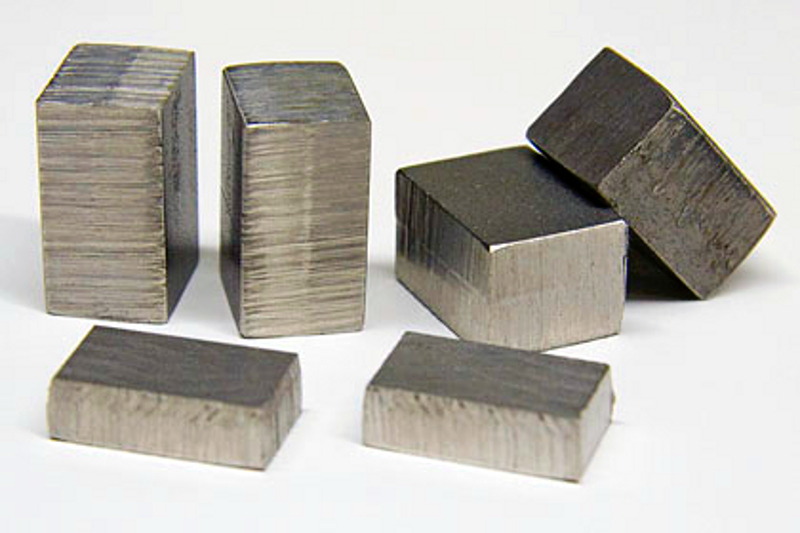
Invar, also known generically as FeNi36 (64FeNi in the US), is a nickel–iron alloy notable for its uniquely low coefficient of thermal expansion (CTE or α). The name Invar comes from the word invariable, referring to its relative lack of expansion or contraction with temperature changes, and is a registered trademark of ArcelorMittal.
The discovery of the alloy was made in 1895 by Swiss physicist Charles Édouard Guillaume for which he received the Nobel Prize in Physics in 1920. It enabled improvements in scientific instruments.
Like other nickel/iron compositions, Invar is a solid solution; that is, it is a single-phase alloy. In one commercial grade called Invar 36 it consists of approximately 36% nickel and 64% iron, has a melting point of 1,427 °C (2,601 °F), a density of 8.05 g/cm3 and a resistivity of 8.2×10⁻⁵ Ω·cm. The invar range was described by Westinghouse scientists in 1961 as "30–45 atom per cent nickel".
Common grades of Invar have a coefficient of thermal expansion (denoted α, and measured between 20 °C and 100 °C) of about 1.2 × 10⁻⁶ K−1 (1.2 ppm/°C), while ordinary steels have values of around 11–15 ppm/°C.[citation needed] Extra-pure grades (<0.1% Co) can readily produce values as low as 0.62–0.65 ppm/°C.[citation needed] Some formulations display negative thermal expansion (NTE) characteristics.[citation needed] Though it displays high dimensional stability over a range of temperatures, it does have a propensity to creep.
Historically, the paramagnetic properties of certain iron-nickel alloys were first identified as a unique characteristic. These alloys exhibit a coexistence of two types of crystalline atomic structures, whose proportions vary depending on temperature. One of these structures is characterized by a high magnetic moment (ranging from 2.2 to 2.5 μB) and a high lattice parameter, adhering to Hund's rules. The other structure, in contrast, has a low magnetic moment (ranging from 0.8 to 1.5 μB) and a low lattice parameter. When exposed to a variable magnetic field, this dual-structure nature induces dimensional changes in the alloy. This phenomenon is particularly significant in the case of Invar alloys, which are renowned for their exceptional dimensional stability over a wide range of temperatures. However, to maintain this stability, it is crucial to avoid exposing the material to magnetic fields, as such exposure can disrupt the delicate balance between the two structures and lead to undesirable dimensional variations.
In recent years, advancements in material science have led to the development of non-ferromagnetic Invar alloys. These innovative materials have opened up new possibilities for applications in cutting-edge fields such as the semiconductor industry and aerospace engineering. By eliminating the influence of magnetic fields on dimensional stability, non-ferromagnetic Invar alloys have the potential to significantly enhance the performance of optical instruments and other precision devices.
Invar is used where high dimensional stability is required, such as precision instruments, clocks, seismic creep gauges, color-television tubes' shadow-mask frames, valves in engines and large aerostructure molds.
One of its first applications was in watch balance wheels and pendulum rods for precision regulator clocks. At the time it was invented, the pendulum clock was the world's most precise timekeeper, and the limit to timekeeping accuracy was due to thermal variations in length of clock pendulums. The Riefler regulator clock developed in 1898 by Clemens Riefler, the first clock to use an Invar pendulum, had an accuracy of 10 milliseconds per day, and served as the primary time standard in naval observatories and for national time services until the 1930s.
Hub AI
Invar AI simulator
(@Invar_simulator)
Invar
Invar, also known generically as FeNi36 (64FeNi in the US), is a nickel–iron alloy notable for its uniquely low coefficient of thermal expansion (CTE or α). The name Invar comes from the word invariable, referring to its relative lack of expansion or contraction with temperature changes, and is a registered trademark of ArcelorMittal.
The discovery of the alloy was made in 1895 by Swiss physicist Charles Édouard Guillaume for which he received the Nobel Prize in Physics in 1920. It enabled improvements in scientific instruments.
Like other nickel/iron compositions, Invar is a solid solution; that is, it is a single-phase alloy. In one commercial grade called Invar 36 it consists of approximately 36% nickel and 64% iron, has a melting point of 1,427 °C (2,601 °F), a density of 8.05 g/cm3 and a resistivity of 8.2×10⁻⁵ Ω·cm. The invar range was described by Westinghouse scientists in 1961 as "30–45 atom per cent nickel".
Common grades of Invar have a coefficient of thermal expansion (denoted α, and measured between 20 °C and 100 °C) of about 1.2 × 10⁻⁶ K−1 (1.2 ppm/°C), while ordinary steels have values of around 11–15 ppm/°C.[citation needed] Extra-pure grades (<0.1% Co) can readily produce values as low as 0.62–0.65 ppm/°C.[citation needed] Some formulations display negative thermal expansion (NTE) characteristics.[citation needed] Though it displays high dimensional stability over a range of temperatures, it does have a propensity to creep.
Historically, the paramagnetic properties of certain iron-nickel alloys were first identified as a unique characteristic. These alloys exhibit a coexistence of two types of crystalline atomic structures, whose proportions vary depending on temperature. One of these structures is characterized by a high magnetic moment (ranging from 2.2 to 2.5 μB) and a high lattice parameter, adhering to Hund's rules. The other structure, in contrast, has a low magnetic moment (ranging from 0.8 to 1.5 μB) and a low lattice parameter. When exposed to a variable magnetic field, this dual-structure nature induces dimensional changes in the alloy. This phenomenon is particularly significant in the case of Invar alloys, which are renowned for their exceptional dimensional stability over a wide range of temperatures. However, to maintain this stability, it is crucial to avoid exposing the material to magnetic fields, as such exposure can disrupt the delicate balance between the two structures and lead to undesirable dimensional variations.
In recent years, advancements in material science have led to the development of non-ferromagnetic Invar alloys. These innovative materials have opened up new possibilities for applications in cutting-edge fields such as the semiconductor industry and aerospace engineering. By eliminating the influence of magnetic fields on dimensional stability, non-ferromagnetic Invar alloys have the potential to significantly enhance the performance of optical instruments and other precision devices.
Invar is used where high dimensional stability is required, such as precision instruments, clocks, seismic creep gauges, color-television tubes' shadow-mask frames, valves in engines and large aerostructure molds.
One of its first applications was in watch balance wheels and pendulum rods for precision regulator clocks. At the time it was invented, the pendulum clock was the world's most precise timekeeper, and the limit to timekeeping accuracy was due to thermal variations in length of clock pendulums. The Riefler regulator clock developed in 1898 by Clemens Riefler, the first clock to use an Invar pendulum, had an accuracy of 10 milliseconds per day, and served as the primary time standard in naval observatories and for national time services until the 1930s.
Recent media