Hubbry Logo
search
logo
2259323

Invariant mass

logo
Community Hub0 Subscribers
Read side by side
from Wikipedia

The invariant mass, rest mass, intrinsic mass, proper mass, or in the case of bound systems simply mass, is the portion of the total mass of an object or system of objects that is independent of the overall motion of the system. More precisely, it is a characteristic of the system's total energy and momentum that is the same in all frames of reference related by Lorentz transformations.[1] If a center-of-momentum frame exists for the system, then the invariant mass of a system is equal to its total mass in that "rest frame". In other reference frames, where the system's momentum is non-zero, the total mass (a.k.a. relativistic mass) of the system is greater than the invariant mass, but the invariant mass remains unchanged.

Because of mass–energy equivalence, the rest energy of the system is simply the invariant mass times the speed of light squared. Similarly, the total energy of the system is its total (relativistic) mass times the speed of light squared.

Systems whose four-momentum is a null vector, a light-like vector within the context of Minkowski space (for example, a single photon or many photons moving in exactly the same direction) have zero invariant mass and are referred to as massless. A physical object or particle moving faster than the speed of light would have space-like four-momenta (such as the hypothesized tachyon), and these do not appear to exist. Any time-like four-momentum possesses a reference frame where the momentum (3-dimensional) is zero, which is a center of momentum frame. In this case, invariant mass is positive and is referred to as the rest mass.

If objects within a system are in relative motion, then the invariant mass of the whole system will differ from the sum of the objects' rest masses. This is also equal to the total energy of the system divided by c2. See mass–energy equivalence for a discussion of definitions of mass. Since the mass of systems must be measured with a weight or mass scale in a center of momentum frame in which the entire system has zero momentum, such a scale always measures the system's invariant mass. For example, a scale would measure the kinetic energy of the molecules in a bottle of gas to be part of invariant mass of the bottle, and thus also its rest mass. The same is true for massless particles in such system, which add invariant mass and also rest mass to systems, according to their energy.

For an isolated massive system, the center of mass of the system moves in a straight line with a steady subluminal velocity (with a velocity depending on the reference frame used to view it). Thus, an observer can always be placed to move along with it. In this frame, which is the center-of-momentum frame, the total momentum is zero, and the system as a whole may be thought of as being "at rest" if it is a bound system (like a bottle of gas). In this frame, which exists under these assumptions, the invariant mass of the system is equal to the total system energy (in the zero-momentum frame) divided by c2. This total energy in the center of momentum frame, is the minimum energy which the system may be observed to have, when seen by various observers from various inertial frames.

Note that for reasons above, such a rest frame does not exist for single photons, or rays of light moving in one direction. When two or more photons move in different directions, however, a center of mass frame (or "rest frame" if the system is bound) exists. Thus, the mass of a system of several photons moving in different directions is positive, which means that an invariant mass exists for this system even though it does not exist for each photon.

Possible 4-momenta of particles. One has zero invariant mass, the other is massive

Sum of rest masses

[edit]

The invariant mass of a system includes the mass of any kinetic energy of the system constituents that remains in the center of momentum frame, so the invariant mass of a system may be greater than sum of the invariant masses (rest masses) of its separate constituents. For example, rest mass and invariant mass are zero for individual photons even though they may add mass to the invariant mass of systems. For this reason, invariant mass is in general not an additive quantity (although there are a few rare situations where it may be, as is the case when massive particles in a system without potential or kinetic energy can be added to a total mass).

Consider the simple case of two-body system, where object A is moving towards another object B which is initially at rest (in any particular frame of reference). The magnitude of invariant mass of this two-body system (see definition below) is different from the sum of rest mass (i.e. their respective mass when stationary). Even if we consider the same system from center-of-momentum frame, where net momentum is zero, the magnitude of the system's invariant mass is not equal to the sum of the rest masses of the particles within it.

The kinetic energy of such particles and the potential energy of the force fields increase the total energy above the sum of the particle rest masses, and both terms contribute to the invariant mass of the system. The sum of the particle kinetic energies as calculated by an observer is smallest in the center of momentum frame (again, called the "rest frame" if the system is bound).

They will often also interact through one or more of the fundamental forces, giving them a potential energy of interaction, possibly negative.

As defined in particle physics

[edit]

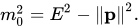
In particle physics, the invariant mass m0 is equal to the mass in the rest frame of the particle, and can be calculated by the particle's energy E and its momentum p as measured in any frame, by the energy–momentum relation: or, in natural units where c = 1,
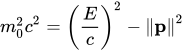
Invariant mass is the same in all frames of reference (see also special relativity). The equations above imply that the invariant mass is the pseudo-Euclidean length of the four-vector (E, p), calculated using the relativistic version of the Pythagorean theorem which has a different sign for the space and time dimensions. This length is preserved under any Lorentz boost or rotation in four dimensions, just like the ordinary length of a vector is preserved under rotations. In quantum theory the invariant mass is a parameter in the relativistic Dirac equation for an elementary particle. The Dirac quantum operator corresponds to the particle four-momentum vector.

Since the invariant mass is determined from quantities which are conserved during a decay, the invariant mass calculated using the energy and momentum of the decay products of a single particle is equal to the mass of the particle that decayed. The mass of a system of particles can be calculated from the general formula: where

  • is the invariant mass of the system of particles, equal to the mass of the decay particle.
  • is the sum of the energies of the particles
  • is the vector sum of the momentum of the particles (includes both magnitude and direction of the momenta)

The term invariant mass is also used in inelastic scattering experiments. Given an inelastic reaction with total incoming energy larger than the total detected energy (i.e. not all outgoing particles are detected in the experiment), the invariant mass (also known as the "missing mass") W of the reaction is defined as follows (in natural units):

If there is one dominant particle which was not detected during an experiment, a plot of the invariant mass will show a sharp peak at the mass of the missing particle.

In those cases when the momentum along one direction cannot be measured (i.e. in the case of a neutrino, whose presence is only inferred from the missing energy) the transverse mass is used.

Example: two-particle collision

[edit]

In a two-particle collision (or a two-particle decay) the square of the invariant mass (in natural units) is

Massless particles

[edit]

The invariant mass of a system made of two massless particles whose momenta form an angle has a convenient expression:

Collider experiments

[edit]

In particle collider experiments, one often defines the angular position of a particle in terms of an azimuthal angle  and pseudorapidity . Additionally the transverse momentum, , is usually measured. In this case if the particles are massless, or highly relativistic () then the invariant mass becomes:

Rest energy

[edit]

Rest energy (also called rest mass energy) is the energy associated with a particle's invariant mass.[2][3]

The rest energy of a particle is defined as: where is the speed of light in vacuum.[2][3][4] In general, only differences in energy have physical significance.[5]

The concept of rest energy follows from the special theory of relativity that leads to Einstein's famous conclusion about equivalence of energy and mass. See Special relativity § Relativistic dynamics and invariance.

See also

[edit]

References

[edit]

Citations

[edit]
  1. ^ Lawrence S. Lerner. Physics for Scientists and Engineers, Volume 2, page 1073. 1997.
  2. ^ a b Nave, C.R. "Relativistic Energy". HyperPhysics. Georgia State University. Retrieved 28 August 2023.
  3. ^ a b "13.6 Relativistic Energy or E = m c^2".
  4. ^ Phillip L. Reu (March 2007). Development of the Doppler Electron Velocimeter—Theory (PDF) (Report). Sandia National Laboratories. SAND2006-6063. Archived from the original (PDF) on 2015-06-23.
  5. ^ Modell, Michael; Reid, Robert C. (1974). Thermodynamics and Its Applications. Englewood Cliffs, NJ: Prentice-Hall. ISBN 0-13-914861-2.
Revisions and contributorsEdit on WikipediaRead on Wikipedia
from Grokipedia
Invariant mass is a fundamental Lorentz-invariant quantity in special relativity and particle physics, representing the rest mass of a single particle or the effective mass of a multi-particle system, which remains unchanged regardless of the inertial reference frame.[1] For a single particle, it is defined by the relation $ m^2 c^4 = E^2 - |\vec{p}|^2 c^2 $, where $ m $ is the invariant mass, $ E $ is the total energy, $ \vec{p} $ is the three-momentum vector, and $ c $ is the speed of light; in the particle's rest frame, where $ \vec{p} = 0 $, this simplifies to $ E = m c^2 $.[2] In particle physics experiments, such as those at the Large Hadron Collider, invariant mass is calculated from the measured energies and momenta of decay products to reconstruct and identify unstable particles, like the Higgs boson or W boson, since it is conserved in decays and independent of boosts along the beam direction.[3] For systems of particles, the invariant mass $ M $ of the total four-momentum $ P = \sum p_i $ satisfies $ M^2 c^4 = P^\mu P_\mu $, allowing non-zero values even for combinations of massless particles, such as two photons colliding head-on, where $ M = 2E / c^2 $ and $ E $ is each photon's energy.[4] This property underpins kinematic analyses, including Mandelstam variables for scattering processes and Dalitz plots for multi-body decays, enabling precise mass determinations and searches for new physics.[1] Unlike the outdated concept of relativistic mass, which varies with velocity, invariant mass is the sole definition of mass in modern physics, emphasizing its role as an intrinsic property tied to the particle's four-momentum squared.[1] Its frame-independence arises from the Minkowski spacetime metric, ensuring consistency across Lorentz transformations, and it plays a central role in verifying conservation laws and predicting thresholds for particle production in high-energy collisions.[2]

Theoretical Foundations

Definition in Special Relativity

In special relativity, the invariant mass of a single particle or composite system is a Lorentz-invariant quantity that remains constant across all inertial reference frames, distinguishing it from the relativistic mass, which depends on the observer's frame and the particle's velocity.[1] This invariance ensures that the intrinsic mass of the system, often referred to as the rest mass for a single particle at rest, provides a fundamental measure of its energy content independent of motion.[5] The concept was introduced by Albert Einstein in his 1905 papers on special relativity and mass-energy equivalence, where he established the framework for understanding how mass relates to energy and momentum in a way that conserves these quantities across frames, laying the groundwork for the mass-energy equivalence principle.[6] Einstein's work emphasized that while apparent mass effects vary with velocity, an underlying invariant property persists, crucial for the theory's consistency in describing physical laws.[5] Central to this definition are prerequisite concepts from special relativity, including the four-momentum vector $ p^\mu = (E/c, \mathbf{p}) $, where $ E $ is the total energy, $ c $ is the speed of light, and $ \mathbf{p} $ is the three-momentum, combined within the Minkowski spacetime metric $ ds^2 = c^2 dt^2 - dx^2 - dy^2 - dz^2 $.[1] This metric, formalized by Hermann Minkowski in 1908, endows spacetime with a pseudo-Euclidean geometry where the invariant interval $ ds^2 $ is unchanged under Lorentz transformations, enabling the four-momentum's squared magnitude to yield a frame-independent scalar. For a single particle, the invariant mass $ m $ is derived from the four-momentum's norm via the relation
m=E2c4p2c2, m = \sqrt{\frac{E^2}{c^4} - \frac{p^2}{c^2}},
where $ p = |\mathbf{p}| $ is the momentum magnitude; this formula follows directly from the invariance of $ p^\mu p_\mu = m^2 c^2 $ under the Minkowski metric.[1] In the particle's rest frame, where $ \mathbf{p} = 0 $, $ E = m c^2 $, confirming the invariant mass as the rest mass.[5] Units for invariant mass are typically expressed in kilograms (kg) in general contexts, aligning with classical mechanics, but in particle physics, it is conventional to use electronvolts per speed of light squared (eV/c²) to reflect energy scales directly.[1]

Invariant Mass Formula

The invariant mass $ M $ of a system of particles is defined by the formula
M=1c2(iEi)2c2ipi2, M = \frac{1}{c^2} \sqrt{ \left( \sum_i E_i \right)^2 - c^2 \left| \sum_i \vec{p}_i \right|^2 },
where $ \sum_i E_i $ is the total energy of the system, $ \sum_i \vec{p}_i $ is the vector sum of the three-momenta, and $ c $ is the speed of light.[7] This expression arises from the invariance of the four-momentum in special relativity. The four-momentum of a single particle is the four-vector $ p^\mu = (E/c, \vec{p}) $, and its Minkowski inner product with itself is $ p^\mu p_\mu = (E/c)^2 - |\vec{p}|^2 = (m c)^2 $, where $ m $ is the rest mass and the metric signature is (+, -, -, -).[8] For a system of multiple particles, the total four-momentum is the sum $ P^\mu = \sum_i p_i^\mu $, so the invariant is $ P^\mu P_\mu = (M c)^2 $, yielding the general formula upon expansion.[8] For a single particle at rest, where $ \vec{p} = 0 $, the formula reduces to $ m = E / c^2 $, consistent with the rest energy $ E = m c^2 $.[7] The invariance of $ M $ under Lorentz transformations follows from the property of the Minkowski metric: if $ P'^\mu = \Lambda^\mu{}\nu P^\nu $ under a Lorentz boost $ \Lambda $, then $ P'^\mu P'\mu = P^\mu P_\mu $ because $ \Lambda^\mu{}\rho \Lambda^\nu{}\sigma \eta_{\mu\nu} = \eta_{\rho\sigma} $, where $ \eta_{\mu\nu} $ is the metric tensor.[8] For example, a boost along the x-direction transforms energy and momentum as $ E' = \gamma (E - v p_x c) $ and $ p_x' = \gamma (p_x - v E / c^2) $, with $ \gamma = 1 / \sqrt{1 - v^2/c^2} $; substituting these into the invariant shows it remains $ M^2 c^4 $.[7][8] As a numerical example, consider a hypothetical single particle at rest with total energy $ E = 100 $ GeV; then $ \vec{p} = 0 $, so $ m = 100 $ GeV/$ c^2 $.[7]

Particle Systems

Sum of Rest Masses vs. Invariant Mass

In special relativity, the invariant mass MM of a multi-particle system is generally not equal to the sum of the individual rest masses mi\sum m_i, as it incorporates contributions from the total energy and momentum of the system.[9] This distinction arises because the invariant mass is defined via the system's four-momentum, reflecting relativistic effects that the simple sum of rest masses overlooks.[10] For unbound systems, such as particles with relative motion, the invariant mass exceeds the sum of rest masses due to kinetic energy contributions. The total energy of the system is Etotal=mi2c4+pi2c2E_\text{total} = \sum \sqrt{m_i^2 c^4 + p_i^2 c^2}, which is strictly greater than mic2\sum m_i c^2 unless all momenta pi=0p_i = 0, as each term mi2c4+pi2c2>mic2\sqrt{m_i^2 c^4 + p_i^2 c^2} > m_i c^2 for nonzero momentum.[9] In the center-of-momentum frame, where the total momentum vanishes, the invariant mass satisfies Mc2=EtotalM c^2 = E_\text{total}, which thus surpasses the sum of rest energies owing to internal kinetic energies.[10] For instance, two particles each of rest mass m0m_0 approaching with speed vv yield a system invariant mass of 2γm02 \gamma m_0, where γ=(1v2/c2)1/2>1\gamma = (1 - v^2/c^2)^{-1/2} > 1.[9] In bound systems, the invariant mass can be smaller than the sum of rest masses because binding energy reduces the total energy available. The binding energy EbE_b accounts for the work needed to separate the components, leading to M=miEb/c2M = \sum m_i - E_b / c^2.[11] A representative example is positronium, an electron-positron bound state analogous to hydrogen, where the invariant mass is slightly less than 2me2 m_e (with mem_e the electron rest mass) due to the few eV binding energy.[12] A common misconception is that the invariant mass always equals the sum of rest masses, but this holds only in the non-relativistic limit where particle velocities are much less than cc and binding or kinetic energies are negligible compared to rest energies.[10] In this approximation, relativistic effects vanish, and MmiM \approx \sum m_i.[9]

Two-Particle Collision Example

Consider a two-particle collision in special relativity, where two particles with rest masses m1m_1 and m2m_2 possess initial four-momenta p1μ=(E1/c,p1)p_1^\mu = (E_1/c, \vec{p_1}) and p2μ=(E2/c,p2)p_2^\mu = (E_2/c, \vec{p_2}), respectively, and collide to form a composite system or decay into products.[13] The invariant mass MM of the incoming system characterizes the total effective rest mass of the pair, independent of the reference frame, and is calculated from the total four-momentum pμ=p1μ+p2μp^\mu = p_1^\mu + p_2^\mu.[14] The formula for the invariant mass is given by
M=(E1+E2)2c4p1+p22c2, M = \sqrt{ \frac{(E_1 + E_2)^2}{c^4} - \frac{|\vec{p_1} + \vec{p_2}|^2}{c^2} },
where E1E_1 and E2E_2 are the total energies, and cc is the speed of light.[13] This quantity MM remains constant before and after the collision because the total four-momentum is conserved in both elastic and inelastic processes, ensuring the invariant mass of the system is preserved across interaction stages.[14] In the center-of-momentum (CM) frame, where the total momentum p1+p2=0\vec{p_1} + \vec{p_2} = 0, the calculation simplifies significantly, as the particles approach with equal and opposite momenta. For identical particles with equal energies EE, the invariant mass satisfies Mc2=2EM c^2 = 2E, highlighting how the total energy in this frame directly yields the effective rest energy of the system.[14] This frame is particularly useful for analyzing collision dynamics, as it underscores the invariance under Lorentz transformations. A key application is determining the threshold energy required in the laboratory frame, where one particle (say, with mass m2m_2) is at rest, to produce a particle or resonance of rest mass MM. The minimum total energy E1E_1 of the incoming particle (mass m1m_1) is
E1,threshold=(M2m12m22)c42m2c2, E_{1,\text{threshold}} = \frac{(M^2 - m_1^2 - m_2^2) c^4}{2 m_2 c^2},
derived by setting the invariant mass of the incoming pair equal to MM at the point where the produced system is at rest in the CM frame.[15] Below this energy, the collision cannot generate the required invariant mass, preventing production. The invariance can be visualized through the vector addition of momenta: the individual three-momenta p1\vec{p_1} and p2\vec{p_2} combine to form the total ptot=p1+p2\vec{p_{\text{tot}}} = \vec{p_1} + \vec{p_2}, whose magnitude relative to the total energy E1+E2E_1 + E_2 determines MM via the formula above; transforming to another frame alters both energy and momentum consistently, leaving MM unchanged.[13]

Massless Particles

In special relativity, a single massless particle, such as a photon, has zero invariant mass, as its energy EE and momentum magnitude pp satisfy the relation E=pcE = pc, where cc is the speed of light, leading to the invariant mass m=0m = 0 from the formula mc2=E2(pc)2m c^2 = \sqrt{E^2 - (pc)^2}.[16] This relation arises because massless particles travel at the speed of light, with their energy entirely kinetic and no rest mass contribution.[17] For a system of multiple massless particles, the total invariant mass can be non-zero if their momenta are not perfectly collinear, as the vector sum of their four-momenta yields an effective rest mass for the composite system. In the case of two photons with energies E1E_1 and E2E_2 propagating at an angle θ\theta relative to each other, the invariant mass MM of the pair is given by
M=2E1E2(1cosθ)c2, M = \frac{\sqrt{2 E_1 E_2 (1 - \cos \theta)}}{c^2},
which demonstrates how relative motion between the particles generates an effective mass.[18] This formula derives from the Minkowski inner product of the photons' four-momenta, where the non-zero angle prevents complete cancellation of the momentum components.[19] A key example occurs in the decay of the neutral pion (π0\pi^0) into two photons, where the invariant mass of the photon pair precisely equals the rest mass of the pion, approximately 135 MeV/c2c^2, conserving the four-momentum in the process π0γγ\pi^0 \to \gamma \gamma.[19] In the pion's rest frame, the photons are emitted back-to-back with equal energies, but in the lab frame, their measured energies and opening angle allow reconstruction of this invariant mass, confirming the decay kinematics.[20] Physically, massless particles contribute to the invariant mass of a system through their collective energy and the misalignment of their momenta, effectively binding the system as if it had a rest mass, even though individual components do not.[4] This interpretation highlights how relative motion among massless constituents can produce observable effects akin to massive particles in composite systems. In high-energy physics, many particles behave approximately as massless in the ultra-relativistic limit, where their speeds approach cc and the energy-momentum relation simplifies to EpcE \approx pc, allowing treatments similar to truly massless particles like photons or gluons for calculating invariant masses in collisions or decays.[20] This approximation is particularly useful for hadrons or leptons at energies much greater than their rest masses, simplifying kinematic analyses in particle detectors.[14]

Experimental and Applied Contexts

Collider Experiments

In high-energy particle collider experiments, the invariant mass of a decaying particle is reconstructed by combining measurements from detector subsystems to determine the total four-momentum of its visible decay products. Charged particle trajectories are tracked in magnetic fields to measure their momenta, while electromagnetic and hadronic calorimeters record energy deposits from both charged and neutral particles. The summed total energy EE and three-momentum p\vec{p} of the system then yield the invariant mass via M=E2p2c2/c2M = \sqrt{E^2 - |\vec{p}|^2 c^2}/c^2, enabling the identification of resonances as peaks in invariant mass distributions.[21] At the Large Hadron Collider (LHC), the ATLAS and CMS collaborations employed this technique to confirm the 2012 discovery of the Higgs boson through invariant mass peaks in key decay channels. In the diphoton (HγγH \to \gamma\gamma) mode, photons are reconstructed from calorimeter clusters, producing a narrow peak at approximately 125 GeV with a full width at half maximum (FWHM) resolution of about 3.9 GeV in ATLAS and approximately 2.6 GeV in CMS, standing out against smooth backgrounds from Drell-Yan and QCD processes. The four-lepton (HZZ4H \to ZZ^* \to 4\ell) channel, involving electron and muon tracks, similarly revealed a resonance at 125 GeV with resolutions of 1.7–2.3 GeV in ATLAS and 1–2 GeV in CMS, where backgrounds like ZZZZ^* continuum and ZZ+jets were subtracted using Monte Carlo simulations and data-driven methods; post-2012 Run 2 data further refined these measurements, determining the Higgs mass to be 125.1 ± 0.1 GeV (as of 2024) with combined precision approaching 0.1%. As of 2025, Run 3 data collection continues, enabling further improvements in Higgs analyses. Invariant mass distributions in collider data are broadened by detector resolution effects, such as momentum smearing from multiple scattering and energy resolution limits in calorimeters, which convolute the true resonance shape with a Gaussian-like response. For the Z boson, reconstructed in dilepton (+\ell^+\ell^-) events at the LHC, this results in a prominent peak at 91 GeV with typical resolutions of 1.5 GeV for muons and 2.5 GeV for electrons, allowing efficient separation from falling Drell-Yan backgrounds modeled via exponential or power-law fits.[22] A pivotal historical application occurred at the e⁺e⁻ Large Electron-Positron (LEP) collider, operational from 1989 to 2000, where invariant mass techniques enabled precise Z and W boson mass determinations. For the Z, energy scans near the 91 GeV pole analyzed over 17 million decays to extract the mass from cross-section lineshapes, achieving 2.1 MeV precision via beam energy calibration to 2 MeV accuracy. W mass measurements from 1996–2000 runs at 161–209 GeV, using fully leptonic and semileptonic decays, reconstructed invariant masses of decay products to reach 33 MeV accuracy, informing electroweak radiative corrections.[23] In events with incomplete reconstruction due to undetected particles like neutrinos, causing missing transverse energy, the transverse mass mTm_T—computed from visible transverse momenta and missing energy—is employed as a proxy. Fitting techniques, such as template matching or binned likelihoods, exploit the mTm_T distribution's endpoint (bounded by the parent mass) or shape to extract resonance parameters, with variants like mT2m_{T2} handling symmetric decay topologies in supersymmetry searches.[24]

Rest Energy Equivalence

The invariant mass MM of a system in special relativity is fundamentally linked to its rest energy through the relation Erest=Mc2E_{\text{rest}} = M c^2, where ErestE_{\text{rest}} is the total energy in the system's center-of-momentum frame and cc is the speed of light. This equation generalizes Einstein's mass-energy equivalence E=mc2E = m c^2 from single particles to composite systems, where MM represents the effective mass derived from the four-momentum invariant.[25] For multi-particle systems, the invariant mass incorporates not only the rest masses of individual constituents but also their kinetic energies, potential energies, and interaction energies in the rest frame, making MM a measure of the system's total internal energy content divided by c2c^2. This extension highlights that binding processes can alter the invariant mass: negative binding energy reduces MM below the sum of individual rest masses, while positive contributions from excitations increase it.[26] A classic example is the deuteron, a bound state of a proton and a neutron, whose invariant mass corresponds to a rest energy about 2.2 MeV less than the sum of the separate proton and neutron rest energies due to the nuclear binding energy.[27] Specifically, the proton rest energy is 938.272 MeV, the neutron rest energy is 939.565 MeV, and the deuteron binding energy is 2.2245 MeV, yielding an invariant mass defect of Δm=2.2245MeV/c2\Delta m = -2.2245 \, \text{MeV}/c^2.[28] This mass reduction underscores how interaction energies manifest as changes in the effective mass of the system.[29] In cosmology and astrophysics, the invariant mass of large-scale systems like galaxy clusters is inferred from their total rest energy, encompassing gravitational binding and kinetic contributions from member galaxies, which provides constraints on dark matter and cosmic expansion. Similarly, for black hole binaries, the system's invariant mass determines the rest energy available for gravitational wave emission during inspiral and merger, influencing observable waveforms and energy release.[30] In particle physics, natural units simplify calculations by setting c=1c = 1 and =1\hbar = 1, rendering mass, energy, and inverse length interchangeable, with 1 GeV equivalent to approximately 1.78×10271.78 \times 10^{-27} kg via m=E/c2m = E / c^2.[31] This convention facilitates expressing particle masses in energy units (e.g., the proton mass as 0.938 GeV), emphasizing the equivalence without explicit factors of cc.[32]
User Avatar
No comments yet.