Hubbry Logo
Full width at half maximumFull width at half maximumMain
Open search
Full width at half maximum
Community hub
Full width at half maximum
logo
8 pages, 0 posts
0 subscribers
Be the first to start a discussion here.
Full width at half maximum
from Wikipedia
Full width at half maximum

In a distribution, full width at half maximum (FWHM) is the difference between the two values of the independent variable at which the dependent variable is equal to half of its maximum value. In other words, it is the width of a spectrum curve measured between those points on the y-axis which are half the maximum amplitude. Half width at half maximum (HWHM) is half of the FWHM if the function is symmetric. The term full duration at half maximum (FDHM) is preferred when the independent variable is time.

FWHM is applied to such phenomena as the duration of pulse waveforms and the spectral width of sources used for optical communications and the resolution of spectrometers. The convention of "width" meaning "half maximum" is also widely used in signal processing to define bandwidth as "width of frequency range where less than half the signal's power is attenuated", i.e., the power is at least half the maximum. In signal processing terms, this is at most −3 dB of attenuation, called half-power point or, more specifically, half-power bandwidth. When half-power point is applied to antenna beam width, it is called half-power beam width.

Specific distributions

[edit]

Normal distribution

[edit]

If the considered function is the density of a normal distribution of the form where σ is the standard deviation and x0 is the expected value, then the relationship between FWHM and the standard deviation is[1] The FWHM does not depend on the expected value x0; it is invariant under translations. The area within this FWHM is approximately 76% of the total area under the function.

Other distributions

[edit]

In spectroscopy half the width at half maximum (here γ), HWHM, is in common use. For example, a Lorentzian/Cauchy distribution of height 1/πγ can be defined by

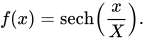
Another important distribution function, related to solitons in optics, is the hyperbolic secant: Any translating element was omitted, since it does not affect the FWHM. For this impulse we have: where arcsch is the inverse hyperbolic secant.

See also

[edit]

References

[edit]
[edit]
Revisions and contributorsEdit on WikipediaRead on Wikipedia
from Grokipedia
The full width at half maximum (FWHM) is a quantitative measure used to describe the width of a peak or distribution in various scientific contexts, defined as the separation between the two points on a where the intensity or is exactly half of its maximum value. This parameter is particularly valuable because it provides a straightforward, shape-independent way to assess the breadth of features like spectral lines, resonance peaks, or Gaussian distributions without requiring complex fitting. In physics and , FWHM serves as a key indicator of resolution, where narrower widths signify higher ability to distinguish closely spaced features, such as in atomic emission lines or instrumental response functions. For instance, in the analysis of Lorentzian or Breit-Wigner line shapes—common in for unstable particle decays or resonances—the FWHM directly relates to the lifetime or decay rate of the , with narrower profiles indicating longer-lived states. Similarly, in and astronomy, it characterizes beam spreads or point spread functions, as in primary beams where the FWHM defines the effective . FWHM is also integral to and , often applied to Gaussian profiles where it approximates 2.355 times the standard deviation (σ), aiding in the evaluation of data spread or filter bandwidths. In medical imaging, such as magnetic resonance spectroscopy, it measures resonance linewidths to assess spectral quality and tissue properties. Its ubiquity stems from computational simplicity: it can be directly extracted from experimental data by identifying the half-maximum points, making it robust for both theoretical modeling and practical measurements across disciplines like and .

Definition and Properties

Definition

The full width at half maximum (FWHM) is defined as the width of a peaked function or signal measured at the points where its value equals half of the maximum . This parameter quantifies the extent of the central portion of the peak by identifying the two points where the intensity or height is half the maximum value, and taking the distance between them along the independent variable axis, such as , , time, or position. It applies broadly to any unimodal function or probability density exhibiting a single prominent peak, serving as a robust indicator of width without requiring assumptions about the underlying shape. The concept originated in the field of as a standard measure for characterizing the broadening of lines, reflecting factors like resolution or physical processes such as Doppler effects. Over time, it was adopted in statistics and to describe the spread or variability in peaked distributions, providing an intuitive metric for that complements measures like standard deviation. For instance, in the Gaussian distribution, commonly encountered in natural phenomena, the FWHM offers a practical way to gauge dispersion. Visually, consider a generic bell-shaped representing a signal intensity versus some variable: the peak rises to a maximum, and the FWHM is determined by drawing a horizontal line at half the peak height, which intersects the at two points; the separation between these intersections captures the core width of the feature. This approach emphasizes the region's where the signal is most significant, effectively quantifying spread or duration in a manner independent of the precise peak or extension. FWHM differs from other width measures, such as the full width at base (FWB), which extends from one baseline intersection to the other across the entire , including extended tails that may arise from or secondary effects. By focusing solely on the half-maximum level, FWHM avoids overestimation from outliers or low-level broadening, making it particularly valuable for peaked profiles where the central region dominates the functional behavior.

Key properties

The full width at half maximum (FWHM) exhibits invariance under vertical scaling, such that multiplying the entire peak by a constant factor to alter its height leaves the FWHM unchanged, as the half-maximum level scales proportionally with the peak . This property renders FWHM particularly advantageous for analyzing signals where intensity variations occur due to experimental conditions, such as differing sample concentrations or detector sensitivities, without affecting the width assessment. For instance, in spectral analysis, this ensures consistent quantification of broadening mechanisms regardless of signal strength. In scenarios involving , such as when a true signal is broadened by an instrument response function, the FWHM of the resultant peak approximates the of the sum of the squares of the individual FWHMs for profiles with similar shapes, like Gaussians. This approximate additivity facilitates the of instrumental effects from intrinsic properties, enabling more accurate determination of underlying widths in fields like . FWHM demonstrates sensitivity to peak asymmetry, where non-symmetric profiles—often featuring extended tails on one side—yield a larger measured width at half maximum than their symmetric equivalents, capturing the influence of factors like interactions or chemical shifts. This characteristic highlights deviations from ideal symmetric broadening, providing diagnostic value for identifying asymmetries in experimental data. Additionally, the units of FWHM match those of the independent variable, such as nanometers for in optical spectra or seconds for temporal pulses, ensuring direct interpretability in context-specific measurements.

Mathematical Formulation

General expression

The full width at half maximum (FWHM) of a continuous unimodal function f(x)f(x) is defined as the distance between the two points on either side of the peak where the function value equals half its maximum . Specifically, if f(x)f(x) attains its maximum value fmaxf_{\max} at position x0x_0, then the FWHM is given by Δx=x1/2+x1/2\Delta x = x_{1/2}^+ - x_{1/2}^-, where x1/2x_{1/2}^- and x1/2+x_{1/2}^+ are the solutions to the equation f(x1/2±)=fmax/2f(x_{1/2}^\pm) = f_{\max}/2 with x1/2<x0<x1/2+x_{1/2}^- < x_0 < x_{1/2}^+. To compute the FWHM, first identify the maximum value fmaxf_{\max} and its location x0x_0. Then, solve the equation f(x)fmax/2=0f(x) - f_{\max}/2 = 0 numerically to find the roots x1/2x_{1/2}^- and x1/2+x_{1/2}^+ flanking the peak, and subtract these points to obtain the width. For functions normalized such that f(x)1f(x) \leq 1 with f(x0)=1f(x_0) = 1, the half-maximum level simplifies to 0.5, so the roots satisfy f(x1/2±)=0.5f(x_{1/2}^\pm) = 0.5. This definition assumes an isolated peak; for functions with multiple or overlapping peaks, the FWHM applies only after isolating the target peak through techniques such as baseline subtraction or multi-component curve fitting to deconvolve contributions. For instance, the admits a closed-form expression for its FWHM.

Relations to other parameters

The full width at half maximum (FWHM) serves as a measure of dispersion in peaked functions and probability distributions, relating directly to other parameters that characterize spread or scale. In the Gaussian distribution, defined by the probability density function f(x)=1σ2πexp((xμ)22σ2)f(x) = \frac{1}{\sigma \sqrt{2\pi}} \exp\left( -\frac{(x - \mu)^2}{2\sigma^2} \right)
Add your contribution
Related Hubs
User Avatar
No comments yet.
