Hubbry Logo
Inverse probability weightingInverse probability weightingMain
Open search
Inverse probability weighting
Community hub
Inverse probability weighting
logo
7 pages, 0 posts
0 subscribers
Be the first to start a discussion here.
Inverse probability weighting
from Wikipedia

Inverse probability weighting is a statistical technique for estimating quantities related to a population other than the one from which the data was collected. Study designs with a disparate sampling population and population of target inference (target population) are common in application.[1] There may be prohibitive factors barring researchers from directly sampling from the target population such as cost, time, or ethical concerns.[2] A solution to this problem is to use an alternate design strategy, e.g. stratified sampling. Weighting, when correctly applied, can potentially improve the efficiency and reduce the bias of unweighted estimators.

One very early weighted estimator is the Horvitz–Thompson estimator of the mean.[3] When the sampling probability is known, from which the sampling population is drawn from the target population, then the inverse of this probability is used to weight the observations. This approach has been generalized to many aspects of statistics under various frameworks. In particular, there are weighted likelihoods, weighted estimating equations, and weighted probability densities from which a majority of statistics are derived. These applications codified the theory of other statistics and estimators such as marginal structural models, the standardized mortality ratio, and the EM algorithm for coarsened or aggregate data.

Inverse probability weighting is also used to account for missing data when subjects with missing data cannot be included in the primary analysis.[4] With an estimate of the sampling probability, or the probability that the factor would be measured in another measurement, inverse probability weighting can be used to inflate the weight for subjects who are under-represented due to a large degree of missing data.

Inverse Probability Weighted Estimator (IPWE)

[edit]

The inverse probability weighting estimator can be used to demonstrate causality when the researcher cannot conduct a controlled experiment but has observed data to model. Because it is assumed that the treatment is not randomly assigned, the goal is to estimate the counterfactual or potential outcome if all subjects in population were assigned either treatment.

We consider random variables jointly distributed according to a law where

  • are the covariates
  • are the two possible treatments
  • is the response
  • No assumptions such as random assignment of treatment are made.

Following Rubin's potential outcomes framework we also stipulate the existence of random variables for each . Semantically, denotes the potential outcome that would be observed if the subject were assigned treatment . Technically speaking, we actually work with the full joint distribution of ; in that case is the marginal distribution for only the observed components of . Special assumptions are needed to infer properties about using , which will be detailed below.

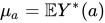
Now suppose we have observations distributed identically and independently according to . The goal is to use the observed data to estimate properties of the potential outcome . For instance, we may wish to compare the mean outcome if all patients in the population were assigned either treatment: . We want to estimate using observed data .

Estimator Formula

[edit]
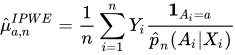
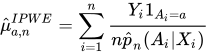
Constructing the IPWE

[edit]
  1. where
  2. construct or using any propensity model (often a logistic regression model)

With the mean of each treatment group computed, a statistical t-test or ANOVA test can be used to judge difference between group means and determine statistical significance of treatment effect.

Assumptions

[edit]

Recall the full joint probability model for the covariate , action , response , and potential outcomes . Recall also that is the marginal distribution of the observed data .

We make the following assumptions on relating the potential outcomes to the observed data. These allow us to infer properties of via .

  • (A1) Consistency: . So for any .
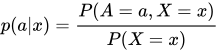
  • (A2) No unmeasured confounders: . Formally, for any bounded, Borel-measurable functions and , for any . This means that treatment assignment is based solely on covariate data and independent of potential outcomes.
  • (A3) Positivity: for all and .

Formal derivation

[edit]

Under the assumptions (A1)-(A3), we will derive the following identities [5]

The first equality is shown as follows:

For the second equality, first note from the proof above that

Now by (A3), almost surely. Furthermore, note that

. Hence we can write

Variance reduction

[edit]

The Inverse Probability Weighted Estimator (IPWE) is known to be unstable if some estimated propensities are too close to 0 or 1. In such instances, the IPWE can be dominated by a small number of subjects with large weights. To address this issue, a smoothed IPW estimator using Rao-Blackwellization has been proposed, which reduces the variance of IPWE by up to 7-fold and helps protect the estimator from model misspecification. [6]

Augmented Inverse Probability Weighted Estimator (AIPWE)

[edit]

An alternative estimator is the augmented inverse probability weighted estimator (AIPWE) combines both the properties of the regression based estimator and the inverse probability weighted estimator. It is therefore a 'doubly robust' method in that it only requires either the propensity or outcome model to be correctly specified but not both. This method augments the IPWE to reduce variability and improve estimate efficiency. This model holds the same assumptions as the Inverse Probability Weighted Estimator (IPWE).[7]

Estimator Formula

[edit]

With the following notations:

  1. is an indicator function if subject i is part of treatment group a (or not).
  2. Construct regression estimator to predict outcome based on covariates and treatment , for some subject i. For example, using ordinary least squares regression.
  3. Construct propensity (probability) estimate . For example, using logistic regression.
  4. Combine in AIPWE to obtain

Interpretation and "double robustness"

[edit]

The later rearrangement of the formula helps reveal the underlying idea: our estimator is based on the average predicted outcome using the model (i.e.: ). However, if the model is biased, then the residuals of the model will not be (in the full treatment group a) around 0. We can correct this potential bias by adding the extra term of the average residuals of the model (Q) from the true value of the outcome (Y) (i.e.: ). Because we have missing values of Y, we give weights to inflate the relative importance of each residual (these weights are based on the inverse propensity, a.k.a. probability, of seeing each subject observations) (see page 10 in [8]).
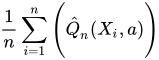
The "doubly robust" benefit of such an estimator comes from the fact that it's sufficient for one of the two models to be correctly specified, for the estimator to be unbiased (either or , or both). This is because if the outcome model is well specified then its residuals will be around 0 (regardless of the weights each residual will get). While if the model is biased, but the weighting model is well specified, then the bias will be well estimated (And corrected for) by the weighted average residuals.[8][9][10]

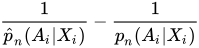
The bias of the doubly robust estimators is called a second-order bias, and it depends on the product of the difference and the difference . This property allows us, when having a "large enough" sample size, to lower the overall bias of doubly robust estimators by using machine learning estimators (instead of parametric models).[11]

See also

[edit]

References

[edit]
Revisions and contributorsEdit on WikipediaRead on Wikipedia
from Grokipedia
Inverse probability weighting (IPW), also known as inverse probability of treatment weighting (IPTW), is a statistical method employed in observational studies to adjust for and estimate causal effects by reweighting sample units inversely proportional to their estimated probability of receiving the observed treatment or exposure given measured covariates. This approach creates a pseudo-population in which treatment assignment is independent of the confounders, allowing for unbiased estimation of marginal effects through techniques such as marginal structural models. The technique traces its origins to , where the Horvitz-Thompson estimator, introduced in 1952, used inverse inclusion probabilities to obtain unbiased estimates of population totals from non-random samples. In the context of , IPW gained prominence in the late through its integration with marginal structural models, particularly in to handle time-varying exposures and confounders affected by prior treatment, as developed by James and colleagues. Propensity scores—the of treatment given covariates—form the basis for estimating these weights, with unstabilized weights calculated as 1/e^(X)1 / \hat{e}(X) for treated units and 1/(1e^(X))1 / (1 - \hat{e}(X)) for untreated units, where e^(X)\hat{e}(X) is the estimated propensity score. Stabilized weights, which incorporate marginal treatment probabilities, are often preferred to reduce variance while preserving consistency. IPW is widely applied in fields like , , and social sciences for analyzing longitudinal data with time-dependent , such as in studies of antiretroviral therapy effects on progression or policy interventions on health outcomes. Key advantages include its ability to accommodate nonlinear relationships between covariates and outcomes without strong parametric assumptions on the outcome model, making it more flexible than traditional regression adjustment in certain scenarios. However, its validity relies on critical assumptions: no unmeasured (exchangeability), positivity (nonzero treatment probability across all covariate levels), consistency (observed outcomes match counterfactuals under observed treatment), and correct specification of the propensity score model. Violations, such as extreme weights from low positivity or model misspecification, can lead to bias or high variance, often necessitating sensitivity analyses or doubly robust extensions like augmented IPW.

Introduction

Definition and Motivation

Inverse probability weighting (IPW) is a technique in causal inference that adjusts for confounding in observational data by assigning weights to individual observations equal to the inverse of the estimated probability of receiving the observed treatment, conditional on measured covariates. These probabilities, known as propensity scores, are typically estimated using models like logistic regression that predict treatment assignment based on baseline characteristics such as age, sex, and other potential confounders. By up-weighting individuals who are underrepresented in their treatment group relative to their covariates, IPW creates a balanced pseudo-population where treatment assignment is independent of those covariates. The motivation for IPW arises from the challenge of in non-experimental studies, where treatments are not randomly assigned, leading to imbalances in covariate distributions between treated and untreated groups that can distort causal effect estimates. Unlike randomized trials, observational data often reflect real-world , and IPW addresses this by emulating through weighting, thereby enabling unbiased estimation of effects like average treatment effects (ATE). This method contrasts with direct adjustment approaches, such as outcome regression, which model the relationship between covariates, treatment, and outcomes but risk if the model is misspecified; IPW avoids such outcome model assumptions, focusing instead on correct specification of the treatment assignment model. To illustrate, consider a binary treatment example evaluating the effect of on using data from the and Nutrition Examination Survey I Epidemiologic Follow-up Study (NHEFS). Quitters and continuing smokers may differ systematically in covariates like age, race, and education; IPW estimates propensity scores for quitting based on these factors and applies inverse weights to balance their distributions across groups. This reweighting yields a pseudo-population where covariate imbalances are minimized, facilitating an unbiased estimate of the ATE, such as an average 3.4 kg greater among quitters compared to if they had continued smoking. Key benefits of IPW include its capacity to reduce in ATE estimation without requiring parametric assumptions about the outcome distribution, making it robust in settings with complex or unknown outcome relationships. It also preserves nearly all points in the analysis, avoiding the information loss common in matching techniques, and supports of effects in specific subpopulations by restricting weights accordingly.

Historical Context

A pivotal development occurred in 1952 with the Horvitz-Thompson estimator, proposed by Daniel G. Horvitz and Donovan J. Thompson, which generalized unbiased estimation in by weighting observations inversely proportional to their inclusion probabilities, providing a foundational method for handling unequal sampling and extending to non-randomized settings. This approach gained traction in the 1980s through the propensity score literature, where Paul R. Rosenbaum and Donald B. Rubin highlighted the central role of estimated treatment assignment probabilities in balancing covariates for causal effects in observational studies, bridging weighting ideas to broader inference problems. The technique was popularized in epidemiology during the 1990s and early 2000s by James M. Robins and colleagues, who adapted inverse probability weighting to marginal structural models for addressing time-dependent confounding in longitudinal data, enabling robust estimation of causal effects in complex observational settings. Hernán and Robins further integrated these methods into modern causal inference frameworks throughout the 2000s, emphasizing their utility in epidemiology and beyond, with practical software implementations emerging in tools like R's ipw package and Stata's teffects commands by around 2010 to facilitate widespread adoption.

Background Concepts

Propensity Scores

The propensity score, denoted as e(X)e(\mathbf{X}), is defined as the of treatment assignment given a vector of observed baseline covariates X\mathbf{X}, formally e(X)=P(A=1X)e(\mathbf{X}) = P(A=1 \mid \mathbf{X}) for a binary treatment indicator AA. This scalar summary balances the distribution of covariates across treatment groups, facilitating in observational studies by enabling adjustments that mimic . Introduced in 1983 in the foundational work by Rosenbaum and Rubin, the propensity score serves as a key tool for reducing when estimating treatment effects under the potential outcomes framework. Logistic regression remains the most common method for estimating propensity scores, modeling the treatment probability as a function of covariates through a logit link to produce probabilities between 0 and 1. For datasets with complex, nonlinear covariate-treatment relationships or high-dimensional features, alternatives such as random forests offer improved flexibility by aggregating multiple decision trees to predict treatment assignment without assuming a specific parametric form. These machine learning approaches can enhance score accuracy in scenarios where logistic models underperform, such as with interactions or rare events. A core property of the propensity score is its role as a balancing score: conditional on e(X)e(\mathbf{X}), the distribution of observed covariates X\mathbf{X} is independent of treatment assignment, allowing for unbiased covariate adjustment via weighting, matching, or stratification. Effective application requires the common support condition, which mandates substantial overlap in the propensity score distributions between treated and untreated units to avoid unreliable and the generation of extreme weights that amplify variance. Practical computation of propensity scores follows a structured to ensure validity. Covariate selection begins by including all variables that influence both treatment assignment and outcomes (confounders), predict treatment alone, or predict outcomes but not treatment, guided by . The selected model is then fitted to the data, followed by diagnostics such as plotting propensity score densities to verify overlap and computing standardized mean differences in covariates before and after adjustment to confirm balance, with differences below 0.1 typically indicating adequate balancing.

Potential Outcomes Framework

The potential outcomes framework, also known as the , provides the foundational counterfactual approach for defining and estimating causal effects in observational and experimental studies. Under this model, each unit in the population is conceptualized as having potential outcomes corresponding to every possible treatment level, allowing researchers to contrast what would have happened under different interventions. Central to the framework is the notation for potential outcomes: for a binary treatment AA (where A=1A=1 indicates treatment and A=0A=0 indicates control), the potential outcome under treatment level aa is denoted Y(a)Y(a), with the observed outcome YY equaling Y(A)Y(A) for the treatment actually received by . This setup formalizes the individual causal effect as Y(1)Y(0)Y(1) - Y(0), though it remains unobservable for any unit due to the fundamental problem of , where only one potential outcome is realized per unit. Identification of causal effects from observed data relies on three key assumptions. The consistency assumption states that if a unit receives treatment A=aA = a, then the observed outcome Y=Y(a)Y = Y(a), linking counterfactuals to observables. The positivity assumption requires that the probability of receiving each treatment level given covariates XX satisfies 0<P(A=aX)<10 < P(A=a \mid X) < 1, ensuring no covariate strata lack exposure to any treatment. Exchangeability, or conditional ignorability, posits that potential outcomes are independent of treatment assignment given covariates, Y(a)AXY(a) \perp A \mid X, which can be achieved through propensity scores that estimate P(A=1X)P(A=1 \mid X) to condition on XX. The primary target parameter in this framework is the average treatment effect (ATE), defined as E[Y(1)Y(0)]E[Y(1) - Y(0)], representing the population-level causal impact of treatment versus control. Under the identifiability assumptions, the ATE can be expressed in terms of observed data as E[E[YA=1,X]]E[E[YA=0,X]]E[E[Y \mid A=1, X]] - E[E[Y \mid A=0, X]], enabling estimation via methods like inverse probability weighting that reweight the sample to mimic a randomized experiment. The framework extends to time-varying treatments in longitudinal settings, where potential outcomes depend on treatment histories Aˉk\bar{A}_k up to time kk. Here, identifiability requires sequential randomization, assuming that treatment at each time is independent of future potential outcomes given the observed history of treatments and covariates.

Core Methods

Inverse Probability Weighted Estimator (IPWE)

The inverse probability weighted estimator (IPWE), also known as the inverse probability of treatment weighting (IPTW) estimator, is a fundamental method in causal inference for estimating the average treatment effect (ATE) from observational data by reweighting observations to balance covariates between treatment groups. This approach relies on the propensity score, defined as the probability of receiving treatment given observed covariates, to create a pseudo-population where treatment assignment is independent of those covariates, thereby adjusting for measured confounding under the assumptions of exchangeability and positivity. The IPWE for the ATE is given by τ^IPW=1ni=1n(AiYie^(Xi)(1Ai)Yi1e^(Xi)),\hat{\tau}_{\text{IPW}} = \frac{1}{n} \sum_{i=1}^n \left( \frac{A_i Y_i}{\hat{e}(X_i)} - \frac{(1 - A_i) Y_i}{1 - \hat{e}(X_i)} \right), where nn is the sample size, Ai{0,1}A_i \in \{0, 1\} is the binary treatment indicator for unit ii, YiY_i is the observed outcome, XiX_i are the covariates, and e^(Xi)\hat{e}(X_i) is the estimated propensity score Pr(Ai=1Xi)\Pr(A_i = 1 \mid X_i). This formula represents the difference between the weighted average outcome under treatment and under control, effectively estimating the counterfactual mean difference \E[Y(1)Y(0)]\E[Y(1) - Y(0)]. To construct the IPWE, first estimate the propensity scores e^(Xi)\hat{e}(X_i) using a model such as logistic regression fitted to predict treatment from covariates XiX_i. Next, compute the inverse probability weights for each unit as wi=Aie^(Xi)+1Ai1e^(Xi)w_i = \frac{A_i}{\hat{e}(X_i)} + \frac{1 - A_i}{1 - \hat{e}(X_i)}, which upweight units underrepresented in their received treatment arm relative to the covariate distribution. Finally, apply these weights to the outcomes by calculating the weighted means separately for treated (Ai=1A_i = 1) and untreated (Ai=0A_i = 0) groups, then subtract to obtain τ^IPW\hat{\tau}_{\text{IPW}}. In practice, stabilized weights can be used by multiplying by the marginal probability of treatment Pr(Ai=1)\Pr(A_i = 1) to reduce variability when propensity scores are extreme, though the basic form suffices for consistent estimation. The interpretation of the IPWE centers on the pseudo-population formed by the weights, where each original unit is replicated wiw_i times, resulting in balanced covariate distributions across treatment arms as if treatment were randomly assigned conditional on XiX_i. This reweighting emulates the covariate structure of a target population (often the full sample) while preserving the outcome distribution within treatment levels. For statistical inference, standard errors of τ^IPW\hat{\tau}_{\text{IPW}} can be estimated using the robust sandwich variance estimator, which accounts for the estimation of e^(Xi)\hat{e}(X_i) and the heteroskedasticity induced by the weights, providing asymptotically valid confidence intervals under standard regularity conditions.

Augmented Inverse Probability Weighted Estimator (AIPWE)

The Augmented Inverse Probability Weighted Estimator (AIPWE) extends the Inverse Probability Weighted Estimator (IPWE) by integrating outcome regression models, which enhances estimation efficiency without sacrificing the robustness provided by propensity score weighting. This approach combines inverse probability weighting with predictions of the conditional mean outcome under each treatment level, allowing for bias correction even if one of the models is misspecified. When the outcome models are omitted or set to zero, the AIPWE reduces to the standard IPWE. The AIPWE is constructed by estimating the average treatment effect τ^AIPW\hat{\tau}_{AIPW} using the following formula: τ^AIPW=1ni=1n[(Ai(Yim^1(Xi))e^(Xi)+m^1(Xi))((1Ai)(Yim^0(Xi))1e^(Xi)+m^0(Xi))],\hat{\tau}_{AIPW} = \frac{1}{n} \sum_{i=1}^n \left[ \left( \frac{A_i (Y_i - \hat{m}_1(X_i))}{\hat{e}(X_i)} + \hat{m}_1(X_i) \right) - \left( \frac{(1-A_i) (Y_i - \hat{m}_0(X_i))}{1-\hat{e}(X_i)} + \hat{m}_0(X_i) \right) \right], where AiA_i is the binary treatment indicator, YiY_i is the observed outcome, XiX_i are covariates, e^(Xi)\hat{e}(X_i) is the estimated propensity score (probability of treatment given covariates), and m^a(Xi)\hat{m}_a(X_i) denotes the predicted outcome under treatment a{0,1}a \in \{0,1\}, typically obtained via regression models such as linear regression, logistic regression for binary outcomes, or more flexible machine learning techniques. A key feature of the AIPWE is its bias correction mechanism, embodied in the augmentation terms Ai(Yim^1(Xi))e^(Xi)\frac{A_i (Y_i - \hat{m}_1(X_i))}{\hat{e}(X_i)} and (1Ai)(Yim^0(Xi))1e^(Xi)\frac{(1-A_i) (Y_i - \hat{m}_0(X_i))}{1-\hat{e}(X_i)}, which offset errors arising from misspecification in either the propensity score model or the outcome regression models. This structure ensures that the estimator remains consistent if at least one model is correctly specified. In practice, implementing the AIPWE requires careful estimation of the nuisance parameters e^(X)\hat{e}(X) and m^a(X)\hat{m}_a(X) to prevent overfitting, particularly when using data-driven methods like machine learning. Cross-fitting addresses this by partitioning the sample into KK folds, fitting the models on K1K-1 folds and evaluating on the held-out fold, then averaging across folds to compute the final estimate. This technique mitigates the bias from using the same data for both model fitting and estimation.

Properties and Analysis

Assumptions and Derivations

Inverse probability weighting (IPW) relies on several core assumptions to ensure the validity of causal estimates. The positivity assumption requires that the propensity score e(X)=P(A=1X)e(X) = P(A=1 \mid X) satisfies 0<e(X)<10 < e(X) < 1 for all observed covariate values XX in the support of the population distribution, ensuring that every individual has a non-zero probability of receiving each treatment level given their covariates. The exchangeability assumption, also known as no unmeasured confounding, posits that treatment assignment is independent of potential outcomes conditional on XX, i.e., {Y(1),Y(0)}AX\{Y(1), Y(0)\} \perp A \mid X, which implies all confounders are measured and conditioned upon. Additionally, the consistency assumption states that the observed outcome YY equals the potential outcome under the received treatment, Y=AY(1)+(1A)Y(0)Y = A Y(1) + (1-A) Y(0). For the IPW estimator to be consistent, the propensity score model must be correctly specified; misspecification leads to biased estimates. The unbiasedness of the IPW estimator for the average treatment effect (ATE), τ^IPW=n1i=1n(AiYie(Xi)(1Ai)Yi1e(Xi))\hat{\tau}_{IPW} = n^{-1} \sum_{i=1}^n \left( \frac{A_i Y_i}{e(X_i)} - \frac{(1-A_i) Y_i}{1-e(X_i)} \right), can be derived under the above assumptions when the true propensity score e(X)e(X) is known. Taking the expectation, E[τ^IPW]=E[AYe(X)(1A)Y1e(X)]E[\hat{\tau}_{IPW}] = E\left[ \frac{A Y}{e(X)} - \frac{(1-A) Y}{1-e(X)} \right]. By the law of iterated expectations, E[AYe(X)]=E[E[AYe(X)X]]=E[E[AYX]e(X)]E\left[ \frac{A Y}{e(X)} \right] = E\left[ E\left[ \frac{A Y}{e(X)} \mid X \right] \right] = E\left[ \frac{E[A Y \mid X]}{e(X)} \right]. Since E[AX]=e(X)E[A \mid X] = e(X) and under exchangeability E[YA=1,X]=E[Y(1)X]E[Y \mid A=1, X] = E[Y(1) \mid X], this simplifies to E[e(X)E[Y(1)X]e(X)]=E[E[Y(1)X]]=E[Y(1)]E\left[ \frac{e(X) E[Y(1) \mid X]}{e(X)} \right] = E[ E[Y(1) \mid X] ] = E[Y(1)]. A symmetric argument yields E[(1A)Y1e(X)]=E[Y(0)]E\left[ \frac{(1-A) Y}{1-e(X)} \right] = E[Y(0)], so E[τ^IPW]=E[Y(1)]E[Y(0)]=τE[\hat{\tau}_{IPW}] = E[Y(1)] - E[Y(0)] = \tau, the true ATE. IPW estimators can exhibit high variance due to extreme weights when e(X)e(X) is close to 0 or 1, particularly in samples with limited overlap. To mitigate this, techniques such as weight trimming—capping weights at upper and lower thresholds (e.g., 95th and 5th percentiles)—are employed to reduce the influence of outliers while preserving approximate unbiasedness under mild conditions. Stabilized weights address variance by scaling the inverse propensity scores with marginal treatment probabilities: for treated units, wi=P(A=1)/e(Xi)w_i^* = P(A=1) / e(X_i), and for control units, wi=P(A=0)/(1e(Xi))w_i^* = P(A=0) / (1 - e(X_i)); these maintain the same estimating equations as standard IPW but yield more stable variance estimates. Under the stated assumptions and with a correctly specified propensity score model, the IPW estimator is consistent as the sample size nn \to \infty, converging in probability to the true ATE. Asymptotically, n(τ^IPWτ)\sqrt{n} (\hat{\tau}_{IPW} - \tau)
Add your contribution
Related Hubs
User Avatar
No comments yet.