
Recent from talks
Ipomoea aquatica
Knowledge base stats:
Talk channels stats:
Members stats:
Ipomoea aquatica
Ipomoea aquatica, commonly known as water spinach or kangkung, is a semi-aquatic, tropical plant grown as a vegetable for its tender shoots. I. aquatica is generally believed to have been first domesticated in Southeast Asia. It is widely cultivated in Southeast Asia, East Asia, and South Asia. It grows abundantly near waterways and requires little to no care.
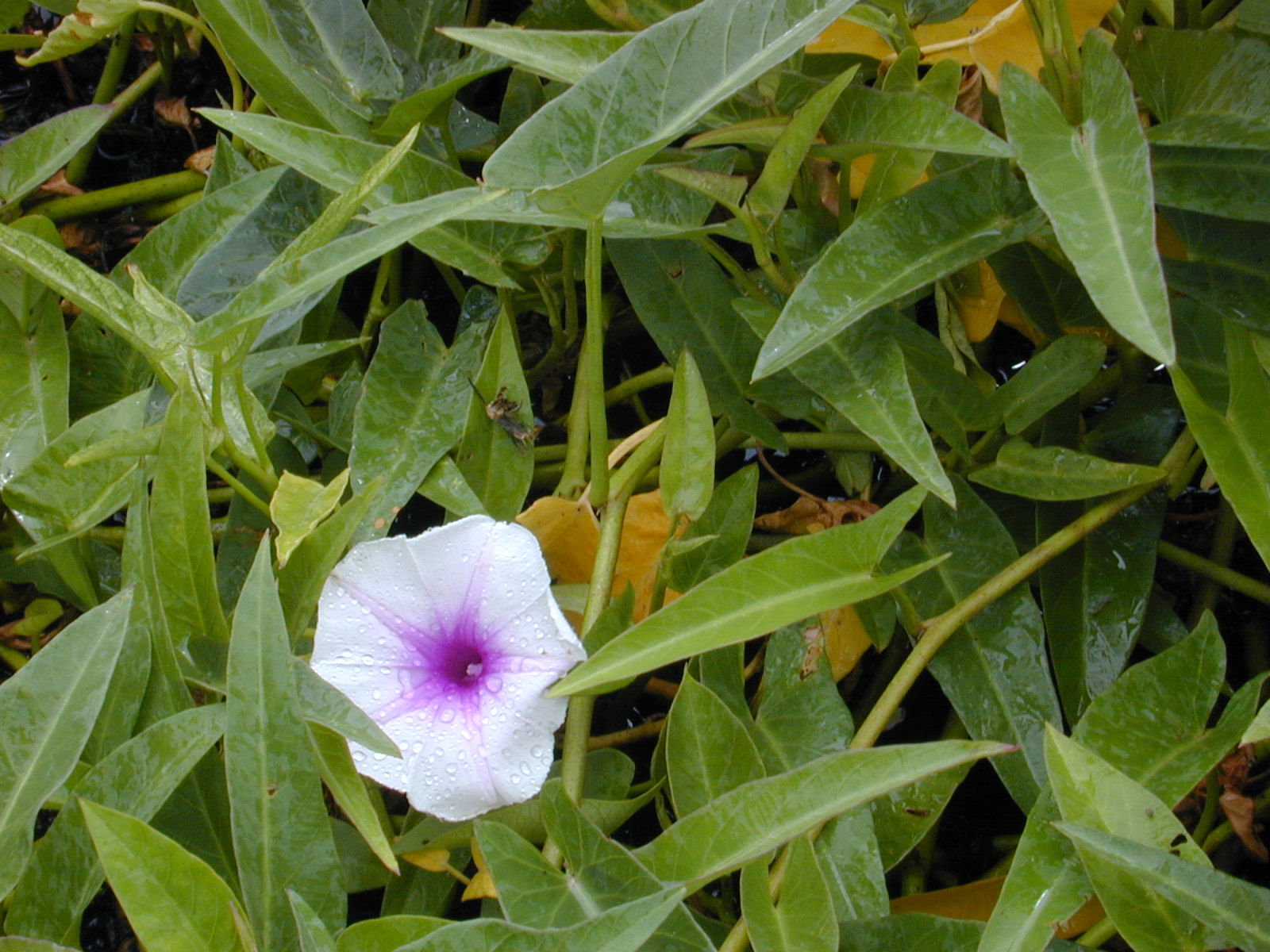
Ipomoea aquatica grows in water or on moist soil. Its stems are 2–3 metres (7–10 ft) or longer, rooting at the nodes. The hollow cavity within the stem makes the plant buoyant. The leaves vary from typically sagittate (arrowhead-shaped) to lanceolate, 5–15 cm (2–6 in) long and 2–8 cm (0.8–3 in) broad. The flowers are trumpet-shaped, 3–5 cm (1–2 in) in diameter, and usually white in colour with a mauve centre. Propagation is either by planting cuttings of the stem shoots, which will root along nodes, or by planting the seeds from flowers that produce seed pods.
Ipomoea aquatica is most widely known as kangkong (also spelled kangkung), its common name in Maritime Southeast Asia, which likely originates from either Malay or one of the languages of the Philippines. It is also known as water spinach, river spinach, water morning glory, water convolvulus, or by the more ambiguous names Chinese spinach, Chinese watercress, Chinese convolvulus or swamp cabbage. It is known as kōngxīncài (空心菜) in Mandarin, ong choy (蕹菜) in Cantonese and in Hawaii, and tung choi (通菜) in modern Cantonese.
The origin of Ipomoea aquatica is not quite clear, but it is generally believed to be native to Southeast Asia and was first cultivated there. This is supported by phylogenetic studies, its ideal climatic conditions, and the number of native pathogens in the region (like Albugo spp.); as well as its predominant cultivation range, the prevalence in usage as food and traditional medicine, and the number of distinct native names in Southeast Asian languages and language families.
Several sources have also cited China or India as the location of the plant's domestication. However, these claims have no supporting evidence other than the appearance of the plant's name in historical records. The first clear mention of I. aquatica in Chinese records is in the Nanfang Caomu Zhuang written by the Chinese botanist Ji Han (AD 263-307). Ji Han specifically identifies I. aquatica as being "a strange vegetable of the south" with a foreign origin brought over by "western countries". The claim for an Indian origin is based on the presence of the old name kalamba for the plant in Sanskrit, presumed to be from around 200 BC, but this is putative.
Ipomoea aquatica is also found in Africa, the southwestern Pacific Islands, and northern Australia. However, in Africa and the Pacific Islands, the number of native common names isn't as varied as in Southeast Asia, and there are very few references to the local use of I. aquatica for any purpose. Similarly, in Australia, it does not have indigenous names at all and is entirely absent in the traditional diet of Indigenous Australians. These imply that I. aquatica weren't native to these regions and were likely introduced relatively late from tropical Asia.
Many of the waters where water spinach grows are fed by domestic or other waste. Pigs in southeast Asia are a natural reservoir for the parasite Fasciolopsis buski. Infections in the Mekong regions resulted from feeding on water spinach. Infections of F. buski in humans through water spinach can be anticipated. The infection can be prevented by proper preparation, such as frying or boiling. Contamination with thermotolerant coliforms (ThC) or protozoan parasites with fecal origin, are very likely when the water spinach is planted in wastewater fed urban systems. Water spinach has great potential as a purifier of aquatic habitats. It is an efficient accumulator of cadmium, lead, and mercury. This characteristic can be dangerous if water spinach is planted for human or animal feed in polluted aquatic systems. Mercury in water spinach is composed mostly as methylmercury and has the highest potential of becoming a threat to human health. The edible parts of the plant have a lower heavy metal concentration. The stems and bottom of the edible portion of the plant are higher in concentration and should be removed to minimize the heavy metal intake.
The vegetable is a common ingredient in East, South and Southeast Asian dishes, such as in stir-fried water spinach. In Singapore, Indonesia, and Malaysia, the tender shoots along with the leaves are usually stir-fried with chili pepper, garlic, ginger, dried shrimp paste (belacan/terasi) and other spices. In Penang and Ipoh, it is cooked with cuttlefish and a sweet and spicy sauce. Also known as eng chhai in the Hokkien dialect, it can also be boiled with preserved cuttlefish, then rinsed and mixed with spicy rojak paste to become jiu hu eng chhai. Boiled eng chhai also can be served with fermented krill noodles – belacan bihun – and prawn mi.
Hub AI
Ipomoea aquatica AI simulator
(@Ipomoea aquatica_simulator)
Ipomoea aquatica
Ipomoea aquatica, commonly known as water spinach or kangkung, is a semi-aquatic, tropical plant grown as a vegetable for its tender shoots. I. aquatica is generally believed to have been first domesticated in Southeast Asia. It is widely cultivated in Southeast Asia, East Asia, and South Asia. It grows abundantly near waterways and requires little to no care.
Ipomoea aquatica grows in water or on moist soil. Its stems are 2–3 metres (7–10 ft) or longer, rooting at the nodes. The hollow cavity within the stem makes the plant buoyant. The leaves vary from typically sagittate (arrowhead-shaped) to lanceolate, 5–15 cm (2–6 in) long and 2–8 cm (0.8–3 in) broad. The flowers are trumpet-shaped, 3–5 cm (1–2 in) in diameter, and usually white in colour with a mauve centre. Propagation is either by planting cuttings of the stem shoots, which will root along nodes, or by planting the seeds from flowers that produce seed pods.
Ipomoea aquatica is most widely known as kangkong (also spelled kangkung), its common name in Maritime Southeast Asia, which likely originates from either Malay or one of the languages of the Philippines. It is also known as water spinach, river spinach, water morning glory, water convolvulus, or by the more ambiguous names Chinese spinach, Chinese watercress, Chinese convolvulus or swamp cabbage. It is known as kōngxīncài (空心菜) in Mandarin, ong choy (蕹菜) in Cantonese and in Hawaii, and tung choi (通菜) in modern Cantonese.
The origin of Ipomoea aquatica is not quite clear, but it is generally believed to be native to Southeast Asia and was first cultivated there. This is supported by phylogenetic studies, its ideal climatic conditions, and the number of native pathogens in the region (like Albugo spp.); as well as its predominant cultivation range, the prevalence in usage as food and traditional medicine, and the number of distinct native names in Southeast Asian languages and language families.
Several sources have also cited China or India as the location of the plant's domestication. However, these claims have no supporting evidence other than the appearance of the plant's name in historical records. The first clear mention of I. aquatica in Chinese records is in the Nanfang Caomu Zhuang written by the Chinese botanist Ji Han (AD 263-307). Ji Han specifically identifies I. aquatica as being "a strange vegetable of the south" with a foreign origin brought over by "western countries". The claim for an Indian origin is based on the presence of the old name kalamba for the plant in Sanskrit, presumed to be from around 200 BC, but this is putative.
Ipomoea aquatica is also found in Africa, the southwestern Pacific Islands, and northern Australia. However, in Africa and the Pacific Islands, the number of native common names isn't as varied as in Southeast Asia, and there are very few references to the local use of I. aquatica for any purpose. Similarly, in Australia, it does not have indigenous names at all and is entirely absent in the traditional diet of Indigenous Australians. These imply that I. aquatica weren't native to these regions and were likely introduced relatively late from tropical Asia.
Many of the waters where water spinach grows are fed by domestic or other waste. Pigs in southeast Asia are a natural reservoir for the parasite Fasciolopsis buski. Infections in the Mekong regions resulted from feeding on water spinach. Infections of F. buski in humans through water spinach can be anticipated. The infection can be prevented by proper preparation, such as frying or boiling. Contamination with thermotolerant coliforms (ThC) or protozoan parasites with fecal origin, are very likely when the water spinach is planted in wastewater fed urban systems. Water spinach has great potential as a purifier of aquatic habitats. It is an efficient accumulator of cadmium, lead, and mercury. This characteristic can be dangerous if water spinach is planted for human or animal feed in polluted aquatic systems. Mercury in water spinach is composed mostly as methylmercury and has the highest potential of becoming a threat to human health. The edible parts of the plant have a lower heavy metal concentration. The stems and bottom of the edible portion of the plant are higher in concentration and should be removed to minimize the heavy metal intake.
The vegetable is a common ingredient in East, South and Southeast Asian dishes, such as in stir-fried water spinach. In Singapore, Indonesia, and Malaysia, the tender shoots along with the leaves are usually stir-fried with chili pepper, garlic, ginger, dried shrimp paste (belacan/terasi) and other spices. In Penang and Ipoh, it is cooked with cuttlefish and a sweet and spicy sauce. Also known as eng chhai in the Hokkien dialect, it can also be boiled with preserved cuttlefish, then rinsed and mixed with spicy rojak paste to become jiu hu eng chhai. Boiled eng chhai also can be served with fermented krill noodles – belacan bihun – and prawn mi.
Recent media