
Recent from talks
Iron sights
Knowledge base stats:
Talk channels stats:
Members stats:
Iron sights
Iron sights are a system of physical alignment markers used as a sighting device to assist the accurate aiming of ranged weapons such as firearms, airguns, crossbows, and bows, or less commonly as a primitive finder sight for optical telescopes. Iron sights, which are typically made of metal, are the earliest and simplest type of sighting device. Since iron sights neither magnify nor illuminate the target, they rely completely on the viewer's naked eye and the available light by which the target is visible. In this respect, iron sights are distinctly different from optical sight designs that employ optical manipulation or active illumination, such as telescopic sights, reflector (reflex) sights, holographic sights, and laser sights.
Iron sights are typically composed of two components mounted perpendicularly above the weapon's bore axis: a 'rear sight' nearer (or 'proximal') to the shooter's eye, and a 'front sight' farther forward (or 'distal') near the muzzle. During aiming, the shooter aligns their line of sight past a gap at the center of the rear sight and towards the top edge of the front sight. When the shooter's line of sight, the iron sights, and target are all aligned, a 'line of aim' that points straight at the target has been created.
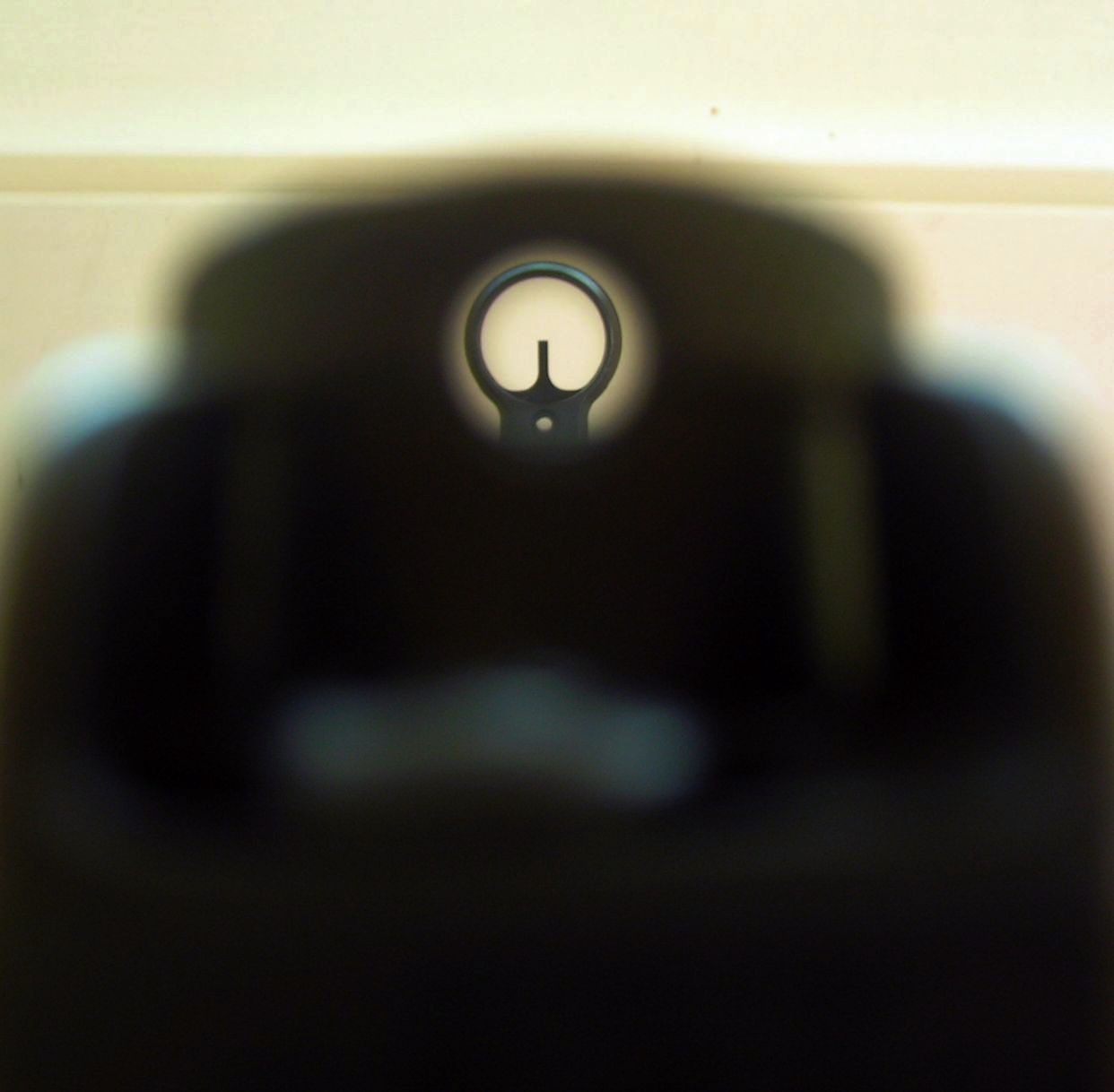
Front sights vary in design but are often a small post, bead, ramp, or ring. There are two main types of rear iron sight: 'open sights', which use an unenclosed notch, and 'aperture sights', which use a circular hole. Nearly all handguns, as well as most civilian, hunting, and police long guns, feature open sights. By contrast, many military service rifles employ aperture sights.
The earliest and simplest iron sights were fixed and could not be easily adjusted. Many modern iron sights are designed to be adjustable for sighting in firearms by adjusting the sights for elevation or windage. On many firearms it is the rear sight that is adjustable.
For precision shooting applications such as varminting or sniping, the iron sights are usually replaced by a telescopic sight. Iron sights may still be fitted alongside other sighting devices (or in the case of some models of optics, incorporated integrally) for back-up usage, if the primary sights are damaged or lost.
In the case of firearms, where the projectile follows a curved ballistic trajectory below the bore axis, the only way to ensure it will hit an intended target is by aiming at the precise point on the trajectory at that target's intended distance. To do that, the shooter aligns their line of sight with the front and rear sights, forming a consistent 'line of aim' (known as the 'sight axis') and in turn producing what is known as the 'point of aim' (POA) within their own field of view, which then gets pointed directly (i.e. aimed) at the target. The physical distance between the front and rear sights is known as the 'sight radius', the longer of which produces smaller angular errors when aiming.
"Sighting in" is a process in which the sight axis is adjusted to intersect the trajectory of the bullet at a designated distance (typically at 100 yards/meters), in order to produce a pre-determined point of impact (POI) at that distance, known as a "zero". Using that "zero" as a default reference, the point of aim can be readily re-calibrated to superimpose with the bullet's point of impact when shooting at different distances. Modern iron sights can all provide some horizontal and vertical adjustments for sighting-in, and often have elevation markings that allow the shooter to quickly compensate (though with rather limited precision) for increasing bullet drops at extended distances. Because the sight axis (which is a straight line) and the projectile trajectory (which is a parabolic curve) must be within the same vertical plane to have any chance of intersecting, it will be very difficult to shoot accurately if the sights are not perpendicularly above the gun barrel (a situation known as canting) when aiming or sighting-in.
Rear sights on long guns (such as rifles and carbines) are usually mounted on a dovetail slot on the back part of the barrel or the receiver, closer to the eye of the shooter, allowing for easy visual pick-up of the notch. Front sights are mounted to the front end of the barrel by dovetailing, soldering, screwing, or staking very close to the muzzle, frequently on a "ramp". Some front sight assemblies include a detachable hood intended to reduce glare, and if the hood is circular, then this provides a reference where the eye will naturally align one within the other.
Hub AI
Iron sights AI simulator
(@Iron sights_simulator)
Iron sights
Iron sights are a system of physical alignment markers used as a sighting device to assist the accurate aiming of ranged weapons such as firearms, airguns, crossbows, and bows, or less commonly as a primitive finder sight for optical telescopes. Iron sights, which are typically made of metal, are the earliest and simplest type of sighting device. Since iron sights neither magnify nor illuminate the target, they rely completely on the viewer's naked eye and the available light by which the target is visible. In this respect, iron sights are distinctly different from optical sight designs that employ optical manipulation or active illumination, such as telescopic sights, reflector (reflex) sights, holographic sights, and laser sights.
Iron sights are typically composed of two components mounted perpendicularly above the weapon's bore axis: a 'rear sight' nearer (or 'proximal') to the shooter's eye, and a 'front sight' farther forward (or 'distal') near the muzzle. During aiming, the shooter aligns their line of sight past a gap at the center of the rear sight and towards the top edge of the front sight. When the shooter's line of sight, the iron sights, and target are all aligned, a 'line of aim' that points straight at the target has been created.
Front sights vary in design but are often a small post, bead, ramp, or ring. There are two main types of rear iron sight: 'open sights', which use an unenclosed notch, and 'aperture sights', which use a circular hole. Nearly all handguns, as well as most civilian, hunting, and police long guns, feature open sights. By contrast, many military service rifles employ aperture sights.
The earliest and simplest iron sights were fixed and could not be easily adjusted. Many modern iron sights are designed to be adjustable for sighting in firearms by adjusting the sights for elevation or windage. On many firearms it is the rear sight that is adjustable.
For precision shooting applications such as varminting or sniping, the iron sights are usually replaced by a telescopic sight. Iron sights may still be fitted alongside other sighting devices (or in the case of some models of optics, incorporated integrally) for back-up usage, if the primary sights are damaged or lost.
In the case of firearms, where the projectile follows a curved ballistic trajectory below the bore axis, the only way to ensure it will hit an intended target is by aiming at the precise point on the trajectory at that target's intended distance. To do that, the shooter aligns their line of sight with the front and rear sights, forming a consistent 'line of aim' (known as the 'sight axis') and in turn producing what is known as the 'point of aim' (POA) within their own field of view, which then gets pointed directly (i.e. aimed) at the target. The physical distance between the front and rear sights is known as the 'sight radius', the longer of which produces smaller angular errors when aiming.
"Sighting in" is a process in which the sight axis is adjusted to intersect the trajectory of the bullet at a designated distance (typically at 100 yards/meters), in order to produce a pre-determined point of impact (POI) at that distance, known as a "zero". Using that "zero" as a default reference, the point of aim can be readily re-calibrated to superimpose with the bullet's point of impact when shooting at different distances. Modern iron sights can all provide some horizontal and vertical adjustments for sighting-in, and often have elevation markings that allow the shooter to quickly compensate (though with rather limited precision) for increasing bullet drops at extended distances. Because the sight axis (which is a straight line) and the projectile trajectory (which is a parabolic curve) must be within the same vertical plane to have any chance of intersecting, it will be very difficult to shoot accurately if the sights are not perpendicularly above the gun barrel (a situation known as canting) when aiming or sighting-in.
Rear sights on long guns (such as rifles and carbines) are usually mounted on a dovetail slot on the back part of the barrel or the receiver, closer to the eye of the shooter, allowing for easy visual pick-up of the notch. Front sights are mounted to the front end of the barrel by dovetailing, soldering, screwing, or staking very close to the muzzle, frequently on a "ramp". Some front sight assemblies include a detachable hood intended to reduce glare, and if the hood is circular, then this provides a reference where the eye will naturally align one within the other.
Recent media