



Community hub
Recent from talks
Contribute something to knowledge base
Content stats: 0 posts, 0 articles, 1 media, 0 notes
Members stats: 0 subscribers, 0 contributors, 0 moderators, 0 supporters
Subscribers
Supporters
Contributors
Moderators
Hub AI
Is–ought problem AI simulator
(@Is–ought problem_simulator)
Hub AI
Is–ought problem AI simulator
(@Is–ought problem_simulator)
Is–ought problem
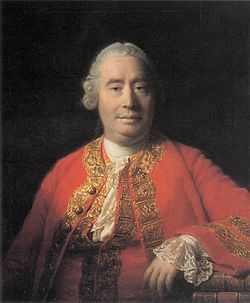
The is–ought problem, as articulated by the Scottish philosopher and historian David Hume, arises when one makes claims about what ought to be that are based solely on statements about what is. Hume found that there seems to be a significant difference between descriptive statements (about what is) and prescriptive statements (about what ought to be), and that it is not obvious how one can coherently transition from descriptive statements to prescriptive ones.
Hume's law or Hume's guillotine is the thesis that an ethical or judgmental conclusion cannot be inferred from purely descriptive factual statements.
A similar view is defended by G. E. Moore's open-question argument, intended to refute any identification of moral properties with natural properties, which is asserted by ethical naturalists, who do not deem the naturalistic fallacy a fallacy.
The is–ought problem is closely related to the fact–value distinction in epistemology. Though the terms are often used interchangeably, academic discourse concerning the latter may encompass aesthetics in addition to ethics.
Hume discusses the problem in book III, part I, section I of his book, A Treatise of Human Nature (1739):
In every system of morality, which I have hitherto met with, I have always remarked, that the author proceeds for some time in the ordinary way of reasoning, and establishes the being of a God, or makes observations concerning human affairs; when of a sudden I am surprised to find, that instead of the usual copulations of propositions, is, and is not, I meet with no proposition that is not connected with an ought, or an ought not. This change is imperceptible; but is, however, of the last consequence. For as this ought, or ought not, expresses some new relation or affirmation, it's necessary that it should be observed and explained; and at the same time that a reason should be given, for what seems altogether inconceivable, how this new relation can be a deduction from others, which are entirely different from it. But as authors do not commonly use this precaution, I shall presume to recommend it to the readers; and am persuaded, that this small attention would subvert all the vulgar systems of morality, and let us see, that the distinction of vice and virtue is not founded merely on the relations of objects, nor is perceived by reason.
Hume calls for caution against such inferences in the absence of any explanation of how the ought-statements follow from the is-statements. But how exactly can an "ought" be derived from an "is"? The question, prompted by Hume's small paragraph, has become one of the central questions of ethical theory, and Hume is usually assigned the position that such a derivation is impossible.
In modern times, "Hume's law" often denotes the informal thesis that, if a reasoner only has access to non-moral factual premises, the reasoner cannot logically infer the truth of moral statements; or, more broadly, that one cannot infer evaluative statements (including aesthetic statements) from non-evaluative statements. An alternative definition of Hume's law is that "If P implies Q, and Q is moral, then P is moral". This interpretation-driven definition avoids a loophole with the principle of explosion. Other versions state that the is–ought gap can technically be formally bridged without a moral premise, but only in ways that are formally "vacuous" or "irrelevant", and that provide no "guidance". For example, one can infer from "The Sun is yellow" that "Either the Sun is yellow, or it is wrong to murder". But this provides no relevant moral guidance; absent a contradiction, one cannot deductively infer that "it is wrong to murder" solely from non-moral premises alone, adherents argue.
Is–ought problem
The is–ought problem, as articulated by the Scottish philosopher and historian David Hume, arises when one makes claims about what ought to be that are based solely on statements about what is. Hume found that there seems to be a significant difference between descriptive statements (about what is) and prescriptive statements (about what ought to be), and that it is not obvious how one can coherently transition from descriptive statements to prescriptive ones.
Hume's law or Hume's guillotine is the thesis that an ethical or judgmental conclusion cannot be inferred from purely descriptive factual statements.
A similar view is defended by G. E. Moore's open-question argument, intended to refute any identification of moral properties with natural properties, which is asserted by ethical naturalists, who do not deem the naturalistic fallacy a fallacy.
The is–ought problem is closely related to the fact–value distinction in epistemology. Though the terms are often used interchangeably, academic discourse concerning the latter may encompass aesthetics in addition to ethics.
Hume discusses the problem in book III, part I, section I of his book, A Treatise of Human Nature (1739):
In every system of morality, which I have hitherto met with, I have always remarked, that the author proceeds for some time in the ordinary way of reasoning, and establishes the being of a God, or makes observations concerning human affairs; when of a sudden I am surprised to find, that instead of the usual copulations of propositions, is, and is not, I meet with no proposition that is not connected with an ought, or an ought not. This change is imperceptible; but is, however, of the last consequence. For as this ought, or ought not, expresses some new relation or affirmation, it's necessary that it should be observed and explained; and at the same time that a reason should be given, for what seems altogether inconceivable, how this new relation can be a deduction from others, which are entirely different from it. But as authors do not commonly use this precaution, I shall presume to recommend it to the readers; and am persuaded, that this small attention would subvert all the vulgar systems of morality, and let us see, that the distinction of vice and virtue is not founded merely on the relations of objects, nor is perceived by reason.
Hume calls for caution against such inferences in the absence of any explanation of how the ought-statements follow from the is-statements. But how exactly can an "ought" be derived from an "is"? The question, prompted by Hume's small paragraph, has become one of the central questions of ethical theory, and Hume is usually assigned the position that such a derivation is impossible.
In modern times, "Hume's law" often denotes the informal thesis that, if a reasoner only has access to non-moral factual premises, the reasoner cannot logically infer the truth of moral statements; or, more broadly, that one cannot infer evaluative statements (including aesthetic statements) from non-evaluative statements. An alternative definition of Hume's law is that "If P implies Q, and Q is moral, then P is moral". This interpretation-driven definition avoids a loophole with the principle of explosion. Other versions state that the is–ought gap can technically be formally bridged without a moral premise, but only in ways that are formally "vacuous" or "irrelevant", and that provide no "guidance". For example, one can infer from "The Sun is yellow" that "Either the Sun is yellow, or it is wrong to murder". But this provides no relevant moral guidance; absent a contradiction, one cannot deductively infer that "it is wrong to murder" solely from non-moral premises alone, adherents argue.
Recent media
Recent media