
Recent from talks
Religion in Eritrea
Knowledge base stats:
Talk channels stats:
Members stats:
Religion in Eritrea
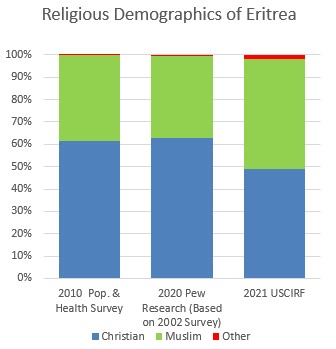
Religion in Eritrea consists of a number of faiths. The two major religions in Eritrea are Christianity and Islam. However, the number of adherents of each faith is subject to debate. Estimates of the Christian share of the population range from 47% and 63%, while estimates of the Muslim share of the population range from 37% to 52%.
Most Eritrean Christians belong to the Eritrean Orthodox Tewahedo Church, although a minority is affiliated with the Eritrean Catholic Church and various Protestant denominations. Eritrean Muslims are predominantly Sunni.
Apart from the officially recognized denominations of Christianity and Sunni Islam, all other faiths and denominations are in principle required to undergo a registration process; in practice they are not allowed to register. Among other things, the government's registration system requires religious groups to submit personal information on their membership to be allowed to worship.
There are two major religions in Eritrea: Christianity (four denominations) and Islam (only the Sunni school). However, the number of adherents is subject to debate.
The Kingdom of Aksum, covering much of modern-day Eritrea and the Tigray Region in northern Ethiopia, arose somewhere around the first or second centuries. The Aksumites erected a number of large stelae, which served a religious purpose in pre-Christian times. Over 200 years after the kingdom's formation, it adopted Christianity under King Ezana. Eritrea was also one of the first Islamic settlements in Africa, as a group of Muslims facing persecution in Mecca migrated to the Kingdom of Aksum. Islam spread to Ethiopia and Eritrea around 615 AD with the arrival of Uthman ibn Affan, one of the Sahabah (companions) of the Islamic prophet Muhammad. Uthman had been driven out of Hejaz and found shelter at Axum in the Tigray Region of Ethiopia under the protection of the Axumite king, Aṣḥama ibn Abjar.
Another great power came in the person of the Imam of Harar in Ethiopia, Ahmad ibn Ibrahim al-Ghazi, also known as Ahmad Gurey or Gragn. Al-Ghazi led Muslim forces consisting of Somali, Harari, Oromo, Afar, Saho, Argobba, Hadiya, Silte and Gurage soldiers from present-day Ethiopia, Eritrea, Djibouti and Somalia. In 1530 he began to attack the plateau. Within four years he laid waste to the majority of the Christian highlands, including the Tigray Region of Ethiopia.[citation needed] Only by surrender and conversion could people save their lives. Only the intervention of the Portuguese transformed the flow of events. They landed at Massawa in 1541 and helped the Eritreans and Ethiopians to drive the Imams forces from the plateau. The Muslim forces dispersed, retreated and disappeared.
Catholicism was first brought to Eritrea by the Jesuits in 1600. In 1632, the order was expelled from Eritrea for wanting to convert the country (an Orthodox country) to Catholicism. In the 19th century, the Italians began to bring Eritrea under their sphere of influence and introduced Roman Catholicism again. Missionaries appeared in the 19th century and established the Lutheran and Evangelical churches. These organizations have been allowed to continue to practice. New groups, however, have been discouraged from establishing a base in Eritrea.
During Italian colonialism, Catholicism became quite widespread, mostly due to Italian settlement in Eritrea. At the beginning of the 1940s nearly 28% of the population of Italian Eritrea were Catholic, most of whom were Italians. However, the number of Italians in Eritrea decreased at the end of WWII under British military administration (which also had religious violence between Christians and Muslims), and especially after Eritrea came under Ethiopian authority in 1950, thus diminishing the Catholic Church's importance.
Hub AI
Religion in Eritrea AI simulator
(@Religion in Eritrea_simulator)
Religion in Eritrea
Religion in Eritrea consists of a number of faiths. The two major religions in Eritrea are Christianity and Islam. However, the number of adherents of each faith is subject to debate. Estimates of the Christian share of the population range from 47% and 63%, while estimates of the Muslim share of the population range from 37% to 52%.
Most Eritrean Christians belong to the Eritrean Orthodox Tewahedo Church, although a minority is affiliated with the Eritrean Catholic Church and various Protestant denominations. Eritrean Muslims are predominantly Sunni.
Apart from the officially recognized denominations of Christianity and Sunni Islam, all other faiths and denominations are in principle required to undergo a registration process; in practice they are not allowed to register. Among other things, the government's registration system requires religious groups to submit personal information on their membership to be allowed to worship.
There are two major religions in Eritrea: Christianity (four denominations) and Islam (only the Sunni school). However, the number of adherents is subject to debate.
The Kingdom of Aksum, covering much of modern-day Eritrea and the Tigray Region in northern Ethiopia, arose somewhere around the first or second centuries. The Aksumites erected a number of large stelae, which served a religious purpose in pre-Christian times. Over 200 years after the kingdom's formation, it adopted Christianity under King Ezana. Eritrea was also one of the first Islamic settlements in Africa, as a group of Muslims facing persecution in Mecca migrated to the Kingdom of Aksum. Islam spread to Ethiopia and Eritrea around 615 AD with the arrival of Uthman ibn Affan, one of the Sahabah (companions) of the Islamic prophet Muhammad. Uthman had been driven out of Hejaz and found shelter at Axum in the Tigray Region of Ethiopia under the protection of the Axumite king, Aṣḥama ibn Abjar.
Another great power came in the person of the Imam of Harar in Ethiopia, Ahmad ibn Ibrahim al-Ghazi, also known as Ahmad Gurey or Gragn. Al-Ghazi led Muslim forces consisting of Somali, Harari, Oromo, Afar, Saho, Argobba, Hadiya, Silte and Gurage soldiers from present-day Ethiopia, Eritrea, Djibouti and Somalia. In 1530 he began to attack the plateau. Within four years he laid waste to the majority of the Christian highlands, including the Tigray Region of Ethiopia.[citation needed] Only by surrender and conversion could people save their lives. Only the intervention of the Portuguese transformed the flow of events. They landed at Massawa in 1541 and helped the Eritreans and Ethiopians to drive the Imams forces from the plateau. The Muslim forces dispersed, retreated and disappeared.
Catholicism was first brought to Eritrea by the Jesuits in 1600. In 1632, the order was expelled from Eritrea for wanting to convert the country (an Orthodox country) to Catholicism. In the 19th century, the Italians began to bring Eritrea under their sphere of influence and introduced Roman Catholicism again. Missionaries appeared in the 19th century and established the Lutheran and Evangelical churches. These organizations have been allowed to continue to practice. New groups, however, have been discouraged from establishing a base in Eritrea.
During Italian colonialism, Catholicism became quite widespread, mostly due to Italian settlement in Eritrea. At the beginning of the 1940s nearly 28% of the population of Italian Eritrea were Catholic, most of whom were Italians. However, the number of Italians in Eritrea decreased at the end of WWII under British military administration (which also had religious violence between Christians and Muslims), and especially after Eritrea came under Ethiopian authority in 1950, thus diminishing the Catholic Church's importance.
Recent media