Hubbry Logo
Isle of ElyIsle of ElyMain
Open search
Isle of Ely
Community hub
Isle of Ely
logo
8 pages, 0 posts
0 subscribers
Be the first to start a discussion here.
Isle of Ely
Isle of Ely
from Wikipedia

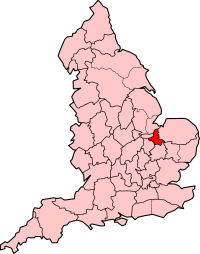
The Isle of Ely (/ˈli/) is a historic region around the city of Ely in Cambridgeshire, England. Between 1889 and 1965, it formed an administrative county.

Key Information

Toponymy

[edit]

Its name has been said to mean "island of eels", a reference to the fish that were often caught in the local rivers for food. This etymology was first recorded by the Venerable Bede.[1]

History

[edit]
1648 map by J Blaeu of Cambridgeshire with the Isle of Ely
1880 map of the Isle of Ely with nearby rivers

Until the 17th century, the area was an island surrounded by a large area of fenland, a type of swamp. It was coveted as an area easy to defend, and was controlled in the very early medieval period by the Gyrwas, an Anglo-Saxon tribe. Upon their marriage in 652, Tondbert, a prince of the Gyrwas, presented Æthelthryth (who became St. Æthelthryth), the daughter of King Anna of the East Angles, with the Isle of Ely. She afterwards founded a monastery at Ely, which was destroyed by Viking raiders in 870, but was rebuilt and became a famous Abbey and Shrine.

The area's natural defences led to it playing a role in the military history of England. Following the Norman Conquest, the Isle became a refuge for Anglo-Saxon forces under Earl Morcar, Bishop Aethelwine of Durham and Hereward the Wake in 1071.[2] The area was taken by William the Conqueror only after a prolonged struggle.[3] The story of Tom Hickathrift is sometimes set around this period. In 1139 civil war broke out between the forces of King Stephen and the Empress Matilda. Bishop Nigel of Ely, a supporter of Matilda, unsuccessfully tried to hold the Isle. In 1143 Geoffrey de Mandeville rebelled against Stephen, and made his base in the Isle. Geoffrey was mortally wounded at Burwell in 1144. [4]

In 1216, during the First Barons' War, the Isle was unsuccessfully defended against the army of King John. Ely took part in the Peasants' Revolt of 1381. During the English Civil War the Isle of Ely was held for the parliamentarians. Troops from the garrison at Wisbech Castle were used in the siege of Crowland and parts of the Fens were flooded to prevent Royalist forces entering Norfolk from Lincolnshire. The Horseshoe sluice on the river at Wisbech and the nearby castle and town defences were upgraded and cannon brought from Ely.[5]

The Fens were drained beginning in 1626 using a network of canals designed by Dutch experts.[6] Many Fenlanders were opposed to the draining as it deprived some of them of their traditional livelihood. Acts of vandalism on dykes, ditches, and sluices were common, but the draining was complete by the end of the century.[7]

Administration

[edit]
This plaque in Chatteris serves as a reminder of the Isle's county status

From 1109 until 1837, the Isle was under the jurisdiction of the Bishop of Ely who appointed a Chief Justice of Ely and exercised temporal powers within the Liberty of Ely. This temporal jurisdiction originated in a charter granted by King Edgar in 970, and confirmed by Edward the Confessor and Henry I to the abbot of Ely. The latter monarch established Ely as the seat of a bishop in 1109, creating the Isle of Ely a county palatine under the bishop. An act of parliament in 1535/6 ended the palatine status of the Isle, with all justices of the peace to be appointed by letters patent issued under the great seal and warrants to be issued in the king's name. However, the bishop retained exclusive jurisdiction in civil and criminal matters, and was custos rotulorum. A chief bailiff was appointed for life by the bishop, and performed the functions of high sheriff within the liberty, who also headed the government of the city of Ely.[8]

In July 1643 Oliver Cromwell was made governor of the isle.[9]

Liberty of Ely Act 1837
Act of Parliament
Long titleAn Act to explain and amend an Act of the Sixth and Seventh Years of His late Majesty, for extinguishing the Secular Jurisdiction of the Archbishop of York and the Bishop of Ely in certain Liberties in the Counties of York, Nottingham, and Cambridge.
Citation7 Will. 4 & 1 Vict. c. 53
Dates
Royal assent15 July 1837
Other legislation
Amended byStatute Law Revision Act 1874

The Liberty of Ely Act 1837 (7 Will. 4 & 1 Vict. c. 53) ended the bishop's secular powers in the Isle. The area was declared a division of Cambridgeshire, with the right to appoint justices revested in the crown. Following the 1837 act the Isle maintained separate Quarter Sessions, and formed its own constabulary.

Under the Local Government Bill of 1888, which proposed the introduction of elected county councils, the Isle was to form part of Cambridgeshire. Following the intervention of the local member of parliament, Charles Selwyn, the Isle of Ely was constituted a separate administrative county in 1889. The county was small in terms of both area and population, and its abolition was proposed by the Local Government Boundary Commission in 1947.[10] The report of the LGBC was not acted upon, and the administrative county survived until 1965. Following the recommendations of the Local Government Commission for England, on 1 April 1965 the bulk of the area was merged to form Cambridgeshire and Isle of Ely, with the Thorney Rural District going to Huntingdon and Peterborough.

Subdivisions

[edit]

In 1894 the county was divided into county districts, with the rural districts being Ely Rural District, Thorney Rural District, Whittlesey Rural District, Wisbech Rural District, North Witchford Rural District, and the urban districts were Ely, March, Whittlesey and Wisbech (the only municipal borough). Whittlesey Rural district consisted of only one parish (Whittlesey Rural), which was added to Whittlesey urban district, in 1926.

The Isle of Ely parliamentary constituency was created as a two-member seat in the First and Second Protectorate Parliaments from 1654 to 1659. The constituency was re-created with a single seat in 1918. In the boundary changes of 1983 it was replaced by the new constituency of North East Cambridgeshire. Original historical documents relating to the Isle of Ely are held by Cambridgeshire Archives and Local Studies at the County Record Office in Ely.

Medieval parishes

[edit]

Chapelries are listed in italics. Parishes are listed by hundred.

Hundred Parishes
Ely DownhamEly St Mary (Chettisham) • Ely Trinity (Stuntney) • Littleport
North Witchford ChatterisDoddington (BenwickMarch) • Whittlesey St AndrewWhittlesey St Mary (EastreaEldernell)
South Witchford Coveney (Manea) • HaddenhamMepalStretham (Thetford) • SuttonWentworthWilburtonWitchamWitchford
Wisbech ElmLeverington (Parson Drove) • Newton (Newton St Mary) • ThorneyTydd St GilesWisbech St Peter (GuyhirnMurrowWisbech St Mary)

Marquessate

[edit]

The title Marquess of the Isle of Ely was created in the Peerage of Great Britain for Prince Frederick. The title of Duke of Edinburgh was first created on 26 July 1726 by King George I, who bestowed it on his grandson Prince Frederick, who became Prince of Wales the following year. The subsidiary titles of the dukedom were Baron of Snowdon, in the County of Caernarvon; Viscount of Launceston, in the County of Cornwall; Earl of Eltham, in the County of Kent;[11] and Marquess of the Isle of Ely. The marquessate was apparently erroneously gazetted as Marquess of the Isle of Wight[11] although Marquess of the Isle of Ely was the intended title. In later editions of the London Gazette the Duke is referred to as the Marquess of the Isle of Ely.[12][13] Upon Frederick's death, the titles were inherited by his son Prince George. When he became George III in 1760, the titles "merged into the Crown", and ceased to exist.

Mining

[edit]

Coprolites were mined in the area in the 1800s for their rich phosphate content.[14][15]

References

[edit]
[edit]
Revisions and contributorsEdit on WikipediaRead on Wikipedia
from Grokipedia
![EnglandIsleOfEly1890.png][float-right]
The Isle of Ely is a historic region in Cambridgeshire, England, centred on the city of Ely and consisting of relatively high ground that formed the largest island amid the surrounding Fenland marshes, rendering it accessible chiefly by boat until systematic drainage in the 17th century connected it to the mainland. The name derives from the Anglo-Saxon Eilig, meaning "Isle of Eels," reflecting the abundance of eels in the adjacent waters, which even served as a form of currency for rents. Established as a religious site in 673 AD by Saint Ætheldreda, who founded a double monastery there, the region gained prominence with the construction of Ely Cathedral starting in 1083 and its elevation to diocesan status in 1109, making it one of England's wealthiest abbeys until the Dissolution. In the 11th century, the Isle served as a stronghold for Anglo-Saxon resistance to the Norman Conquest, where Hereward the Wake led a prolonged rebellion against William the Conqueror from its defensible marshes around 1070–1071. Administratively, it enjoyed liberties with royal-like jurisdiction granted by charters from King Edgar in 970 and later confirmed, evolving into a separate county council from 1889 until 1965.

Etymology and Geography

Toponymy

The name "Ely" derives from Old English *ǣlġē, a compound of *ǣl ('eel') and ġē ('district'), denoting a region abundant in eels due to the fenland waterways. The term "Isle of Ely" incorporates "isle" from Old English ēg ('island' or 'dry ground in marsh'), underscoring the area's elevation above surrounding wetlands, which rendered it insular in character prior to 17th-century drainage. This descriptive nomenclature reflects the landscape's hydrological isolation rather than a strictly tidal island. Attestations in early sources include "Elig" in the , linking the site to 7th-century monastic foundations amid . By the of 1086, the region appears under variants approximating "Ely," distinguishing its holdings from continental Norman precedents. Medieval charters, such as those from the 12th–13th centuries, consistently employ "Isle of Ely" (Latin Insula de Ely) to demarcate ecclesiastical and temporal lands separate from broader , preserving the toponym despite gradual landscape modifications. Alternative derivations, including Percy H. Reaney's proposal in his 1943 English Place-Name Society volume of a Nordic root implying 'muddy ,' have been advanced but lack the empirical support of the eel-based interpretation, which aligns with documented faunal abundance and linguistic parallels in fen-edge settlements. The name's endurance post-drainage—completed largely by 1650—attests to its entrenched usage in administrative and cultural records.

Physical Geography and Formation

The Isle of Ely consists of a low ridge of glacial emerging from the surrounding deposits of the Fenland basin in eastern . This elevated terrain, primarily composed of resistant chalky () overlying , reaches a maximum height of approximately 39 meters (128 feet) above at points such as Haddenham, while the core around Ely stands at about 26 meters (85 feet) above . The till's nature derives from incorporated fragments, providing a substrate more suitable for certain than the adjacent acidic peats. Geologically, the Isle formed during the Pleistocene Anglian glaciation around 450,000 years ago, when ice sheets advanced across the region, depositing a thick layer of diamicton known as Chalky-Jurassic Till, commonly referred to as boulder clay due to its clay-rich matrix with embedded stones. This deposit proved more erosion-resistant than the underlying softer sediments and surrounding lowlands, which subsided under subsequent fluvial and marine influences, preserving the Isle as a distinct topographic feature amid the developing Fenland. Glacial sands and gravels locally overlie or interbed with the till, contributing to the varied superficial geology. In the epoch, following glacial retreat, relative sea-level rise—driven by eustatic changes and isostatic adjustments—facilitated marine incursions into the Fenland basin, promoting organic accumulation and formation up to several meters thick in surrounding areas. This process, combined with autogenic mire growth, effectively isolated as a dryland enclave bounded by meandering waterways like the River Great Ouse, rendering it accessible primarily by boat until later modifications. The contrast between the Isle's soils and the impermeable, water-retentive peats of underscored its environmental distinctiveness, influencing hydrology and early landscape stability.

History

Prehistoric and Roman Periods

Archaeological evidence indicates activity in the Isle of Ely region through stray finds of lithic implements, suggesting transient use of fen edges for hunting and resource gathering in environments. Pollen cores from fenland sites reveal a of forested wetlands during this period, supporting seasonal exploitation rather than . artifacts, including polished axes and scatters, point to continued intermittent occupation focused on the higher ground and fen margins, with evidence of early land clearance. By the , activity intensified around sites like to the south, where timber platforms and causeways facilitated access across marshes, though direct evidence within the Isle remains sparse and tied to ritual or resource sites. settlements emerged from approximately 400–300 BC, featuring enclosures and permanent occupations on islands and elevated silts, as excavated at West Fen Road, Ely, indicating organized exploitation of the fen margins for and . Trackways, including constructions of brushwood and timber, crossed the wetlands, enabling connectivity amid rising water levels. Roman influence from the AD onward emphasized industrial exploitation over dense settlement, with the marshy terrain limiting villas or towns; instead, salterns for salt production proliferated on coastal silts, as evidenced by excavations at and yielding hearths, briquetage, and waste dumps dated to the 2nd–4th centuries. Rural farmsteads and enclosures appeared sporadically, such as at Lancaster Way, Ely, but remained peripheral to the broader agrarian network. Roads like the Via Devana, extending northwest from through , integrated the region into military and trade routes, with branches facilitating access to fen resources despite the challenging topography.

Anglo-Saxon Era and Norman Conquest

The Isle of Ely's prominence amid the surrounding fenlands rendered it a strategic refuge during Anglo-Saxon instability, particularly against Viking incursions that ravaged eastern from the late onward. Ely Abbey, a for monks and nuns, was established circa 673 by , an East Anglian princess and of , on the site's sole hill to foster monastic self-sufficiency through agriculture and isolation from secular disturbances. The abbey's destruction by Danish raiders in 870 exemplified the region's vulnerability, yet its refounding under King Edgar around 970 restored its role as a spiritual and defensive bastion, leveraging the ' inaccessibility for protection. Following William the Conqueror's victory at in , the Isle of Ely emerged as a focal point of Anglo-Saxon resistance during the Norman consolidation of power. In 1070, , an exiled English , launched a guerrilla campaign from the island's marshy fastnesses, exploiting the terrain's bogs and waterways to evade Norman forces and raid their holdings, as chronicled in the medieval Gesta Herewardi. Joined by Danish allies under Sweyn Estrithson and figures like Earl Morcar, Hereward's forces briefly controlled Ely Abbey, using it as a base until 1071. Norman countermeasures emphasized engineering and to overcome ' defenses. William dispatched armies to construct causeways, including one at Aldreth that initially collapsed under assault, while erecting motte-and-bailey castles, such as at Aldreth and directly in Ely around 1070, to project control and suppress rebels. by monastic guides facilitated the island's fall in 1071, scattering Hereward's band, though his evasion underscored ' enduring tactical value. The transition to Norman ecclesiastical oversight culminated in 1109, when King Henry I and Archbishop Anselm elevated Ely Abbey to a bishopric, carving the from Lincoln's territory and appointing Abbot Hervey le Breton as the first , thereby integrating the isle into centralized feudal and church structures. This reform subordinated the former abbey's autonomy to episcopal authority, marking the erosion of Anglo-Saxon monastic independence in favor of Norman administrative hierarchies.

Medieval Development and Ecclesiastical Power

The construction of the present Ely Cathedral commenced in 1083 under Abbot Simeon, the first Norman abbot of the Benedictine monastery, replacing earlier Anglo-Saxon structures and symbolizing the consolidation of ecclesiastical authority in the region. The monastery, elevated to a bishopric in 1109, amassed substantial wealth through tithes on agricultural produce and fisheries, with annual rentals including monetary payments of 56s. 4d. alongside 14,500 eels from fenland tenants, underscoring the economic reliance on local resources like eel fisheries that served as a form of medieval . This revenue supported extensive , as evidenced by charters delineating episcopal estates and servile tenancies graded by holding size. The Bishop of Ely's temporal jurisdiction over the Isle of Ely formed a medieval liberty with quasi-palatine powers, akin to those of counties palatine, enabling the bishop to exercise king-like authority including pardons for felonies within the territory. Episcopal manors, such as those at Doddington and Little Downham, functioned as administrative centers for estate oversight, while palaces like the one adjoining the cathedral in Ely facilitated governance and hosted royal visits, reinforcing the see's semi-autonomous status. These holdings, managed through customary feudal obligations, granted the bishopric influence over local justice, taxation, and infrastructure like roadways. Tensions arose from the burdens of these obligations, exemplified by peasant resistance against demands at manors such as Brandon in , where disputes over servile dues escalated into localized revolts between circa 1300 and 1381, highlighting conflicts between landlords and tenants amid broader agrarian pressures. Such episodes reflected the friction inherent in the church's dominant role, where manorial courts enforced labor services and fines, yet charters occasionally recorded concessions to mitigate unrest and sustain productivity on fen-edge estates.

Post-Medieval Changes and Civil War

The under culminated in the suppression of Ely Abbey on November 10, 1539, marking a pivotal shift in within the Isle of Ely. Although the abbey's church was promptly refounded as the Cathedral Church of the Holy Trinity with a dean and chapter inheriting substantial monastic estates to sustain the new ecclesiastical structure, smaller religious houses in the vicinity, such as Denny Abbey, were fully dissolved and their properties alienated to before being granted or sold to secular landowners. This transfer redirected former monastic rental incomes—estimated in national surveys like the Valor Ecclesiasticus at significant annual yields for larger houses, though specific Ely figures reflect pre-dissolution ecclesiastical control over fen pastures and arable—toward gentry families, fostering lay investment in and early drainage efforts amid the region's persistent flooding. During the (1642–1651), the Isle of Ely's fenland isolation conferred strategic military utility, serving primarily as a Parliamentarian stronghold from which , as member of Parliament for , recruited and quartered troops. Royalist incursions, including attempts to capture the cathedral city in early 1643, were repelled, underscoring the area's defensibility against besiegers but also its role in broader Eastern Association campaigns led by Cromwell against positions in adjacent , such as the June 1643 siege of . The conflict disrupted nascent drainage initiatives, exacerbating flood risks and economic stagnation, yet highlighted ' tactical value for maneuver and supply in . Post-war, under the regime, renewed advocacy for systematic fen drainage emerged, with Cromwell's government facilitating resumption of pre-war projects to enhance agricultural output and revenue. Seventeenth-century enclosure debates pitted projectors against commoners, who rioted against loss of grazing commons, but Dutch-engineered interventions, spearheaded by from 1630 onward under the Earl of Bedford's syndicate, constructed cuts like the Old Bedford River to redirect waters, empirically curtailing inundations that previously rendered vast tracts unproductive. These efforts, accelerating after 1650, diminished prevalence—termed "fen ague" from mosquito vectors in stagnant pools—while converting wetlands to arable, yielding documented uplifts in land productivity as shrinkage stabilized post-drainage, though initial challenged sustainability.

Modern Administrative and Economic Shifts

The Isle of Ely was established as a distinct by the Local Government Act 1888, which separated it from the residual county of effective 1 April 1889, reflecting its longstanding status as a historic with unique jurisdictional privileges. This arrangement enabled independent local governance through the Isle of Ely County Council, handling responsibilities such as , highways, and until the mid-20th century. On 1 April 1965, the Isle of Ely was merged with Cambridgeshire under the Cambridgeshire and Isle of Ely Order 1964 to form a new administrative county of Cambridgeshire and Isle of Ely, prompted by recommendations to consolidate smaller units for efficient service provision. This entity endured only until 1 April 1974, when the Local Government Act 1972 restructured it by combining it with Huntingdon and Peterborough into the modern county of Cambridgeshire, eliminating separate administrative recognition of the Isle while integrating its parishes into larger districts. The reforms, aimed at standardizing non-metropolitan counties with populations suitable for unified administration, nonetheless preserved informal local attachments to the Isle's fenland heritage amid broader national centralization. Economic connectivity advanced with the opening of on 30 July 1845 by the Eastern Counties Railway, linking the region to and and spurring agricultural exports from reclaimed fenlands. infrastructure, including RAF Witchford (opened 1943 as a bomber station) and nearby RAF Mepal, further modernized transport networks through runways and ancillary facilities that transitioned to civilian use postwar. These developments correlated with demographic expansion, from 63,861 residents in the 1891 to 89,180 by 1961, driven by enhanced access to markets and labor opportunities in farming and .

Governance and Administration

Historical Administrative Status

The Isle of Ely operated as a distinct with palatine-like privileges under the , stemming from the establishment of the in 1109 by King Henry I, who granted the bishop temporal authority over the region alongside spiritual oversight. This jurisdiction encompassed the right to convene courts, appoint a , levy taxes independently, and exercise limited powers of pardon for offenses committed within the Isle, enabling autonomous governance tailored to the challenges of fenland maintenance and drainage. These powers originated from earlier royal charters to the monastic house, such as King Edgar's grant of 970, which endowed the abbey with the Isle's appurtenances and immunities, privileges transferred to the bishopric upon its creation. The Bishop's authority mirrored aspects of counties palatine like Durham, where prelates held quasi-regal powers, though Ely was formally a royal franchise rather than a full palatinate, with strictly limited to the Isle's boundaries to preserve local control amid the surrounding marshes. Parliamentary legislation during Henry VIII's reign, including statutes designating the Isle as a in its own right by 1536, affirmed these boundaries and rights, ensuring the bishopric's continuity after the in 1539 while curtailing some monastic claims. This framework persisted for centuries, underscoring the Isle's exceptional status separate from proper. The temporal powers of the were abolished by the Liberty of Ely Act 1837, which vested jurisdiction in and aligned the area with standard county administration, ending the bishop's role in secular courts and taxation within the Isle.

Subdivisions and Local Governance

The historic region of the is now administratively subdivided primarily between District and within , with civil parishes serving as the lowest tier of local governance. Key parishes in include the city parish of Ely, and the town parishes of and , each with their own parish or town councils handling local matters such as community facilities and minor planning. These parishes operate under the two-tier system of District Council for district-level services like and , and for upper-tier responsibilities including and . Parts of the former Isle of Ely extend into , encompassing parishes such as and Doddington, where similar parish governance applies under Fenland District Council. Fenland's boundaries overlap with historic Isle of Ely territories defined under the Local Government Act 1972, which reorganized non-metropolitan districts without altering the fenland's core drainage dependencies. Local governance in these overlapping fen areas includes specialized water management by the Ely Group of Internal Drainage Boards, which maintain boundaries and operations under the Land Drainage Act 1991 for flood defense and land drainage in districts covering approximately 100 square kilometers around Ely. Electoral divisions for within the former Isle of Ely area include single-member divisions such as Ely, , and South, alongside multi-member divisions like Soham North and Stretham, elected via first-past-the-post in 2021. These divisions align with district wards, for instance Ely East (population 4,800 in 2021), Ely West (5,200), (11,000), and Soham North/South (combined 12,500), reflecting census distributions concentrated in fen-edge settlements. Representation totals four county councillors from divisions tied to Isle of Ely parishes, with boundaries periodically reviewed by the Local Government Boundary Commission for to ensure electoral parity.

Medieval Parishes and Ecclesiastical Divisions

The medieval ecclesiastical divisions of the Isle of Ely were organized into parishes subordinate to the , who exercised palatine authority over the liberty encompassing the hundreds of Ely, Witchford, and , as delineated in 13th-century court rolls and charters. This structure derived from the pre-Conquest Abbey of Ely's holdings, with recording key settlements like Ely (92 households in 1086, including 20 ploughlands and fisheries valued at £30 annually) and adjacent manors such as Haddenham under monastic tenure. Core parishes, including Ely St. Mary (erected 1198–1215 with dependent chapels at Stuntney and Little Thetford) and demesne-linked units like and Witchford, formed the territorial basis for collection and spiritual oversight, with corn-tithes centralized in structures such as the Sextry Barn. Lay subsidies from the , including the 1327 twentieth tax, provide demographic and economic insights, with contributing over one-sixth of Cambridgeshire's total yield despite fiscal immunities, highlighting wealth disparities—bishopric core areas like Ely yielded higher assessments than fen-edge parishes due to arable demesnes and manorial profits, while taxation shifted to royal commissioners post-1270 amid eroding exemptions. These rolls, preserved in records (e.g., E 179/81/6), underscore dependencies tying economies to episcopal courts, which adjudicated agrarian disputes and enforced feudal services across 10 hides in Ely alone per Domesday. Peculiar jurisdictions, exempt from broader diocesan or royal oversight, characterized the liberty's manors and hundreds, where the bishop's Elyensis and justices of assize handled pleas, jail delivery, and courts independently of county sheriffs—a privilege confirmed by Edward III's 1343 and documented in Wisbech hundred rolls from Edward I's reign, persisting until the dismantled such immunities. Parishes under these divisions managed via alms and churchwardens prior to statutory provisions, while overseeing through in episcopal surveys, ensuring communal grazing and drainage obligations before 17th-century enclosures altered fenland tenures.

Economy and Land Use

Fen Drainage and Agricultural Transformation

The drainage of the Fens in and around the Isle of Ely began in 1630, when Francis Russell, 4th Earl of , commissioned Dutch engineer to reclaim approximately 95,000 acres of marshland under royal authorization from King Charles I. Vermuyden's engineering included cutting the 21-mile Old Bedford River from Earith to Denver Sluice and later introducing washes in the 1650s to accommodate periodic flooding, transforming waterlogged bogs into arable fields. This initial effort, funded by the Bedford Level and associates dubbed the Gentleman Adventurers, shifted the local economy from seasonal wildfowling and fishing to year-round crop production on the exposed fertile soils. By the 18th and 19th centuries, parliamentary acts facilitated further land rationalization and drainage enhancements, replacing open commons with consolidated holdings amenable to modern techniques. The adoption of steam-powered pumping engines, such as the 1831 Stretham Old Engine, addressed persistent flooding exacerbated by shrinkage, sustaining agricultural viability across the region. These measures enabled intensive cultivation of grains, , and root crops, yielding productivity gains that supported Britain's expanding population and food needs, with ' peat lands proving exceptionally responsive to arable farming post-reclamation. Drainage profoundly improved health outcomes by lowering water tables and eliminating breeding grounds in stagnant pools, curtailing the prevalence of —termed "fen ague"—which had plagued inhabitants for centuries. This reduction in incidence, coupled with expanded farmland, fostered demographic expansion in the Isle of Ely, as habitable and economically productive land attracted settlers and investment. Although shrinkage of drained led to rates that depressed land levels by about 6 meters below adjacent rivers over time, necessitating continuous pumping, the overall causal benefits in caloric output and national from the converted acreage substantially exceeded these drawbacks. The reclaimed , including Ely's environs, became a cornerstone of English , prioritizing empirical gains in output over preservation of pre-drainage conditions.

Mining and Natural Resource Extraction

Peat extraction for fuel, known locally as turf cutting, has occurred in the Isle of Ely since , utilizing the region's extensive fen deposits that reach depths of several meters across approximately 300,000 acres. This activity supplied households and industries until the , with transported initially by along drainage channels and later by rail as infrastructure developed in the . Production continued in areas like Woodwalton Fen into , where it was sold for local fuel and , though quantities diminished with fen drainage efforts that prioritized agricultural conversion over resource removal. Clay quarrying, particularly of , supported brick and tile production tied to construction demands around Ely from the 15th century onward, with workings documented at sites including , Downham, and Southery in the Isle of Ely. clay deposits further enabled widespread brick-making in 19th- and early 20th-century , including the region, fueling local building booms amid fenland development. Gravel extraction occurred on a smaller scale, primarily from river terrace deposits, but lacked the industrial prominence of peat or clay due to the fenland's sedimentary dominance. Post-World War II, extraction activities declined sharply as mechanized farming expanded on drained lands, reducing demand for traditional peat fuel and limiting quarrying amid shifting economic priorities. This transition exacerbated land from peat oxidation and shrinkage, with historical rates in reaching up to 3 cm per year over periods like 1845–1973, though contemporary averages fall below 1 cm annually in managed areas. Such , averaging 0.27–2.8 cm yearly in fen peat soils, underscores the long-term environmental costs of prior extraction and drainage practices.

Industrial and Contemporary Economic Activities

The economy of the Isle of Ely has diversified in the 20th and 21st centuries beyond , with and trading emerging as significant activities, particularly in potato supply chains. Companies such as Isle of Ely Produce, based in , handle procurement, trading, and marketing of es and fresh produce for wholesalers, food services, and processors across the and , leveraging the region's fertile fenland soils. Tourism has become a cornerstone of contemporary economic activity, primarily fueled by , which draws around 150,000 visitors annually, contributing to local retail, hospitality, and related services. This sector supports self-sufficiency efforts outlined in local masterplans, which emphasize business growth and visitor infrastructure to retain economic output in manufacturing, property, and retail. In , which includes the Isle of Ely, the service sector predominates in employment, with business and public service associations forming the largest job category among approximately 39,000 total jobs as of 2021 data. The district's proximity to the technology corridor drives commuting to knowledge-intensive roles, underpinning robust employment growth of 2.4% per annum from 2018 to 2024, with knowledge-intensive sectors expanding at 2.7% annually. Infrastructure enhancements mitigate connectivity and environmental challenges, including upgrades to the A142, such as the £1 million Lancaster Way improvements completed in 2021, which added and cyclist facilities, and the Ely Southern Bypass opened in 2018 to alleviate congestion linking the A142 to the A10. These investments support economic resilience amid the fenland's inherent vulnerabilities.

Peerage and Associated Titles

Marquessate of Ely

The Marquessate of Ely, of the County of Wexford, was created in the on 13 December 1800 for Charles Tottenham-Loftus (1738–1806), an Anglo-Irish politician who had assumed the additional surname Loftus in 1785 upon inheriting substantial estates from his maternal uncle, Henry Loftus, 1st Earl of Ely (whose peerages had become extinct on his death in 1766). This elevation built on Loftus's prior titles in the Irish peerage—Baron Loftus of (1785), Viscount Loftus (1789), and Earl of Ely (1794)—which traced descent through the Tottenham-Loftus lineage connected to earlier Loftus viscountcies, including the short-lived Viscountcy of Loftus created in 1756. The marquessate's combined the Loftus arms (, a chevron ermine between three lozenges or) with those of the Tottenham family (argent, a chevron gules between three trefoils slipped vert), reflecting the merged inheritance. Upon the 1st Marquess's death on 22 March 1806, the title passed to his eldest surviving son, John Loftus (1770–1845), 2nd Marquess, a Knight of the Garter who served as of the King's County. Succession continued through the Loftus line: the 3rd Marquess, John Henry Loftus (1814–1857), eldest son of the 2nd Marquess's deceased eldest son; followed by the 4th Marquess, John Henry Wellington Graham Loftus (1849–1889), son of the 3rd. The 5th Marquess, John Loftus (b. circa 1851–1889), brother to the 4th, died without male issue on 1 December 1889, prompting the title's passage to collateral kin. Thereafter, the marquessate devolved through remaining male descendants of the founding Tottenham-Loftus stock, shifting to the Tottenham surname in later generations as the direct Loftus male line concluded. The 6th Marquess, George Herbert Loftus (1854–1935), was a cousin via the 2nd Marquess's brother; he was succeeded by his son, George Henry Wellington Loftus (1903–1969), 7th Marquess. The 8th Marquess, Charles John Tottenham (1913–2006), and current 9th Marquess, John Henry Joshua Tottenham (b. 1943), represent the Tottenham branch, inheriting via male descent from cadet lines of the original family. Subsidiary titles, such as the earldom, have endured alongside the marquessate, with estates including in passing with the peerage. No revivals occurred, as the title avoided extinction through consistent male succession per the original .

Cultural and Heritage Aspects

Religious Sites and Cathedral

Ely Cathedral, the principal religious site in the Isle of Ely, originated as a monastic foundation established by Saint Etheldreda in 673, with the current structure's construction commencing in 1083 under Abbot Simeon and receiving cathedral status in 1109. The building served as the seat of the Diocese of Ely, encompassing a Romanesque and later Gothic elements, including the presbytery extended between 1234 and 1252. Its most distinctive feature, the and Lantern Tower, was engineered in the 1320s following the collapse of the original crossing tower on 13 February 1322; this replacement utilized a massive wooden vault and framework, comprising approximately 400 tons of timber clad in lead, rising 142 feet to illuminate the crossing while distributing structural loads through eight stone piers. Monastic remnants persist around the cathedral precinct, including the Prior's House and dating to the 12th and 13th centuries, which represent the earliest surviving buildings from the Benedictine era, alongside fragments of the prior's kitchen with its large fireplaces. The shrine of Saint Etheldreda, housing her relics and central to the site's pre-Reformation devotional functions, was dismantled in 1541 amid the , though historical records note the dispersal of her remains, with claims of archaeological continuity in preserved elements like panels repurposed post-destruction. Following the abbey's suppression in 1539, the cathedral was refounded by in 1541 under a dean and eight canons, transitioning to serve as the diocesan hub while the functioned as the of Holy Trinity until 1938, ensuring ongoing liturgical use without interruption. This adaptation preserved the structure's role in local worship, with the precinct's ecclesiastical layout—encompassing , chapter house, and sites—reflecting medieval monastic adapted for post-Reformation governance.

Notable Historical Figures and Events

Æthelthryth, also known as Etheldreda (c. 636–679), an East Anglian princess who became queen of , established a for men and women on of Ely around 673, leveraging its isolated, elevated position amid the surrounding . She retreated there after separating from her second husband, King Ecgfrith, to pursue a religious life, serving as abbess until her death from plague on 23 June 679. The Venerable , in his Ecclesiastical History of the English People (completed 731), recounts her vow of chastity upheld through both marriages and notes that her body, exhumed in 695, showed no signs of decay—a phenomenon interpreted as miraculous evidence of sanctity, with her relics later enshrined and drawing pilgrims. This account, drawn from contemporary monastic records, underscores the Isle's early role as a spiritual refuge, though later hagiographies amplified supernatural elements without independent verification. In 1070, Anglo-Saxon thegn Hereward, known as "the Wake" for his vigilance, led a rebellion against Norman rule from the Isle of Ely, allying with disinherited English nobles and Danish forces under Sweyn Estrithson to exploit the region's marshy inaccessibility as a base. The uprising, centered at Ely Abbey under Abbot Thurstan's initial support before his flight, involved raids on Peterborough Abbey and held out until William the Conqueror constructed a causeway across the fens in 1071, employing local guides to breach defenses and suppress the revolt by early 1072. Gesta Herewardi, a 12th-century Latin text attributed to a monk of Ely, portrays Hereward's exploits as heroic resistance, though its semi-legendary nature blends verifiable Norman chronicles—like the Anglo-Saxon Chronicle's mention of the siege—with folkloric embellishments; primary evidence confirms the event's occurrence and the Isle's strategic value as a "camp of refuge" but not all attributed feats. Oliver Cromwell resided on the Isle of Ely from 1636 to 1646, inheriting his uncle's house at 29 St Mary's Street and serving as collector for the , a role that immersed him in local fenland disputes over and royal drainage schemes. As MP for from 1640, he initially resisted King Charles I's fen drainage initiatives in , prioritizing opposition to royal prerogatives over agricultural improvement, though post-1649 records show his administration advancing and pumping to reclaim from seasonal flooding. This period marked Cromwell's transition from local farmer to national figure, with Ely's insular geography mirroring the defensive isolation he later employed in military campaigns, as evidenced by his governance records and correspondence.

Preservation and Modern Significance

The Ely Pits and Meadows, located on the southeastern outskirts of Ely, is designated as a Site of Special Scientific Interest (SSSI) for its geological significance, including Jurassic marine reptile fossils, and biological value as a breeding ground for nationally important bird populations such as bitterns. This protection underscores broader fenland conservation efforts, where SSSI designations cover over 8,900 hectares across the Fens, balancing habitat preservation with the region's engineered drainage systems that prevent flooding and sustain arable land. In the 2020s, policy debates have intensified over rewilding proposals versus agricultural productivity, with government incentives explored to convert farmland to natural habitats for biodiversity gains, potentially offsetting losses through enhanced ecosystem services like soil protection and pest control that could indirectly boost adjacent crop yields. However, such shifts face resistance from farmers, as the Fens encompass half of England's most productive soil, yielding 37% of national vegetables including celery, where rewilding risks undermining food security and local livelihoods tied to intensive cultivation enabled by historical drainage. Tourism infrastructure, including riverside paths along the River Great Ouse, supports Ely's appeal as a visitor destination, drawing 1.25 million tourists annually and generating an estimated £91 million for the local through heritage sites and . These paths facilitate access to fenland landscapes without compromising drainage-maintained , contributing to GDP via sustainable activities that highlight the area's transformed rather than inherent fragility. Cultural festivals like the annual Eel Festival preserve the Isle of Ely's heritage, commemorating eels as a historical staple diet and economic from , with parades and events fostering community identity and on adaptive land use. Educational initiatives emphasize the 17th-century drainage projects led by engineers like , which converted marshlands into fertile farmland through dykes and pumps, demonstrating human engineering's causal role in enabling high-yield agriculture over unmanaged wetlands. This focus counters underemphasis on reclamation benefits, underscoring productivity gains from interventionist approaches in policy discussions.

References

Add your contribution
Related Hubs
User Avatar
No comments yet.