
Recent from talks
Isleworth
Knowledge base stats:
Talk channels stats:
Members stats:
Isleworth
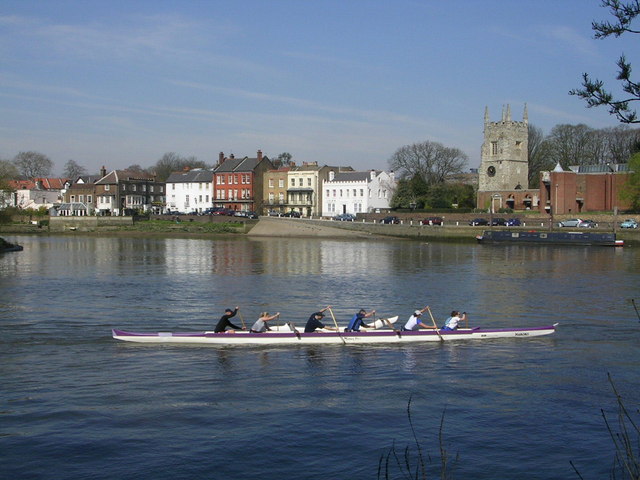
Isleworth (/ˈaɪzəlwəθ/ ⓘ EYE-zəl-wərth) is a suburban town in the London Borough of Hounslow, West London, England.
It lies immediately east of Hounslow and west of the River Thames and its tributary the River Crane. Isleworth's original area of settlement, alongside the Thames, is known as Old Isleworth. The northwest corner of the town, bordering on Osterley to the north and Lampton to the west, is known as Spring Grove.
Isleworth's former Thames frontage of approximately one mile, excluding that of the Syon Park estate, was reduced to little over half a mile in 1994 when a borough boundary realignment was effected in order to unite the district of St Margaret's wholly within London Borough of Richmond upon Thames. As a result, most of Isleworth's riverside is that part overlooking the 8.6-acre (3.5 ha) islet of Isleworth Ait: the short-length River Crane flows into the Thames south of the Isleworth Ait, and its artificial distributary the Duke of Northumberland's River west of the Isleworth Ait, one of two Colne distributaries constructed for aesthetic reasons between 1600 and 1750. The town is the birthplace of broadcaster David Attenborough.
Excavations around the eastern end of the Syon Park estate have unearthed evidence of a Romano-British settlement. 'Gislheresuuyrth', meaning in Old English Enclosure belonging to [a man called] Gīslhere, is first referred to as a permanent settlement in an Anglo-Saxon charter in the year 695. The Domesday Book says that during the reign (1042–1066) of Edward the Confessor the manor belonged to "Earl Algar" (probably Ælfgar of Mercia), and a modern road off South St today carries his name.
Isleworth was a well-cultivated farming and trading settlement, more valuable than many of its neighbours, stretching from the Middlesex bank of the River Thames west to the centre of Hounslow (including the land of later Hounslow Priory) and as far as the borders of Southall (in Hayes parish at the time) at the time of the Norman Conquest in 1066. The Domesday Book (1086) as Gistelesworde records its 55 ploughlands, 118 households and amount rendered, £72 per year, to its feudal system overlords. After the Conquest, successive Norman barons of the St Valeri family held the manor of Isleworth but there is no evidence that they ever lived there – it being held as a source of revenue and power. One of the later barons gave several manorial rents and privileges to London's Hospital of St Giles. He also gave the church and advowson to the Abbey of St Valeri, which stood at the mouth of the Somme in Picardy.
In 1227, when he took control of England from his childhood regents, Henry III seized Isleworth and other property of the St Valeri family and gave the manor to his brother, Richard, 1st Earl of Cornwall. He built a new moated manor house, which is described in the Black Book of the Exchequer – having a tiled roof, chimney, two bedchambers and an inner courtyard. Beyond the moat was an outer courtyard with a number of buildings for servants and supplies, and a short distance away was a watermill.
The exact location of this house is not recorded, but a report of an area long ago known as 'Moated Place' puts the likely place between the Northumberland Arms and Twickenham Road, with the watermill being near Railshead, on the River Crane (not where the traditional Isleworth mill 'Kidd's Mill', because the stream there is artificial and did not exist at that time). The seemingly classic medieval manor house was burned down during the Second Barons' War in 1264.
The Abbey of St Valeri in Picardy held the livings (benefices) and revenues of several English parish church lands and, responding to growing disquiet over these foreign holdings, in 1391 it transferred those of Isleworth (for a fee) to William of Wykeham, who endowed them to Winchester College, which he founded. The Wardens and Scholars of Winchester College therefore became proprietors of productive rectory (which had glebelands). This lasted for 150 years, then in 1543 King Henry VIII exchanged with Winchester certain manors elsewhere for five churches in Middlesex, including All Saints.
Hub AI
Isleworth AI simulator
(@Isleworth_simulator)
Isleworth
Isleworth (/ˈaɪzəlwəθ/ ⓘ EYE-zəl-wərth) is a suburban town in the London Borough of Hounslow, West London, England.
It lies immediately east of Hounslow and west of the River Thames and its tributary the River Crane. Isleworth's original area of settlement, alongside the Thames, is known as Old Isleworth. The northwest corner of the town, bordering on Osterley to the north and Lampton to the west, is known as Spring Grove.
Isleworth's former Thames frontage of approximately one mile, excluding that of the Syon Park estate, was reduced to little over half a mile in 1994 when a borough boundary realignment was effected in order to unite the district of St Margaret's wholly within London Borough of Richmond upon Thames. As a result, most of Isleworth's riverside is that part overlooking the 8.6-acre (3.5 ha) islet of Isleworth Ait: the short-length River Crane flows into the Thames south of the Isleworth Ait, and its artificial distributary the Duke of Northumberland's River west of the Isleworth Ait, one of two Colne distributaries constructed for aesthetic reasons between 1600 and 1750. The town is the birthplace of broadcaster David Attenborough.
Excavations around the eastern end of the Syon Park estate have unearthed evidence of a Romano-British settlement. 'Gislheresuuyrth', meaning in Old English Enclosure belonging to [a man called] Gīslhere, is first referred to as a permanent settlement in an Anglo-Saxon charter in the year 695. The Domesday Book says that during the reign (1042–1066) of Edward the Confessor the manor belonged to "Earl Algar" (probably Ælfgar of Mercia), and a modern road off South St today carries his name.
Isleworth was a well-cultivated farming and trading settlement, more valuable than many of its neighbours, stretching from the Middlesex bank of the River Thames west to the centre of Hounslow (including the land of later Hounslow Priory) and as far as the borders of Southall (in Hayes parish at the time) at the time of the Norman Conquest in 1066. The Domesday Book (1086) as Gistelesworde records its 55 ploughlands, 118 households and amount rendered, £72 per year, to its feudal system overlords. After the Conquest, successive Norman barons of the St Valeri family held the manor of Isleworth but there is no evidence that they ever lived there – it being held as a source of revenue and power. One of the later barons gave several manorial rents and privileges to London's Hospital of St Giles. He also gave the church and advowson to the Abbey of St Valeri, which stood at the mouth of the Somme in Picardy.
In 1227, when he took control of England from his childhood regents, Henry III seized Isleworth and other property of the St Valeri family and gave the manor to his brother, Richard, 1st Earl of Cornwall. He built a new moated manor house, which is described in the Black Book of the Exchequer – having a tiled roof, chimney, two bedchambers and an inner courtyard. Beyond the moat was an outer courtyard with a number of buildings for servants and supplies, and a short distance away was a watermill.
The exact location of this house is not recorded, but a report of an area long ago known as 'Moated Place' puts the likely place between the Northumberland Arms and Twickenham Road, with the watermill being near Railshead, on the River Crane (not where the traditional Isleworth mill 'Kidd's Mill', because the stream there is artificial and did not exist at that time). The seemingly classic medieval manor house was burned down during the Second Barons' War in 1264.
The Abbey of St Valeri in Picardy held the livings (benefices) and revenues of several English parish church lands and, responding to growing disquiet over these foreign holdings, in 1391 it transferred those of Isleworth (for a fee) to William of Wykeham, who endowed them to Winchester College, which he founded. The Wardens and Scholars of Winchester College therefore became proprietors of productive rectory (which had glebelands). This lasted for 150 years, then in 1543 King Henry VIII exchanged with Winchester certain manors elsewhere for five churches in Middlesex, including All Saints.
Recent media