Hubbry Logo
Ismael MerloIsmael MerloMain
Open search
Ismael Merlo
Community hub
Ismael Merlo
logo
8 pages, 0 posts
0 subscribers
Be the first to start a discussion here.
Ismael Merlo
Ismael Merlo
from Wikipedia

Key Information

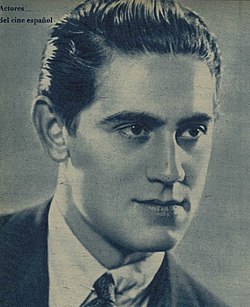
Ismael Merlo (1 September 1918 – 10 September 1984) was a Spanish actor. He appeared in 82 films and television shows between 1941 and 1984. He starred in the 1966 film La caza, which won the Silver Bear for Best Director at the 16th Berlin International Film Festival.[1]

Partial filmography

[edit]
  • Stowaway on Board (1941) - Antonciño
  • Rojo y negro (1942) - Miguel
  • The Wheel of Life (1942) - Alberto del Vall
  • No te niegues a vivir (1942)
  • La niña está loca (1943) - Enrique
  • Cristina Guzmán (1943) - Marqués de Atalanta
  • Idols (1943) - Juan Luis Gallardo
  • Cuento de hadas (1951) - Jaime
  • La moza de cántaro (1954) - Felipe IV
  • Pescando millones (1959)
  • Llegaron los franceses (1959)
  • La fiel infantería (1960) - Andrés
  • Litri and His Shadow (1960) - Pepe Aguayo
  • Three Ladies (1960) - Dr. San Román
  • Ventolera (1962) - Máximo
  • Aprendiendo a morir (1962) - Rafael Sánchez
  • La viudita naviera (1962) - Santiago Filgueras
  • Mentirosa (1962) - Chili
  • Los que no fuimos a la guerra (1962) - Pons
  • You and Me Are Three (1962) - Dr. Alberto Cendreras
  • Sabían demasiado (1962) - Don Rafael, 'El cajero'
  • Escuela de seductoras (1962) - Enrique
  • Trigo limpio (1962) - Jerónimo
  • Llovidos del cielo (1962)
  • Esa pícara pelirroja (1963) - Pablo Corell
  • El sol en el espejo (1963) - Salazar
  • La pandilla de los once (1963) - Toni antes del cambio imagen
  • La batalla del domingo (1963) - El risitas
  • Trampa mortal (1963) - Don Tomás
  • El precio de un asesino (1963) - John Berstein
  • La chica del trébol (1964) - D. Andrés
  • A Canção da Saudade (1964) - Leonel
  • La boda era a las doce (1964) - Andrés
  • Fin de semana (1964) - Don Alejandro Orteu
  • Los gatos negros (1964)
  • La caza (1966) - José
  • Las viudas (1966) - Médico del Hotel (segment "El Aniversario")
  • Jugando a morir (1966) - Empresario
  • The Cannibal Man (1972) - Jefe de personal
  • Experiencia prematrimonial (1972) - Andrés, padre de Alejandra
  • Flor de santidad (1973) - Electus, el ciego
  • Las señoritas de mala compañía (1973) - Don Pedro
  • Tormento (1974) - Padre Nones
  • Una pareja... distinta (1974) - Manolo
  • The Marriage Revolution (1974) - Padre de Begoña
  • La madrastra (1974) - Marcos
  • Furtivos (1975) - Cura
  • Las protegidas (1975) - Ignacio Aguirre
  • Madrid, Costa Fleming (1976) - Sr. Conca
  • Las largas vacaciones del 36 (1976) - El Abuelo
  • Los hijos de... (1976) - Mauricio
  • Climax (1977) - Don Rafael / Art teacher
  • Paco l'infaillible (1979) - Marqués
  • La campanada (1980) - Padre
  • The Autonomines (1983) - Don Ángel
  • Los hermanos Cartagena (1984) - Padre de Daniel

References

[edit]
[edit]
Revisions and contributorsEdit on WikipediaRead on Wikipedia
from Grokipedia
''Ismael Merlo'' is a Spanish actor known for his prolific and versatile career spanning theater, cinema, and television from the 1930s until his death in 1984. Born on September 1, 1918, in Valencia, Spain, he came from a family of actors and made his professional debut in 1934 at age sixteen with the Enrique Rambal company in a production of Around the World in 80 Days. He appeared in numerous films and television productions, often in character and supporting roles, and gained particular recognition for performances in notable Spanish films including La caza (1966) and Furtivos (1975). His early career centered on theater, where he worked with companies such as Isabel Garcés after the Spanish Civil War and later formed his own group specializing in comedy. He balanced stage work with occasional film roles in the 1940s and 1950s before returning more actively to cinema in the 1960s, becoming a frequent presence in films and anthology television series like Estudio 1. The son of actors Abelardo Merlo and Amparo Piquer, he was also the father of actress María Luisa Merlo and grandfather to actors Luis Merlo and Amparo Larrañaga. He died on September 10, 1984, in Madrid, Spain.

Early life

Family background and birth

Ismael Merlo was born on September 1, 1918, in Valencia, Spain. Coming from a theatrical family, he was the son of actors Abelardo Merlo Bort and Amparo Piquer Adsuara. His parents' involvement in acting immersed him in Valencia's performing arts scene from an early age. This family tradition in acting extended to later generations, as his daughter and grandchildren continued in the profession.

Entry into acting

Ismael Merlo made his professional stage debut in 1934 at the Teatro Ruzafa in Valencia, performing with Enrique Rambal's company in an adaptation of Jules Verne's La vuelta al mundo en ochenta días, where he played half a dozen characters at the age of sixteen. Born into a family of actors—his father was Abelardo Merlo and his mother Amparo Piquer—this early start built on his familial theatrical heritage. During the Spanish Civil War, Merlo worked as a young actor with companies including those of Milagros Leal and Salvador Soler. He was mobilized by the Republican side, sent to the front, gravely wounded by a gunshot that nearly caused him to lose his left arm, and declared unfit for combat. In the immediate postwar period, he moved to Madrid and joined Isabel Garcés's company, marking his transition to the capital's theater scene.

Theater career

Early theater work and post-war years

Tras el fin de la Guerra Civil Española en 1939, Ismael Merlo se incorporó a la compañía de María Fernanda Ladrón de Guevara, con la que interpretó la comedia La madre guapa de Adolfo Torrado en Madrid. Posteriormente pasó a formar parte de la compañía de Isabel Garcés, consolidando su presencia en la escena teatral madrileña de la posguerra. Durante estos años, se convirtió en intérprete habitual de las comedias de Carlos Llopis, destacando su participación en obras como La vida en un bloc y El misterioso señor N. En la década de 1940, Merlo se afianzó como uno de los galanes más destacados del teatro madrileño, reconocido por su presencia escénica en el género cómico. En 1943 fundó su propia compañía junto a Milagros Pérez de León, con la que gestionó un repertorio de treinta obras y realizó giras continuas por toda España. Durante este periodo, sus apariciones cinematográficas iniciales constituyeron una actividad secundaria a su dedicación principal al teatro.

Leadership roles and major productions

In his mature theater career from the late 1950s onward, Ismael Merlo frequently assumed leadership roles by heading his own theatrical company and starring in prominent productions, often shaping their artistic direction through his central performances. He developed a long-standing collaboration with playwright Alfonso Paso and actress Diana Maggi, specializing in roles depicting the "average man" navigating everyday complexities with humor and humanity. Among his major productions was Alfonso Paso's comedy Usted puede ser un asesino, which premiered on May 27, 1958, at Madrid's Teatro de la Comedia under Merlo's company, with Merlo and Maggi in leading roles that highlighted their successful partnership in portraying relatable, middle-class figures. Another key collaboration with Paso came in Cuatro y Ernesto (1960), where Merlo and Maggi starred after initial performances in Valencia, further cementing their reputation in Paso's ensemble-driven comedies. Merlo's versatility extended to an exceptional gender-crossing role when he portrayed the domineering matriarch Bernarda in Federico García Lorca's La casa de Bernarda Alba, premiered on September 17, 1976, at Madrid's Teatro Eslava, earning acclaim for his bold and straightforward interpretation of the title character. Later highlights included his participation in Antonio Gala's Petra regalada (1980) and Fernando Quiñones's El grito (premiered January 29, 1982, at Cádiz's Gran Teatro Falla), where he played the silent grandfather in a work adapted from Quiñones's prose. These stage achievements unfolded alongside his ongoing film and television commitments during the same period.

Later stage performances

In his later years, Ismael Merlo remained highly active in theater, maintaining a rigorous schedule of performances well into the 1980s. He appeared in productions such as El caso de la mujer asesinadita by Miguel Mihura and Álvaro de Laiglesia, which he performed at the Teatro Principal in Valencia in 1984. Merlo's final stage work was in Antonio Buero Vallejo's Diálogo secreto, a play that premiered in August 1984 at the Teatro Victoria Eugenia in San Sebastián before moving to other venues including the Teatro Infanta Isabel in Madrid. He was a key member of the cast in this production, sharing the stage with actors such as Carlos Lemos and Manuel Tejada. Merlo continued performing in Diálogo secreto consistently during its run, demonstrating his unwavering dedication to the theater almost until the end of his life, with his last appearance on stage occurring just hours before his death on September 10, 1984. Following his passing, the Teatro Infanta Isabel closed for two days, after which Pablo Sanz assumed Merlo's role to allow the production to resume on September 13. Merlo's persistent engagement with live performance in these final months reflected his lifelong commitment to the stage, even as he balanced other professional commitments.

Film career

Film debut and early roles

Ismael Merlo made his film debut in 1941 with a role in the comedy Polizón a bordo, directed by Florián Rey. During the early 1940s, he took on important roles in several Spanish productions amid his ongoing theater commitments. His early film credits included Rojo y negro in 1942 and Cristina Guzmán in 1943. He also appeared in La moza de cántaro in 1954, portraying Felipe IV. Merlo's involvement in cinema during the 1940s and 1950s remained selective and limited, as he soon returned to the theater after his initial film appearances, forming his own company and specializing in comedy while staying away from the film industry for many years. Throughout his entire career, he accumulated approximately 82 credits across film and television.

Notable film performances

Ismael Merlo solidified his reputation as a versatile character actor in Spanish cinema from the mid-1960s onward, delivering memorable supporting performances in films directed by prominent auteurs of the era. He starred in Carlos Saura's La caza (1966) as José, one of three Civil War veterans whose rabbit-hunting expedition exposes simmering tensions and serves as an allegory for post-war Spanish society. The film earned the Silver Bear for Best Director at the 16th Berlin International Film Festival. ) In 1974, Merlo received the Premio del Sindicato Nacional del Espectáculo for his work in Una pareja... distinta, directed by Pedro Lazaga. He subsequently portrayed the priest in José Luis Borau's Furtivos (1975), a critically regarded drama about poaching and family dynamics under repression. He played El Abuelo in Jaime Camino's Las largas vacaciones del 36 (1976), contributing to the film's exploration of bourgeois life during the early months of the Spanish Civil War. Merlo continued to appear in notable films into the 1980s, including Mariano Ozores' comedy Las autonosuyas (1983) and Entre hermanos (1984). One of his final roles was in Fernando Fernán Gómez's Ninette y un señor de Murcia (1984), an adaptation highlighting his enduring presence in Spanish screen work. These performances underscored his consistent contribution to Spanish cinema as a dependable character actor, often in ensemble casts.

Television career

Involvement with Televisión Española

Ismael Merlo was a prominent figure in Televisión Española's dramatic programming, becoming one of the network's most recognizable actors in anthology series that adapted theater for television. His involvement with TVE's dramatic output was extensive, with frequent appearances in Estudio 1, the flagship anthology program that presented classic and contemporary plays. He performed in numerous episodes of Estudio 1 across nearly two decades, taking on diverse roles in productions such as Julio César (1965), El cielo dentro de casa (1966), De la noche a la mañana (1974), and La profesión de la señora Warren (1979). These appearances reflected his versatility and established him as a mainstay in TVE's efforts to bring high-quality theater to Spanish audiences. Merlo also featured in other TVE anthology and dramatic formats, such as Ficciones and La Comedia, contributing to the network's broad repertoire of televised drama during the era. His regular television work with TVE overlapped with his ongoing film career in the same period.

Key television series and roles

Ismael Merlo featured in several notable television series on Televisión Española during the later years of his career, often in leading or recurring capacities within narrative formats. He starred as the protagonist Nicolás Villanueva in the comedy series El señor Villanueva y su gente (1979), appearing in all 14 episodes alongside Lola Herrera as Cristina de Villanueva and Amelia de la Torre as the grandmother. In 1984, Merlo played Pierre in the television adaptation Ninette y un señor de Murcia, a role he portrayed across all 8 episodes. He also had supporting appearances in other series, including as Don Aureliano in Ramón y Cajal (1982) for 2 episodes and as Laforque in La máscara negra (1982).

Personal life

Marriages and family

Ismael Merlo's family life revolved around his marriages to actresses and the continuation of a theatrical dynasty that spanned multiple generations. His first marriage was to María Luisa Colomina, during which their daughter María Luisa Merlo was born; she went on to become a well-known actress in her own right. Merlo later married actress Vicky Lagos, and they remained together until his death in 1984; they had a son David Merlo. He also had a partnership with actress Diana Maggi. Through his daughter María Luisa Merlo, Merlo became the grandfather of actors Amparo Larrañaga, Luis Merlo, and Pedro Larrañaga, who carried forward the family's acting tradition.

Death

Final years and passing

In his final years, Ismael Merlo maintained an active presence in theater despite his age. He performed in the play Diálogo secreto, appearing on stage just hours before his death. On September 10, 1984, Merlo suffered a myocardial infarction and died in Madrid at the age of 66. The attack occurred shortly after he had finished a performance in Diálogo secreto, underscoring his dedication to acting until the very end. He had also appeared in the television series Ninette y un señor de Murcia that same year.

References

Add your contribution
Related Hubs
User Avatar
No comments yet.