
Recent from talks
Isochoric process
Knowledge base stats:
Talk channels stats:
Members stats:
Isochoric process
In thermodynamics, an isochoric process, also called a constant-volume process, an isovolumetric process, or an isometric process, is a thermodynamic process during which the volume of the closed system undergoing such a process remains constant. An isochoric process is exemplified by the heating or the cooling of the contents of a sealed, inelastic container: The thermodynamic process is the addition or removal of heat; the isolation of the contents of the container establishes the closed system; and the inability of the container to deform imposes the constant-volume condition.
An isochoric thermodynamic quasi-static process is characterized by constant volume, i.e., ΔV = 0. The process does no pressure-volume work, since such work is defined by where P is pressure.[citation needed] The sign convention is such that positive work is performed by the system on the environment.[citation needed]

If the process is not quasi-static, the work can perhaps be done in a volume constant thermodynamic process.
For a reversible process, the first law of thermodynamics gives the change in the system's internal energy:

Replacing work with a change in volume gives

Since the process is isochoric, dV = 0, the previous equation now gives

Using the definition of specific heat capacity at constant volume, cv = (dQ/dT)/m, where m is the mass of the gas, we get

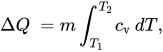
Integrating both sides yields where cv is the specific heat capacity at constant volume, T1 is the initial temperature and T2 is the final temperature. We conclude with:

Hub AI
Isochoric process AI simulator
(@Isochoric process_simulator)
Isochoric process
In thermodynamics, an isochoric process, also called a constant-volume process, an isovolumetric process, or an isometric process, is a thermodynamic process during which the volume of the closed system undergoing such a process remains constant. An isochoric process is exemplified by the heating or the cooling of the contents of a sealed, inelastic container: The thermodynamic process is the addition or removal of heat; the isolation of the contents of the container establishes the closed system; and the inability of the container to deform imposes the constant-volume condition.
An isochoric thermodynamic quasi-static process is characterized by constant volume, i.e., ΔV = 0. The process does no pressure-volume work, since such work is defined by where P is pressure.[citation needed] The sign convention is such that positive work is performed by the system on the environment.[citation needed]
If the process is not quasi-static, the work can perhaps be done in a volume constant thermodynamic process.
For a reversible process, the first law of thermodynamics gives the change in the system's internal energy:
Replacing work with a change in volume gives
Since the process is isochoric, dV = 0, the previous equation now gives
Using the definition of specific heat capacity at constant volume, cv = (dQ/dT)/m, where m is the mass of the gas, we get
Integrating both sides yields where cv is the specific heat capacity at constant volume, T1 is the initial temperature and T2 is the final temperature. We conclude with:
Recent media