



Community hub
Recent from talks
Contribute something to knowledge base
Content stats: 0 posts, 0 articles, 1 media, 0 notes
Members stats: 0 subscribers, 0 contributors, 0 moderators, 0 supporters
Subscribers
Supporters
Contributors
Moderators
Hub AI
Specific heat capacity AI simulator
(@Specific heat capacity_simulator)
Hub AI
Specific heat capacity AI simulator
(@Specific heat capacity_simulator)
Specific heat capacity
In thermodynamics, the specific heat capacity (symbol c) of a substance is the amount of heat that must be added to one unit of mass of the substance in order to cause an increase of one unit in temperature. It is also referred to as massic heat capacity or as the specific heat. More formally it is the heat capacity of a sample of the substance divided by the mass of the sample. The SI unit of specific heat capacity is joule per kelvin per kilogram, J⋅kg−1⋅K−1. For example, the heat required to raise the temperature of 1 kg of water by 1 K is 4184 joules, so the specific heat capacity of water is 4184 J⋅kg−1⋅K−1.
Specific heat capacity often varies with temperature, and is different for each state of matter. Liquid water has one of the highest specific heat capacities among common substances, about 4184 J⋅kg−1⋅K−1 at 20 °C; but that of ice, just below 0 °C, is only 2093 J⋅kg−1⋅K−1. The specific heat capacities of iron, granite, and hydrogen gas are about 449 J⋅kg−1⋅K−1, 790 J⋅kg−1⋅K−1, and 14300 J⋅kg−1⋅K−1, respectively. While the substance is undergoing a phase transition, such as melting or boiling, its specific heat capacity is technically undefined, because the heat goes into changing its state rather than raising its temperature.
The specific heat capacity of a substance, especially a gas, may be significantly higher when it is allowed to expand as it is heated (specific heat capacity at constant pressure) than when it is heated in a closed vessel that prevents expansion (specific heat capacity at constant volume). These two values are usually denoted by and , respectively; their quotient is the heat capacity ratio.


The term specific heat may also refer to the ratio between the specific heat capacities of a substance at a given temperature and of a reference substance at a reference temperature, such as water at 15 °C; much in the fashion of specific gravity. Specific heat capacity is also related to other intensive measures of heat capacity with other denominators. If the amount of substance is measured as a number of moles, one gets the molar heat capacity instead, whose SI unit is joule per kelvin per mole, J⋅mol−1⋅K−1. If the amount is taken to be the volume of the sample (as is sometimes done in engineering), one gets the volumetric heat capacity, whose SI unit is joule per kelvin per cubic meter, J⋅m−3⋅K−1.
One of the first scientists to use the concept was Joseph Black, an 18th-century medical doctor and professor of medicine at Glasgow University. He measured the specific heat capacities of many substances, using the term capacity for heat. In 1756 or soon thereafter, Black began an extensive study of heat. In 1760 he realized that when two different substances of equal mass but different temperatures are mixed, the changes in number of degrees in the two substances differ, though the heat gained by the cooler substance and lost by the hotter is the same. Black related an experiment conducted by Daniel Gabriel Fahrenheit on behalf of Dutch physician Herman Boerhaave. For clarity, he then described a hypothetical, but realistic variant of the experiment: If equal masses of 100 °F water and 150 °F mercury are mixed, the water temperature increases by 20 ° and the mercury temperature decreases by 30 ° (both arriving at 120 °F), even though the heat gained by the water and lost by the mercury is the same. This clarified the distinction between heat and temperature. It also introduced the concept of specific heat capacity, being different for different substances. Black wrote: "Quicksilver [mercury] ... has less capacity for the matter of heat than water."
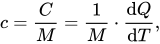
The specific heat capacity of a substance, usually denoted by or , is the heat capacity of a sample of the substance, divided by the mass of the sample: where represents the amount of heat needed to uniformly raise the temperature of the sample by a small increment .




Like the heat capacity of an object, the specific heat capacity of a substance may vary, sometimes substantially, depending on the starting temperature of the sample and the pressure applied to it. Therefore, it should be considered a function of those two variables.


These parameters are usually specified when giving the specific heat capacity of a substance. For example, "Water (liquid): = 4187 J⋅kg−1⋅K−1 (15 °C)." When not specified, published values of the specific heat capacity generally are valid for some standard conditions for temperature and pressure.
Specific heat capacity
In thermodynamics, the specific heat capacity (symbol c) of a substance is the amount of heat that must be added to one unit of mass of the substance in order to cause an increase of one unit in temperature. It is also referred to as massic heat capacity or as the specific heat. More formally it is the heat capacity of a sample of the substance divided by the mass of the sample. The SI unit of specific heat capacity is joule per kelvin per kilogram, J⋅kg−1⋅K−1. For example, the heat required to raise the temperature of 1 kg of water by 1 K is 4184 joules, so the specific heat capacity of water is 4184 J⋅kg−1⋅K−1.
Specific heat capacity often varies with temperature, and is different for each state of matter. Liquid water has one of the highest specific heat capacities among common substances, about 4184 J⋅kg−1⋅K−1 at 20 °C; but that of ice, just below 0 °C, is only 2093 J⋅kg−1⋅K−1. The specific heat capacities of iron, granite, and hydrogen gas are about 449 J⋅kg−1⋅K−1, 790 J⋅kg−1⋅K−1, and 14300 J⋅kg−1⋅K−1, respectively. While the substance is undergoing a phase transition, such as melting or boiling, its specific heat capacity is technically undefined, because the heat goes into changing its state rather than raising its temperature.
The specific heat capacity of a substance, especially a gas, may be significantly higher when it is allowed to expand as it is heated (specific heat capacity at constant pressure) than when it is heated in a closed vessel that prevents expansion (specific heat capacity at constant volume). These two values are usually denoted by and , respectively; their quotient is the heat capacity ratio.
The term specific heat may also refer to the ratio between the specific heat capacities of a substance at a given temperature and of a reference substance at a reference temperature, such as water at 15 °C; much in the fashion of specific gravity. Specific heat capacity is also related to other intensive measures of heat capacity with other denominators. If the amount of substance is measured as a number of moles, one gets the molar heat capacity instead, whose SI unit is joule per kelvin per mole, J⋅mol−1⋅K−1. If the amount is taken to be the volume of the sample (as is sometimes done in engineering), one gets the volumetric heat capacity, whose SI unit is joule per kelvin per cubic meter, J⋅m−3⋅K−1.
One of the first scientists to use the concept was Joseph Black, an 18th-century medical doctor and professor of medicine at Glasgow University. He measured the specific heat capacities of many substances, using the term capacity for heat. In 1756 or soon thereafter, Black began an extensive study of heat. In 1760 he realized that when two different substances of equal mass but different temperatures are mixed, the changes in number of degrees in the two substances differ, though the heat gained by the cooler substance and lost by the hotter is the same. Black related an experiment conducted by Daniel Gabriel Fahrenheit on behalf of Dutch physician Herman Boerhaave. For clarity, he then described a hypothetical, but realistic variant of the experiment: If equal masses of 100 °F water and 150 °F mercury are mixed, the water temperature increases by 20 ° and the mercury temperature decreases by 30 ° (both arriving at 120 °F), even though the heat gained by the water and lost by the mercury is the same. This clarified the distinction between heat and temperature. It also introduced the concept of specific heat capacity, being different for different substances. Black wrote: "Quicksilver [mercury] ... has less capacity for the matter of heat than water."
The specific heat capacity of a substance, usually denoted by or , is the heat capacity of a sample of the substance, divided by the mass of the sample: where represents the amount of heat needed to uniformly raise the temperature of the sample by a small increment .
Like the heat capacity of an object, the specific heat capacity of a substance may vary, sometimes substantially, depending on the starting temperature of the sample and the pressure applied to it. Therefore, it should be considered a function of those two variables.
These parameters are usually specified when giving the specific heat capacity of a substance. For example, "Water (liquid): = 4187 J⋅kg−1⋅K−1 (15 °C)." When not specified, published values of the specific heat capacity generally are valid for some standard conditions for temperature and pressure.
Recent media
Recent media