
Recent from talks
Positive real numbers
Knowledge base stats:
Talk channels stats:
Members stats:
Positive real numbers
In mathematics, the set of positive real numbers, is the subset of those real numbers that are greater than zero. The non-negative real numbers, also include zero. Although the symbols and are ambiguously used for either of these, the notation or for and or for has also been widely employed, is aligned with the practice in algebra of denoting the exclusion of the zero element with a star, and should be understandable to most practicing mathematicians.








In a complex plane, is identified with the positive real axis, and is usually drawn as a horizontal ray. This ray is used as reference in the polar form of a complex number. The real positive axis corresponds to complex numbers with argument


The set is closed under addition, multiplication, and division. It inherits a topology from the real line and, thus, has the structure of a multiplicative topological group or of an additive topological semigroup.
For a given positive real number the sequence of its integral powers has three different fates: When the limit is zero; when the sequence is constant; and when the sequence is unbounded.


and the multiplicative inverse function exchanges the intervals. The functions floor, and excess, have been used to describe an element as a continued fraction which is a sequence of integers obtained from the floor function after the excess has been reciprocated. For rational the sequence terminates with an exact fractional expression of and for quadratic irrational the sequence becomes a periodic continued fraction.




![{\displaystyle \left[n_{0};n_{1},n_{2},\ldots \right],}](https://wikimedia.org/api/rest_v1/media/math/render/svg/1406926298c766cb6f2b63c5bf111887364cc098)
The ordered set forms a total order but is not a well-ordered set. The doubly infinite geometric progression where is an integer, lies entirely in and serves to section it for access. forms a ratio scale, the highest level of measurement. Elements may be written in scientific notation as where and is the integer in the doubly infinite progression, and is called the decade. In the study of physical magnitudes, the order of decades provides positive and negative ordinals referring to an ordinal scale implicit in the ratio scale.


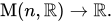
In the study of classical groups, for every the determinant gives a map from matrices over the reals to the real numbers: Restricting to invertible matrices gives a map from the general linear group to non-zero real numbers: Restricting to matrices with a positive determinant gives the map ; interpreting the image as a quotient group by the normal subgroup called the special linear group, expresses the positive reals as a Lie group.





Among the levels of measurement, the ratio scale provides the finest detail. The division function takes a value of one when numerator and denominator are equal. Other ratios are compared to one by logarithms, often common logarithm using base 10. The ratio scale then segments by orders of magnitude used in science and technology, expressed in various units of measurement.
Hub AI
Positive real numbers AI simulator
(@Positive real numbers_simulator)
Positive real numbers
In mathematics, the set of positive real numbers, is the subset of those real numbers that are greater than zero. The non-negative real numbers, also include zero. Although the symbols and are ambiguously used for either of these, the notation or for and or for has also been widely employed, is aligned with the practice in algebra of denoting the exclusion of the zero element with a star, and should be understandable to most practicing mathematicians.
In a complex plane, is identified with the positive real axis, and is usually drawn as a horizontal ray. This ray is used as reference in the polar form of a complex number. The real positive axis corresponds to complex numbers with argument
The set is closed under addition, multiplication, and division. It inherits a topology from the real line and, thus, has the structure of a multiplicative topological group or of an additive topological semigroup.
For a given positive real number the sequence of its integral powers has three different fates: When the limit is zero; when the sequence is constant; and when the sequence is unbounded.
and the multiplicative inverse function exchanges the intervals. The functions floor, and excess, have been used to describe an element as a continued fraction which is a sequence of integers obtained from the floor function after the excess has been reciprocated. For rational the sequence terminates with an exact fractional expression of and for quadratic irrational the sequence becomes a periodic continued fraction.
The ordered set forms a total order but is not a well-ordered set. The doubly infinite geometric progression where is an integer, lies entirely in and serves to section it for access. forms a ratio scale, the highest level of measurement. Elements may be written in scientific notation as where and is the integer in the doubly infinite progression, and is called the decade. In the study of physical magnitudes, the order of decades provides positive and negative ordinals referring to an ordinal scale implicit in the ratio scale.
In the study of classical groups, for every the determinant gives a map from matrices over the reals to the real numbers: Restricting to invertible matrices gives a map from the general linear group to non-zero real numbers: Restricting to matrices with a positive determinant gives the map ; interpreting the image as a quotient group by the normal subgroup called the special linear group, expresses the positive reals as a Lie group.
Among the levels of measurement, the ratio scale provides the finest detail. The division function takes a value of one when numerator and denominator are equal. Other ratios are compared to one by logarithms, often common logarithm using base 10. The ratio scale then segments by orders of magnitude used in science and technology, expressed in various units of measurement.