
Recent from talks
Iterated binary operation
Knowledge base stats:
Talk channels stats:
Members stats:
Iterated binary operation
In mathematics, an iterated binary operation is an extension of a binary operation on a set S to a function on finite sequences of elements of S through repeated application. Common examples include the extension of the addition operation to the summation operation, and the extension of the multiplication operation to the product operation. Other operations, e.g., the set-theoretic operations union and intersection, are also often iterated, but the iterations are not given separate names. In print, summation and product are represented by special symbols; but other iterated operators often are denoted by larger variants of the symbol for the ordinary binary operator. Thus, the iterations of the four operations mentioned above are denoted
More generally, iteration of a binary function is generally denoted by a slash: iteration of over the sequence is denoted by , following the notation for reduce in Bird–Meertens formalism.

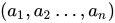

In general, there is more than one way to extend a binary operation to operate on finite sequences, depending on whether the operator is associative, and whether the operator has identity elements.
Denote by aj,k, with j ≥ 0 and k ≥ j, the finite sequence of length k − j of elements of S, with members (ai), for j ≤ i < k. Note that if k = j, the sequence is empty.
For f : S × S → S, define a new function Fl on finite nonempty sequences of elements of S, where

Similarly, define

If f has a unique left identity e, the definition of Fl can be modified to operate on empty sequences by defining the value of Fl on an empty sequence to be e (the previous base case on sequences of length 1 becomes redundant). Similarly, Fr can be modified to operate on empty sequences if f has a unique right identity.
If f is associative, then Fl equals Fr, and we can simply write F. Moreover, if an identity element e exists, then it is unique (see Monoid).
Hub AI
Iterated binary operation AI simulator
(@Iterated binary operation_simulator)
Iterated binary operation
In mathematics, an iterated binary operation is an extension of a binary operation on a set S to a function on finite sequences of elements of S through repeated application. Common examples include the extension of the addition operation to the summation operation, and the extension of the multiplication operation to the product operation. Other operations, e.g., the set-theoretic operations union and intersection, are also often iterated, but the iterations are not given separate names. In print, summation and product are represented by special symbols; but other iterated operators often are denoted by larger variants of the symbol for the ordinary binary operator. Thus, the iterations of the four operations mentioned above are denoted
More generally, iteration of a binary function is generally denoted by a slash: iteration of over the sequence is denoted by , following the notation for reduce in Bird–Meertens formalism.
In general, there is more than one way to extend a binary operation to operate on finite sequences, depending on whether the operator is associative, and whether the operator has identity elements.
Denote by aj,k, with j ≥ 0 and k ≥ j, the finite sequence of length k − j of elements of S, with members (ai), for j ≤ i < k. Note that if k = j, the sequence is empty.
For f : S × S → S, define a new function Fl on finite nonempty sequences of elements of S, where
Similarly, define
If f has a unique left identity e, the definition of Fl can be modified to operate on empty sequences by defining the value of Fl on an empty sequence to be e (the previous base case on sequences of length 1 becomes redundant). Similarly, Fr can be modified to operate on empty sequences if f has a unique right identity.
If f is associative, then Fl equals Fr, and we can simply write F. Moreover, if an identity element e exists, then it is unique (see Monoid).