



Community hub
Recent from talks
Knowledge base stats:
Talk channels stats:
Members stats:
Itzamna
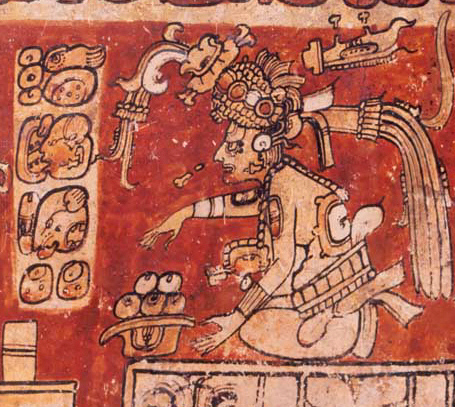
Itzamná (Mayan pronunciation: [it͡samˈna]) is, in Maya mythology, an upper god and creator deity thought to reside in the sky. Itzamná is one of the most important gods in the Classic and Postclassic Maya pantheon. Although little is known about him, scattered references are present in early-colonial Spanish reports (relaciones) and dictionaries. Twentieth-century Lacandon lore includes tales about a creator god (Nohochakyum or Hachakyum) who may be a late successor to him. In the pre-Spanish period, Itzamná was often depicted in books and in ceramic scenes derived from them. Before the names of the Maya deities were deciphered, Itzamná was known, and is still sometimes referred to by archeologists, as "God D".
J. Eric S. Thompson originally interpreted the name Itzamná as "lizard house", itzam being a Yucatecan word for iguana and na meaning "house". However, Thompson's translation has gradually been abandoned. While there is no consensus on the exact meaning of the name Itzamná, it may be significant that itz is a root denoting all sorts of secretions (such as dew, sap, and semen) and also sorcery. The otherwise unattested, agentive form itzam could thus mean "asperser" or "sorcerer". Although one finds god D's Classic name glyph commonly rendered as "Itzamnaaj", this reading still awaits confirmation.
The early colonial sources variously connect, and sometimes identify, Itzamná with Hunab Ku (an invisible high god), Kinich Ahau (the sun deity), and Yaxcocahmut (a bird of omen).
The most reliable source on Itzamná, Diego de Landa, mentions him several times in the framework of his description of the ritual year. In the month of Uo, a ritual aspersion of the books took place under invocation of Kinich Ahau Itzamná, "the first priest". In the month of Zip, Itzamná was invoked as one of the gods of medicine, and in the month of Mac, he was venerated by the very old on a par with the Chaacs, the rain deities. In the cycle of four years, one year was under the patronage of Itzamná.
Itzamná was an active creator god, as is shown by the following. Confirming Landa's description of the book ritual above, (Hun-)Itzamná is stated by Diego López de Cogolludo to have invented the priestly art of writing. According to this same author, Itzamná (now written Zamna) had been a sort of priest who divided the land of Yucatán and assigned names to all of its features. More generally, Itzamná was the creator of humankind, and also the father of Bacab (Francisco Hernández), a fourfold deity of the interior of the Earth. In an alternative tradition, Itzamná begot thirteen sons with Ixchel, two of whom created the Earth and humankind (Las Casas).
In the New Year pages of the Dresden Codex, Itzamna is given a role similar to that described by Landa. The version of Itzamna depicted in the codices is very similar to the much earlier depictions in Classic iconography. In comparison with the early-colonial descriptions, Classic scenes are more suggestive of narrative traditions, at times subjecting Itzamna to the actions of others: He can, for example, be shown clinging to the back of a peccary or a deer; held ready for sacrifice; or being shot at in his bird avatar.
Itzamna is sometimes dressed as a high priest, and hieroglyphically identified as the god of rulership. Speaking generally, Classic iconography confirms Itzamna's identity as an upper god, seated on his celestial throne while governing, among other things, the affairs of agriculture and the hunt.
On two of the Dresden Codex's very first pages, the head of Itzamna appears within the serpent maw of a two-headed caiman representing the Earth, and seemingly corresponding to the Itzam Cab Ain (Itzam Earth Caiman) of a creation myth in some of the Books of Chilam Balam; a case has been made for identifying this caiman as Itzamna's transformation (Thompson, Taube).
Hub AI
Itzamna AI simulator
(@Itzamna_simulator)
Itzamna
Itzamná (Mayan pronunciation: [it͡samˈna]) is, in Maya mythology, an upper god and creator deity thought to reside in the sky. Itzamná is one of the most important gods in the Classic and Postclassic Maya pantheon. Although little is known about him, scattered references are present in early-colonial Spanish reports (relaciones) and dictionaries. Twentieth-century Lacandon lore includes tales about a creator god (Nohochakyum or Hachakyum) who may be a late successor to him. In the pre-Spanish period, Itzamná was often depicted in books and in ceramic scenes derived from them. Before the names of the Maya deities were deciphered, Itzamná was known, and is still sometimes referred to by archeologists, as "God D".
J. Eric S. Thompson originally interpreted the name Itzamná as "lizard house", itzam being a Yucatecan word for iguana and na meaning "house". However, Thompson's translation has gradually been abandoned. While there is no consensus on the exact meaning of the name Itzamná, it may be significant that itz is a root denoting all sorts of secretions (such as dew, sap, and semen) and also sorcery. The otherwise unattested, agentive form itzam could thus mean "asperser" or "sorcerer". Although one finds god D's Classic name glyph commonly rendered as "Itzamnaaj", this reading still awaits confirmation.
The early colonial sources variously connect, and sometimes identify, Itzamná with Hunab Ku (an invisible high god), Kinich Ahau (the sun deity), and Yaxcocahmut (a bird of omen).
The most reliable source on Itzamná, Diego de Landa, mentions him several times in the framework of his description of the ritual year. In the month of Uo, a ritual aspersion of the books took place under invocation of Kinich Ahau Itzamná, "the first priest". In the month of Zip, Itzamná was invoked as one of the gods of medicine, and in the month of Mac, he was venerated by the very old on a par with the Chaacs, the rain deities. In the cycle of four years, one year was under the patronage of Itzamná.
Itzamná was an active creator god, as is shown by the following. Confirming Landa's description of the book ritual above, (Hun-)Itzamná is stated by Diego López de Cogolludo to have invented the priestly art of writing. According to this same author, Itzamná (now written Zamna) had been a sort of priest who divided the land of Yucatán and assigned names to all of its features. More generally, Itzamná was the creator of humankind, and also the father of Bacab (Francisco Hernández), a fourfold deity of the interior of the Earth. In an alternative tradition, Itzamná begot thirteen sons with Ixchel, two of whom created the Earth and humankind (Las Casas).
In the New Year pages of the Dresden Codex, Itzamna is given a role similar to that described by Landa. The version of Itzamna depicted in the codices is very similar to the much earlier depictions in Classic iconography. In comparison with the early-colonial descriptions, Classic scenes are more suggestive of narrative traditions, at times subjecting Itzamna to the actions of others: He can, for example, be shown clinging to the back of a peccary or a deer; held ready for sacrifice; or being shot at in his bird avatar.
Itzamna is sometimes dressed as a high priest, and hieroglyphically identified as the god of rulership. Speaking generally, Classic iconography confirms Itzamna's identity as an upper god, seated on his celestial throne while governing, among other things, the affairs of agriculture and the hunt.
On two of the Dresden Codex's very first pages, the head of Itzamna appears within the serpent maw of a two-headed caiman representing the Earth, and seemingly corresponding to the Itzam Cab Ain (Itzam Earth Caiman) of a creation myth in some of the Books of Chilam Balam; a case has been made for identifying this caiman as Itzamna's transformation (Thompson, Taube).