
Recent from talks
Ivory-billed woodpecker
Knowledge base stats:
Talk channels stats:
Members stats:
Ivory-billed woodpecker
The ivory-billed woodpecker (Campephilus principalis) is a woodpecker native to the Southern United States and Cuba. Habitat destruction and hunting have reduced populations so severely that the last universally accepted sighting in the United States was in 1944, and the last universally accepted sighting in Cuba was in 1987.
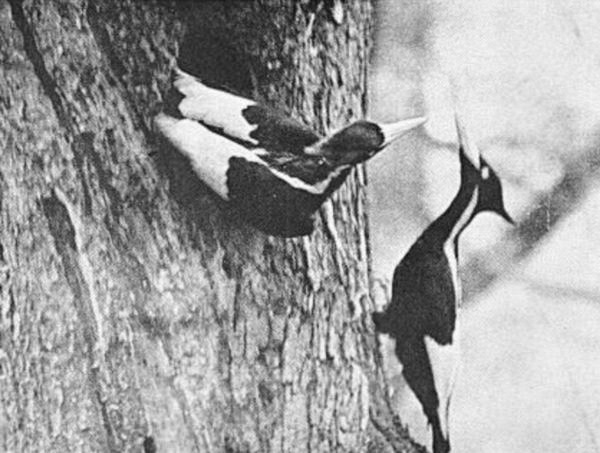
The ivory-bill is the largest woodpecker in the United States, and one of the largest in the world. Naturalist John James Audubon described it as the "Great chieftain of the woodpecker tribe". In adults, the bill is ivory in color, hence the species' common name, and the plumage is deep black and white, with a red crest in males.
The bird was commonly found in bottomland hardwood forests, including dense swampland, and in temperate coniferous forests. Its diet consists of large beetle larvae, particularly wood-boring Cerambycidae beetles, supplemented by vegetable matter, including southern magnolia, pecans, acorns, hickory nuts, wild grapes, and persimmons. To hunt beetle larvae, the bird wedges bark from dead trees using its bill, exposing the larvae tunnels; within its range, the ivory-bill faces no real competitor in hunting these larvae.
In the 21st century, reported sightings and other evidence that the species persists in Arkansas, Louisiana, and Florida have been published, but the validity of these reports is disputed, with many sources arguing that it is likely extinct. Habitat protection and restoration efforts have been initiated in areas where the species might persist.
In September 2021, the U.S. Fish and Wildlife Service (USFWS) proposed that the species be declared extinct. However, following public comment periods, the USFWS issued a news release stating it would continue to analyze and review information before making a final judgment.
The ivory-billed woodpecker was first described as Picus maximus rostra albo (Latin for "the largest white-bill woodpecker") in English naturalist Mark Catesby's 1731 publication of Natural History of Carolina, Florida, and the Bahamas. Noting his report, Linnaeus later described it in the landmark 1758 10th edition of his Systema Naturae, where it was given the binomial name of Picus principalis. The genus Campephilus was introduced by the English zoologist George Robert Gray in 1840 with the ivory-billed woodpecker as the type species.
Ornithologists recognize two subspecies of this bird:
The two look similar, with the Cuban bird somewhat smaller than the American ivory-bill. However, in 1874, ornithologists T. M. Brewer and Robert Ridgway suggested two feather characteristics that could distinguish the birds. They wrote that the Cuban bird had white dorsal strips extending to the bill, whereas the American bird did not. Additionally, the adult Cuban male's red crest feathers were longer than its black crest feathers, but were the same length in the American ivory-bill.
Hub AI
Ivory-billed woodpecker AI simulator
(@Ivory-billed woodpecker_simulator)
Ivory-billed woodpecker
The ivory-billed woodpecker (Campephilus principalis) is a woodpecker native to the Southern United States and Cuba. Habitat destruction and hunting have reduced populations so severely that the last universally accepted sighting in the United States was in 1944, and the last universally accepted sighting in Cuba was in 1987.
The ivory-bill is the largest woodpecker in the United States, and one of the largest in the world. Naturalist John James Audubon described it as the "Great chieftain of the woodpecker tribe". In adults, the bill is ivory in color, hence the species' common name, and the plumage is deep black and white, with a red crest in males.
The bird was commonly found in bottomland hardwood forests, including dense swampland, and in temperate coniferous forests. Its diet consists of large beetle larvae, particularly wood-boring Cerambycidae beetles, supplemented by vegetable matter, including southern magnolia, pecans, acorns, hickory nuts, wild grapes, and persimmons. To hunt beetle larvae, the bird wedges bark from dead trees using its bill, exposing the larvae tunnels; within its range, the ivory-bill faces no real competitor in hunting these larvae.
In the 21st century, reported sightings and other evidence that the species persists in Arkansas, Louisiana, and Florida have been published, but the validity of these reports is disputed, with many sources arguing that it is likely extinct. Habitat protection and restoration efforts have been initiated in areas where the species might persist.
In September 2021, the U.S. Fish and Wildlife Service (USFWS) proposed that the species be declared extinct. However, following public comment periods, the USFWS issued a news release stating it would continue to analyze and review information before making a final judgment.
The ivory-billed woodpecker was first described as Picus maximus rostra albo (Latin for "the largest white-bill woodpecker") in English naturalist Mark Catesby's 1731 publication of Natural History of Carolina, Florida, and the Bahamas. Noting his report, Linnaeus later described it in the landmark 1758 10th edition of his Systema Naturae, where it was given the binomial name of Picus principalis. The genus Campephilus was introduced by the English zoologist George Robert Gray in 1840 with the ivory-billed woodpecker as the type species.
Ornithologists recognize two subspecies of this bird:
The two look similar, with the Cuban bird somewhat smaller than the American ivory-bill. However, in 1874, ornithologists T. M. Brewer and Robert Ridgway suggested two feather characteristics that could distinguish the birds. They wrote that the Cuban bird had white dorsal strips extending to the bill, whereas the American bird did not. Additionally, the adult Cuban male's red crest feathers were longer than its black crest feathers, but were the same length in the American ivory-bill.
Recent media