


Community hub
Recent from talks
Contribute something
Nothing was collected or created yet.
Ixtoc I oil spill
View on Wikipedia| Ixtoc 1 | |
|---|---|
 | |
 Interactive map of Ixtoc 1 | |
| Location | Bay of Campeche, Gulf of Mexico Campeche, Mexico |
| Coordinates | 19°24′30″N 92°19′30″W / 19.408333°N 92.325°W |
| Date | 3 June 1979 – 23 March 1980 |
| Cause | |
| Cause | Wellhead blowout |
| Operator | Pemex |
| Spill characteristics | |
| Volume | 3 million barrels (130,000,000 U.S. gallons; 480,000 cubic meters)[1] |
| Area | 2,800 km2 (1,100 sq mi) |
| Shoreline impacted | 261 km (162 mi) |
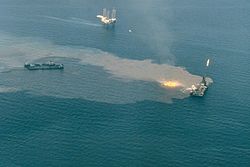
Ixtoc 1 was an exploratory oil well being drilled by the semi-submersible drilling rig Sedco 135 in the Bay of Campeche of the Gulf of Mexico, about 100 km (62 mi) northwest of Ciudad del Carmen, Campeche in waters 50 m (164 ft) deep.[2] On 3 June 1979, the well suffered a blowout resulting in the largest oil spill in history at its time. To-date, it remains the second largest marine oil spill in history after the Deepwater Horizon oil spill.[3]
Accident
[edit]Mexico's state-owned oil company Pemex (Petróleos Mexicanos) was drilling a 3 km (1.9 mi) deep oil well when the drilling rig Sedco 135 lost drilling mud circulation.
In modern rotary drilling, mud is circulated down the drillpipe and back up the wellbore to the surface. The goal is to equalize the pressure through the shaft and to monitor the returning mud for gas. Without the counter-pressure provided by the circulating mud, the pressure in the formation allowed oil to fill the well column, blowing out the well. The oil caught fire, and Sedco 135 was extensively burned then scuttled.[2]
At the time of the accident, Sedco 135 was drilling at a depth of about 3,600 metres (11,800 ft) below the seafloor.[4] The day before Ixtoc suffered the blowout and resulting fire that caused her to sink, the drill bit hit a region of soft strata. Subsequently, the circulation of drilling mud was lost resulting in a loss of hydrostatic pressure.[5] Rather than returning to the surface, the drilling mud was escaping into fractures that had formed in the rock at the bottom of the hole. Pemex officials decided to remove the bit, run the drill pipe back into the hole and pump materials down this open-ended drill pipe to seal off the fractures that were causing the loss of circulation.
During the removal of the pipe on Sedco 135, the dancing mud suddenly began to flow up towards the surface; by removing the drillstring the well was swabbed (an effect observed when mud must flow down the annulus to replace displaced drill pipe volume below the bit) leading to a kick. Normally, this flow can be stopped by activating shear rams contained in the blowout preventer (BOP). These rams are designed to sever and seal off the well on the ocean floor; however, in this case, the drill collars had been brought in line with the BOP and the BOP rams were not able to sever the thick steel walls of the drill collars leading to a catastrophic blowout.
The drilling mud was followed by a large quantity of oil and gas at a flow rate that was still increasing. The oil and gas fumes exploded on contact with the operating pump motors, starting a fire which led to the collapse of the Sedco 135 drilling rig riser. The collapse caused damage to the BOP stack at the seafloor. The damage to the BOP led to the release of significant quantities of oil into the Gulf.[4]
Volume and extent of spill
[edit]
In the initial stages of the spill, an estimated 30,000 barrels (5,000 m3) of oil per day were flowing from the well. One barrel of oil is equivalent to 159 liters (or 42 gallons) of liquid. In July 1979, the pumping of mud into the well reduced the flow to 20,000 barrels (3,000 m3) per day, and early in August the pumping of nearly 100,000 steel, iron, and lead balls into the well reduced the flow to 10,000 barrels (2,000 m3) per day. Pemex claimed that half of the released oil burned when it reached the surface, a third of it evaporated, and the rest was contained or dispersed.[6] Mexican authorities also drilled two relief wells into the main well to lower the pressure of the blowout, however, the oil continued to flow for three months following the completion of the first relief well.[7] In total, around 3,300,000 barrels (520,000 m3) were spilled throughout the roughly 10 months it took for the oil to stop leaking.[8]
Pemex contracted Conair Aviation to spray the chemical dispersant Corexit 9527 on the oil. A total of 493 aerial missions were flown, treating 1,100 square miles (2,800 km2) of oil slick. Dispersants were not used in the U.S. area of the spill because of the dispersant's inability to treat weathered oil. Eventually the on-scene coordinator (OSC) requested that Mexico stop using dispersants north of 25°N.[6]
In Texas, an emphasis was placed on coastal countermeasures protecting the bays and lagoons formed by the barrier islands. Impacts of oil on the barrier island beaches were ranked as second in importance to protecting inlets to the bays and lagoons. This was done with the placement of skimmers and booms. Efforts were concentrated on the Brazos-Santiago Pass, Port Mansfield Channel, Aransas Pass, and Cedar Bayou which during the spill was sealed with sand. Economically and environmentally sensitive barrier island beaches were cleaned daily. Laborers used rakes and shovels to clean beaches rather than heavier equipment which removed too much sand. Ultimately, 71,500 barrels (11,000 m3) of oil impacted 162 miles (260 km) of U.S. beaches, and over 10,000 cubic yards (8,000 m3) of oiled material were removed.[6]
Containment
[edit]In the next nine months, experts and divers including Red Adair were brought in to contain and cap the oil well.[6] An average of approximately 10,000 to 30,000 barrels (2,000 to 5,000 m3) per day were discharged into the Gulf until it was finally capped on 23 March 1980, nearly 10 months later.[9] In similarity to the Deepwater Horizon oil spill 31 years later, the list of methods attempted to remediate the leak included lowering a cap over the well, plugging the leak with mud and "junk", use of dispersants, and spending months attempting to drill relief wells.[10][11]
Aftermath
[edit]Prevailing currents carried the oil towards the Texas coastline. The US government had two months to prepare booms to protect major inlets. Pemex spent $100 million to clean up the spill and avoided most compensation claims by asserting sovereign immunity as a state-run company.[12]
The oil slick surrounded Rancho Nuevo, in the Mexican state of Tamaulipas, which is one of the few nesting sites for Kemp's ridley sea turtles. Thousands of baby sea turtles were airlifted to a clean portion of the Gulf of Mexico to help save the rare species.
Long-term effects
[edit] |
The oil that was lost during the blow-out polluted a considerable part of the offshore region in the Gulf of Mexico as well as much of the coastal zone, which consists primarily of sandy beaches and barrier islands often enclosing extensive shallow lagoons.
The oil on Mexican beaches in early September was calculated to be about 6000 metric tons. Based on reports from various groups and individuals, five times that figure is thought to represent a fair estimate of what had landed on Mexican beaches. Investigations along the Texas coast show that approximately 4000 metric tons of oil or less than 1 percent was deposited there. The rest of the oil, about 120,000 metric tons or 25 percent, sank to the bottom of the Gulf.[13]
The oil had a severe impact on the littoral crab and mollusk fauna of the beaches which were contaminated. The populations of crabs, e.g. the ghost crab Ocypode quadrata, was almost eliminated over a wide area. The crab populations on coral islands along the coast were also reduced to only a few percents of the normal populations about nine months after the spill.[13]
A study concluded that the most persistent problems were the coastal lagoons lining the bay, as well as the pollution of estuaries. Specifically, they had problematic effects on the breeding and growth of several different species of food fish species.[14]
The oil washed ashore, 30 cm (1 ft) deep in some places, as it was pushed north by prevailing winds and currents until it crossed the Texas border two months later and eventually coated almost 170 miles (270 km) of US beaches. The beach that caused most international concern in Mexico was Rancho Nuevo, a key nesting ground for critically endangered Kemp's ridley sea turtles which had already moved inland in their hundreds to lay eggs. By the time the eggs hatched, the oil had reached the shore.
Fishing was banned or restricted by Mexican authorities in contaminated areas north and south of the well. Fish and octopus catches dropped by 50 to 70% from the 1978 levels.[13] Other species that had longer life spans took longer to recover, and it took until the late 1980s for the population of Kemp's ridley turtles to begin to recover. Ridley turtles only produce a few hundred eggs each year, in contrast with the millions of eggs that shrimp lay.[15]
There is much less information on the impact of the Ixtoc 1 spill on benthic species (bottom dwellers). The best studies were on the Texas coast over 1000 km from the spill. Massive kills can occur when oil reaches the benthos in sufficient quantity. The only indication of a massive kill may be the remains of the dead organisms, but if they lack hard parts there will be little evidence.[16]
A report prepared for the US Bureau of Land Management concluded concerning the spill's effect on US waters:
Despite a massive intrusion of petroleum hydrocarbon pollutants from the Ixtoc 1 event into the study region of the South Texas Outer Continental Shelf during 1979-1980, no definitive damage can be associated with this or other known spillage events (e.g., Burmah Agate) on either the epibenthic commercial shrimp population (based on chemical evidence) or the benthic infaunal community. Such conclusions have no bearing on intertidal or littoral communities, which were not the subject of this study.[17]
See also
[edit]

References
[edit]- ^ Marshall, Jessica (2010-06-01). "Gulf Oil Spill Not the Biggest Ever". Discovery News. Retrieved 2010-06-14.
- ^ a b John Charles Milne (2 Nov 2008). "Sedco 135 Series". OilCity. Archived from the original on 20 December 2008. Retrieved 20 May 2010.
- ^ Elena Egawhary (7 May 2010). "How big is the Deepwater Horizon oil spill?". BBC News.
oil spilled ... first Iraq War, 1991. ... Although not a single offshore spill, it saw massive oil leaks that easily dwarf Ixtoc 1
- ^ a b Linda Garmon (25 October 1980). "Autopsy of an Oil Spill". Science News. Vol. 118, no. 17. pp. 267–270.
- ^ "Ixtoc 1 Oil Spill Economic Impact Study" (PDF). Bureau of Land Management. pp. 4–6. Retrieved 2010-05-06.
- ^ a b c d Emergency Response Division Office of Response and Restoration, National Ocean Service. "Ixtoc I". IncidentNews. National Oceanic and Atmospheric Administration, US Department of Commerce. Archived from the original on 3 May 2012. Retrieved 30 May 2010.
- ^ Robert Campbell (May 24, 2010). "BP's Gulf battle echoes monster '79 Mexico oil spill". Reuters.
- ^ Julian Miglierini. "Mexicans still haunted by 1979 Ixtoc spill". BBC News. Retrieved April 1, 2020.
- ^ Emergency Response Division Office of Response and Restoration, National Ocean Service. "Ixtoc I: Countermeasures / Mitigation". IncidentNews. National Oceanic and Atmospheric Administration, US Department of Commerce. Archived from the original on 10 May 2010. Retrieved 30 May 2010.
- ^ "Catastrophic Thinking: How to Ensure Oil Spill Disasters Do Not Happen Again", Scientific American, July 27, 2010
- ^ "The lost legacy of the last great oil spill", Scientific American, July 14, 2010
- ^ "BP's Gulf battle echoes monster '79 Mexico oil spill". Reuters. 2010-05-24.
- ^ a b c Jernelöv, Arne; Lindén, Olof (1981). "The Caribbean: Ixtoc I: A Case Study of the World's Largest Oil Spill". Ambio. 10 (6). Allen Press for the Royal Swedish Academy of Sciences: 299–306. JSTOR 4312725.
- ^ Berger, Matthew O.; Godoy, Emilio (2010-06-27). "Ixtoc Disaster Holds Clues to Evolution of an Oil Spill". Inter Press Service News Agency. Archived from the original on 2010-06-20.
- ^ Glenn Garvin (2010-06-27). "After big 1979 spill, a stunning recovery". The News Observer. Archived from the original on 24 July 2010.
- ^ Teal, John M.; Howarth, Robert W. (January 1984). "Oil spill studies: A review of ecological effects". Environmental Management. 8 (1): 27–43. Bibcode:1984EnMan...8...27T. doi:10.1007/BF01867871.
- ^ ERCO/Energy Resources Co. Inc. (19 March 1982). "Ixtoc Oil Spill Assessment, Final Report, Executive Summary Prepared for the US Bureau of Land Management, Contract No. AA851-CTO-71" (.PDF). US Department of the Interior, Minerals Management Service Mission. p. 27. Retrieved 14 July 2010.
External links
[edit]- Photo gallery by the US National Oceanic and Atmospheric Administration.
- TV news reports from the 1970s regarding the Ixtoc spill and comparisons with the BP spill of 2010
Ixtoc I oil spill
View on GrokipediaBackground and Context
Geological Setting and Exploratory Drilling
The Ixtoc I exploratory well was located in the Bay of Campeche, southwestern Gulf of Mexico, approximately 100 kilometers northwest of Ciudad del Carmen, Mexico, at coordinates 19°24′N 90°13′W, in water depths of 50 meters.[10][11] The site lies within the Campeche Shelf, part of the broader Gulf of Mexico passive margin basin, which features thick Mesozoic and Cenozoic sedimentary sequences dominated by carbonate platforms, reefs, and overlying clastic deposits from terrigenous sources.[12] Hydrocarbon potential in this region stems from Jurassic-Cretaceous source rocks and reservoirs trapped by salt diapirs and structural folds, with exploratory targets often in Upper Jurassic carbonates or Tertiary sands based on seismic interpretations of reefal and platformal buildups.[13][14] Petróleos Mexicanos (Pemex), Mexico's state-owned oil company, initiated drilling of Ixtoc I on December 10, 1978, using the semi-submersible rig Sedco 135 leased for the operation.[5][1] The well was designed as a wildcat exploratory borehole to test for commercial hydrocarbons, with a planned total depth of 18,044 feet (5,500 meters) measured depth, targeting potential reservoirs in the subsurface sedimentary column informed by prior seismic surveys.[6] By early June 1979, drilling had progressed to approximately 3,615 meters (11,850 feet), encountering high-pressure formations that necessitated adjustments in drilling mud weight to maintain well control.[2][5] This depth placed the borehole in the upper portions of the targeted stratigraphic interval, where overpressured zones are common due to rapid sedimentation and compaction disequilibrium in the basin.[15]Well Design and Operational Setup
The Ixtoc I exploratory well was drilled by Petróleos Mexicanos (PEMEX) to evaluate hydrocarbon reserves in carbonate formations spanning Paleocene, Cretaceous, and Jurassic ages within the Bay of Campeche, Gulf of Mexico.[16] Drilling operations commenced on December 10, 1978, at a site approximately 80–94 kilometers northwest of Ciudad del Carmen, at coordinates 19°24'N, 92°13'W, in water depths of 50 meters (164 feet).[5][17][1] The well was designed to reach a planned total depth of 18,044 feet (approximately 5,500 meters), employing a conventional casing program with progressively smaller diameters to isolate formations and maintain well integrity: a 30-inch conductor, 20-inch surface casing, 13⅜-inch and 9⅝-inch intermediate strings, and a 7-inch liner set at 11,792 feet.[17] Below the liner, operations proceeded in an open-hole section using a 6-inch bit on 3½-inch drill pipe.[17] The subsea wellhead supported the casing strings and housed a blowout preventer (BOP) stack on the seafloor, configured with triplicate annular preventers for sealing around pipe or open hole, ram-type preventers for pipe and blind shear functions, and kill and choke lines for pressure control.[17] Operational setup utilized the Sedco 135, a semi-submersible drilling rig built in 1965 by Ingalls Shipyard with a displacement of 3,527 tons, featuring three cylindrical caissons for buoyancy during transit and positioning, as well as columnar support when pretensioned in shallow waters.[17] The rig supported rotary drilling with ready-mixed water-based drilling mud as the primary circulating fluid to provide hydrostatic balance against formation pressures, augmented with lost circulation materials during prior episodes of mud loss at shallower depths.[17] By late May 1979, the well had advanced to approximately 3,600 meters measured depth, with routine monitoring of mud returns and pressures conducted via standard drilling parameters.[5]The Blowout Incident
Sequence of Events on June 3, 1979
On June 3, 1979, at approximately 3:30 a.m., the Ixtoc I exploratory well, drilled by Petróleos Mexicanos (Pemex) using the SEDCO 135 semi-submersible drilling rig in the Bay of Campeche, experienced a catastrophic blowout during attempts to regain control after losing drilling mud circulation the previous day.[5] High formation pressure, measured at 350 kg/cm², forced mud to surge upward through the drill pipe, overwhelming sealing efforts that involved withdrawing the pipe to insert a cement plug.[5] The uncontrolled influx of oil and gas from the well, located in 50 meters of water depth, led to an eruption that ignited upon reaching the surface, sparking an explosion and intense fire on the platform.[1] [10] The blowout preventer (BOP) failed to activate effectively or seal the well, exacerbating the loss of hydrostatic control provided by the drilling mud column.[18] The fire rapidly consumed the rig structure, causing it to collapse and sink onto the wellhead approximately 100 meters below the surface, which damaged the casing and prevented immediate capping.[1] This sequence marked the initiation of the spill, with crude oil beginning to discharge uncontrollably from the damaged wellhead at an initial estimated rate of 30,000 barrels per day.[18] Divers later accessed the BOP, but ruptured valves under sustained pressure forced its reopening to avert further destruction, delaying containment.[1]Root Causes and Equipment Failures
The blowout at the Ixtoc I exploratory well occurred on June 3, 1979, due to a sudden loss of drilling mud circulation, which allowed high-pressure oil and gas from the reservoir to enter the wellbore uncontrollably.[1][10] This circulation failure stemmed from drilling operations penetrating a zone of soft strata the previous day, June 2, at a depth of approximately 3,615 meters, where the drill bit encountered unexpected geological pressures without sufficient mud weight to maintain hydrostatic balance.[19] The influx of formation fluids, known as a kick, was not adequately circulated out, leading to a rapid pressure buildup and surge of hydrocarbons up the drill string.[6] Critical equipment failures compounded the incident, particularly with the blowout preventer (BOP) stack installed on the seafloor at 50 meters depth. The BOP, intended to seal the well via annular and ram mechanisms including shear rams designed to cut the drill pipe and isolate the flow, malfunctioned during activation attempts.[19] Jamming of the pipe wrenches prevented the drill string from being dropped to clear the BOP of obstructing drill collars, rendering the ram shears inoperable and allowing continued efflux.[6] Extreme reservoir pressures, estimated at around 350 kg/cm², further exacerbated the failure by forcing mud and oil upward through the drill pipe despite closure efforts.[5] Operational decisions prior to the blowout, such as proceeding with drilling despite circulation issues and inadequate real-time monitoring of downhole pressures, contributed causally by delaying recognition and response to the developing kick.[19] The subsequent ignition of escaping oil and gas caused an explosion and fire, leading to the platform's collapse onto the wellhead, which physically damaged surface control lines and further impeded immediate capping.[1] These mechanical and procedural lapses, absent rigorous testing of BOP functionality under high-pressure simulations, directly enabled the uncontrolled release estimated at 30,000 barrels per day initially.[20]Spill Dynamics and Monitoring
Estimated Volume and Discharge Rates
The Ixtoc I oil spill released an estimated 3.3 to 3.5 million barrels of crude oil into the Gulf of Mexico over approximately 290 days, from June 3, 1979, to March 23, 1980.[21] This volume, equivalent to roughly 140 million gallons or 500,000 metric tons, positioned it as one of the largest peacetime oil spills at the time, surpassing prior incidents in scale but with estimates varying due to challenges in precise measurement amid ongoing discharge and dispersion.[21] Official assessments, including those from U.S. government analyses, derived these figures from observed flow durations, partial containment data, and remote sensing, though Pemex-reported totals leaned toward the lower end of the range around 3 million barrels, potentially understating due to operational incentives for minimization.[1] Discharge rates fluctuated significantly, influenced by well dynamics, debris interference, and early mitigation attempts like the installation of containment domes. Initial rates following the June 3 blowout reached up to 30,000 barrels per day, driven by unconstrained reservoir pressure in the shallow 164-foot water depth.[22] [21] By mid-August 1979, flow decreased substantially—possibly to around 10,000 barrels per day—owing to partial blockages from collapsed wellhead structures and inserted relief pipe obstructions, as documented in NOAA observations during research cruises.[22] Subsequent efforts further modulated output, stabilizing at 5,000 to 10,000 barrels per day until final capping via relief wells in March 1980.[1] These variations underscore the empirical difficulty in real-time quantification, with average daily rates approximating 11,000 barrels derived retrospectively from total volume divided by duration.[21]| Phase | Estimated Flow Rate (barrels/day) | Duration/Context |
|---|---|---|
| Initial (June 1979) | Up to 30,000 | Uncontrolled blowout phase.[22] [21] |
| Mid-spill (August 1979 onward) | ~10,000 | Partial mitigation via debris and pipes.[22] [1] |
| Late phase (pre-capping) | 5,000–10,000 | Stabilized after relief interventions.[1] |
Oil Trajectory, Weathering, and Dispersion
The oil from the Ixtoc I blowout, released at the seafloor in approximately 50 meters of water in the Bay of Campeche, rapidly rose to the surface and formed an initial slick that drifted west to west-northwest under prevailing local winds and currents.[23] Portions were then transported northward parallel to the western Gulf of Mexico coast via the Mexican Coastal Current, which attains speeds up to 1 knot about 50 km offshore, reaching Texas beaches including South Padre Island, Mustang Island, and Port Aransas by early to mid-August 1979.[23] [24] The Texas Coastal Current facilitated northerly flow during summer, while winter shifts to southerly movement along the Campeche Bank retained much oil in the southern Gulf's anticyclonic circulation; satellite imagery from Landsat Multispectral Scanner and Coastal Zone Color Scanner confirmed slicks extending northwest and north, validating field observations of shoreline impacts.[24] [23] Tropical storms, such as a mid-September 1979 depression, further influenced paths by driving oil inland up to 400 meters on Brazos Island and redistributing it into nearshore waters.[23] Weathering commenced upon surfacing in the tropical Gulf environment, with evaporation stripping volatile fractions such as benzenes and naphthalenes, thereby altering composition and reducing acute toxicity.[22] Photooxidation under intense sunlight produced polar compounds like alkyl benzoic acids and induced color shifts to reddish-brown in emulsions, while emulsification formed stable water-in-oil mixtures—described as "chocolate mousse"—with water contents ranging from 56% to 82% and specific gravities around 1.055.[23] [22] These emulsions fragmented into tar balls (1–20 mm diameter) with hardened, weathered outer crusts enclosing less-altered interiors often laden with sediments and detritus; microbial oxidation targeted hydrocarbons like hexadecane and naphthalene but proceeded slowly due to nutrient limitations, with rates potentially accelerating 20–300 times under nutrient enrichment.[23] [22] Overall, weathering increased oil viscosity and hydrophilicity, promoting stranding over prolonged surface transport.[22] Dispersion involved both horizontal slick movement via windrows—aligned with currents and winds, such as northeast drifts at 055° true from the wellhead in September 1979—and limited vertical mixing, with oil concentrations dropping from 10,000 ppb near the source to 5 ppb kilometers away, thinning with depth but absent in the nepheloid layer.[23] [22] Natural processes, augmented by storms, sank tar balls to 65 feet and buried oil on beaches (up to 40 cm on shell substrates), while chemical dispersants like Corexit 9527 achieved only 1.9% efficacy against weathered oil.[23] Sheens and streaks formed around tar aggregates under moderate winds, but the shallow release and surface dominance constrained deep-water dispersion, confining most impacts to the upper water column and coastal zones.[1] [23]
Containment and Mitigation Efforts
Initial Capping Attempts and Challenges
Following the blowout on June 3, 1979, immediate efforts to control the Ixtoc I well were severely impeded by the collapse of the Sedco 1355 drilling platform, which damaged the wellhead and scattered debris including the derrick and approximately 3,000 meters of drilling pipe across the site.[1] This wreckage created poor underwater visibility and physical obstructions, preventing rapid access to the blowout preventer (BOP) and complicating any direct intervention.[1] Pemex, the state-owned operator, enlisted blowout control specialists from the Red Adair Company in Houston, Texas, to extinguish the initial fire and attempt capping, but these early operations faced insurmountable technical hurdles due to the structural damage.[1] In late June 1979, divers and remotely operated vehicles, including Martech International's TREC and submersible Pioneer I, were deployed to activate the BOP valves.[1] However, the extreme reservoir pressure—estimated at around 350 kg/cm²—ruptured the valves, allowing oil and gas to bypass the seals and forcing the BOP to be reopened to avert further equipment failure.[5] This attempt not only failed to stem the flow, initially exceeding 30,000 barrels per day, but also highlighted the compromised integrity of the well casing, which had been breached by the platform's sinking, permitting uncontrolled hydrocarbon escape into surrounding seawater.[17] By mid-August 1979, Pemex resorted to injecting small steel and lead balls (1-2 kg each) into the wellhead under high pressure to restrict the annulus and reduce discharge.[5] This method temporarily lowered the flow rate from approximately 10,000 metric tons per day to 4,400 metric tons per day, but the majority of balls were ejected by the unrelenting upward force, rendering the approach marginally effective at best.[5][17] A more ambitious containment measure involved deploying a large inverted dome-like structure dubbed the "sombrero"—weighing 310 tons, 12 meters wide, and 6 meters high—over the wellhead in mid-September to mid-October 1979 to capture escaping oil and gas for redirection to surface vessels.[17][5] While it achieved partial success, recovering up to 30% of the output (with higher efficiency for gas than oil), the device proved vulnerable to Gulf of Mexico weather conditions; rough seas damaged it by early December, necessitating removal and halting partial containment.[5] Logistical constraints, including limited tanker capacity and ongoing high-velocity discharge, further undermined its viability, as the structure could not fully enclose the erratic, debris-laden flow.[5] These repeated setbacks underscored the limitations of 1970s-era technology against the combination of shallow-water (50 meters) dynamics, mechanical damage, and persistent overpressure, delaying full resolution for months.[1][17]Relief Wells and Final Sealing
Petróleos Mexicanos (Pemex) pursued relief wells as the primary method to regain control of the Ixtoc I blowout after direct capping efforts failed due to equipment damage and persistent high pressures. Drilling of the initial relief well commenced approximately one week after the June 3, 1979, incident, with a second relief well started shortly thereafter to provide redundancy and enhance the chances of successful intersection with the original 3,615-meter-deep wellbore.[25][26] These wells were targeted to intersect the uncontrolled reservoir section, allowing injection of dense drilling mud to counteract formation pressures and, ultimately, cement to form a permanent barrier. The process encountered significant technical hurdles, including imprecise subsurface navigation in a geologically complex formation and interference from the ongoing oil and gas discharge, which complicated drilling stability and required multiple sidetracks. By late November 1979, the first relief well achieved intersection with the blowout well, enabling partial kill operations that reduced the discharge rate by roughly 50 percent through mud circulation.[27] However, residual flow persisted, necessitating continued operations with the second relief well for full pressure equalization. Final sealing was accomplished on March 23, 1980, when cement was pumped via the relief wells to plug the original wellbore effectively, halting all discharge after 290 days and an estimated release of 475,000 metric tons of crude oil.[5][10][1] This marked the longest sustained blowout control effort up to that time, highlighting the efficacy of relief well technology despite prolonged timelines in shallow-water exploratory contexts.Environmental Impacts
Immediate Effects on Marine Life and Habitats
The Ixtoc I oil spill, beginning on June 3, 1979, released crude oil into the Bay of Campeche, rapidly impacting pelagic ecosystems through surface slicks and water-soluble hydrocarbons. Phytoplankton biomass, primary productivity, and diversity declined significantly in Campeche Sound from June 1979 to March 1980, with small phytoflagellates proving highly susceptible while diatoms predominated. Zooplankton communities experienced disruptions, evidenced by large blooms north and west of Tampico in September 1979, potentially linked to selective mortality or eutrophication from oil inputs.[7] [5] Fish assemblages near the spill site showed acute reductions in species richness and diversity, particularly affecting larval and juvenile stages, which suffered high mortality rates (48-94% in redfish larvae exposed to oil fractions) and deformities. Adult demersal fish exhibited lower overall impacts due to high water temperatures exceeding 25°C, rapid life cycles, and dilution via coastal circulation, though commercial catches dropped 50-70% along affected Mexican and Texas coasts in September 1979. Shrimp spawning grounds in Campeche Bay faced poisoning across an estimated 15,000 km², assuming toxicity thresholds of 0.1 ppm.[7] [5] [23] Benthic habitats endured smothering from approximately 120,000 metric tons of sunken oil, with average bottom concentrations below 1 g/m² but sufficient for localized damage; infaunal densities, including mole crabs and amphipods, decreased significantly in intertidal and subtidal zones sampled September 24-29, 1979. Crustacean populations, such as ghost crabs (Ocypode quadrata), were nearly eliminated along hundreds of kilometers of coastline, with coral island crab numbers reduced to a few percent by early 1980. Sediments accumulated hydrocarbons up to 81 μg/g by June 1980, reducing oxygenated layers and subsurface suitability for macrofauna.[5] [23] [7] Seabird populations in oiled coastal areas, including Padre Island and Laguna Madre, declined during peak oiling in August-September 1979, with birds avoiding contaminated beaches and up to 10% becoming oiled, leading to lethargy, weight loss, and low survival odds for heavily coated individuals (e.g., 82 birds >75% oiled). Aerial counts showed shorebird densities dropping below 4,000 during heavy impacts, rising post-storm cleanup; collections included 26 oiled birds like blue-faced boobies, with a few thousand seabird deaths reported in U.S. waters. Sea turtles experienced minor effects, with 7 oiled individuals (mostly green turtles) collected, including some fatalities. Coastal habitats suffered from oil mousse, sheens, and tar balls, though barrier islands mitigated inland lagoon intrusion.[23] [28]Empirical Evidence of Recovery and Resilience
Monitoring post-spill revealed that approximately 50% of the released oil evaporated, 12% underwent biodegradation by sunlight and microorganisms, and additional portions dispersed or sank, demonstrating the role of physical and biological processes in attenuating impacts within the vast Gulf ecosystem.[29] Sedimentary hydrocarbon levels in affected areas peaked at 81 μg g⁻¹ in 1980 but declined to near-baseline values of around 32 μg g⁻¹ by 1981, indicating relatively rapid dilution in surface sediments through weathering and burial.[7] These mechanisms, enhanced by the region's natural oil seepage (estimated at 690,000 barrels annually) and populations of oil-degrading bacteria, contributed to the resilience observed in pelagic and nearshore environments.[29] Empirical data on biota showed short-term disruptions followed by recoveries in select populations; for instance, intertidal crabs, mussels, and snails experienced near-elimination but repopulated within five years, while shrimp spawning in the Bay of Campeche remained largely unaffected according to studies from the National Autonomous University of Mexico.[29] Phytoplankton biomass and diversity exhibited local seasonal declines in 1979-1980 but stabilized without clear long-term deficits attributable solely to the spill, aided by natural variability.[7] Overall, broader Gulf ecosystems demonstrated robustness, returning to functional normalcy within 5-10 years in many compartments, as evidenced by sustained productivity despite the spill's scale.[29] Benthic communities, however, displayed slower recovery trajectories; projections based on sedimentation rates of 0.072 cm/year estimate full restoration around the spill site could require over 100 additional years from 2015, with residual oil persisting in deeper sediments more than 40 years later.[30][31] Fisheries data indicate mixed outcomes, with penaeid shrimp landings in Campeche Sound dropping significantly post-1979 (from historical highs to lows around 500 tons by 2000), though causation remains debated amid confounding factors like overfishing and habitat alteration rather than persistent spill effects alone.[7] Limited long-term monitoring—research largely ceased after well capping—constrains definitive attribution, but available metrics underscore pelagic realms recovering faster than benthic ones due to oil's surface-biased distribution and dilution dynamics.[7][31]Economic and Societal Consequences
Cleanup Costs and Resource Allocation
Pemex, Mexico's state-owned petroleum company responsible for the Ixtoc I exploratory well, incurred primary cleanup expenses estimated at $498 million in 1979 dollars for lost oil, equipment, and response operations, equivalent to approximately $1.4 billion adjusted to 2010 values.[32][33] Broader assessments placed total costs, including damages, at around $1.5 billion, with response-specific outlays comprising $0.4 billion.[34] These figures encompassed mobilization of Pemex's available recovery assets, such as skimmers, containment booms, and dispersants, though no comprehensive operational reports were publicly released by Mexican authorities.[34] Resource allocation prioritized containment at the wellhead and offshore recovery over extensive coastal remediation in Mexico, where cleanup of oiled habitats was largely absent and deferred to natural processes like wave action and biodegradation. In contrast, U.S. coastal areas, particularly Texas beaches spanning 162 miles, saw localized mechanical removal efforts using heavy equipment and contractors, alongside debates over intervention versus natural recovery at sites like Padre Island National Seashore.[32] The U.S. government, through agencies like NOAA, allocated resources for monitoring, collecting over 4,000 environmental samples to assess transboundary impacts, but without direct reimbursement from Pemex.[34] Pemex invoked sovereign immunity as a state entity to evade most U.S. compensation claims, including suits from Texas for $10 million in public cleanup expenditures and broader federal demands exceeding $400 million in damages.[32] This limited cross-border resource sharing, forcing affected U.S. jurisdictions to fund their own mitigation independently, highlighting disparities in state-run versus private-sector accountability for spill response.[32] Overall, the episode underscored inefficient allocation, with Pemex's expenditures focused domestically while external ecological and economic burdens remained uncompensated.[34]Disruptions to Fisheries, Tourism, and Local Economies
The Ixtoc I oil spill prompted temporary restrictions on fishing in affected areas of the Gulf of Mexico, particularly shrimp trawling in Campeche Sound and along Texas coasts, due to concerns over oil contamination. However, comprehensive economic assessments concluded there were no significant direct or indirect effects on commercial fishing revenues or operations at regional or subregional levels from 1979 to 1981. Biological sampling detected no aromatic hydrocarbons in shrimp tissues, and shrimp resource abundance and capture volumes showed no quantifiable decline attributable to the spill, though minor taste alterations were reported in some industrial catches.[8][34] Tourist activities faced disruptions from oil stranding on beaches in Mexico's Campeche region and Texas's southern coast, leading to reduced visitation during the 1979 summer season. In Texas Subregion V (South Padre Island area), tourism losses were estimated at $3.6–$4.0 million, driven by a roughly 50% drop in business. Overall recreational losses across impacted Texas subregions totaled about $3.1 million in direct costs, with indirect effects not exceeding $1 million. These impacts were confined primarily to 1979, as beach cleaning and natural dispersion mitigated prolonged effects.[8] Local economies in Mexican fishing communities, such as those in Campeche state, experienced short-term setbacks from oiled habitats and activity halts, contributing to perceptions of a lasting downturn amid broader oil industry expansion. In Texas, cleanup expenditures reached $331,000 at the state level, while the U.S. Small Business Administration approved 238 disaster loans totaling over $7 million for affected businesses. Pemex allocated $42 million for cleanup efforts, part of an overall spill cost estimate of $1.5 billion including damages. Empirical analyses indicated minimal long-term economic disruption, with both environmental and economic conditions returning to pre-spill baselines within 2–3 years, underscoring the spill's transient effects relative to the scale of release.[8][34][35]Political, Legal, and Regulatory Ramifications
Pemex Accountability and State-Run Mismanagement
The blowout at Ixtoc I stemmed from operational failures during exploratory drilling managed by Petróleos Mexicanos (Pemex), Mexico's state-owned oil monopoly, which leased the Sedco 135 semi-submersible rig. On June 3, 1979, a loss of drilling mud circulation created a pressure imbalance in the well, triggering an influx of hydrocarbons that overwhelmed the blowout preventer—a critical safety device intended to seal the wellbore. This led to an explosion, fire, and the rig's sinking within hours, initiating an uncontrolled oil release estimated at 30,000 to 150,000 barrels per day initially.[1] The absence of redundant safeguards, such as effective mud weight monitoring and preventer testing protocols, exemplified lapses in well control practices under Pemex's oversight.[17] Pemex's containment response was protracted and initially ineffective, reflecting challenges inherent to state-directed operations lacking immediate private-sector incentives for rapid remediation. The collapsed rig obstructed direct access to the wellhead, forcing reliance on relief wells drilled from nearby platforms; however, early efforts to inject cement, seawater, and drilling mud failed to reduce flow significantly, allowing the spill to persist for 290 days until final capping on March 23, 1980.[5] Pemex hired international blowout specialists, but coordination delays and technical hurdles—compounded by the company's monopoly status, which insulated it from competitive pressures to prioritize safety investments—extended the environmental exposure.[1] Accountability for Pemex was severely limited by its status as a state instrumentality, enabling invocation of sovereign immunity that shielded it from U.S. litigation over transboundary damages. A federal judge in Houston ruled in 1982 that Pemex could not be sued in American courts for spill-related claims, despite oil tarballs reaching Texas beaches and prompting local cleanup expenditures.[36] Pemex self-funded approximately $100 million in mitigation efforts but provided no compensation to U.S. entities, underscoring how state ownership circumvents international liability mechanisms otherwise applicable to private firms. This structure fostered minimal internal reforms or penalties post-incident, as political priorities favored resource extraction over rigorous safety enforcement in Pemex's operations.[37]Cross-Border Relations and Compensation Disputes
The Ixtoc I oil spill, originating in Mexican waters on June 3, 1979, resulted in an estimated 3 million barrels of crude oil entering the Gulf of Mexico, with significant portions drifting northward to impact approximately 165 miles of Texas coastline, prompting cross-border tensions between the United States and Mexico.[28][38] United States officials, including a special ambassador, proposed diplomatic discussions for Mexico to address damages to beaches and wildlife, such as threats to whooping cranes in the Aransas National Wildlife Refuge, but Mexican President José López Portillo rejected these overtures on August 25, 1979, describing them as "disconcerting" and attributing the request to domestic U.S. political pressures.[39] This refusal exacerbated existing frictions in bilateral relations, imperiling a planned September 1979 summit between López Portillo and President Jimmy Carter, which was already stalled over natural gas pricing disputes where Mexico demanded $9 per 1,000 cubic feet compared to the U.S. offer aligned with Canadian rates of $2.60.[39] Compensation claims escalated through legal channels, with the U.S. government filing suit against Petróleos Mexicanos (Pemex) and contractors on October 24, 1979, seeking $6 million for cleanup expenditures, while the State of Texas initiated a separate action on October 19, 1979, demanding $10 million for public costs and environmental remediation.[17] Private litigants, including a class action by fishermen affected in fisheries and tourism, pursued up to $350 million in damages by 1983, contributing to aggregate claims nearing $400 million against Pemex, Sedco (the drilling contractor), and Permargo (a Mexican drilling firm).[17] Pemex, as Mexico's state-owned petroleum monopoly, asserted sovereign immunity under the U.S. Foreign Sovereign Immunities Act, arguing the Ixtoc I operations constituted governmental acts rather than commercial activities amenable to U.S. jurisdiction.[36] Federal courts upheld Pemex's immunity, with U.S. District Judge Robert O'Conor ruling on March 30, 1982, that Pemex could not be sued in U.S. courts for spill-related damages, shielding the entity from liability despite its role in the blowout and failure to cap the well promptly.[17][36] Consequently, no direct compensation was provided by Mexico or Pemex to U.S. claimants, leaving recovery limited to settlements from private parties like Sedco, which paid $2 million to the U.S. government and $2.14 million to private plaintiffs in March 1983, after which suits against Pemex and Permargo were dropped.[17] These outcomes underscored gaps in international frameworks for transboundary oil spills from state-controlled operations, as existing conventions like those on vessel pollution offered no recourse against sovereign entities, prompting scholarly calls for strict liability regimes in offshore drilling but yielding no binding diplomatic resolution.[38][28]Lessons Learned and Broader Implications
Technological and Procedural Advancements
The Ixtoc I blowout highlighted deficiencies in drilling fluid management and formation pressure evaluation, where insufficient mud weight failed to counter reservoir pressures, allowing an uncontrolled influx that bypassed the blowout preventer stack.[19] Procedural refinements post-incident emphasized rigorous pre-drill pore pressure predictions using seismic data and logging, alongside real-time monitoring of mud weight, pit volumes, and flow rates to detect kicks earlier.[6] These protocols aimed to maintain hydrostatic balance, reducing the risk of underbalanced drilling conditions that contributed to the June 3, 1979, event.[5] A pivotal procedural advancement validated by Ixtoc I was the deployment of relief wells as a primary containment strategy for subsea blowouts. Pemex drilled two relief wells—Ixtoc IA and IB—starting in July 1979, with the second intersecting the original wellbore at approximately 11,000 feet on March 23, 1980, enabling heavy mud circulation to achieve dynamic kill and permanently cap the flow after 290 days.[5] [19] This demonstrated the feasibility of precise well intersection despite challenges like shallow water depths (50 meters) and high flow rates (up to 30,000 barrels per day initially), informing subsequent guidelines for relief well planning, including multiple intersection attempts and dynamic killing techniques with lighter fluids to manage friction losses.[40] Industry responses included updated well control training standards through organizations like the International Association of Drilling Contractors, stressing simulator-based simulations of blowout scenarios and enhanced blowout preventer testing regimens to verify shear ram functionality under high-pressure conditions.[19] While not mandating acoustic or deadman activation systems at the time—innovations accelerated post-2010 Deepwater Horizon—the Ixtoc experience reinforced redundant barriers in well design, such as dual shear rams and improved cementing practices to isolate zones.[6] These measures collectively elevated risk assessment in exploratory drilling, though implementation varied by jurisdiction due to Pemex's state monopoly limiting immediate global regulatory enforcement.[19]Comparisons with Subsequent Spills
The Ixtoc I blowout released an estimated 3.4 million barrels of crude oil over nine months, a volume surpassed only by the 2010 Deepwater Horizon spill, which discharged approximately 4.9 million barrels in 87 days from a subsea wellhead at 1,500 meters depth.[31][29] Unlike Ixtoc I's surface release in shallow waters (50 meters), Deepwater Horizon's plumes formed subsurface plumes that ascended slowly, complicating containment and leading to widespread deep-sea deposition before surfacing.[31] The prolonged low-flow rate at Ixtoc I (peaking at 30,000 barrels per day) enabled substantial natural attenuation, with roughly 50% of the oil evaporating, 12% biodegrading via sunlight and microbes, and 25% sinking as tar balls, reducing acute surface slicks compared to Deepwater Horizon's rapid initial surge.[29] Response efforts at Ixtoc I were hampered by limited technology and Pemex's delayed international collaboration, relying on rudimentary relief wells and booms that captured minimal oil, with the well capped only after multiple failed attempts on March 23, 1980.[27] In contrast, Deepwater Horizon mobilized over 6,500 vessels, 1.8 million gallons of dispersants, and in-situ burning, recovering or dispersing about 74% of the oil, though critics noted dispersants may have exacerbated toxicity to plankton and fish larvae by fragmenting hydrocarbons into smaller, bioavailable particles.[29] Environmental legacies differ: Ixtoc I devastated benthic communities and shrimp stocks initially, with sediments retaining detectable residues decades later and full recovery projected beyond 2015 based on sedimentation rates of 0.072 cm/year, yet Gulf ecosystems showed resilience with many species rebounding in 5-10 years.[31] Deepwater Horizon caused similar coastal oiling (2,113 km affected) and deep-sea impacts but benefited from more funded monitoring, revealing persistent effects on cetaceans and marshes potentially lasting decades, informed partly by Ixtoc I's understudied recovery patterns.[31] For non-Gulf spills, the 1989 Exxon Valdez grounding released 261,905 barrels of heavy crude instantaneously onto Prince William Sound's rocky shores, a fraction of Ixtoc I's volume but with outsized persistence due to Alaska's cold temperatures slowing biodegradation—unlike the tropical Gulf's warmer conditions that accelerated microbial breakdown at Ixtoc I.[3] Exxon Valdez's nearshore, enclosed environment amplified shoreline adhesion and wildlife mortality (e.g., 250,000 seabirds), contrasting Ixtoc I's open-ocean dispersion that limited U.S. coastal impacts despite oil reaching Texas beaches; recovery timelines extended longer for Exxon Valdez's herring and sea otters (decades in some cases) versus Ixtoc I's faster faunal rebound.[29] These differences underscore how spill dynamics—offshore versus coastal, light versus heavy oil—affect outcomes more than volume alone, with Ixtoc I serving as a benchmark for blowout resilience over tanker incidents like Exxon Valdez.[31]| Spill Event | Date | Estimated Volume (barrels) | Duration | Primary Location |
|---|---|---|---|---|
| Ixtoc I | 1979 | 3,400,000 | 9 months | Gulf of Mexico |
| Exxon Valdez | 1989 | 261,905 | Instantaneous | Alaska |
| Deepwater Horizon | 2010 | 4,900,000 | 87 days | Gulf of Mexico |