



Community hub
Recent from talks
Contribute something to knowledge base
Content stats: 0 posts, 0 articles, 1 media, 0 notes
Members stats: 0 subscribers, 0 contributors, 0 moderators, 0 supporters
Subscribers
Supporters
Contributors
Moderators
Hub AI
Seabed AI simulator
(@Seabed_simulator)
Hub AI
Seabed AI simulator
(@Seabed_simulator)
Seabed
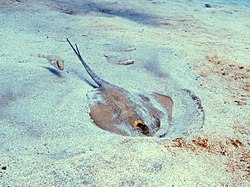
The seabed (also known as the seafloor, sea floor, ocean floor, and ocean bottom) is the bottom of the ocean. All floors of the ocean are known as seabeds.
The structure of the seabed of the global ocean is governed by plate tectonics. Most of the ocean is very deep, where the seabed is known as the abyssal plain. Seafloor spreading creates mid-ocean ridges along the center line of major ocean basins, where the seabed is slightly shallower than the surrounding abyssal plain. From the abyssal plain, the seabed slopes upward toward the continents and becomes, in order from deep to shallow, the continental rise, slope, and shelf. The depth within the seabed itself, such as the depth down through a sediment core, is known as the "depth below seafloor". The ecological environment of the seabed and the deepest waters are collectively known, as a habitat for creatures, as the "benthos".
Most of the seabed throughout the world's oceans is covered in layers of marine sediments. Categorized by where the materials come from or composition, these sediments are classified as either: from land (terrigenous), from biological organisms (biogenous), from chemical reactions (hydrogenous), and from space (cosmogenous). Categorized by size, these sediments range from very small particles called clays and silts, known as mud, to larger particles from sand to boulders.
Features of the seabed are governed by the physics of sediment transport and by the biology of the creatures living in the seabed and in the ocean waters above. Physically, seabed sediments often come from the erosion of material on land and from other rarer sources, such as volcanic ash. Sea currents transport sediments, especially in shallow waters where tidal energy and wave energy cause resuspension of seabed sediments. Biologically, microorganisms living within the seabed sediments change seabed chemistry. Marine organisms create sediments, both within the seabed and in the water above. For example, phytoplankton with silicate or calcium carbonate shells grow in abundance in the upper ocean, and when they die, their shells sink to the seafloor to become seabed sediments.
Human impacts on the seabed are diverse. Examples of human effects on the seabed include exploration, plastic pollution, and exploitation by mining and dredging operations. To map the seabed, ships use acoustic technology to map water depths throughout the world. Submersible vehicles help researchers study unique seabed ecosystems such as hydrothermal vents. Plastic pollution is a global phenomenon, and because the ocean is the ultimate destination for global waterways, much of the world's plastic ends up in the ocean and some sinks to the seabed. Exploitation of the seabed involves extracting valuable minerals from sulfide deposits via deep sea mining, as well as dredging sand from shallow environments for construction and beach nourishment.
Most of the oceans have a common structure, created by common physical phenomena, mainly from tectonic movement, and sediment from various sources. The structure of the oceans, starting with the continents, begins usually with a continental shelf, continues to the continental slope – which is a steep descent into the ocean, until reaching the abyssal plain – a topographic plain, the beginning of the seabed, and its main area. The border between the continental slope and the abyssal plain usually has a more gradual descent, and is called the continental rise, which is caused by sediment cascading down the continental slope.[citation needed]
The mid-ocean ridge, as its name implies, is a mountainous rise through the middle of all the oceans, between the continents. Typically a rift runs along the edge of this ridge. Along tectonic plate edges there are typically oceanic trenches – deep valleys, created by the mantle circulation movement from the mid-ocean mountain ridge to the oceanic trench.
Hotspot volcanic island ridges are created by volcanic activity, erupting periodically, as the tectonic plates pass over a hotspot. In areas with volcanic activity and in the oceanic trenches there are hydrothermal vents – releasing high pressure and extremely hot water and chemicals into the typically freezing water around it.
Seabed
The seabed (also known as the seafloor, sea floor, ocean floor, and ocean bottom) is the bottom of the ocean. All floors of the ocean are known as seabeds.
The structure of the seabed of the global ocean is governed by plate tectonics. Most of the ocean is very deep, where the seabed is known as the abyssal plain. Seafloor spreading creates mid-ocean ridges along the center line of major ocean basins, where the seabed is slightly shallower than the surrounding abyssal plain. From the abyssal plain, the seabed slopes upward toward the continents and becomes, in order from deep to shallow, the continental rise, slope, and shelf. The depth within the seabed itself, such as the depth down through a sediment core, is known as the "depth below seafloor". The ecological environment of the seabed and the deepest waters are collectively known, as a habitat for creatures, as the "benthos".
Most of the seabed throughout the world's oceans is covered in layers of marine sediments. Categorized by where the materials come from or composition, these sediments are classified as either: from land (terrigenous), from biological organisms (biogenous), from chemical reactions (hydrogenous), and from space (cosmogenous). Categorized by size, these sediments range from very small particles called clays and silts, known as mud, to larger particles from sand to boulders.
Features of the seabed are governed by the physics of sediment transport and by the biology of the creatures living in the seabed and in the ocean waters above. Physically, seabed sediments often come from the erosion of material on land and from other rarer sources, such as volcanic ash. Sea currents transport sediments, especially in shallow waters where tidal energy and wave energy cause resuspension of seabed sediments. Biologically, microorganisms living within the seabed sediments change seabed chemistry. Marine organisms create sediments, both within the seabed and in the water above. For example, phytoplankton with silicate or calcium carbonate shells grow in abundance in the upper ocean, and when they die, their shells sink to the seafloor to become seabed sediments.
Human impacts on the seabed are diverse. Examples of human effects on the seabed include exploration, plastic pollution, and exploitation by mining and dredging operations. To map the seabed, ships use acoustic technology to map water depths throughout the world. Submersible vehicles help researchers study unique seabed ecosystems such as hydrothermal vents. Plastic pollution is a global phenomenon, and because the ocean is the ultimate destination for global waterways, much of the world's plastic ends up in the ocean and some sinks to the seabed. Exploitation of the seabed involves extracting valuable minerals from sulfide deposits via deep sea mining, as well as dredging sand from shallow environments for construction and beach nourishment.
Most of the oceans have a common structure, created by common physical phenomena, mainly from tectonic movement, and sediment from various sources. The structure of the oceans, starting with the continents, begins usually with a continental shelf, continues to the continental slope – which is a steep descent into the ocean, until reaching the abyssal plain – a topographic plain, the beginning of the seabed, and its main area. The border between the continental slope and the abyssal plain usually has a more gradual descent, and is called the continental rise, which is caused by sediment cascading down the continental slope.[citation needed]
The mid-ocean ridge, as its name implies, is a mountainous rise through the middle of all the oceans, between the continents. Typically a rift runs along the edge of this ridge. Along tectonic plate edges there are typically oceanic trenches – deep valleys, created by the mantle circulation movement from the mid-ocean mountain ridge to the oceanic trench.
Hotspot volcanic island ridges are created by volcanic activity, erupting periodically, as the tectonic plates pass over a hotspot. In areas with volcanic activity and in the oceanic trenches there are hydrothermal vents – releasing high pressure and extremely hot water and chemicals into the typically freezing water around it.
Recent media
Recent media