
Recent from talks
John Watts de Peyster
Knowledge base stats:
Talk channels stats:
Members stats:
John Watts de Peyster
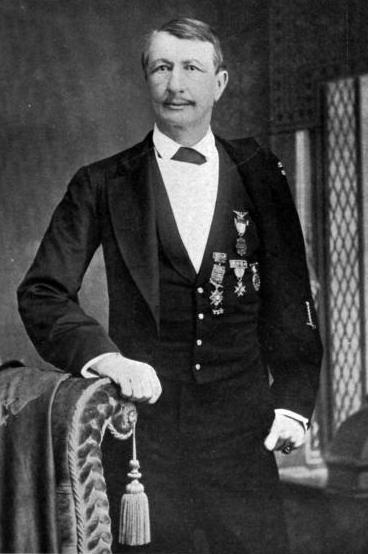
John Watts de Peyster, Sr. (March 9, 1821 – May 4, 1907) was an American author on the art of war, philanthropist, and the Adjutant General of New York. He served in the New York State Militia during the Mexican–American War.
De Peyster was born in Manhattan into a wealthy old New York City Huguenot family, and was a descendant of Johannes de Peyster Sr. His father was Frederic de Peyster, a wealthy New York City lawyer, investor, and philanthropist. He was a first cousin of Maj. Gen. Philip Kearny. His great great grandfather was Abraham de Peyster, an early Mayor of New York City, whose brother was Johannes de Peyster, also Mayor. His grandfather was a nephew of Arent DePeyster.
He studied law at Columbia University, although he did not graduate on account of his poor health. He had become an invalid at a young age due to a heart affliction he developed during service as a volunteer fireman. De Peyster was heavily involved as a volunteer firefighter with the No. 5 Hose Carriage during his collegiate years, including a major fire in 1836, leading to his health problems. Despite these physical difficulties, he was described by some as feisty, and even dictatorial.
He later received the honorary degrees of M.A. from Columbia College, LL.D. from Nebraska College, and Ph.D. from Franklin & Marshall College. He was one of the organizers of the New York City Police Department and Fire Department. Reforms he advocated through publications which were eventually implemented nationwide included a paid Fire Department, and Steam Fire Engines, and New York City was the first in the nation to adopt such measures.
He spent his entire career in the New York State Militia, being promoted to brigadier general in 1851. He served as state Judge Advocate General and eventually Adjutant General, before resigning over a conflict with Governor Myron Clark in 1855. He traveled through Europe extensively as a military observer, and implemented many reforms that modernized the militia for the upcoming conflict.
Already a brigadier general of the state militia at the onset of the Civil War, he met with what he perceived (and declared) to be prejudiced resistance from Abraham Lincoln when he attempted to raise regiments for the Union Army. In 1861, de Peyster traveled to Washington, D.C., to solicit a commission as a brigadier general of the Regular Army and offered to raise two regiments of artillery, which he felt best suited his expertise and physical condition. He was met with little interest after New York had already filled its national recruitment quota of 75,000 men.
Each of his three sons served in the conflict in the Union Army. The eldest, John Watts de Peyster Jr., performed duty as an aide-de-camp and artillery commander with the Army of the Potomac and mustered out as a brevet brigadier general; Frederic de Peyster III, was a colonel and surgeon; while the youngest, Johnston de Peyster, was a second lieutenant in charge of a battery of artillery credited with hoisting the first Union flag over the Confederate capitol of Richmond, Virginia, after its fall.
The career militia officer had always suffered from poor health, and turned down a commission as a colonel of cavalry offered to him by New York Senator Ira Harris in June 1863 on behalf of Generals Joseph Hooker and Alfred Pleasonton, who may have had an eye towards de Peyster's social connections. Other notable figures with limited field experience who were promoted to brigadier general by Pleasonton at that time were Elon J. Farnsworth, son of a Congressman, Wesley Merritt, and George Armstrong Custer.
Hub AI
John Watts de Peyster AI simulator
(@John Watts de Peyster_simulator)
John Watts de Peyster
John Watts de Peyster, Sr. (March 9, 1821 – May 4, 1907) was an American author on the art of war, philanthropist, and the Adjutant General of New York. He served in the New York State Militia during the Mexican–American War.
De Peyster was born in Manhattan into a wealthy old New York City Huguenot family, and was a descendant of Johannes de Peyster Sr. His father was Frederic de Peyster, a wealthy New York City lawyer, investor, and philanthropist. He was a first cousin of Maj. Gen. Philip Kearny. His great great grandfather was Abraham de Peyster, an early Mayor of New York City, whose brother was Johannes de Peyster, also Mayor. His grandfather was a nephew of Arent DePeyster.
He studied law at Columbia University, although he did not graduate on account of his poor health. He had become an invalid at a young age due to a heart affliction he developed during service as a volunteer fireman. De Peyster was heavily involved as a volunteer firefighter with the No. 5 Hose Carriage during his collegiate years, including a major fire in 1836, leading to his health problems. Despite these physical difficulties, he was described by some as feisty, and even dictatorial.
He later received the honorary degrees of M.A. from Columbia College, LL.D. from Nebraska College, and Ph.D. from Franklin & Marshall College. He was one of the organizers of the New York City Police Department and Fire Department. Reforms he advocated through publications which were eventually implemented nationwide included a paid Fire Department, and Steam Fire Engines, and New York City was the first in the nation to adopt such measures.
He spent his entire career in the New York State Militia, being promoted to brigadier general in 1851. He served as state Judge Advocate General and eventually Adjutant General, before resigning over a conflict with Governor Myron Clark in 1855. He traveled through Europe extensively as a military observer, and implemented many reforms that modernized the militia for the upcoming conflict.
Already a brigadier general of the state militia at the onset of the Civil War, he met with what he perceived (and declared) to be prejudiced resistance from Abraham Lincoln when he attempted to raise regiments for the Union Army. In 1861, de Peyster traveled to Washington, D.C., to solicit a commission as a brigadier general of the Regular Army and offered to raise two regiments of artillery, which he felt best suited his expertise and physical condition. He was met with little interest after New York had already filled its national recruitment quota of 75,000 men.
Each of his three sons served in the conflict in the Union Army. The eldest, John Watts de Peyster Jr., performed duty as an aide-de-camp and artillery commander with the Army of the Potomac and mustered out as a brevet brigadier general; Frederic de Peyster III, was a colonel and surgeon; while the youngest, Johnston de Peyster, was a second lieutenant in charge of a battery of artillery credited with hoisting the first Union flag over the Confederate capitol of Richmond, Virginia, after its fall.
The career militia officer had always suffered from poor health, and turned down a commission as a colonel of cavalry offered to him by New York Senator Ira Harris in June 1863 on behalf of Generals Joseph Hooker and Alfred Pleasonton, who may have had an eye towards de Peyster's social connections. Other notable figures with limited field experience who were promoted to brigadier general by Pleasonton at that time were Elon J. Farnsworth, son of a Congressman, Wesley Merritt, and George Armstrong Custer.
Recent media