



Community hub
Recent from talks
Knowledge base stats:
Talk channels stats:
Members stats:
JAT Flight 367
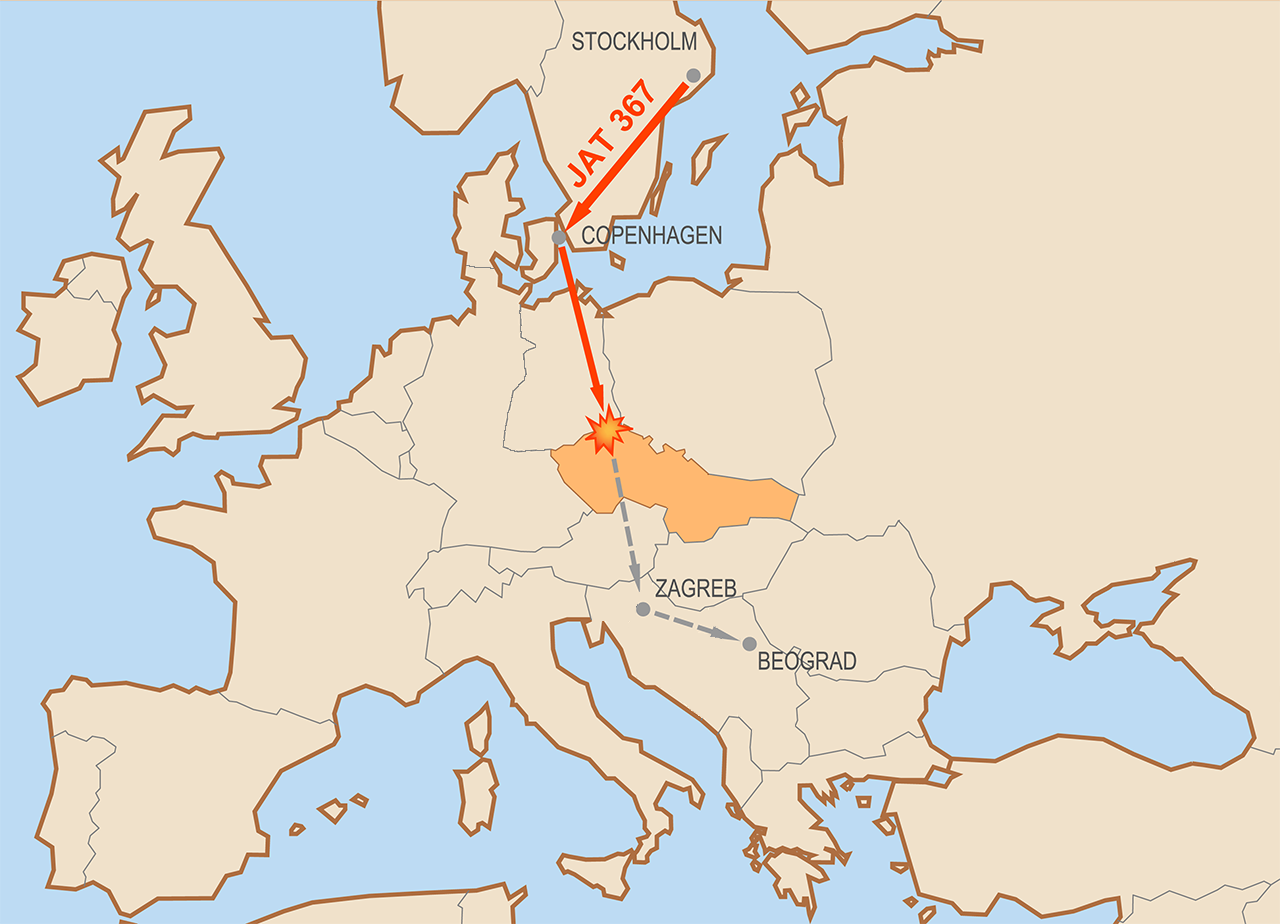
JAT Flight 367 was a McDonnell Douglas DC-9-32 aircraft (registration YU-AHT) which exploded shortly after overflying NDB Hermsdorf (located in or around Hinterhermsdorf, in the present-day municipality of Sebnitz), East Germany, while en route from Stockholm, Sweden, to Belgrade, SFR Yugoslavia, on 26 January 1972. The aircraft, piloted by Captain Ludvik Razdrih and First Officer Ratko Mihić, broke into three pieces and spun out of control, crashing near the village of Srbská Kamenice in Czechoslovakia (now the Czech Republic). Of the 28 on board, 27 were killed upon ground impact and one Serbian crew member, Vesna Vulović (1950–2016), survived. She holds the Guinness world record for surviving the highest fall without a parachute at 10,160 m (33,330 ft).
The secondary crew of JAT Flight 367, flying from Stockholm to Belgrade with stopovers in Copenhagen and Zagreb, arrived in Denmark on the morning of 25 January 1972. Flight 367 departed from Stockholm Arlanda Airport at 1:30 p.m. (13:30 UTC) on 26 January. The aircraft, a McDonnell Douglas DC-9-32, landed at Copenhagen Airport at 2:30 p.m., where it was taken over by Vulović and her colleagues. "As it was late, we were in the terminal and saw it park," Vulović said. "I saw all the passengers and crew deplane. One man seemed terribly annoyed. It was not only me that noticed him either. Other crew members saw him, as did the station manager in Copenhagen. I think it was the man who put the bomb in the baggage. I think he had checked in a bag in Stockholm, got off in Copenhagen and never re-boarded the flight."
Flight 367 departed from Copenhagen Airport at 3:15 p.m. At 4:01 p.m, an explosion tore through the DC-9's baggage compartment. The explosion caused the aircraft to break apart over the Czechoslovak village of Srbská Kamenice. Vulović was the only survivor of the 28 passengers and crew. Some reports stated Vulović was at the rear of the aircraft when the explosion occurred, but she has stated she was told that she was found in the middle section of the plane. She was discovered by villager Bruno Honke, who heard her screaming amid the wreckage. Her turquoise uniform was covered in blood and her 3-inch (76 mm) stiletto heels had been torn off by the force of the impact. Honke had been a medic during World War II and was able to keep Vulović alive until rescuers arrived. Vulović was in a coma for 27 days and was temporarily paralyzed from the waist down, but survived. She continued working for JAT, holding a desk job.
Between 1962 and 1982, the Croatian nationalist group carried out 128 terror attacks against Yugoslavian civilian and military targets. The Yugoslav authorities suspected that émigré Croatian terrorists were to blame for bringing down Flight 367. The day of the crash, a bomb exploded aboard a train travelling from Vienna to Zagreb, injuring six. A man, describing himself as a Croatian nationalist, called the Swedish newspaper Kvällsposten the following day and claimed responsibility for the bombing of Flight 367. No arrests have yet been made. The Czechoslovak Civil Aviation Authority later attributed the explosion to a briefcase bomb.
On 10 October 2024, TV4's investigative program Kalla fakta aired a documentary that found a group of Croat nationalists based in Sweden were implicated in the bombing. Reporter Tonchi Percan discovered names of suspects and found previously classified documents from the Yugoslav security service. The documents contain detailed information about how the crime was planned, financed, and executed. For each one of the seven individuals, the documents contains intelligence from between 38 and 59 different secret agents. The seven men were exiled Croats associated with the Bugojno group who had resided in Sweden and Germany. Kalla fakta interviewed the three Swedish men who were still alive in 2024; two of them denied involvement in the bombing, while the third claimed not to remember anything.
The officially stated cause of the Flight 367 crash was challenged occasionally over the years by conspiracy theories. For example, in 1997 the Czech periodical Letectví a kosmonautika reported that the plane was shot down by mistake by Czechoslovak air defenses.
The discussion about different aspects of the crash was reopened on 8 January 2009, when German news magazine Tagesschau featured a report by investigative journalists Peter Hornung and Pavel Theiner. Allegedly based on newly obtained documents mainly from the Czech Civil Aviation Authority, they concluded that it was "extremely likely" that the plane had been mistakenly shot down only a few hundred meters above the ground by a MiG fighter of the Czechoslovak Air Force, having been mistaken for an enemy aircraft while attempting a forced landing. All the evidence suggesting that the plane was destroyed at high altitude by explosives placed in a suitcase would be therefore have been forged by Czechoslovak secret police.
As evidence that the DC-9 had broken up at a lower altitude, the journalists cited eyewitnesses from Srbská Kamenice, who had seen the plane burning but still intact below the low-hanging clouds, and confirmation of a Serbian aviation expert (who had been present at the crash site) that the debris area had been much too small for a crash from high altitude; it also referred to sightings of a second plane. According to Hornung, Flight 367 got into difficulties, "went into a steep descent and found itself over a sensitive military area", close to a nuclear weapons facility. However, Hornung himself stated that for his theory "there are only indications, no evidence".
Hub AI
JAT Flight 367 AI simulator
(@JAT Flight 367_simulator)
JAT Flight 367
JAT Flight 367 was a McDonnell Douglas DC-9-32 aircraft (registration YU-AHT) which exploded shortly after overflying NDB Hermsdorf (located in or around Hinterhermsdorf, in the present-day municipality of Sebnitz), East Germany, while en route from Stockholm, Sweden, to Belgrade, SFR Yugoslavia, on 26 January 1972. The aircraft, piloted by Captain Ludvik Razdrih and First Officer Ratko Mihić, broke into three pieces and spun out of control, crashing near the village of Srbská Kamenice in Czechoslovakia (now the Czech Republic). Of the 28 on board, 27 were killed upon ground impact and one Serbian crew member, Vesna Vulović (1950–2016), survived. She holds the Guinness world record for surviving the highest fall without a parachute at 10,160 m (33,330 ft).
The secondary crew of JAT Flight 367, flying from Stockholm to Belgrade with stopovers in Copenhagen and Zagreb, arrived in Denmark on the morning of 25 January 1972. Flight 367 departed from Stockholm Arlanda Airport at 1:30 p.m. (13:30 UTC) on 26 January. The aircraft, a McDonnell Douglas DC-9-32, landed at Copenhagen Airport at 2:30 p.m., where it was taken over by Vulović and her colleagues. "As it was late, we were in the terminal and saw it park," Vulović said. "I saw all the passengers and crew deplane. One man seemed terribly annoyed. It was not only me that noticed him either. Other crew members saw him, as did the station manager in Copenhagen. I think it was the man who put the bomb in the baggage. I think he had checked in a bag in Stockholm, got off in Copenhagen and never re-boarded the flight."
Flight 367 departed from Copenhagen Airport at 3:15 p.m. At 4:01 p.m, an explosion tore through the DC-9's baggage compartment. The explosion caused the aircraft to break apart over the Czechoslovak village of Srbská Kamenice. Vulović was the only survivor of the 28 passengers and crew. Some reports stated Vulović was at the rear of the aircraft when the explosion occurred, but she has stated she was told that she was found in the middle section of the plane. She was discovered by villager Bruno Honke, who heard her screaming amid the wreckage. Her turquoise uniform was covered in blood and her 3-inch (76 mm) stiletto heels had been torn off by the force of the impact. Honke had been a medic during World War II and was able to keep Vulović alive until rescuers arrived. Vulović was in a coma for 27 days and was temporarily paralyzed from the waist down, but survived. She continued working for JAT, holding a desk job.
Between 1962 and 1982, the Croatian nationalist group carried out 128 terror attacks against Yugoslavian civilian and military targets. The Yugoslav authorities suspected that émigré Croatian terrorists were to blame for bringing down Flight 367. The day of the crash, a bomb exploded aboard a train travelling from Vienna to Zagreb, injuring six. A man, describing himself as a Croatian nationalist, called the Swedish newspaper Kvällsposten the following day and claimed responsibility for the bombing of Flight 367. No arrests have yet been made. The Czechoslovak Civil Aviation Authority later attributed the explosion to a briefcase bomb.
On 10 October 2024, TV4's investigative program Kalla fakta aired a documentary that found a group of Croat nationalists based in Sweden were implicated in the bombing. Reporter Tonchi Percan discovered names of suspects and found previously classified documents from the Yugoslav security service. The documents contain detailed information about how the crime was planned, financed, and executed. For each one of the seven individuals, the documents contains intelligence from between 38 and 59 different secret agents. The seven men were exiled Croats associated with the Bugojno group who had resided in Sweden and Germany. Kalla fakta interviewed the three Swedish men who were still alive in 2024; two of them denied involvement in the bombing, while the third claimed not to remember anything.
The officially stated cause of the Flight 367 crash was challenged occasionally over the years by conspiracy theories. For example, in 1997 the Czech periodical Letectví a kosmonautika reported that the plane was shot down by mistake by Czechoslovak air defenses.
The discussion about different aspects of the crash was reopened on 8 January 2009, when German news magazine Tagesschau featured a report by investigative journalists Peter Hornung and Pavel Theiner. Allegedly based on newly obtained documents mainly from the Czech Civil Aviation Authority, they concluded that it was "extremely likely" that the plane had been mistakenly shot down only a few hundred meters above the ground by a MiG fighter of the Czechoslovak Air Force, having been mistaken for an enemy aircraft while attempting a forced landing. All the evidence suggesting that the plane was destroyed at high altitude by explosives placed in a suitcase would be therefore have been forged by Czechoslovak secret police.
As evidence that the DC-9 had broken up at a lower altitude, the journalists cited eyewitnesses from Srbská Kamenice, who had seen the plane burning but still intact below the low-hanging clouds, and confirmation of a Serbian aviation expert (who had been present at the crash site) that the debris area had been much too small for a crash from high altitude; it also referred to sightings of a second plane. According to Hornung, Flight 367 got into difficulties, "went into a steep descent and found itself over a sensitive military area", close to a nuclear weapons facility. However, Hornung himself stated that for his theory "there are only indications, no evidence".