



Community hub
Recent from talks
Knowledge base stats:
Talk channels stats:
Members stats:
Human polyomavirus 2
Human polyomavirus 2, commonly referred to as the JC virus or John Cunningham virus, is a type of human polyomavirus. It was identified by electron microscopy in 1965 by ZuRhein and Chou, and by Silverman and Rubinstein.[citation needed] It was later isolated in culture and named using the initials of a patient by the name of John Cunningham from whom it was isolated and had developed progressive multifocal leukoencephalopathy (PML). The virus causes leukoencephalopathy and other diseases only in cases of immunodeficiency, as in AIDS or during treatment with immunosuppressive drugs (e.g. in organ transplant patients).
The initial site of infection may be the tonsils, or possibly the gastrointestinal tract. The virus then remains latent in the gastrointestinal tract and can also infect the tubular epithelial cells in the kidneys, where it continues to reproduce, shedding virus particles in the urine. In addition, recent studies suggest that this virus may latently infect the human semen as well as the chorionic villi tissues. Serum antibodies against Human polyomavirus 2 have also been found in spontaneous abortion-affected women as well as in women who underwent voluntary interruption of pregnancy.
Human polyomavirus 2 can cross the blood–brain barrier into the central nervous system, where it infects oligodendrocytes and astrocytes, possibly through the 5-HT2A serotonin receptor. Human polyomavirus 2 DNA can be detected in both non-PML affected and PML-affected (see below) brain tissue.
Human polyomavirus 2 found in the central nervous system of PML patients almost invariably have differences in promoter sequence to Human polyomavirus 2 found in healthy individuals. It is thought that these differences in promoter sequence contribute to the fitness of the virus in the CNS and thus to the development of PML. Certain transcription factors present in the early promoter sequences of Human polyomavirus 2 can induce tropism and viral proliferation that leads to PML. The Spi-B factor was shown to be crucial in initiating viral replication in certain strains of transgenic mice. The protein encoded by these early sequences, T-antigen, also plays a key role in viral proliferation, directing the initiation of DNA replication for the virus as well as performing a transcriptional switch to allow for the formation of the various capsid and regulatory proteins needed for viral fitness. Further research is needed to determine the exact etiological role of T-antigen, but there seems to be a connection to the early initiation of the active virus from its archetypal dormant state.[citation needed]
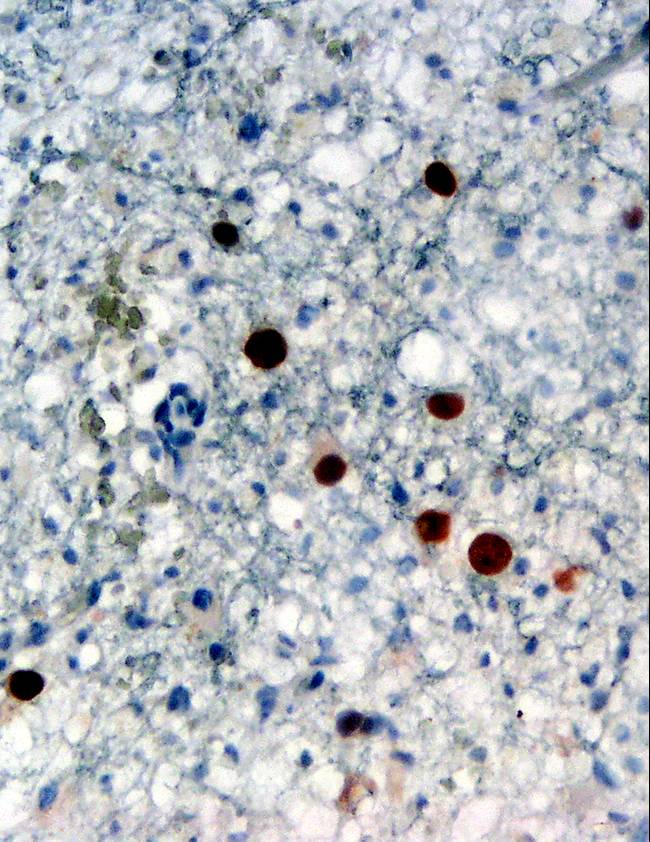
Immunodeficiency or immunosuppression allows Human polyomavirus 2 to reactivate. In the brain, it causes the often fatal progressive multifocal leukoencephalopathy, or PML, by destroying oligodendrocytes. Whether this represents the reactivation of Human polyomavirus 2 within the CNS or seeding of newly reactivated Human polyomavirus 2 via blood or lymphatics is unknown. Several studies since 2000 have suggested that the virus is also linked to colorectal cancer, as Human polyomavirus 2 has been found in malignant colon tumors, but these findings are still controversial.
Although Human polyomavirus 2 infection is classically associated with white matter demyelination and PML pathogenesis, recent literature has identified viral variants as etiological agents of other novel syndromes. For example, Human polyomavirus 2 has been found to infect the granule cell layer of the cerebellum, while sparing Purkinje cells, ultimately causing severe cerebellar atrophy. This syndrome, called JCV granule cell layer neuronopathy (JCV GCN), is characterized by a productive and lytic infection by a JC variant with a mutation in the VP1 coding region.[citation needed]
Human polyomavirus 2 also appears to mediate encephalopathy, due to infection of cortical pyramidal neurons (CPN) and astrocytes. Analysis of the JCV CPN variant revealed differences from JCV GCN: no mutations were found in the VP1 coding region; however, a 143–base-pair deletion was identified in the agnogene, coding for a 10–amino-acid truncated peptide, which is believed to mediate CPN tropism. Additionally, analysis of the subcellular localization of JC CPN virions in nuclei, cytoplasm, and axons suggests that the virus may travel through axons to increase infectivity.
Human polyomavirus 2 may also be a causative agent of aseptic meningitis (JCVM), as Human polyomavirus 2 was the only pathogen identified in the CSF of certain patients with meningitis. Analysis of the JCVM variant revealed archetype-like regulatory regions with no mutations in coding sequences. The precise molecular mechanisms mediating Human polyomavirus 2 meningeal tropism remain to be found.
Hub AI
Human polyomavirus 2 AI simulator
(@Human polyomavirus 2_simulator)
Human polyomavirus 2
Human polyomavirus 2, commonly referred to as the JC virus or John Cunningham virus, is a type of human polyomavirus. It was identified by electron microscopy in 1965 by ZuRhein and Chou, and by Silverman and Rubinstein.[citation needed] It was later isolated in culture and named using the initials of a patient by the name of John Cunningham from whom it was isolated and had developed progressive multifocal leukoencephalopathy (PML). The virus causes leukoencephalopathy and other diseases only in cases of immunodeficiency, as in AIDS or during treatment with immunosuppressive drugs (e.g. in organ transplant patients).
The initial site of infection may be the tonsils, or possibly the gastrointestinal tract. The virus then remains latent in the gastrointestinal tract and can also infect the tubular epithelial cells in the kidneys, where it continues to reproduce, shedding virus particles in the urine. In addition, recent studies suggest that this virus may latently infect the human semen as well as the chorionic villi tissues. Serum antibodies against Human polyomavirus 2 have also been found in spontaneous abortion-affected women as well as in women who underwent voluntary interruption of pregnancy.
Human polyomavirus 2 can cross the blood–brain barrier into the central nervous system, where it infects oligodendrocytes and astrocytes, possibly through the 5-HT2A serotonin receptor. Human polyomavirus 2 DNA can be detected in both non-PML affected and PML-affected (see below) brain tissue.
Human polyomavirus 2 found in the central nervous system of PML patients almost invariably have differences in promoter sequence to Human polyomavirus 2 found in healthy individuals. It is thought that these differences in promoter sequence contribute to the fitness of the virus in the CNS and thus to the development of PML. Certain transcription factors present in the early promoter sequences of Human polyomavirus 2 can induce tropism and viral proliferation that leads to PML. The Spi-B factor was shown to be crucial in initiating viral replication in certain strains of transgenic mice. The protein encoded by these early sequences, T-antigen, also plays a key role in viral proliferation, directing the initiation of DNA replication for the virus as well as performing a transcriptional switch to allow for the formation of the various capsid and regulatory proteins needed for viral fitness. Further research is needed to determine the exact etiological role of T-antigen, but there seems to be a connection to the early initiation of the active virus from its archetypal dormant state.[citation needed]
Immunodeficiency or immunosuppression allows Human polyomavirus 2 to reactivate. In the brain, it causes the often fatal progressive multifocal leukoencephalopathy, or PML, by destroying oligodendrocytes. Whether this represents the reactivation of Human polyomavirus 2 within the CNS or seeding of newly reactivated Human polyomavirus 2 via blood or lymphatics is unknown. Several studies since 2000 have suggested that the virus is also linked to colorectal cancer, as Human polyomavirus 2 has been found in malignant colon tumors, but these findings are still controversial.
Although Human polyomavirus 2 infection is classically associated with white matter demyelination and PML pathogenesis, recent literature has identified viral variants as etiological agents of other novel syndromes. For example, Human polyomavirus 2 has been found to infect the granule cell layer of the cerebellum, while sparing Purkinje cells, ultimately causing severe cerebellar atrophy. This syndrome, called JCV granule cell layer neuronopathy (JCV GCN), is characterized by a productive and lytic infection by a JC variant with a mutation in the VP1 coding region.[citation needed]
Human polyomavirus 2 also appears to mediate encephalopathy, due to infection of cortical pyramidal neurons (CPN) and astrocytes. Analysis of the JCV CPN variant revealed differences from JCV GCN: no mutations were found in the VP1 coding region; however, a 143–base-pair deletion was identified in the agnogene, coding for a 10–amino-acid truncated peptide, which is believed to mediate CPN tropism. Additionally, analysis of the subcellular localization of JC CPN virions in nuclei, cytoplasm, and axons suggests that the virus may travel through axons to increase infectivity.
Human polyomavirus 2 may also be a causative agent of aseptic meningitis (JCVM), as Human polyomavirus 2 was the only pathogen identified in the CSF of certain patients with meningitis. Analysis of the JCVM variant revealed archetype-like regulatory regions with no mutations in coding sequences. The precise molecular mechanisms mediating Human polyomavirus 2 meningeal tropism remain to be found.