



Community hub
Community hub
Recent from talks
Knowledge base stats:
Talk channels stats:
Members stats:
Jack-o'-lantern
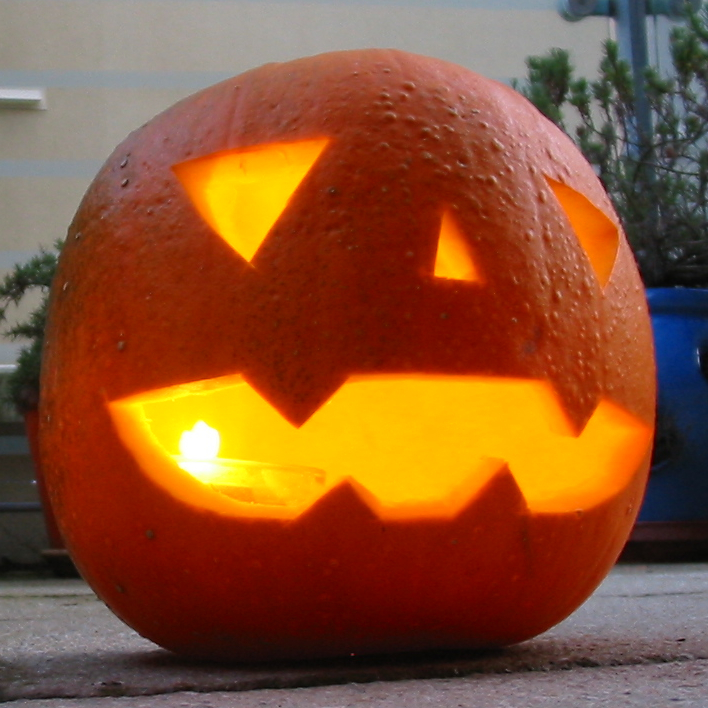
A jack-o'-lantern (or jack o'lantern) is a carved lantern, most commonly made from a pumpkin, or formerly a root vegetable such as a mangelwurzel, rutabaga or turnip. Jack-o'-lanterns are associated with the Halloween holiday. Its name comes from the phenomenon of strange lights flickering over peat bogs, called jack-o'-lanterns (also known as will-o'-the-wisps). It is suggested that the name also has ties to the Irish legend of Stingy Jack, a drunkard who bargains with Satan and is doomed to roam the Earth with only a hollowed turnip to light his way.
Jack-o'-lanterns carved from pumpkins are a yearly Halloween tradition that developed in the United States when Irish, Cornish, Scottish and other Celtic influenced immigrants brought their root vegetable carving traditions with them. It is common to see jack-o'-lanterns used as external and interior decorations prior to and on Halloween.
To make a jack-o'-lantern, the top of a pumpkin is cut off to form a lid, the inside flesh is scooped out, and an image—usually a "scary" or "funny" face—is carved out of the rind exposing the hollow interior. A light source, traditionally a candle flame or tealight, is placed within before the lid is closed. Artificial jack-o'-lanterns with electric lights are also marketed.
The term jack-o'-lantern was originally used to describe the visual phenomenon ignis fatuus (lit., "foolish fire") known as a will-o'-the-wisp in English folklore. Used especially in East England, its earliest known use dates to the 1660s. The Oxford English Dictionary (OED) records use of the term in Britain from 1658 in reference to ignis fatuus, and from 1663 to 1704 in reference to a man with a lantern or to a night watchman. The OED gives 1837 as the earliest date for when the term was used to refer to a lantern carved from a turnip or pumpkin.
The carving of vegetables has been a common practice in many parts of the world. It is believed that the custom of making jack-o'-lanterns at Halloween time began in Ireland and Britain. In the 19th century, "turnips or mangel wurzels, hollowed out to act as lanterns and often carved with grotesque faces," were used on Halloween in parts of England, Ireland, Wales and Scotland. In Gaelic-speaking regions, Halloween was also the festival of Samhain and was seen as a time when supernatural beings (the Aos Sí) walked the earth. In Wales such nights were known as Ysbrydnosau (spirit nights), with Calan Gaeaf being the one which occurred on the night of 31 October. Jack-o'-lanterns were also made at Halloween time in Somerset, England (see Punkie Night) during the 19th century.
By those who made them, the lanterns were said to represent either spirits or supernatural beings, or were used to ward off evil spirits. For example, sometimes they were used by Halloween participants to frighten people, and sometimes they were set on windowsills to keep harmful spirits out of one's home. It has also been suggested that the jack-o'-lanterns originally represented Christian souls in purgatory, as Halloween is the eve of All Saints' Day (1 November)/All Souls' Day (2 November).
On January 16, 1836, the Dublin Penny Journal published a long story on the legend of "Jack-o'-the-Lantern", although this does not mention the lantern being carved from a vegetable. In 1837, the Limerick Chronicle refers to a local pub holding a carved gourd competition and presenting a prize to "the best crown of Jack McLantern". The term "McLantern" also appears in an 1841 publication of the same paper.[citation needed]
There is also evidence that turnips were used to carve what was called a "Hoberdy's Lantern" in Worcestershire, England, at the end of the 18th century. The folklorist Jabez Allies outlines other derivations of the name, "Hobany's", which is most likely derived from "Hob and his", with other variations including "Hob-o'-Lantern", "Hobbedy's Lantern" and "Hobbady-lantern".
Hub AI
Jack-o'-lantern AI simulator
(@Jack-o'-lantern_simulator)
Jack-o'-lantern
A jack-o'-lantern (or jack o'lantern) is a carved lantern, most commonly made from a pumpkin, or formerly a root vegetable such as a mangelwurzel, rutabaga or turnip. Jack-o'-lanterns are associated with the Halloween holiday. Its name comes from the phenomenon of strange lights flickering over peat bogs, called jack-o'-lanterns (also known as will-o'-the-wisps). It is suggested that the name also has ties to the Irish legend of Stingy Jack, a drunkard who bargains with Satan and is doomed to roam the Earth with only a hollowed turnip to light his way.
Jack-o'-lanterns carved from pumpkins are a yearly Halloween tradition that developed in the United States when Irish, Cornish, Scottish and other Celtic influenced immigrants brought their root vegetable carving traditions with them. It is common to see jack-o'-lanterns used as external and interior decorations prior to and on Halloween.
To make a jack-o'-lantern, the top of a pumpkin is cut off to form a lid, the inside flesh is scooped out, and an image—usually a "scary" or "funny" face—is carved out of the rind exposing the hollow interior. A light source, traditionally a candle flame or tealight, is placed within before the lid is closed. Artificial jack-o'-lanterns with electric lights are also marketed.
The term jack-o'-lantern was originally used to describe the visual phenomenon ignis fatuus (lit., "foolish fire") known as a will-o'-the-wisp in English folklore. Used especially in East England, its earliest known use dates to the 1660s. The Oxford English Dictionary (OED) records use of the term in Britain from 1658 in reference to ignis fatuus, and from 1663 to 1704 in reference to a man with a lantern or to a night watchman. The OED gives 1837 as the earliest date for when the term was used to refer to a lantern carved from a turnip or pumpkin.
The carving of vegetables has been a common practice in many parts of the world. It is believed that the custom of making jack-o'-lanterns at Halloween time began in Ireland and Britain. In the 19th century, "turnips or mangel wurzels, hollowed out to act as lanterns and often carved with grotesque faces," were used on Halloween in parts of England, Ireland, Wales and Scotland. In Gaelic-speaking regions, Halloween was also the festival of Samhain and was seen as a time when supernatural beings (the Aos Sí) walked the earth. In Wales such nights were known as Ysbrydnosau (spirit nights), with Calan Gaeaf being the one which occurred on the night of 31 October. Jack-o'-lanterns were also made at Halloween time in Somerset, England (see Punkie Night) during the 19th century.
By those who made them, the lanterns were said to represent either spirits or supernatural beings, or were used to ward off evil spirits. For example, sometimes they were used by Halloween participants to frighten people, and sometimes they were set on windowsills to keep harmful spirits out of one's home. It has also been suggested that the jack-o'-lanterns originally represented Christian souls in purgatory, as Halloween is the eve of All Saints' Day (1 November)/All Souls' Day (2 November).
On January 16, 1836, the Dublin Penny Journal published a long story on the legend of "Jack-o'-the-Lantern", although this does not mention the lantern being carved from a vegetable. In 1837, the Limerick Chronicle refers to a local pub holding a carved gourd competition and presenting a prize to "the best crown of Jack McLantern". The term "McLantern" also appears in an 1841 publication of the same paper.[citation needed]
There is also evidence that turnips were used to carve what was called a "Hoberdy's Lantern" in Worcestershire, England, at the end of the 18th century. The folklorist Jabez Allies outlines other derivations of the name, "Hobany's", which is most likely derived from "Hob and his", with other variations including "Hob-o'-Lantern", "Hobbedy's Lantern" and "Hobbady-lantern".