Hubbry Logo
TurnipTurnipMain
Open search
Turnip
Community hub
Turnip
logo
8 pages, 0 posts
0 subscribers
Be the first to start a discussion here.
Turnip
Turnip
from Wikipedia

Turnip
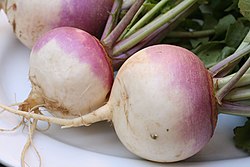
Turnip roots
Scientific classification Edit this classification
Kingdom: Plantae
Clade: Tracheophytes
Clade: Angiosperms
Clade: Eudicots
Clade: Rosids
Order: Brassicales
Family: Brassicaceae
Genus: Brassica
Species:
Variety:
B. r. var. rapa
Trinomial name
Brassica rapa var. rapa

The turnip or white turnip (Brassica rapa subsp. rapa) is a root vegetable commonly grown in temperate climates worldwide for its white, fleshy taproot. Small, tender varieties are grown for human consumption, while larger varieties are grown as feed for livestock. The name turnip – used in many regions – may also be used to refer to rutabaga (or neep or swede), which is a different but related vegetable.[1]

Etymology

[edit]

The origin of the word turnip is uncertain, though it is hypothesised that it could be a compound of turn as in turned/rounded on a lathe and neep, derived from Latin napus, the word for the plant. According to An Universal Etymological English Dictionary, turn refers to "round napus to distinguish it from the napi, which were generally long".[2]

Description

[edit]
A bunch of Hakurei turnips

The most common type of turnip is mostly white-skinned, apart from the upper 1 to 6 centimetres (12 to 2+12 inches), which protrude above the ground and are purple or red or greenish where the sun has hit. This above-ground part develops from stem tissue but is fused with the root.[citation needed] The interior flesh is entirely white. The root is roughly globular, from 5–20 cm (2–8 in) in diameter, and lacks side roots. Underneath, the taproot (the normal root below the swollen storage root) is thin and 10 cm (4 in) or more in length; it is often trimmed off before the vegetable is sold. The leaves grow directly from the above-ground shoulder of the root, with little or no visible crown or neck (as found in rutabagas).[citation needed]

Turnip leaves are sometimes eaten as "turnip greens" ("turnip tops" in the UK), and they resemble mustard greens (to which they are closely related) in flavor. Turnip greens are a common side dish in southeastern U.S. cooking, primarily during late fall and winter. Smaller leaves are preferred. Varieties of turnip grown specifically for their leaves resemble mustard greens and have small roots. These include rapini (broccoli rabe), bok choy, and Chinese cabbage. Similar to raw cabbage or radish, turnip leaves and roots have a pungent flavor that becomes milder after cooking.[citation needed]

Turnip roots weigh up to 1 kilogram (2 pounds), although they are usually harvested when smaller. Size is partly a function of variety and partly a function of the length of time a turnip has grown.

Nutrition

[edit]
Turnip greens, cooked, boiled, drained, without salt
Nutritional value per 100 g (3.5 oz)
Energy84 kJ (20 kcal)
4.4 g
Sugars0.5 g
Dietary fiber3.5 g
0.2 g
1.1 g
Vitamins and minerals
VitaminsQuantity
%DV
Vitamin A equiv.
42%
381 μg
42%
4575 μg
Thiamine (B1)
4%
0.045 mg
Riboflavin (B2)
6%
0.072 mg
Niacin (B3)
3%
0.411 mg
Pantothenic acid (B5)
5%
0.274 mg
Vitamin B6
11%
0.18 mg
Folate (B9)
30%
118 μg
Vitamin C
30%
27.4 mg
Vitamin E
13%
1.88 mg
Vitamin K
307%
368 μg
MineralsQuantity
%DV
Calcium
11%
137 mg
Iron
4%
0.8 mg
Magnesium
5%
22 mg
Manganese
15%
0.337 mg
Phosphorus
2%
29 mg
Potassium
7%
203 mg
Sodium
1%
29 mg
Other constituentsQuantity
Water93.2 g
Lutein8440 µg

Percentages estimated using US recommendations for adults,[3] except for potassium, which is estimated based on expert recommendation from the National Academies.[4]
Turnips, cooked, boiled, drained, without salt
Nutritional value per 100 g (3.5 oz)
Energy92 kJ (22 kcal)
5.1 g
Sugars3.0
Dietary fiber2.0 g
0.1 g
0.7 g
Vitamins and minerals
VitaminsQuantity
%DV
Thiamine (B1)
2%
.027 mg
Riboflavin (B2)
2%
.023 mg
Niacin (B3)
2%
.299 mg
Pantothenic acid (B5)
3%
.142 mg
Vitamin B6
4%
.067 mg
Folate (B9)
2%
9 μg
Vitamin C
13%
11.6 mg
MineralsQuantity
%DV
Calcium
3%
33 mg
Iron
1%
.18 mg
Magnesium
2%
9 mg
Manganese
3%
.071 mg
Phosphorus
2%
26 mg
Potassium
6%
177 mg
Sodium
1%
16 mg
Zinc
1%
.12 mg
Other constituentsQuantity
Water93.6 g

Percentages estimated using US recommendations for adults,[3] except for potassium, which is estimated based on expert recommendation from the National Academies.[4]

Boiled green leaves of the turnip top ("turnip greens") provide 84 kilojoules (20 kilocalories) of food energy in a reference serving of 100 grams (3+12 oz), and are 93% water, 4% carbohydrates, and 1% protein, with negligible fat (table). The boiled greens are a rich source (more than 20% of the Daily Value, DV) particularly of vitamin K (350% DV), with vitamin A, vitamin C, and folate also in significant content (30% DV or greater, table). Boiled turnip greens also contain substantial lutein (8440 micrograms per 100 g).

In a 100-gram reference amount, boiled turnip root supplies 92 kJ (22 kcal), with only vitamin C in a moderate amount (14% DV). Other micronutrients in boiled turnip are in low or negligible content (table). Boiled turnip is 94% water, 5% carbohydrates, and 1% protein, with negligible fat.

History

[edit]

Wild forms of the turnip and its relatives, the mustards and radishes, are found over western Asia and Europe. Starting as early as 2000 BCE, related oilseed subspecies of Brassica rapa like oleifera may have been domesticated several times from the Mediterranean to India, though these are not the same turnips cultivated for their roots.[5] Previous estimates of domestication dates are limited to linguistic analyses of plant names.[6]

Edible turnips were first domesticated in Central Asia several thousand years ago, supported by genetic studies of both wild and domesticated varieties showing Central Asian varieties are the most genetically diverse crops.[7] Ancient literary references to turnips in Central Asia, and the existence of words for 'turnip' in ancestral languages of the region, also support the turnip as the original domesticated form of Brassica rapa subsp. rapa.[7] It later spread to Europe and East Asia with farmers in both areas later selecting for larger leaves; it subsequently became an important food in the Hellenistic and Roman world.[5] Among Jews in antiquity, the turnip was regarded as a food of the poor, to the extent that the Talmud declares, "Woe to the house in which the turnip passes". Rabbinic sources further observe that turnips were consumed in various forms, "fresh, boiled, or ground," and that their flavor was enhanced when cooked with meat.[8] The turnip later spread to China, and reached Japan by 700 CE.[5]

Turnips were an important crop in the cuisine of Antebellum America. They were grown for their greens as well as the roots, and could yield edible greens within a few weeks of planting, making them a staple of new plantations still in the process of becoming productive. They could be planted as late as the fall and still provide newly arrived settlers with a source of food. The typical southern way of cooking turnip greens was to boil them with a chunk of salt pork. The broth obtained from this process was known as pot likker and was served with crumbled corn pone, often made from coarse meal when little else was available along the antebellum frontier.[9]

Cultivation

[edit]

The 1881 American Household Cyclopedia advises that turnips can be grown in fields that have been harrowed and ploughed. It recommends planting in late May or June and weeding and thinning with a hoe throughout the summer.[10]

As a root crop, turnips grow best in cool weather; hot temperatures cause the roots to become woody and bad-tasting. They are typically planted in the spring in cold-weather climates (such as the northern US and Canada) where the growing season is only 3–4 months. In temperate climates (ones with a growing season of 5–6 months), turnips may also be planted in late summer for a second fall crop. In warm-weather climates (7 or more month growing season), they are planted in the fall. 55–60 days is the average time from planting to harvest.[citation needed]

Turnip crop in flower, c.1930

Turnips are a biennial plant, taking two years from germination to reproduction. The root spends the first year growing and storing nutrients, and the second year flowers, produces seeds, and dies. The flowers of the turnip are tall and yellow, with the seeds forming in pea-like pods. In areas with less than seven-month growing seasons, temperatures are too cold for the roots to survive the winter. To produce seeds, pulling the turnips and storing them over winter is necessary, taking care not to damage the leaves. During the spring, they may be set back in the ground to complete their lifecycle.[11]: 98 

Relevance in human use

[edit]

In England around 1700, Charles "Turnip" Townshend promoted the use of turnips in a four-year crop-rotation system that enabled year-round livestock feeding.[12]

In Scottish and some other English dialects, the word turnip can also refer to rutabagas (North American English), also known as swedes in England, a variety of Brassica napus, which is a hybrid between the turnip, Brassica rapa, and the cabbage. Turnips are generally smaller with white flesh, while rutabagas are larger with yellow flesh. Scottish English sometimes distinguishes turnips as white turnips, and sometimes distinguishes rutabagas as neeps.

In the Austrian region of Wildschönau, farmers produce a kind of schnaps called Krautinger from a variation of Brassica rapa ssp. Rapa, since they were granted permission to do so under Empress Maria Theresia in the 18th century.[13] It is notorious for its distinct taste and smell.

Heraldry

[edit]
Three golden turnips in the coat of arms of Kauvatsa

The turnip is an old vegetable charge in heraldry. It was used by Leonhard von Keutschach, prince-archbishop of Salzburg. The turnip is still the heart shield in the arms of Keutschach am See.[14]

The arms of the former municipality of Kiikala, Finland, were Gules, a turnip Or.[15]

References

[edit]
[edit]
Revisions and contributorsEdit on WikipediaRead on Wikipedia
from Grokipedia
The turnip (Brassica rapa subsp. rapa) is a cool-season in the family, cultivated primarily for its enlarged, crisp white , which is typically rounded and may have a purple-tinged crown, as well as its tender, fuzzy green leaves that resemble mustard greens. It is a grown as an annual, reaching 12–14 inches in height with light green, sparsely pubescent leaves and small yellow flowers in its second year, thriving in moderately deep, fertile, slightly acidic soils (pH around 6.0) and tolerating frost but bolting in summer heat. Originating from wild forms in the region, turnips were likely domesticated by humans near the Hindu Kush mountains in present-day between 3,500 and 6,000 years ago, initially selected for their starchy taproots before spreading westward to and eastward to , where further breeding produced diverse cultivars including leafy greens like and oilseed varieties. In , turnips have been consumed as a since and used as for over 600 years, with U.S. agricultural research in the early 1900s emphasizing their value for nutrition. Turnips are nutrient-dense, providing high levels of , vitamins C and B6, folic acid, calcium, , and other micronutrients like , , niacin, magnesium, and , while also containing glucosinolates that may offer protective effects against certain cancers. They are versatile in , with young and greens eaten raw in salads, cooked in soups or stews, or used as , and their tops offering 20–25% crude protein for ; best harvested when roots are 2–3 inches in diameter after 40–60 days of growth. Cultivation occurs worldwide in temperate regions, planted in fall or spring in rows spaced 18 inches apart, requiring full sun and well-drained soil, with varieties like 'Purple Top White Globe' prized for both roots and tops.

Taxonomy and Nomenclature

Etymology

The English word "turnip" first appeared around 1530 as "turnep" or "turnepe," likely a compound formed from "turn," referring to the rounded shape of the root as if turned on a lathe, and "nepe" or "nep," an earlier term for the vegetable derived from Latin nāpus, meaning turnip or rape. This etymology is supported by Nathan Bailey's An Universal Etymological English Dictionary (1721), which explains "turn" as distinguishing the round napus from the generally long napi. Linguistically, the root traces back further to nǣp or nēp (Anglian dialect), borrowed directly from Latin nāpus, a term used by classical authors like for the plant. By , this evolved into "nepe," but the full compound "turnip" emerged to specify the bulbous variety. The Latin nāpus also influenced , such as French navet, a of nef or navet, entering English usage indirectly through Norman influences after the . In Scottish and northern English dialects, "neep" persists as a for turnip, preserving the older form. Related terms highlight distinctions within the genus. The turnip (Brassica rapa subsp. rapa) contrasts with the "rutabaga," a larger relative (Brassica napus), whose name derives from Swedish dialectal rotabagge (circa 1799 in English), combining rot ("," from Proto-Indo-European wrād-, meaning branch or ) and bagge ("" or "lump," akin to ""). This Swedish term, meaning " " or "baggy ," reflects the vegetable's swollen form and underscores etymological divergence from the turnip's Latin-derived name, avoiding confusion with other species like or .

Taxonomy and Classification

The turnip belongs to the family , genus , species Brassica rapa L., and specifically the subspecies Brassica rapa subsp. rapa (Metzg.), which is cultivated primarily for its edible root. This subspecies is distinguished from others within B. rapa, such as subsp. oleifera (DC.) Metzg., which is grown for oilseed production as turnip rape. The classification reflects the plant's position in the order and its close relation to other . Phylogenetically, traces its origins to wild populations in , particularly the Hindu Kush mountain region near present-day , where began around 3,500 to 6,000 years ago through human selection for diverse traits. Genetic diversity studies reveal that wild B. rapa forms underwent independent events across , leading to in crop morphotypes like , , and types, with reduced in cultivated lines compared to feral or wild relatives. In the broader taxonomy, B. rapa (with its AA ) is a key progenitor in the "" model, which illustrates the allotetraploid origins of major crops through hybridization and genome duplication. It contributes the A genome to species such as (L.) Czern. (AABB, Indian mustard) and Brassica napus L. (AACC, ), alongside B. oleracea L. (CC) and B. nigra (L.) W.D.J. Koch (BB). Subspecies variations in B. rapa—including subsp. rapa for roots, subsp. chinensis (L.) Hanelt for leafy greens like , and subsp. pekinensis (Lour.) Hanelt for —demonstrate adaptive genetic divergence driven by regional cultivation pressures. B. rapa exhibits hybridization potential with related diploids like B. nigra, facilitating and the polyphyletic origins of allotetraploids such as B. juncea via interspecific crosses, as evidenced by and nuclear DNA analyses. This capability underscores the genus's evolutionary plasticity but also raises concerns for in agricultural settings.

Botanical Characteristics

Morphology

The turnip (Brassica rapa subsp. rapa) is a biennial characterized by an upright growth habit, forming a basal rosette of leaves in the first year before developing a flowering stem in the second year. It typically reaches heights of 30–120 cm, with erect stems that are simple or branched in the upper half and may be hairless or sparsely covered in soft hairs. The plant features a prominent that swells into a globular or tuberous , measuring 5–20 cm in diameter, composed of and root tissues with from the . The upper portion of the root often exhibits purple or red pigmentation due to accumulation, while the interior remains and fleshy. Leaves form a basal rosette, measuring 10–40 cm in length, with pinnately lobed or divided edges, a large central lobe, and smaller side lobes; they are glabrous or finely hairy, yellowish-green, and wavy-margined, resembling those of mustard plants but with more pronounced lobing. Flowers are bright yellow, with four petals 6–13 mm long, arranged in terminal racemes, and the is self-incompatible, relying on insect pollination. Fruits develop as linear siliques, 3–8 cm long and 2–4 mm wide, containing 8–15 seeds per locule for a total of 16–30 small, oval, reticulate seeds that are yellow to dark brown. As a cool-season , the turnip completes root development in 55–60 days from , with occurring when the swollen reaches maturity. In its biennial life cycle, the first year is dedicated to vegetative growth and storage formation, followed by bolting and seed production in the second year after .

Varieties and Cultivars

Turnip varieties are broadly categorized into root-focused and leaf-focused types, with selections emphasizing tenderness, size, and storage quality for culinary or forage use. Root-focused cultivars, such as the white-fleshed 'Purple Top White Globe', produce small, globe-shaped roots measuring 2 to 3 inches in diameter with purple shoulders and white flesh, ideal for fresh human consumption due to their mild flavor and tender texture. Larger varieties like the yellow-fleshed 'Golden Ball' or 'Yellow Globe' develop 3- to 4-inch amber roots suitable for long-term storage, offering a sweet, non-woody interior that resists pithiness even at maturity. These white- and yellow-fleshed groups represent primary divisions in turnip root cultivars, with white types dominating European selections and yellow ones valued for their color and flavor retention. Leaf-focused varieties prioritize abundant, mild greens over root development, often yielding harvests in 30 to 40 days. Cultivars like 'Seven Top' and 'Shogoin' produce tall plants with broad, tender leaves high in vitamins, commonly grown for greens in both home and commercial settings, though their remain small and secondary. 'Shogoin', a traditional Japanese type, features fine-grained white alongside its foliage, making it versatile for dual harvest, while 'Alltop' focuses almost exclusively on tops with minimal formation. Asian selections such as 'Hakurei' emphasize salad-quality that are crisp and buttery, with flat to round shapes adapted for quick cooking or raw use. Turnips exhibit regional adaptations, with European varieties typically featuring white-fleshed, globe-shaped roots suited to cooler climates, contrasting Asian types like 'Shogoin' that form larger, flatter roots resilient in warmer conditions. This distinction often leads to confusion with (Brassica napus), a related but distinct with larger, yellow-fleshed roots and a cross between turnip and . Breeding efforts for turnips have emphasized hybrid vigor and disease resistance since the early , transitioning from heirloom open-pollinated types like 'Purple Top White Globe' to modern s developed by private seed companies. Japanese breeders have pioneered white turnips with improved uniformity and yield, while global programs select for resistance to clubroot (Plasmodiophora brassicae), incorporating dominant genes from resistant landraces into elite lines for sustainable cultivation. For instance, European fodder turnips like ECD04 have been bred for multiple clubroot pathotypes through , enhancing field performance without yield penalties.

Nutritional Profile

Composition

Turnip roots and greens are low-calorie with high content and a composition dominated by carbohydrates and , alongside notable micronutrients and bioactive compounds. The roots consist primarily of , approximately 92% by weight, which contributes to their crisp texture and low . Turnip greens, similarly, are about 90% , supporting their as a hydrating leafy . Both parts contain negligible amounts of (0.1 g per 100 g) and no , making them suitable for low-fat diets. The macronutrient profile of boiled turnip roots provides 22 kcal per 100 g, with 5.1 g of carbohydrates (including 1.8 g of ), 0.7 g of protein, and minimal . Raw turnip greens offer 32 kcal per 100 g, comprising 7.13 g of carbohydrates (with 3.2 g of ), 1.5 g of protein, and 0.3 g of . These values reflect the ' status as nutrient-dense yet energy-light foods, with aiding digestive . Nutritional data per USDA FoodData Central (accessed 2025).
Nutrient (per 100 g)Boiled Turnip RootsRaw Turnip Greens
Energy22 kcal32 kcal
Carbohydrates5.1 g7.13 g
1.8 g3.2 g
Protein0.7 g1.5 g
Total Fat0.1 g0.3 g
Turnip roots are moderate sources of (21 mg, 23% DV) and (233 mg), essential for immune function and balance, respectively. The greens are particularly rich in (368 µg, 307% DV), supporting blood clotting and bone health, and (380 µg RAE, providing over 40% DV), which promotes vision and . Turnips contain glucosinolates, sulfur-containing compounds responsible for their characteristic pungency and sharp flavor, with gluconasturtiin being a prominent example in both roots and greens. These phytochemicals are hydrolyzed by the enzyme upon tissue damage, yielding isothiocyanates with potential properties.

Health Benefits and Research

Turnips, as members of the genus, contain glucosinolates that hydrolyze into , such as 2-phenylethyl isothiocyanate, which have demonstrated and anti-cancer properties in and animal models. Recent studies (2024-2025) continue to support prebiotic and roles of turnip and glucosinolates. These compounds inhibit proliferation and induce in various lines, including those from , colon, and tissues, by modulating enzymes like and promoting detoxification pathways. A 2018 review highlighted analogs derived from turnip glucosinolates as particularly promising for their chemopreventive effects, though these findings are primarily from preclinical studies. The notes that isothiocyanates from like turnips suppress tumor development in models of , liver, colon, and cancers. The high fiber content in turnips supports digestive health by promoting regularity and fostering beneficial . Soluble fibers, including inulin-like , act as prebiotics, selectively stimulating the growth of and species while modulating short-chain production in the colon. A study on Tibetan turnip demonstrated their ability to restore intestinal flora balance in mice with induced , enhancing microbial diversity and barrier function. Additionally, turnips provide , which observational data from the National Health and Nutrition Examination Survey (NHANES) link to improved bone mineral density; higher intakes are associated with reduced risk of and in adults over 50, particularly women. Recent research underscores broader cardiovascular benefits from Brassica vegetables, including turnips. A dose-response of prospective cohort studies found that higher cruciferous vegetable intake is inversely associated with risk, potentially due to content aiding regulation and effects. However, a 2022 and of randomized controlled trials reported no significant impact of Brassica consumption on lipid profiles or blood glucose in adults, suggesting benefits may be more pronounced in observational settings. On the risk side, raw turnip consumption may pose goitrogenic effects for individuals with conditions, as glucosinolates can inhibit iodine uptake and synthesis, potentially exacerbating ; cooking mitigates this by inactivating the enzyme . A 2024 found limited evidence linking higher Brassica intake to goiter or dysfunction in humans, particularly with adequate iodine intake, though some associations noted in iodine-deficient populations. Despite these findings, gaps persist in human clinical trials on turnip-specific benefits, with most evidence derived from , animal, or general studies rather than randomized controlled trials in humans. Reviews emphasize that while preclinical data support and roles, long-term human outcomes require further investigation to confirm efficacy and optimal dosing. authorities recommend incorporating turnips into a varied diet for potential benefits, alongside other , to support overall nutrition without exceeding exposure in vulnerable groups.

History

Origins and Domestication

The wild progenitor of the turnip (Brassica rapa subsp. rapa) is the wild form of B. rapa, native to the mountainous regions of Central Asia, including the Hindu Kush and Himalayan foothills in areas spanning modern-day Afghanistan, Pakistan, and Tajikistan. This species likely originated as a weedy or feral plant in these diverse ecological niches, with genetic evidence indicating high nucleotide diversity in wild populations from the Caucasus, Siberia, and Central Asia, supporting Central Asia as the primary center of domestication. Human selection began targeting the enlarged root-hypocotyl and leaves for food and fodder, marking the initial steps in transforming wild B. rapa into cultivated forms. Domestication of turnips occurred approximately 3,430 to 5,930 years before present (roughly 1430–3930 BCE), making it the earliest domesticated morphotype within B. rapa. Archaeological evidence corroborates this timeline, with turnip seeds and roots documented at multiple sites across Asia dating back to around 2500 BCE, consistent with Bronze Age contexts in regions like the Indus Valley and Central Asia. Genetic studies reveal a significant reduction in diversity in modern turnip cultivars compared to wild populations, attributed to bottlenecks from founder effects and selective breeding for desirable traits such as larger roots and non-bolting growth habits. These analyses, using whole-genome sequencing, show that Central Asian turnip landraces retain the highest genetic diversity, underscoring their role as a progenitor pool for subsequent diversification. Early human uses of turnips focused on their dual role as a and in ancient societies of Central and , including and , where they provided nutritious roots and greens for both people and . By around 1000 BCE, cultivated turnips had spread eastward and westward along trade routes such as the , facilitating parallel paths within B. rapa that distinguished root-focused turnips from seed-focused oilseed varieties like (B. rapa subsp. oleifera). This divergence arose from independent selection pressures in and , where turnips served as a foundational before evolving into specialized leafy and oilseed forms.

Historical Spread and Uses

The turnip, domesticated in around 2000 BCE, spread westward to the Mediterranean region by the and was widely cultivated in the by the 1st century CE, where it served as both a source and, notoriously, a hurled at unpopular figures. In medieval and , turnips gained prominence in agricultural practices, particularly as a root crop in rotations that improved and supported feeding, with records indicating their integration into farming systems by the . A key innovation came in the 18th century with the Norfolk four-course rotation system, popularized by Charles "Turnip" Townshend, which alternated , turnips, , and to eliminate periods, boost yields, and provide winter , revolutionizing British agriculture. In , turnips reached during the (300 BCE–250 CE) via continental trade routes, becoming a staple adapted to local climates. The shogoin turnip, a large, white variety prized for its tender roots and greens, emerged in the Kyoho era (1716–1736) when farmers in Kyoto's Shogoin district imported seeds from nearby and selectively bred them over centuries for culinary use in traditional dishes like senmaizuke pickles. European explorers introduced turnips to the in the , where they quickly became a hardy, versatile crop suited to colonial gardens and fields. By the antebellum era in the American South (early to mid-19th century), turnips were a dietary mainstay for enslaved people, provided as rations alongside corn and , and cultivated in personal "truck patches" for greens and roots that supplemented meager allotments and offered nutritional resilience during harsh conditions. Enslavers in regions like the Chesapeake issued turnips as early as the 1810s, valuing their ease of growth and role in sustaining labor forces through the 1850s. During the 19th century in Britain, turnips solidified their role as a primary fodder crop, enabling year-round livestock maintenance and supporting the Agricultural Revolution's productivity gains, as detailed in contemporary guides like the 1881 Household Cyclopedia, which emphasized their soil-enriching benefits and cultivation for animal feed in rotated fields. This fodder emphasis persisted into the 20th century, with turnips promoted during World War II's "Dig for Victory" campaign, launched in 1939 by the British Ministry of Agriculture, which urged civilians to grow them in allotments and gardens to combat food shortages, yielding millions of tons of home-produced vegetables by 1945. Traditionally, turnips also found use in folk medicine; in 17th-century Europe, English surgeon John Woodall recommended them among anti-scorbutic remedies like scurvy grass to treat vitamin C deficiency on long voyages, recognizing their modest ascorbic acid content as a preventive against the disease.

Cultivation

Growing Requirements

Turnips are a cool-season that performs best in temperate climates with average temperatures ranging from 10°C to 24°C (50°F to 75°F), as higher temperatures can lead to bitter flavors and poor development. They exhibit strong frost tolerance, surviving temperatures as low as -7°C (20°F) for short periods, though prolonged exposure below freezing may cause damage to foliage and . Most varieties reach maturity in 55 to 60 days from planting, allowing for quick harvests in suitable conditions. For optimal growth, turnips require well-drained, fertile soils such as sandy or , with a range of 6.0 to 7.5 to support availability and expansion. Nitrogen demands typically range from 50 to 100 kg/ha, applied primarily at planting to promote vigorous early growth without excess that could favor leafy tops over roots. Acidic soils below 6.0 should be avoided, as they increase susceptibility to clubroot disease, a soil-borne that deforms roots. Seeds should be direct-sown at a depth of approximately 1 cm (½ inch) in rows spaced 30 cm (12 inches) apart, with initial spacing of 5 to 10 cm (2 to 4 inches) between seeds to allow for subsequent , which ensures proper development and . is essential once seedlings emerge, removing weaker plants to maintain 5 to 8 cm (2 to 3 inches) between individuals. Consistent soil moisture is critical throughout the growing cycle, with requirements of 25 to 50 mm (1 to 2 inches) of water per week to prevent cracking or woody roots, achieved through regular irrigation especially in sandy soils. Balanced NPK fertilizers should be incorporated based on soil tests, with emphasis on phosphorus and potassium for root quality alongside nitrogen.

Modern Practices

In modern turnip cultivation, has significantly enhanced efficiency since the early , incorporating precision seeding equipment that allows for uniform placement at depths of 1-2 cm to optimize rates. GPS-guided planting systems enable tractors to follow exact field maps, reducing overlap and seed waste by up to 10-15% compared to manual methods. Automated harvesting machines, such as topper-harvesters, lift roots while minimizing soil disturbance, achieving throughput rates of 0.5-1 per hour in commercial operations. Trials in hydroponic and systems have explored soilless turnip production to address land constraints, with setups yielding greens in 30-45 days under controlled LED lighting. These approaches, while promising for , face challenges like root deformation in aeroponic towers, limiting adoption to experimental scales. Sustainability practices emphasize , where turnips are integrated into four-field systems—alternating with , cereals, and brassicas—to prevent nutrient depletion and suppress pathogens, maintaining levels above 3%. under standards like USDA Organic requires such rotations, prohibiting synthetic fertilizers and promoting cover cropping to enhance and reduce by 20-50% over . Yield improvements through hybrid varieties, such as those developed for uniform size and resistance, have increased averages to 30-40 tons per hectare under optimal conditions, compared to 15-20 tons per hectare for traditional open-pollinated types. Amid climate challenges, breeding programs focus on drought-tolerant turnip cultivars, selecting for traits like deeper root systems and reduced transpiration rates to sustain yields under water deficits of 50% below normal. These efforts, often using in , have produced varieties tolerant to levels as low as 20%. Genetically modified turnip research remains limited due to stringent regulations in major markets, with trials emphasizing non-GM enhancements for heat and resilience.

Pests, Diseases, and Management

Turnips, as members of the genus, are susceptible to several key insect pests that can significantly impact both foliage and roots. Flea beetles (Phyllotreta spp.) are among the most common, feeding on young leaves and creating characteristic shot-hole damage that weakens seedlings and reduces . , including species like the cabbage aphid (Brevicoryne brassicae) and green peach aphid (), colonize undersides of leaves, sucking sap and transmitting viral diseases while causing leaf curling and stunted growth. Root maggots, primarily from the cabbage root maggot (Delia radicum), burrow into roots, leading to tunneling, rot, and plant wilting, often resulting in total crop loss if unmanaged. Diseases pose another major threat to turnip production, with fungal and bacterial pathogens thriving in cool, moist conditions. Clubroot, caused by the soilborne Plasmodiophora brassicae, produces on roots that distort and swell the , impairing nutrient uptake and yield; spores can persist in soil for up to 20 years. Black rot, induced by the bacterium , manifests as V-shaped lesions on leaves and blackened veins, progressing to and seedborne spread that contaminates future plantings. Viral infections, such as turnip mosaic virus (TuMV), lead to mosaic patterns, mottling, and on leaves, severely reducing vigor and marketability through aphid-vectored transmission. Effective management of these threats relies on (IPM) strategies that combine cultural, biological, and chemical controls to minimize environmental impact. Crop rotation with non-host plants for at least 3–4 years is essential to break pest and cycles, particularly for clubroot and root maggots. Planting resistant varieties, such as those bred for clubroot tolerance, reduces susceptibility without relying on inputs. Biopesticides like provide organic control for and flea beetles by disrupting feeding and reproduction, applied as foliar sprays during early infestation. Chemical options, including insecticides like spinosad for maggots, should be used judiciously as a last resort within IPM thresholds. Maintaining around 7.2 through liming helps suppress clubroot development. In the 2020s, has exacerbated fungal outbreaks in crops, including turnips, due to warmer temperatures and altered rainfall patterns favoring pathogens like and Sclerotinia. Growers can monitor emerging threats using tools like the USDA's Pest Tracker, which provides real-time maps and alerts for invasive pests and diseases affecting crucifers.

Human Uses

Culinary Applications

Turnips are versatile in culinary preparations, with methods varying based on the root's age and variety. Older, larger turnips are typically peeled to remove the tougher outer skin before cooking, while tender young varieties like Hakurei can be consumed raw, sliced thinly for salads or even eaten whole like a for their mild, crisp flavor. Common cooking techniques include or to soften the texture. Turnips do not shrink significantly when boiled, as they soften and may absorb some liquid while maintaining approximately the same volume. This is often followed by mashing for dishes like turnip casseroles, during which the volume decreases significantly due to draining of excess water, and further reduction occurs in the subsequent baking stage, to caramelize natural sugars and enhance sweetness, and to mellow inherent bitterness through acidification. When baked or roasted, turnips shrink noticeably by 20–30% or more due to moisture evaporation, depending on cooking time and temperature. These approaches transform the vegetable's sharp, peppery taste into a more palatable profile suitable for various dishes. In regional cuisines, turnips feature prominently in traditional recipes that highlight their earthy qualities. In Scottish cooking, "neeps and tatties" combines mashed boiled turnips (neeps) with potatoes (tatties), often seasoned simply with butter and pepper, serving as a classic accompaniment to during Burns Night celebrations. Korean utilizes turnip greens in , a stir-fried seasoned with , , and to bring out their tender, slightly bitter notes. In Indian households, shalgam curry (turnip sabzi) simmers peeled and cubed turnips in a spiced tomato-onion gravy with , , and chili, creating a hearty, vegan dry or semi-gravy dish paired with flatbreads. Cooking turnips reduces levels of glucosinolates, the compounds responsible for their bitterness, while improving overall digestibility compared to raw consumption. This makes them ideal for pairings with richer elements, such as meats in stews or creamy soups, where their subtle sharpness balances fatty flavors. Varietal differences, like the tenderness of Hakurei turnips, allow for raw uses without extensive preparation. In modern trends, particularly in 2020s menus, turnips appear in fermented forms like kkakdugi-style variants, where cubed roots are lacto-fermented with chili and for benefits, or as gourmet elements in roasted purees and innovative salads at upscale restaurants.

Agricultural and Forage Roles

Turnips play a significant role in agricultural systems as a forage crop, particularly for livestock grazing. Large-rooted varieties, such as forage turnips (Brassica rapa subsp. rapa), are often sown in fields and grazed in situ by sheep, cattle, and dairy cows, providing a nutrient-dense winter feed option due to their ability to overwinter in temperate climates. These crops offer high digestibility, with total digestible nutrients ranging from 70% to 80% on a dry matter basis, enabling efficient energy utilization and supporting weight gain in ruminants during periods of limited pasture availability. The leaves and roots together provide a balanced feed with 14% to 22% crude protein, making turnips a cost-effective supplement that reduces the need for harvested hay or silage. In cover cropping practices, turnips contribute to through biofumigation, where their glucosinolates break down upon incorporation to suppress soilborne pathogens, nematodes, and weeds without synthetic chemicals. Their deep taproots alleviate and enhance nutrient cycling, while surface residue helps control on moderately sloped fields when managed properly, though on steep slopes should be avoided to prevent loosening. Turnips are frequently intercropped or rotated with like to boost and overall , promoting long-term fertility in sustainable systems. Economically, turnips represent a low-input option suited to small farms, requiring minimal fertilization and while yielding quick for or soil benefits, thus lowering operational costs compared to crops. Global trade in fresh turnips reached approximately $1.88 billion in export value in recent years, with major producers like the exporting significant volumes as part of broader vegetable trade, supporting rural economies through . In , rotations including turnips enhance and reduce environmental impacts, as evidenced by studies showing diversified rotations increase yields and lower per unit of output. Historically, the 18th-century innovations of Charles "Turnip" Townshend introduced the Norfolk four-course rotation system, alternating , turnips, , and , which boosted arable yields by 20-30% through improved and winter availability for . This system, widely adopted in Britain by the late 1700s, marked a pivotal shift toward , enabling population growth and agricultural surplus during the .

Cultural Significance

Folklore and Literature

In , the turnip features prominently in the fairy tale "The Turnip," first published in 1812, where a poor soldier cultivates an enormous turnip that earns him a royal reward through honest effort, while his greedy rich brother fails in a similar endeavor, underscoring themes of humility and the folly of envy. This narrative, rooted in oral traditions, portrays the turnip as a symbol of unexpected abundance accessible to the humble. Similarly, in Irish legends, turnips served as precursors to jack-o'-lanterns, carved with eerie faces and illuminated to ward off malevolent spirits during , the ancient Celtic harvest festival marking the end of summer; this practice stemmed from the folktale of , a wanderer condemned to roam eternally with a coal-lit turnip lantern. These carved turnips, known as "ghost turnips," were placed in windows or fields to protect against fairies and the restless dead, reflecting the vegetable's role in rituals blending harvest gratitude with supernatural vigilance. Turnips also appear in harvest rituals across , such as Switzerland's Räbechilbi festival on (November 11), where communities carve intricate lanterns from turnips to parade through villages, illuminating the onset of winter and honoring agricultural cycles with light symbolizing hope amid darkness. Similar traditions exist in Scandinavian countries, where turnips are carved into lanterns for autumn festivals, echoing themes of warding off winter's spirits. In English idioms, the turnip evokes or foolishness, as in the phrase "dumb as a turnip" or the slang "turnip-head" for a rustic , a usage dating to the when turnips were stereotyped as fare implying intellectual dullness. In literature, turnips represent survival and hardship, notably in John Steinbeck's 1939 novel , where Dust Bowl migrants plant and peel turnips amid famine, highlighting their role as a staple for the impoverished during the . This depiction draws from historical accounts of turnips as resilient, low-status foods sustaining rural laborers. Globally, in Chinese traditions, radish cakes (luóbo gāo), commonly mistranslated as "turnip cakes" in English despite being made from daikon radish rather than turnips, are a staple during celebrations and symbolize rising prosperity and good fortune, as the word for cake (gāo) homophonically evokes "tall" or "elevated" status; though not directly tied to , their inclusion in festive meals promotes communal well-being and abundance.

Heraldry and Symbolism

In , the turnip appears as a charge symbolizing agricultural roots and prosperity, though it is relatively uncommon compared to more prevalent vegetal emblems like leeks or thistles. One notable example is the of the former Finnish of Kauvatsa, adopted in 1957, which features three golden turnips on a silver field to represent the region's farming heritage and rural economy. Similarly, in the 16th century, Prince-Archbishop Leonhard von Keutschach of incorporated a turnip into his personal arms, drawing from a legend where the vegetable motivated his scholarly success after being thrown at him by his uncle; this emblem, appearing up to 58 times at , signifies wealth and perseverance in the face of adversity. While turnips are rare in English and Scottish blazons—appearing in only isolated family arms rather than widespread badges—they evoke earthiness and resilience as a hardy tied to rural identity. In , vegetal charges often favor plants like heather or for associations, leaving the turnip as an linked more to continental influences than native traditions. The turnip's depiction in period armory, typically "proper" with green leaves, a , and white root, underscores its role as a of grounded, enduring agricultural life. Symbolically, the turnip has represented thrift and innovation in 19th-century British contexts, particularly in political cartoons where it alluded to the Hanoverian monarchy's German agricultural ties, such as turnip cultivation in . By the , it embodied progressive farming practices and economic frugality, as seen in depictions of systems that boosted productivity while promoting sustainable land use. In modern applications, the turnip features in emblems for farming organizations emphasizing organic and local production, such as the Turnip Truck Natural Market in , whose branding highlights and community-sourced produce since its founding in 2001. This use reinforces the vegetable's association with rural resilience, distinguishing it from flashier national symbols while connecting to broader European agricultural histories.

References

Add your contribution
Related Hubs
User Avatar
No comments yet.