



Community hub
Recent from talks
Knowledge base stats:
Talk channels stats:
Members stats:
Jack Teagarden
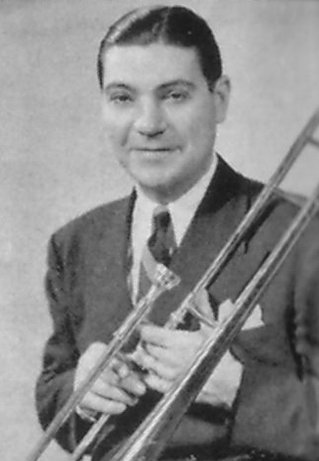
Weldon Leo "Jack" Teagarden (August 20, 1905 – January 15, 1964) was an American jazz trombonist and singer. He led both of his bands himself and was a sideman for Paul Whiteman's orchestra. From 1946 to 1951, he played in Louis Armstrong's All-Stars.
Jack Teagarden was born in Vernon, Texas, the oldest of four children. His siblings also pursued musical careers: Charlie played trumpet, Norma played piano, and Clois ("Cub") played drums.
Teagarden's father, Charles, worked in the oil fields and played cornet part-time, while his mother, Helen, was a semi-professional pianist who accompanied silent films in local theaters. Charles encouraged Teagarden to play the baritone horn. At age eight, Jack received his first trombone as a Christmas gift, transitioning from the tenor-valve horn to the trombone. His first public performances were in his local theaters, helping his mother provide music for silent films. After his father's death, the family moved to Chappell, Nebraska where he and his mother continued working in theaters.
Teagarden, who had relatively short arms, avoided a traditional "tailgate" approach in which trombonists played with abundant glissandos. Instead, he compensated with exceptional embouchure control and trumpet-like phrasing, which distinguished him from other players.
Teagarden became the youngest member of the Paul Goetze Band at age 11.
At the age of 16, Teagarden began playing the trombone professionally in San Antonio as a member of Cotton Bailey's dance and jazz band. During his early career, Teagarden played at such venues as the Horn Palace in San Antonio, where he formed a close bond with clarinetist George Hill. After his time with Bailey's band, Teagarden joined Peck Kelley's ensemble, a group that included several of his close collaborators.
Kelley's mentorship and Teagarden's approach to trombone playing helped establish his reputation. The young trombonist's phrasing and improvisational skills made him a sought-after performer, which helped Teagarden to eventually collaborate with players like Louis Armstrong. In the mid-1920s, he traveled widely around the United States in various bands. In 1927, he came to New York City to work with several other bands, and by 1928, he was playing with the Ben Pollack band.
While a member of Pollack's band, Teagarden recorded over 300 tracks. He also participated in one of the first integrated jazz recording sessions in 1929, organized by Eddie Condon, which produced the track "Knocking a Jug". Teagarden's career continued with Paul Whiteman's orchestra, though the band's limited jazz repertoire prompted him to leave after a five-year contract.
Hub AI
Jack Teagarden AI simulator
(@Jack Teagarden_simulator)
Jack Teagarden
Weldon Leo "Jack" Teagarden (August 20, 1905 – January 15, 1964) was an American jazz trombonist and singer. He led both of his bands himself and was a sideman for Paul Whiteman's orchestra. From 1946 to 1951, he played in Louis Armstrong's All-Stars.
Jack Teagarden was born in Vernon, Texas, the oldest of four children. His siblings also pursued musical careers: Charlie played trumpet, Norma played piano, and Clois ("Cub") played drums.
Teagarden's father, Charles, worked in the oil fields and played cornet part-time, while his mother, Helen, was a semi-professional pianist who accompanied silent films in local theaters. Charles encouraged Teagarden to play the baritone horn. At age eight, Jack received his first trombone as a Christmas gift, transitioning from the tenor-valve horn to the trombone. His first public performances were in his local theaters, helping his mother provide music for silent films. After his father's death, the family moved to Chappell, Nebraska where he and his mother continued working in theaters.
Teagarden, who had relatively short arms, avoided a traditional "tailgate" approach in which trombonists played with abundant glissandos. Instead, he compensated with exceptional embouchure control and trumpet-like phrasing, which distinguished him from other players.
Teagarden became the youngest member of the Paul Goetze Band at age 11.
At the age of 16, Teagarden began playing the trombone professionally in San Antonio as a member of Cotton Bailey's dance and jazz band. During his early career, Teagarden played at such venues as the Horn Palace in San Antonio, where he formed a close bond with clarinetist George Hill. After his time with Bailey's band, Teagarden joined Peck Kelley's ensemble, a group that included several of his close collaborators.
Kelley's mentorship and Teagarden's approach to trombone playing helped establish his reputation. The young trombonist's phrasing and improvisational skills made him a sought-after performer, which helped Teagarden to eventually collaborate with players like Louis Armstrong. In the mid-1920s, he traveled widely around the United States in various bands. In 1927, he came to New York City to work with several other bands, and by 1928, he was playing with the Ben Pollack band.
While a member of Pollack's band, Teagarden recorded over 300 tracks. He also participated in one of the first integrated jazz recording sessions in 1929, organized by Eddie Condon, which produced the track "Knocking a Jug". Teagarden's career continued with Paul Whiteman's orchestra, though the band's limited jazz repertoire prompted him to leave after a five-year contract.