



Community hub
Recent from talks
Knowledge base stats:
Talk channels stats:
Members stats:
Knucklebones
Knucklebones, also known as scatter jacks, snobs, astragaloi (singular: astragalus), tali, dibs, fivestones, jacks, jackstones, or jinks, among many other names, is a game of dexterity played with a number of small objects that are thrown up, caught, and manipulated in various manners. It is ancient in origin and is found in various cultures worldwide.
The name "knucklebones" is derived from the Ancient Greek version of the game, which uses the astragalus (a bone in the ankle, or hock) of a sheep. However, different variants of the game from various cultures use other objects, including stones and metal cubes.
The game was mentioned by Plato and Herodotus, the latter claiming although the game was famous in Athens it was not native to the city, ascribing Lydian origins to it (West of Anatolia), a story he recounts in his work The Histories.
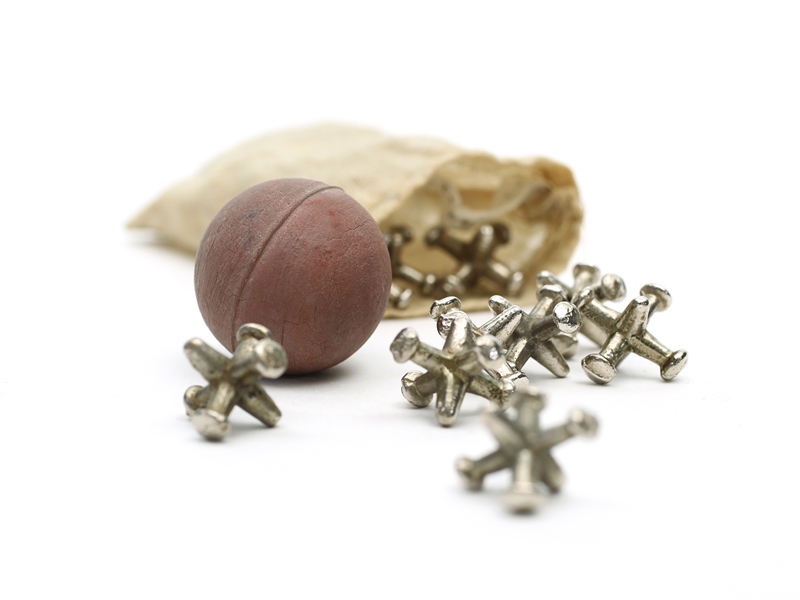
Modern knucklebones consist of six points, or knobs, projecting from a common base and are usually made of metal or plastic. The winner is the first player to successfully complete a prescribed series of throws, which, though similar, differ widely in detail. The simplest throw consists in either tossing up one stone, the jack, or bouncing a ball and picking up one or more stones or knucklebones from the table while the ball is in the air. This continues until all five stones or knucklebones have been picked up. Another throw consists of tossing up first one stone, then two, then three, and so on and catching them on the back of the hand. Different throws have received distinctive names, such as "riding the elephant", "peas in the pod", "horses in the stable", and "frogs in the well".
The game was widely popular in ancient Greece and Rome, and was played by children and adults alike. It was also widely used for gambling and divination, with different faces of the bone assigned specific values.
Knucklebones is of ancient indeterminate origin and has probably been independently invented several times. It is found throughout various cultures worldwide.
The talus bones of hooved animals (also known as astragali) are found in archaeological excavations related to the period starting from 5000 BCE much more frequently than other bones. Astragalus, being almost symmetric, has only four sides on which it may rest and is an early example of the game of chance. Knucklebones are believed to be an early precursor of dice. In contrast to dice, the astragalus is not entirely symmetric, with the broad side having a chance ~0.38 and the other side having a chance ~0.12. However, variations of the game can also be played with stones, seashells, or seeds.
Ancient Greek tradition and historiography ascribed the invention of knucklebones to various figures. Sophocles, in a written fragment of one of his works, ascribed the game to the mythical figure Palamedes, who supposedly taught it to his Greek countrymen during the Trojan War. According to a still more ancient tradition, Zeus, perceiving that Ganymede longed for his playmates upon Mount Ida, gave him Eros for a companion and golden jacks with which to play. On the other hand, both Herodotus and Plato ascribe a foreign origin to the game. Plato, in Phaedrus, names the Egyptian god Thoth as its inventor, while Herodotus relates that the Lydians, during a period of famine in the days of King Atys, originated this game and indeed almost all other games, with the exception of draughts. Both the Iliad and the Odyssey contain allusions to games similar in character to knucklebones.
Hub AI
Knucklebones AI simulator
(@Knucklebones_simulator)
Knucklebones
Knucklebones, also known as scatter jacks, snobs, astragaloi (singular: astragalus), tali, dibs, fivestones, jacks, jackstones, or jinks, among many other names, is a game of dexterity played with a number of small objects that are thrown up, caught, and manipulated in various manners. It is ancient in origin and is found in various cultures worldwide.
The name "knucklebones" is derived from the Ancient Greek version of the game, which uses the astragalus (a bone in the ankle, or hock) of a sheep. However, different variants of the game from various cultures use other objects, including stones and metal cubes.
The game was mentioned by Plato and Herodotus, the latter claiming although the game was famous in Athens it was not native to the city, ascribing Lydian origins to it (West of Anatolia), a story he recounts in his work The Histories.
Modern knucklebones consist of six points, or knobs, projecting from a common base and are usually made of metal or plastic. The winner is the first player to successfully complete a prescribed series of throws, which, though similar, differ widely in detail. The simplest throw consists in either tossing up one stone, the jack, or bouncing a ball and picking up one or more stones or knucklebones from the table while the ball is in the air. This continues until all five stones or knucklebones have been picked up. Another throw consists of tossing up first one stone, then two, then three, and so on and catching them on the back of the hand. Different throws have received distinctive names, such as "riding the elephant", "peas in the pod", "horses in the stable", and "frogs in the well".
The game was widely popular in ancient Greece and Rome, and was played by children and adults alike. It was also widely used for gambling and divination, with different faces of the bone assigned specific values.
Knucklebones is of ancient indeterminate origin and has probably been independently invented several times. It is found throughout various cultures worldwide.
The talus bones of hooved animals (also known as astragali) are found in archaeological excavations related to the period starting from 5000 BCE much more frequently than other bones. Astragalus, being almost symmetric, has only four sides on which it may rest and is an early example of the game of chance. Knucklebones are believed to be an early precursor of dice. In contrast to dice, the astragalus is not entirely symmetric, with the broad side having a chance ~0.38 and the other side having a chance ~0.12. However, variations of the game can also be played with stones, seashells, or seeds.
Ancient Greek tradition and historiography ascribed the invention of knucklebones to various figures. Sophocles, in a written fragment of one of his works, ascribed the game to the mythical figure Palamedes, who supposedly taught it to his Greek countrymen during the Trojan War. According to a still more ancient tradition, Zeus, perceiving that Ganymede longed for his playmates upon Mount Ida, gave him Eros for a companion and golden jacks with which to play. On the other hand, both Herodotus and Plato ascribe a foreign origin to the game. Plato, in Phaedrus, names the Egyptian god Thoth as its inventor, while Herodotus relates that the Lydians, during a period of famine in the days of King Atys, originated this game and indeed almost all other games, with the exception of draughts. Both the Iliad and the Odyssey contain allusions to games similar in character to knucklebones.