Hubbry Logo
Talus boneTalus boneMain
Open search
Talus bone
Community hub
Talus bone
logo
8 pages, 0 posts
0 subscribers
Be the first to start a discussion here.
Talus bone
Talus bone
from Wikipedia
Talus bone
Anatomy of the right foot
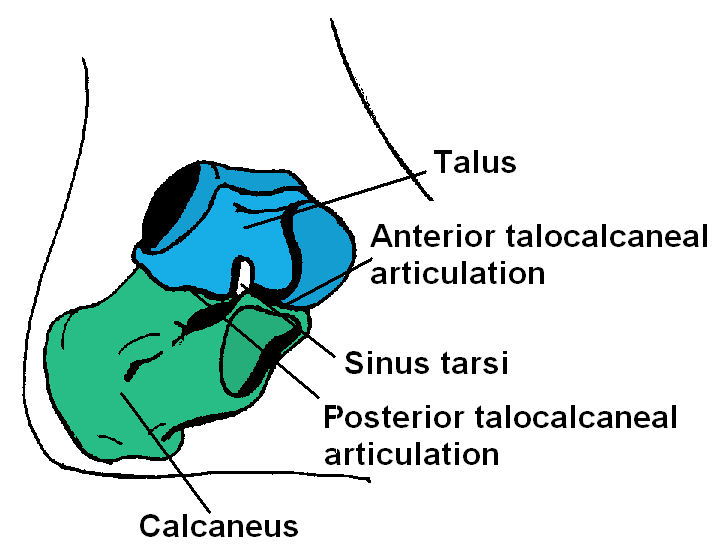
Subtalar joint, viewed from an angle between lateral and frontal.
Details
Identifiers
Latinos talus, astragalus
MeSHD013628
TA98A02.5.10.001
TA21448
FMA9708
Anatomical terms of bone

The talus (/ˈtləs/; Latin for ankle[1] or ankle bone;[2] pl.: tali), talus bone, astragalus (/əˈstræɡələs/), or ankle bone is one of the group of foot bones known as the tarsus. The tarsus forms the lower part of the ankle joint. It transmits the entire weight of the body from the lower legs to the foot.[3]

The talus has joints with the two bones of the lower leg, the tibia and thinner fibula. These leg bones have two prominences (the lateral and medial malleoli) that articulate with the talus. At the foot end, within the tarsus, the talus articulates with the calcaneus (heel bone) below, and with the curved navicular bone in front; together, these foot articulations form the ball-and-socket-shaped talocalcaneonavicular joint.

The talus is the second largest of the tarsal bones;[4] it is also one of the bones in the human body with the highest percentage of its surface area covered by articular cartilage. It is also unusual in that it has a retrograde blood supply, i.e. arterial blood enters the bone at the distal end.[citation needed]

In humans, no muscles attach to the talus, unlike most bones, and its position therefore depends on the position of the neighbouring bones.[5]

In humans

[edit]
Left talus, from above and below, with anterior side of the bone at top of image
Os trigonum on X-ray

Though irregular in shape, the talus can be subdivided into three parts.

Facing anteriorly, the head carries the articulate surface of the navicular bone, and the neck, the roughened area between the body and the head, has small vascular channels.[3]

The body features several prominent articulate surfaces: On its superior side is the trochlea tali, which is semi-cylindrical,[6] and it is flanked by the articulate facets for the two malleoli.[3] The ankle mortise, the fork-like structure of the malleoli, holds these three articulate surfaces in a steady grip, which guarantees the stability of the ankle joint. However, because the trochlea is wider in front than at the back (approximately 5–6 mm) the stability in the joint vary with the position of the foot: with the foot dorsiflexed (toes pulled upward) the ligaments of the joint are kept stretched, which guarantees the stability of the joint; but with the foot plantarflexed (as when standing on the toes) the narrower width of the trochlea causes the stability to decrease.[7] Behind the trochlea is a posterior process with a medial and a lateral tubercle separated by a groove for the tendon of the flexor hallucis longus. Exceptionally, the lateral of these tubercles forms an independent bone called os trigonum or accessory talus; it may represent the tarsale proximale intermedium. On the bone's inferior side, three articular surfaces serve for the articulation with the calcaneus, and several variously developed articular surfaces exist for the articulation with ligaments.[3]

For descriptive purposes the talus bone is divided into three sections, neck, body, and head.

[edit]

The talus bone of the ankle joint connects the leg to the foot.

The head of talus looks forward and medialward; its anterior articular or navicular surface is large, oval, and convex. Its inferior surface has two facets, which are best seen in the fresh condition.[8]

The medial, situated in front of the middle calcaneal facet, is convex, triangular, or semi-oval in shape, and rests on the plantar calcaneonavicular ligament; the lateral, named the anterior calcaneal articular surface, is somewhat flattened, and articulates with the facet on the upper surface of the anterior part of the calcaneus.[8]

Neck

[edit]

The neck of talus is directed anteromedially, and comprises the constricted portion of the bone between the body and the oval head.[8]

Its upper and medial surfaces are rough, for the attachment of ligaments; its lateral surface is concave and is continuous below with the deep groove for the interosseous talocalcaneal ligament.[8]

Body

[edit]
Talus in red, showing surrounding bones

The body of the talus comprises most of the volume of the talus bone (ankle bone). It presents with five surfaces; a superior, inferior, medial, lateral and a posterior:[8]

  • The superior surface of the body presents, behind, a smooth trochlear surface, the trochlea, for articulation with the tibia. The trochlea is broader in front than behind, convex from before backward, slightly concave from side to side: in front it is continuous with the upper surface of the neck of the bone.
  • the inferior surface presents two articular areas, the posterior and middle calcaneal surfaces, separated from one another by a deep groove, the sulcus tali. The groove runs obliquely forward and lateralward, becoming gradually broader and deeper in front: in the articulated foot it lies above a similar groove upon the upper surface of the calcaneus, and forms, with it, a canal (sinus tarsi) filled up in the fresh state by the interosseous talocalcaneal ligament. The posterior calcaneal articular surface is large and of an oval or oblong form. It articulates with the corresponding facet on the upper surface of the calcaneus, and is deeply concave in the direction of its long axis which runs forward and lateralward at an angle of about 45° with the median plane of the body. The middle calcaneal articular surface is small, oval in form and slightly convex; it articulates with the upper surface of the sustentaculum tali of the calcaneus.
  • The medial surface presents at its upper part a pear-shaped articular facet for the medial malleolus, continuous above with the trochlea; below the articular surface is a rough depression for the attachment of the deep portion of the deltoid ligament of the ankle-joint.
  • The lateral surface carries a large triangular facet, concave from above downward, for articulation with the lateral malleolus; its anterior half is continuous above with the trochlea; and in front of it is a rough depression for the attachment of the anterior talofibular ligament. Between the posterior half of the lateral border of the trochlea and the posterior part of the base of the fibular articular surface is a triangular facet which comes into contact with the transverse inferior tibiofibular ligament during flexion of the ankle-joint; below the base of this facet is a groove which affords attachment to the posterior talofibular ligament.
  • The posterior surface is narrow, and traversed by a groove running obliquely downward and medialward, and transmitting the tendon of the Flexor hallucis longus. Lateral to the groove is a prominent tubercle, the posterior process, to which the posterior talofibular ligament is attached; this process is sometimes separated from the rest of the talus, and is then known as the os trigonum. Medial to the groove is a second smaller tubercle.

Development

[edit]

During the 7th to 8th intrauterine month an ossification center is formed in the anklebone.[3]

Fracture

[edit]
From left to right: Fracture of the neck, body and posterior process of the talus

The talus bone lacks a good blood supply. Because of this, healing a broken talus can take longer than most other bones. One with a broken talus may not be able to walk for many months without crutches and will further wear a walking cast or boot of some kind after that.

Talus injuries may be difficult to recognize,[9][10] and lateral process fractures in particular may be radiographically occult. If not recognized and managed appropriately, a talus fracture may result in complications and long-term morbidity. A 2015 review came to the conclusion that isolated talar body fractures may be more common than previously thought.[4]

A fractured talar body often has a displacement that is best visualised using CT imaging. In case a talus fracture is accompanied by a dislocation, restoration of articular and axial alignment is necessary to optimize ankle and hindfoot function.[9]

As dice

[edit]

Dice were originally made from the talus of hoofed animals, leading to the nickname "bones" for dice. Colloquially known as "knucklebones", these are approximately tetrahedral. Modern Mongolians still use such bones as shagai for games and fortune-telling, with each piece relating to a symbolic meaning.[11]

In other animals

[edit]

The talus apparently derives from the fusion of three separate bones in the feet of primitive amphibians; the tibiale, articulating with tibia, the intermedium, between the bases of the tibia and fibula, and the fourth centrale, lying in the mid-part of the tarsus. These bones are still partially separate in modern amphibians, which therefore do not have a true talus.[12]

The talus forms a considerably more flexible joint in mammals than it does in reptiles. This reaches its greatest extent in artiodactyls, where the distal surface of the bone has a smooth keel to allow greater freedom of movement of the foot, and thus increase running speed.[12]

In non-mammal amniotes, the talus is generally referred to as the astragalus.

In modern crocodiles, the astragalus bears a peg which inserts into a corresponding socket on the calcaneum, and the hinge of the ankle joint runs between the two tarsals; this condition is referred to as "croc-normal"; this "croc-normal" condition was likely ancestral for archosaurs. In dinosaurs (including modern birds) and pterosaurs, the hinge of the ankle instead is distal to the two tarsals.[13][14] Far rarer are archosaurs with a "croc-reversed" ankle joint, in which the calcaneus bears a peg whilst the astragalus bears a socket.[15]

In the theropod dinosaur lineage leading to birds, the astragalus gradually increases in size until it forms the entire proximal facet of the ankle articulation; additionally the anterior ascending process gradually extends increasingly proximally. In modern birds, the astragalus is fused with the tibia to form the tibiotarsus.[16]

Additional images

[edit]

See also

[edit]

Notes

[edit]

References

[edit]
[edit]
Revisions and contributorsEdit on WikipediaRead on Wikipedia
from Grokipedia
The talus bone, also known as the ankle bone or astragalus, is an irregularly shaped tarsal bone in the human hindfoot that serves as the primary connector between the lower leg and the foot, articulating superiorly with the and to form the ankle joint while transmitting body weight downward to the rest of the foot. It is the second largest bone in the foot after the , characterized by a saddle-like structure with no muscular attachments and approximately 60% of its surface covered in articular cartilage, which facilitates smooth joint motion. The bone's unique anatomy enables essential movements of the ankle and foot, including dorsiflexion, plantarflexion, inversion, and eversion, through its involvement in the talocrural, subtalar, and transverse tarsal joints. Structurally, the talus comprises three main components: the head, which articulates anteriorly with the and inferiorly with the via multiple facets; the neck, a constricted region that slopes downward and medially, connecting the head to the body and containing the sulcus tali that forms part of the tarsal sinus; and the body, featuring the trochlear (dome) surface superiorly for the ankle mortise, as well as medial, lateral, and posterior processes that support ligamentous attachments. Its blood supply is tenuous, primarily derived from branches of the posterior tibial, peroneal, and anterior tibial (dorsalis pedis) arteries, with limited vascularity in the neck and body regions increasing the risk of following injury. Clinically, the talus is notable for its fracture susceptibility—accounting for about 1% of all lower extremity fractures but up to 50% of hindfoot fractures—often resulting from high-energy trauma like falls or , and it is prone to complications such as , osteochondral lesions, and due to its weight-bearing role and poor healing potential. Developmental variations, including congenital vertical talus or accessory ossicles like the os trigonum, can also affect foot alignment and function.

Anatomy

Structure

The talus is an irregularly shaped tarsal in the human foot, characterized by its lack of muscular attachments and extensive articular surfaces, making it unique among the tarsal bones. It consists of three main components: the head, neck, and body, with the body being the largest portion. The bone's morphology supports its role as a connector between the and foot, with approximately 60% of its surface covered by articular . The talar head is a rounded anterior projection that forms the most distal part of the bone, featuring a convex, ovoid anterior surface. This head is separated from the by a slight constriction and is almost entirely enveloped in on its anterior and superior aspects. Inferiorly, the head bears three articular facets—anterolateral, anteromedial, and middle—divided by ridges, contributing to its complex contour. The neck of the talus is a constricted region connecting the head to the body, oriented obliquely in an inferomedial direction. It is narrower than both adjacent parts, measuring on average about 3.3 cm in width, and its inferior surface contains the sulcus tali, a deep groove that expands laterally into the sinus tarsi. This narrow renders it particularly susceptible to fractures due to its limited cross-sectional area. The body of the talus represents the largest and most robust portion, encompassing the superior trochlea and posterior elements. It includes a lateral process on its inferolateral aspect and a posterior process that bifurcates into medial and lateral tubercles separated by a groove. The medial tubercle is smaller and projects more inferiorly, while the lateral tubercle is larger and more prominent. These tubercles and processes provide attachment points for ligaments, enhancing stability. The body's overall dimensions average approximately 5.4 cm in length, 4.1 cm in width, and 3.1 cm in height, varying slightly by and . The trochlea, or talar dome, forms the pulley-shaped superior surface of the body, presenting a convex, wedge-shaped convexity that is broader anteriorly (average width ~3.0 cm) than posteriorly (~2.3-2.6 cm). This anterior-posterior asymmetry contributes to the bone's tapered profile, with the trochlear surface gently curved in the and mildly concave in the . Laterally and medially, the body features comma-shaped malleolar facets for interaction with the distal and , while the posterior aspect of the inferior surface includes a concave calcaneal articular facet.

Articulations and ligaments

The talus bone forms several key articulations in the foot, primarily serving as a connector between the leg and the hindfoot. The talocrural joint, also known as the ankle joint, is a synovial where the superior trochlea of the talus articulates with the inferior surfaces of the distal and the medial of the , allowing for dorsiflexion and plantarflexion movements. This articulation is reinforced by the surrounding ligaments and transmits forces from the lower leg to the foot. Inferiorly, the talus articulates with the at the , a compound comprising posterior, middle, and anterior facets; the posterior and middle facets on the talus specifically interface with corresponding surfaces on the , facilitating inversion and eversion of the foot. The head of the talus articulates anteriorly with the , forming part of the (also called the Chopart joint), which connects the hindfoot to the midfoot and contributes to the foot's adaptability during . These articulations collectively enable the talus to link the ankle to the subtalar and midtarsal regions without direct muscular attachments, relying instead on ligamentous stability. The ligaments associated with the talus provide crucial medial and lateral support to these joints. On the medial side, the , a strong triangular complex, originates from the medial of the and fans out to attach to the talus, , and navicular; it consists of superficial components (such as the tibionavicular and tibiocalcaneal ligaments) and deeper posterior tibiotalar fascicles, collectively resisting eversion and talar abduction. Laterally, the collateral ligament complex includes three primary bands: the (ATFL), which extends from the anterior inferior lateral of the to the anterior aspect of the talar neck, limiting anterior talar displacement and inversion during plantarflexion; the (CFL), running from the lateral to the lateral , stabilizing both the talocrural and subtalar joints in neutral and dorsiflexed positions; and the posterior talofibular ligament (PTFL), connecting the posterior lateral to the posterior talus, providing posterior stability and resisting excessive dorsiflexion. The sinus tarsi and tarsal canal play integral roles in ligament passage and joint stabilization. The sinus tarsi, a lateral bony depression between the talus and , contains the cervical and interosseous talocalcaneal s, which reinforce the and provide proprioceptive feedback. Extending medially from the sinus tarsi, the tarsal canal is a narrower osseous that accommodates the interosseous talocalcaneal and branches of the , further securing the posterior aspect of the against shear forces.

Blood supply and innervation

The talus bone receives its arterial blood supply primarily from three major sources: the posterior tibial artery, the anterior tibial artery (also known as the dorsalis pedis artery), and the peroneal artery. The posterior tibial artery contributes through branches that supply the medial and lateral tubercles via the posterior tubercle and forms the tarsal canal artery, which provides the dominant supply to the talar body, including a deltoid branch for the medial third. The anterior tibial artery supplies the superomedial aspect of the talar neck via medial tarsal branches, while the peroneal artery anastomoses with the dorsalis pedis to form the tarsal sinus artery, which together with the tarsal canal artery supplies the inferolateral talar neck. These arteries enter the talus through vascular foramina on its non-articular surfaces, with key branches including the sinus tarsi artery and deltoid branches. Venous drainage of the talus follows the arterial supply, primarily via the peroneal and posterior tibial veins, which converge into the venous plexuses of the foot and ankle. Intraosseous circulation within the talus is limited due to its extensive articular coverage, which encompasses approximately 60-70% of its surface, making the bone heavily reliant on extraosseous vascular supply with minimal anastomoses between the major arterial branches. This precarious intraosseous network contributes to the talus's vulnerability to ischemia, particularly when extraosseous vessels are compromised. Innervation to the talus is predominantly sensory, derived from branches of the deep peroneal (supplying the dorsal aspect), the (including posterior tibial branches for the medial side), and the (for lateral sensory feedback), with no significant motor innervation due to the absence of muscular attachments. Additional contributions come from the medially and branches of the superficial peroneal for the dorsolateral and lateral regions. The talar neck represents a critical watershed area with tenuous blood supply, rendering it particularly susceptible to ischemia and following disruption of the extraosseous vessels.

Function

Role in locomotion

The talus bone serves as a critical intermediary in the lower limb, transmitting body weight from the to the foot bones during the stance phase of locomotion. Positioned at the , it receives the vertical forces generated by body mass and redistributes them across the tarsal bones, enabling efficient while maintaining structural integrity. This transmission is essential for activities such as walking and standing, where the talus acts as a pivot to transfer up to several times the body's weight without compromising mobility. In facilitating ankle movements, the talus enables dorsiflexion, ranging from 0 to 20 degrees, which lifts the foot upward to clear obstacles during the swing phase, and plantarflexion, up to 50 degrees, which points the foot downward for propulsion. At the , the talus articulates with the to permit inversion and eversion, allowing the foot to adapt to uneven terrain by tilting medially or laterally, thus enhancing balance and directional changes during locomotion. These motions collectively ensure smooth transitions between phases of movement, integrating the talus's role in both the talocrural and subtalar joints. During the gait cycle, the talus contributes to heel strike absorption by cushioning initial ground contact through controlled dorsiflexion and eversion, dissipating impact forces to prevent jarring. In the push-off phase, it supports via plantarflexion and inversion, generating forward as the body advances. This integration optimizes energy efficiency and stride length in walking and running. The talus also provides stability in upright posture by forming a key component of the medial longitudinal arch, which supports the foot's vaulted structure and distributes weight evenly to maintain equilibrium without excessive strain on surrounding tissues. This arch configuration, with the talus as its keystone, resists collapse under gravitational load, facilitating prolonged standing and bipedal posture.

Biomechanics

The talus serves as a pivotal structure in the lower limb's load transmission pathway, articulating with the and to transfer compressive forces from the body to the foot. During normal walking, the ankle complex, with the talus at its core, experiences peak loads of approximately five times body weight, escalating to up to thirteen times body weight during activities like running. The trochlear surface of the talus, characterized by its wedge-shaped morphology—wider anteriorly than posteriorly—facilitates this transmission while resisting anterior translation, thereby maintaining stability under . This design ensures efficient force distribution to the subtalar and transverse tarsal joints, with the tibiotalar articulation handling about 83% of the axial load and the talar dome supporting 77–90% of the tibial-talar interface forces. Joint congruence in the talocrural articulation varies with position, influencing load distribution and minimizing stress concentrations. In the neutral position, the contact area between the talar trochlea and tibial plafond is relatively limited, typically around 4–5 cm² under physiological loads, representing less than 50% of the available cartilage-covered surface to allow for mobility. This area expands significantly during dorsiflexion, reaching up to 7.3 cm² at 20° of dorsiflexion, which enhances congruence by engaging more of the broader anterior trochlea within the mortise, thereby optimizing force dissipation across the . Such positional changes in contact area are critical for accommodating the ankle's multiplanar demands without excessive . Stress distribution across the talar surfaces reflects these biomechanical adaptations, with compressive forces concentrated on the trochlear dome during . Under static loads equivalent to twice body weight (approximately 1.5 kN), mean contact pressures on the reach 9.9 MPa, with higher values observed in plantarflexion due to reduced contact area compared to dorsiflexion. These stresses are unevenly distributed, often peaking anterolaterally in neutral positions, underscoring the talus's role in buffering peak forces through its geometric and material resilience. Motion kinematics of the talus involve coupled interactions between the talocrural and subtalar joints, enabling triplanar foot motion. For instance, talocrural dorsiflexion or plantarflexion in the sagittal plane induces corresponding eversion or inversion at the subtalar joint, with the subtalar contribution accounting for about 20% of the total ankle complex's sagittal range of motion (typically 65–75° overall). A representative coupling ratio shows that 10° of talocrural motion may elicit 2–5° of subtalar motion, depending on the plane and loading, facilitating adaptive pronation and supination during gait. The cortical bone of the talus, with an apparent density of 1.2–1.8 g/cm³ and a modulus of elasticity of 15–20 GPa, provides the necessary stiffness to withstand these kinematic demands without deformation.

Development and variations

Ossification and growth

The talus bone originates embryologically from the somatic layer of the , which contributes to the formation of the limb during . The lower limb bud emerges around the fourth week of , with mesenchymal condensation leading to the cartilage anlage of the talus by the seventh week, establishing its precartilaginous model prior to . This endochondral process follows the typical pattern for tarsal bones, where the initial template defines the bone's future morphology. The primary for the talus appears in the body of the during the sixth to eighth month of fetal life, typically around seven months in utero, marking the onset of . Unlike long bones, the talus lacks secondary ossification centers and epiphyseal growth plates; instead, postnatal growth occurs primarily through periosteal , where new is deposited on the outer surfaces to increase and the progressively. By three months postnatal, approximately 55% of the talus is , with continued expansion leading to largely complete ossification of the main body by around six years of age. Ossification and growth of the talus complete by , with the posterior process potentially involving a separate center (os trigonum) that fuses between ages 7-10 in females and 9-12 in males, though this is not universal. Sex differences are evident throughout development, with females exhibiting earlier and more advanced centers in the talus and other tarsal bones compared to males at equivalent gestational or postnatal ages, reflecting broader skeletal dimorphism.

Anatomical variations

The os trigonum represents one of the most common anatomical variations of the talus, manifesting as an accessory ossicle derived from the unfused of the posterolateral . This variant occurs in 7-25% of individuals, with higher detection rates on imaging such as CT scans where prevalence reaches up to 30% in populations. Although typically benign, it can become symptomatic in activities involving repetitive plantar flexion, particularly among dancers, where it contributes to posterior ankle impingement through compression of adjacent soft tissues. Variations in the lateral talar include elongation, termed Stieda's process, and less commonly bifid configurations, which alter the posterior contour and may impinge on the sinus tarsi, potentially leading to lateral ankle discomfort. These forms arise from incomplete fusion during development and have a reported of 1-15% depending on the population studied, with elongated variants more frequently associated with mechanical overload in dynamic ankle movements. Trochlear ridge anomalies encompass deviations in the shape of the talar dome, such as flat or excessively domed profiles, which affect congruence and stability. A flat trochlea reduces the depth of the articular surface and has been linked to diminished tibiotalar stability, increasing susceptibility to . Size asymmetries between left and right tali reflect in skeletal development. Racial variations further influence dimensions, with studies indicating longer talar lengths in African populations compared to Caucasians or Asians, aiding in population affinity assessments. Recent investigations have expanded understanding of these variants. A 2024 atlas based on over 900 tali documented more than 15 distinct morphological , including facet and tubercle anomalies, establishing a standardized to facilitate clinical and bioanthropological applications.

Clinical significance

Fractures and injuries

Talus fractures are relatively uncommon, accounting for less than 1% of all fractures and 3% to 6% of foot fractures. These injuries typically result from high-energy trauma, such as motor vehicle accidents or falls from height, which impose axial loads on the dorsiflexed foot, or from lower-energy mechanisms like repetitive stress in activities involving jumping, as seen in athletes. The talus's precarious blood supply, detailed in anatomical descriptions, heightens the risk of complications when these vascular structures are disrupted. Classification systems guide management, with the Hawkins classification (modified by Canale) applied to talar neck fractures, the most common type: Type I involves nondisplaced fractures; Type II features subtalar or ; Type III includes both subtalar and ankle involvement; and Type IV extends to talonavicular . For talar body fractures, the Sneppen delineates types based on plane, such as coronal or sagittal shear, or comminuted crush patterns. relies on imaging, where computed tomography (CT) is the gold standard with superior accuracy over plain X-rays, which have approximately 60% sensitivity for detecting and classifying talar injuries, as shown in a 2025 meta-analysis. Complications are frequent due to the talus's limited vascularity, with occurring in 0-15% of Hawkins Type I nondisplaced talar neck fractures, 20-50% of displaced neck fractures (rising to over 90% in Types III and IV) from disruption of retinacular vessels. affects 10-20% of cases, particularly in comminuted body fractures, while can lead to incongruity. Treatment for nondisplaced fractures, particularly Hawkins Type I talar neck fractures, typically involves conservative (non-operative) treatment with below-knee cast immobilization for 8-12 weeks (non-weight-bearing for the initial 6 weeks), followed by gradual progressive weight-bearing. Displaced fractures require open reduction and (ORIF) using screws to restore alignment; severe comminuted or Hawkins Type IV injuries may necessitate primary to prevent collapse. Outcomes for Hawkins Type I fractures are generally favorable, with high fracture union rates, a low risk of avascular necrosis (0-15%), and good to excellent functional results in approximately 65-90% of cases, though some patients may experience post-traumatic arthrosis, restricted joint motion, or mild pain. Outcomes vary by fracture severity and timeliness of intervention, with developing in 40-60% of patients, predominantly affecting the subtalar and tibiotalar joints, and leading to and stiffness. Rehabilitation emphasizes early motion preservation through protected protocols to mitigate stiffness, though functional scores like the AOFAS hindfoot scale often remain moderate (around 70-80 points) in displaced cases.

Other disorders

Osteochondritis dissecans (OCD) of the talus primarily affects the talar dome and represents approximately 4% of all osteochondral lesions. These lesions involve focal disruption of the subchondral bone and overlying articular , often leading to , swelling, and mechanical symptoms such as catching or locking in the ankle . The condition is classified into stages I through IV using the Berndt-Harty system, which assesses stability and fragmentation: stage I indicates subchondral compression, stage II shows incomplete , stage III denotes a nondisplaced fragment, and stage IV involves a displaced or loose fragment. Early detection via MRI is crucial, as progression can result in cartilage degeneration and if untreated. Avascular necrosis (AVN) of the talus, also known as osteonecrosis, arises from disrupted blood supply and can be idiopathic or post-traumatic, with the latter often following injuries that compromise the talus's retrograde vascularity. The Ficat and Arlet staging system is applied to talar AVN, progressing from stage I (preradiographic necrosis detectable by MRI) to stage IV (advanced collapse with secondary arthritis). Approximately 15-30% of cases progress to subchondral collapse, particularly in shoulder-type lesions involving the talar neck or body, leading to pain, stiffness, and joint deformity. Management focuses on preserving bone viability in early stages through non-weight-bearing protocols, though advanced collapse often necessitates surgical intervention like core decompression. Talar coalition refers to anomalous bony, cartilaginous, or fibrous union between the talus and adjacent tarsal bones, most commonly the talocalcaneal joint, with a of 1-2% in the general . This congenital condition restricts subtalar motion, causing rigid flatfoot, recurrent ankle sprains, and peroneal spasm due to compensatory muscle hyperactivity. Talocalcaneal coalitions, accounting for about 37% of tarsal coalitions, often manifest in as the coalition ossifies, leading to hindfoot valgus and potential secondary . Diagnosis relies on imaging features like the C-sign on lateral radiographs, with treatment ranging from to resection for symptomatic cases. Tumors of the talus are rare, comprising less than 3% of primary neoplasms, with benign lesions predominating. Chondroblastoma, a benign cartilaginous tumor arising from epiphyseal chondroblasts, occurs in 1-3% of all tumors and involves the talus in about 4% of its cases, typically presenting with and swelling in young patients aged 10-20 years. These lytic lesions with chondroid matrix may mimic or AVN radiographically. Intraosseous lipomas, benign fatty tumors accounting for 0.1-2.5% of tumors, can also affect the talus, often appearing as well-defined cystic lesions with fat attenuation on MRI and rarely causing symptoms unless fractured. Malignant tumors like are exceptionally uncommon in the talus. Infections involving the talus, such as post-injury , occur when invade following trauma, leading to bone destruction, formation, and if not promptly treated with antibiotics and . Gouty can affect the talus through urate crystal deposition, forming tophi that erode subchondral and induce osteochondral lesions, mimicking trauma or with acute inflammatory flares and . These tophaceous deposits, seen in advanced , may cause cystic changes or pathologic fractures, emphasizing the need for serum monitoring in atypical ankle pathologies.

Comparative and historical aspects

In other animals

In quadrupedal mammals adapted for locomotion, such as , the talus exhibits an elongated morphology that facilitates efficient and stability during high-speed, straight-line movement. This adaptation supports the animal's ability to cover large distances rapidly, with the talus forming a key component of the hock joint alongside the and other tarsal bones. In equids, the talus contributes to the overall rigidity of the tarsus, enhancing force transmission from the to the ground. Among , the talus shows notable variations tied to locomotor styles, with arboreal like displaying a reduced overall size and a more mobile talar head to accommodate flexible foot movements during brachiation and leaping. This morphology, characterized by lower curvature in the talar head and sustentaculum facets, promotes mobility and elastic energy storage in the foot, aiding in agile arboreal navigation. In contrast, more terrestrial primates exhibit talar features suited to , though ' design emphasizes dorsiflexion and inversion for grasping branches. In birds, the talus, or astragalus, is evolutionarily incorporated into the proximal tarsals that fuse with the to form the tibiotarsus, while the distal tarsals merge with the metatarsals to create the , an elongated bone analogous to the mammalian tarsus for weight support during perching or walking. This fusion pattern enhances lightweight leg structure for flight in most species. In flightless birds, such as ostriches and emus, the and associated structures become robustly developed rather than vestigial, with increased cross-sectional thickness and length to support graviportal and high-speed running. Evolutionary trends in the talus trace back to basal amniotes, where the astragalus and calcaneum originated as separate elements but underwent fusion in the proximal tarsus for enhanced terrestrial stability; in reptiles like mesosaurs, the astragalus forms via early ontogenetic fusion of the intermedium, tibiale, and proximal centralia, while the calcaneum derives from the fibulare and remains distinct. This separation persists and diversifies in mammals, allowing greater ankle mobility compared to the more rigid reptilian configurations, reflecting adaptations from sprawling to upright postures. Veterinarily, talus fractures hold significant importance in performance equines like racehorses, where stress-induced injuries predominate due to repetitive high-impact loading. Sagittal or incomplete fractures, often arising from maladaptive under compression, shear, and torsional stresses, are rare but can cause severe lameness and career-ending damage, particularly in the proximal trochlear groove. Early detection via MRI or CT is crucial, as these microfractures may underlie catastrophic failures and require prolonged rest or arthroscopic intervention for recovery.

Etymology and use as dice

The term "talus" originates from the Latin word talus, which denoted the ankle or anklebone and was also applied to fashioned from such bones. This nomenclature reflects the bone's historical dual role in and gaming. The Greek equivalent, astragalos, similarly referred to the ankle bone of animals like sheep or goats and extended to used as rudimentary , highlighting a shared Indo-European linguistic tied to both skeletal structure and play. Astragali, the knucklebones derived from the talus of sheep, goats, or cattle, served as precursors to modern dice due to their natural irregular shape, featuring four relatively flat sides suitable for landing unpredictably. These sides were often marked with values such as 1, 3, 4, and 6, providing inherent randomness without needing carving, unlike later cubic forms. In ancient Rome, the game of tali involved throwing four such bones, with outcomes scored based on the upward-facing sides; the highest throw, Venus, occurred when all four showed different sides (1, 3, 4, and 6), while the lowest, Canis, featured all 1s. Beyond gaming, astragali held ritual importance, particularly in practices known as . In , oracles cast five —each valued at 1, 3, 4, or 6—to interpret outcomes from 32 possible combinations, often invoking deities like Apollo for guidance. This method persisted into Roman and medieval periods for , especially among women, before evolving into more standardized board games. By the , largely gave way to six-sided cubic dice in , which offered greater fairness through symmetry and uniform numbering from 1 to 6, marking a shift from organic to manufactured gaming tools. Astragali appear frequently in archaeological contexts, underscoring their cultural ubiquity; for instance, examples were interred in Tutankhamun's tomb around 1323 BCE, likely for use in the . In , the talus indirectly evokes vulnerability through the motif, where the hero's unprotected tendon insertion at the heel symbolizes a fatal weakness, though the bone itself was not the precise target. Today, the term "talus" endures in to describe the sloping base of a fortified , thicker at the bottom for stability, a usage derived from the bone's sloped contours.

References

  1. https://en.wiktionary.org/wiki/talus
Add your contribution
Related Hubs
User Avatar
No comments yet.