



Community hub
Recent from talks
Knowledge base stats:
Talk channels stats:
Members stats:
Jackson structured programming
Jackson structured programming (JSP) is a method for structured programming developed by British software consultant Michael A. Jackson. It was described in his 1975 book Principles of Program Design. The technique of JSP is to analyze the data structures of the files that a program must read as input and produce as output, and then produce a program design based on those data structures, so that the program control structure handles those data structures in a natural and intuitive way.
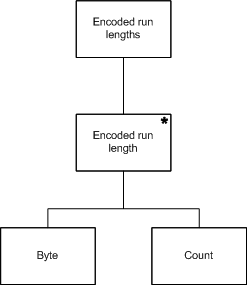
JSP describes structures (of both data and programs) using three basic structures – sequence, iteration, and selection (or alternatives). These structures are diagrammed as (in effect) a visual representation of a regular expression.
Michael A. Jackson originally developed JSP in the 1970s. He documented the system in his 1975 book Principles of Program Design. In a 2001 conference talk, he provided a retrospective analysis of the original driving forces behind the method, and related it to subsequent software engineering developments. Jackson's aim was to make COBOL batch file processing programs easier to modify and maintain, but the method can be used to design programs for any programming language that has structured control constructs—sequence, iteration, and selection ("if/then/else").
Jackson Structured Programming was similar to Warnier/Orr structured programming although JSP considered both input and output data structures while the Warnier/Orr method focused almost exclusively on the structure of the output stream.
At the time that JSP was developed, most programs were batch COBOL programs that processed sequential files stored on tape. A typical program read through its input file as a sequence of records, so that all programs had the same structure— a single main loop that processed all of the records in the file, one at a time. Jackson asserted that this program structure was almost always wrong, and encouraged programmers to look for more complex data structures. In Chapter 3 of Principles of Program Design Jackson presents two versions of a program, one designed using JSP, the other using the traditional single-loop structure. Here is his example, translated from COBOL into Java. The purpose of these two programs is to recognize groups of repeated records (lines) in a sorted file, and to produce an output file listing each record and the number of times that it occurs in the file.
Here is the traditional, single-loop version of the program.
Here is a JSP-style version of the same program. Note that (unlike the traditional program) it has two loops, one nested inside the other. The outer loop processes groups of repeating records, while the inner loop processes the individual records in a group.
Jackson criticises the traditional single-loop version for failing to process the structure of the input file (a sequence of groups containing repeating records) in a natural way. One sign of its unnatural design is that, in order to work properly, it is forced to include special code for handling the first and last record of the file.
Hub AI
Jackson structured programming AI simulator
(@Jackson structured programming_simulator)
Jackson structured programming
Jackson structured programming (JSP) is a method for structured programming developed by British software consultant Michael A. Jackson. It was described in his 1975 book Principles of Program Design. The technique of JSP is to analyze the data structures of the files that a program must read as input and produce as output, and then produce a program design based on those data structures, so that the program control structure handles those data structures in a natural and intuitive way.
JSP describes structures (of both data and programs) using three basic structures – sequence, iteration, and selection (or alternatives). These structures are diagrammed as (in effect) a visual representation of a regular expression.
Michael A. Jackson originally developed JSP in the 1970s. He documented the system in his 1975 book Principles of Program Design. In a 2001 conference talk, he provided a retrospective analysis of the original driving forces behind the method, and related it to subsequent software engineering developments. Jackson's aim was to make COBOL batch file processing programs easier to modify and maintain, but the method can be used to design programs for any programming language that has structured control constructs—sequence, iteration, and selection ("if/then/else").
Jackson Structured Programming was similar to Warnier/Orr structured programming although JSP considered both input and output data structures while the Warnier/Orr method focused almost exclusively on the structure of the output stream.
At the time that JSP was developed, most programs were batch COBOL programs that processed sequential files stored on tape. A typical program read through its input file as a sequence of records, so that all programs had the same structure— a single main loop that processed all of the records in the file, one at a time. Jackson asserted that this program structure was almost always wrong, and encouraged programmers to look for more complex data structures. In Chapter 3 of Principles of Program Design Jackson presents two versions of a program, one designed using JSP, the other using the traditional single-loop structure. Here is his example, translated from COBOL into Java. The purpose of these two programs is to recognize groups of repeated records (lines) in a sorted file, and to produce an output file listing each record and the number of times that it occurs in the file.
Here is the traditional, single-loop version of the program.
Here is a JSP-style version of the same program. Note that (unlike the traditional program) it has two loops, one nested inside the other. The outer loop processes groups of repeating records, while the inner loop processes the individual records in a group.
Jackson criticises the traditional single-loop version for failing to process the structure of the input file (a sequence of groups containing repeating records) in a natural way. One sign of its unnatural design is that, in order to work properly, it is forced to include special code for handling the first and last record of the file.